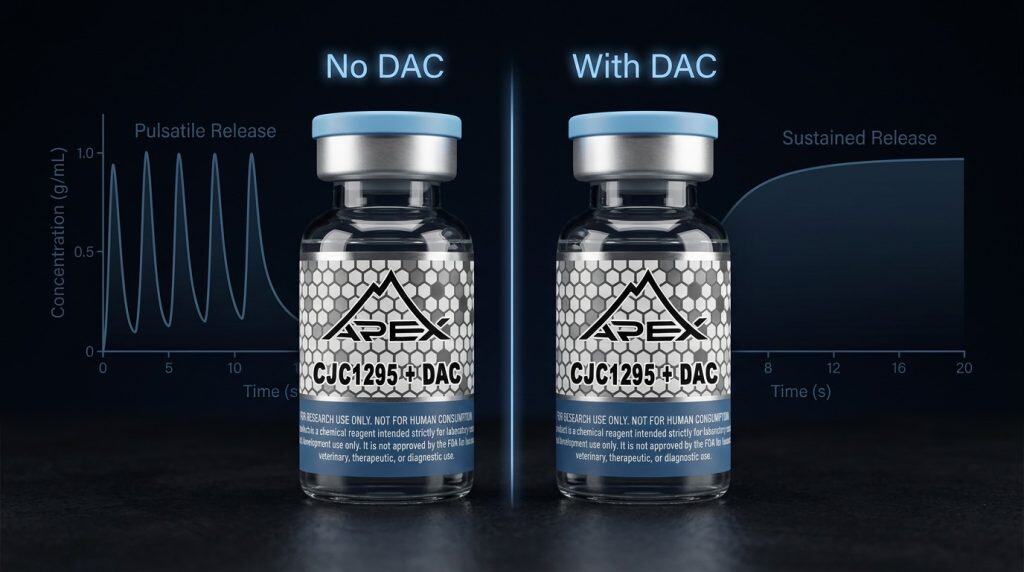
CJC-1295 is a synthetic analog of growth-hormone-releasing hormone (GHRH 1-29) carrying four amino-acid substitutions that resist enzymatic degradation, studied in two forms: with a Drug Affinity Complex (DAC) that covalently binds serum albumin to give a multi-day half-life, and without DAC (Modified GRF 1-29) for short-acting activity. In research it stimulates the GHRH receptor on pituitary somatotrophs to increase growth-hormone and IGF-1 output, with the DAC form producing sustained, days-long elevation.
CJC-1295 is a growth-hormone-releasing-hormone (GHRH) analog engineered around a single problem: native GHRH is destroyed in the bloodstream within minutes. By substituting amino acids that block enzymatic cleavage — and, in one version, attaching a chemical group that tethers the peptide to albumin — CJC-1295 dramatically extends the duration of GHRH-receptor stimulation.[1][2] The single most important thing to understand about CJC-1295 is that “CJC-1295” refers to two distinct research forms — with DAC and without DAC — that differ enormously in half-life.
This guide covers CJC-1295‘s molecular identity and the all-important DAC-versus-no-DAC distinction, the GHRH-receptor mechanism, the published growth-hormone and IGF-1 research, its study in combination with ghrelin-receptor agonists, and how it sits within the Apex growth-hormone-axis research cluster of the Apex Research Library. Every factual claim is referenced to the primary literature, and CJC-1295 is supplied strictly as a research-grade chemical reagent for in-vitro and preclinical investigation — not a drug, supplement, or therapy for human or veterinary use.
CJC-1295 at a Glance
- CJC-1295 is a tetrasubstituted analog of human GHRH(1-29), engineered to resist the dipeptidyl-peptidase-IV cleavage that rapidly inactivates native GHRH.
- It exists in two research forms: without DAC (Modified GRF 1-29) — CAS 863288-34-0, MW ~3,367.9 g/mol, PubChem CID 56841945; and with DAC — CAS 446262-90-4, MW ~3,647.2 g/mol, PubChem CID 91971820.
- The Drug Affinity Complex (DAC) is a maleimidopropionyl group that covalently binds circulating albumin, extending the half-life to roughly 5.8–8.1 days in human study.
- Both forms act on the GHRH receptor of pituitary somatotrophs to stimulate growth-hormone release and downstream IGF-1; the DAC form produces sustained, days-long elevation.
- It is frequently studied alongside a ghrelin-receptor agonist such as ipamorelin, because the GHRH and ghrelin pathways are complementary.
- CJC-1295 has no FDA-approved formulation; Apex supplies both forms strictly as ≥99% (HPLC + MS verified) research reagents for in-vitro and preclinical use only.
CJC-1295 (with DAC and without DAC)
What Is CJC-1295? Molecular Identity
CJC-1295 is built on the GHRH(1-29) backbone — the first 29 residues of growth-hormone-releasing hormone, which is the shortest fragment that retains the full hormone’s biological activity. Native GHRH is rapidly cleaved in plasma by dipeptidyl peptidase IV (DPP-IV) at the 2–3 peptide bond, which is why it acts only briefly; CJC-1295 carries four amino-acid substitutions designed to block that cleavage and other degradation, conferring protease resistance.[1] This tetrasubstituted GHRH(1-29) is the molecule common to both forms of CJC-1295.
With DAC vs Without DAC (the Critical Distinction)
The two forms of CJC-1295 are genuinely different molecules with different identifiers and vastly different half-lives, and they should never be conflated. The without-DAC form is Modified GRF 1-29 (CAS 863288-34-0, PubChem CID 56841945, MW ~3,367.9 g/mol): the tetrasubstituted peptide alone, short-acting. The with-DAC form (CAS 446262-90-4, PubChem CID 91971820, MW ~3,647.2 g/mol) adds a Drug Affinity Complex — a maleimidopropionyl group that covalently binds circulating serum albumin, turning the small peptide into a long-lived albumin conjugate. Alba and colleagues showed this albumin binding extends the half-life, such that once-daily administration sustained growth-hormone and IGF-1 profiles in animal models,[3] and Teichman and colleagues measured a half-life of roughly 5.8 to 8.1 days for CJC-1295 with DAC in humans, with sustained dose-dependent elevation of GH and IGF-I.[2]
A note on nomenclature for accurate sourcing: some material describes a single CAS number (863288-34-0) as applying to “both versions” of CJC-1295. That is correct only for the no-DAC (Mod GRF 1-29) form; the DAC form carries the distinct CAS 446262-90-4 and a higher molecular weight reflecting the added DAC group. Identity confirmation by mass spectrometry distinguishes the two unambiguously.
The GHRH Receptor and Mechanism
GHRH-receptor agonism → cAMP → growth-hormone release
Both forms of CJC-1295 act as agonists at the GHRH receptor, a pituitary-specific G-protein-coupled receptor on somatotroph cells that signals through cAMP to stimulate growth-hormone synthesis and release, and somatotroph proliferation. Downstream growth hormone raises IGF-1. The substitutions give protease resistance; the DAC group adds albumin binding and a multi-day half-life, converting brief GHRH-receptor stimulation into a sustained one. All findings summarized here are from cell, animal, and human-research settings.
GHRH-Receptor Signaling
The target receptor is well characterized. Mayo and colleagues identified the GHRH receptor as a pituitary-specific G-protein-coupled receptor of the secretin/VIP (family B) class,[4] a seven-transmembrane receptor that mediates GHRH-induced cAMP accumulation and growth-hormone release,[5] and which, beyond acute GH release, drives somatotroph proliferation.[6] CJC-1295 simply provides a degradation-resistant, long-acting ligand for this receptor.
Continuous vs Pulsatile Stimulation
The DAC form’s long half-life has a mechanistic consequence worth noting. Ionescu and colleagues found that continuous GHRH-receptor stimulation by CJC-1295 with DAC raises trough and mean growth-hormone levels, while the normal pulsatile pattern of GH secretion is largely preserved.[7] This continuous-versus-pulsatile question is central to interpreting the two forms: the no-DAC form delivers a brief, pulse-like stimulus, while the DAC form delivers a sustained one.
Published Research: Growth Hormone and IGF-1
Sustained GH and IGF-1 Elevation
The core pharmacodynamic finding is durable activation of the GH/IGF-1 axis. The Teichman human study reported sustained, dose-dependent elevation of both GH and IGF-I for days after a single CJC-1295-with-DAC dose,[2] and broader work confirms that CJC-1295 activates the GH/IGF-1 axis in healthy human subjects via pituitary GHRH-receptor binding.[8] The IGF-1 elevation is the downstream marker most often used to gauge the response.
IGF-1 as the Research Readout
Across the CJC-1295 literature, IGF-1 is the marker most often used to gauge a response, and for a clear reason: where growth hormone itself is secreted in short bursts and clears quickly, circulating IGF-1 integrates growth-hormone exposure over time, so it reflects sustained activation of the axis more stably than a single GH measurement. This is part of why the long-acting DAC form is informative in research — its days-long growth-hormone elevation translates into a correspondingly sustained IGF-1 signal that the Teichman human data tracked directly.[2][8] Interpreting CJC-1295 pharmacodynamics therefore usually means reading the GH and IGF-1 responses together: the immediate growth-hormone change and the integrated IGF-1 change. These are research biomarkers measured in study subjects, not clinical endpoints.
Protease Resistance: the Design Rationale
The reason CJC-1295 works where native GHRH fails is protease resistance. Frohman and colleagues established that native GHRH is rapidly cleaved by DPP-IV at the 2–3 bond, and that amino-acid substitutions at the cleavage site dramatically slow that inactivation[1] — the principle behind CJC-1295’s four substitutions. Analytical work has characterized CJC-1295 as a GHRH(1-29) analog detectable by high-resolution mass spectrometry, relevant to identity confirmation and anti-doping testing.[9]
Combination With a Ghrelin-Receptor Agonist
CJC-1295 is frequently studied alongside a ghrelin-receptor agonist because the two GH-release pathways are complementary. The ghrelin/GH-secretagogue receptor (engaged by ipamorelin and the GHRPs) signals through a different second-messenger route than the GHRH receptor — the GHRH receptor through cAMP, the ghrelin receptor through phospholipase-C and calcium — and co-activating the two potentiates the growth-hormone response roughly two-fold over either pathway alone.[10][11][12] Consistent with this, human studies show that combined GHRH-plus-GH-releasing-peptide stimulation produces a greater growth-hormone response than either alone.[13][14] This synergy is the rationale behind the widely studied CJC-1295/ipamorelin pairing; see the Ipamorelin research guide and the Ipamorelin vs CJC-1295 comparison.
CJC-1295 vs Other GHRH Analogs
CJC-1295 is one of several GHRH-receptor analogs studied in growth-hormone research, distinguished mainly by duration of action.
CJC-1295 (DAC / no-DAC) vs Sermorelin vs Tesamorelin
| Attribute | CJC-1295 with DAC | CJC-1295 no DAC (Mod GRF 1-29) | Sermorelin | Tesamorelin |
|---|---|---|---|---|
| Backbone | Tetrasubstituted GHRH(1-29) + DAC | Tetrasubstituted GHRH(1-29) | GHRH(1-29)NH2 | Stabilized GHRH(1-44) analog |
| Half-life | ~5.8–8.1 days | Short (minutes) | Short (~minutes) | Short |
| GH pattern | Sustained elevation | Pulse-like | Pulse-like | Pulse-like |
| Regulatory status | Research-only | Research-only | Was FDA-approved (Geref) | FDA-approved (Egrifta) |
The contrast with Sermorelin — the GHRH(1-29) analog that gives only brief, pulse-like GH stimulation[15] — is the subject of a dedicated Sermorelin vs CJC-1295 comparison. Tesamorelin, a stabilized GHRH analog approved for HIV-associated lipodystrophy, is another point of reference within the same class.[16]
Stability, Handling, and Reconstitution (Research Use)
The guidance below concerns laboratory handling of CJC-1295 as a research reagent. Nothing here is a human dosing, administration, or usage instruction; CJC-1295 is for in-vitro and preclinical research only.
Lyophilized Storage
Store both forms of lyophilized CJC-1295 at −20°C, protected from light and moisture; well-stored lyophilized material is expected to remain stable over extended periods. See the Apex peptide storage guide.
Reconstitution
CJC-1295 dissolves in bacteriostatic water for laboratory preparation. Researchers planning in-vitro concentrations can use the Apex reconstitution calculator and the how to reconstitute peptides protocol; reconstituted solution is held at 2–8°C with freeze-thaw cycling minimized. These tools support laboratory work and contain no human-use directions.
Identity and Purity Verification (COA, HPLC, MS)
Because the DAC and no-DAC forms differ by the DAC group and roughly 280 daltons, mass-spectrometric identity confirmation is essential to know which form is in the vial. Apex supplies CJC-1295 at ≥99% purity, verified by reversed-phase HPLC and mass spectrometry, with per-lot certificates of analysis through the lab-verified COA archive; see the primers on how to read a certificate of analysis and HPLC testing for peptide purity.
Regulatory Status
CJC-1295, in either form, is not approved by the FDA, EMA, or any other regulatory authority as a drug and has no approved therapeutic indication; growth-hormone-axis peptides are monitored in anti-doping control. Apex supplies it strictly as a research-grade chemical reagent for in-vitro and preclinical laboratory work, not for human or veterinary use.
Sourcing Research-Grade CJC-1295
For GHRH-receptor and growth-hormone-axis research, CJC-1295 should be sourced as documented research-grade material with the specific form — with DAC or without DAC — confirmed by mass spectrometry. Apex supplies both forms as ≥99%-pure lyophilized peptides, HPLC- and MS-verified, for in-vitro and preclinical use only.
CJC-1295 (No DAC / Mod GRF 1-29)
Research-grade tetrasubstituted GHRH(1-29), short-acting, verified to ≥99% purity by HPLC and mass spectrometry, with a per-lot certificate of analysis. Supplied strictly for in-vitro and preclinical research.
View CJC-1295 (No DAC) →
CJC-1295 (With DAC)
Research-grade GHRH(1-29) analog with the albumin-binding Drug Affinity Complex for a multi-day half-life, verified to ≥99% purity by HPLC and mass spectrometry, with a per-lot certificate of analysis. Supplied strictly for in-vitro and preclinical research.
View CJC-1295 (With DAC) →Frequently Asked Questions
What is CJC-1295?
CJC-1295 is a synthetic analog of growth-hormone-releasing hormone, built on the GHRH(1-29) backbone with four amino-acid substitutions that resist enzymatic degradation. It stimulates the GHRH receptor on pituitary somatotrophs to increase growth-hormone release and downstream IGF-1. It is studied in two forms, with and without a Drug Affinity Complex (DAC). Apex Laboratory supplies CJC-1295 as a research-grade chemical reagent for in-vitro and preclinical research only.
What is the difference between CJC-1295 with DAC and without DAC?
They are distinct molecules with very different half-lives. The without-DAC form is Modified GRF 1-29 (CAS 863288-34-0, MW about 3,367.9 g/mol), the tetrasubstituted peptide alone, which is short-acting. The with-DAC form (CAS 446262-90-4, MW about 3,647.2 g/mol) adds a maleimidopropionyl group that covalently binds serum albumin, extending the half-life to roughly 5.8 to 8.1 days in human study (Teichman 2006). A single CAS number does not apply to both forms.
How does CJC-1295 work?
Both forms of CJC-1295 act as agonists at the GHRH receptor, a pituitary G-protein-coupled receptor that signals through cAMP to stimulate growth-hormone release (Mayo 1992). The four substitutions resist the dipeptidyl-peptidase-IV cleavage that rapidly inactivates native GHRH (Frohman 1989), and the DAC group adds albumin binding and a multi-day half-life (Alba 2006). Downstream growth hormone raises IGF-1. These are cell, animal, and human-research findings.
What is Modified GRF 1-29?
Modified GRF 1-29 is the without-DAC form of CJC-1295: the tetrasubstituted GHRH(1-29) peptide without the albumin-binding Drug Affinity Complex. It is short-acting, delivering a brief, pulse-like stimulus to the GHRH receptor, in contrast to the sustained, days-long stimulation of the with-DAC form. Its CAS number is 863288-34-0 and its molecular weight is about 3,367.9 g/mol (PubChem CID 56841945).
How long does CJC-1295 with DAC last?
In a human study, CJC-1295 with DAC had a measured half-life of roughly 5.8 to 8.1 days and produced sustained, dose-dependent elevation of growth hormone and IGF-1 lasting days after a single dose (Teichman 2006). The long duration comes from the DAC group covalently binding circulating albumin (Alba 2006). This is a research pharmacokinetic finding, not a dosing recommendation; the reagent is for laboratory use only.
Why is CJC-1295 used with ipamorelin?
The two act on different receptors and their effects are complementary. CJC-1295 stimulates the GHRH receptor (cAMP pathway), while ipamorelin is a ghrelin-receptor (GHS-R1a) agonist that signals through a different route (Raun 1998). Human studies show that combined GHRH-plus-GH-releasing-peptide stimulation produces a greater growth-hormone response than either pathway alone (Wideman 2000; Maas 2000), which is the rationale for studying the pairing.
Does CJC-1295 disrupt natural GH pulsatility?
Research on the DAC form suggests the pulsatile pattern is largely preserved. Ionescu and colleagues found that continuous GHRH-receptor stimulation by CJC-1295 with DAC raises trough and mean growth-hormone levels while the normal pulsatile secretion pattern remains largely intact (Ionescu 2006). This is a research observation about GH secretion dynamics in study subjects, not a statement about any use of the reagent.
What is the molecular weight of CJC-1295?
It depends on the form. The without-DAC form (Modified GRF 1-29) has a molecular weight of about 3,367.9 g/mol (CAS 863288-34-0, PubChem CID 56841945). The with-DAC form has a molecular weight of about 3,647.2 g/mol (CAS 446262-90-4, PubChem CID 91971820), the difference reflecting the added Drug Affinity Complex group. Mass spectrometry distinguishes the two forms reliably.
How is CJC-1295 stored and reconstituted for research?
Both forms of lyophilized CJC-1295 are stored at minus 20 degrees Celsius, protected from light and moisture. For laboratory use the peptide dissolves in bacteriostatic water; reconstituted material is held at 2 to 8 degrees Celsius with freeze-thaw cycling minimized, and longer-term aliquots are frozen at minus 20 degrees Celsius. These are laboratory-handling conventions only and are not a human dosing or administration instruction.
Is CJC-1295 FDA-approved?
No. CJC-1295, in either the with-DAC or without-DAC form, is not approved by the FDA, EMA, or any other regulatory authority as a drug and has no approved therapeutic indication. Growth-hormone-axis peptides are monitored in anti-doping control. The research-grade CJC-1295 supplied by Apex Laboratory is strictly for in-vitro and preclinical laboratory research and is not for human or veterinary use.
How is research-grade CJC-1295 purity verified?
Research-grade CJC-1295 is characterized by reversed-phase HPLC, which quantifies purity by separating the intended peptide from synthesis byproducts, and by mass spectrometry, which confirms identity and distinguishes the with-DAC form (about 3,647.2 g/mol) from the without-DAC form (about 3,367.9 g/mol). Apex supplies both at greater-than-or-equal-to 99 percent purity with per-lot certificates of analysis available through its lab-verified archive.
Continue Your Research
Related Growth-Hormone-Axis Research Guides
Growth-Hormone-Axis Research Peptides
The cluster hub situating CJC-1295 among GHRH analogs and growth-hormone secretagogues.
Open HubIpamorelin Research Guide
The ghrelin-receptor agonist studied as the complementary partner to CJC-1295.
Read GuideSermorelin vs CJC-1295
A direct comparison of two GHRH-receptor analogs across half-life and GH-release pattern.
CompareIpamorelin vs CJC-1295
The ghrelin-receptor versus GHRH-receptor approaches to growth-hormone secretagogue research.
CompareReferences
All citations were verified against the published record via the NCBI E-utilities API for existence, correct attribution, and support of the associated claim. Each links to its PubMed record.
- Frohman LA, Downs TR, Heimer EP, Felix AM Dipeptidylpeptidase IV and trypsin-like enzymatic degradation of human growth hormone-releasing hormone in plasma. J Clin Invest. 1989;83(5):1533-40. PMID: 2565342
- Teichman SL, Neale A, Lawrence B, Gagnon C, Castaigne JP, Frohman LA Prolonged stimulation of growth hormone (GH) and insulin-like growth factor I secretion by CJC-1295, a long-acting analog of GH-releasing hormone, in healthy adults. J Clin Endocrinol Metab. 2006;91(3):799-805. PMID: 16352683
- Alba M, Fintini D, Sagazio A, Lawrence B, Castaigne JP, Frohman LA, et al. Once-daily administration of CJC-1295, a long-acting growth hormone-releasing hormone (GHRH) analog, normalizes growth in the GHRH knockout mouse. Am J Physiol Endocrinol Metab. 2006;291(6):E1290-4. PMID: 16822960
- Mayo KE Molecular cloning and expression of a pituitary-specific receptor for growth hormone-releasing hormone. Mol Endocrinol. 1992;6(10):1734-44. PMID: 1333056
- Lin C, Lin SC, Chang CP, Rosenfeld MG Pit-1-dependent expression of the receptor for growth hormone releasing factor mediates pituitary cell growth. Nature. 1992;360(6406):765-8. PMID: 1334535
- Mayo KE, Miller T, DeAlmeida V, Godfrey P, Zheng J, Cunha SR Regulation of the pituitary somatotroph cell by GHRH and its receptor. Recent Prog Horm Res. 2000;55:237-66; discussion 266-7. PMID: 11036940
- Ionescu M, Frohman LA Pulsatile secretion of growth hormone (GH) persists during continuous stimulation by CJC-1295, a long-acting GH-releasing hormone analog. J Clin Endocrinol Metab. 2006;91(12):4792-7. PMID: 17018654
- Sackmann-Sala L, Ding J, Frohman LA, Kopchick JJ Activation of the GH/IGF-1 axis by CJC-1295, a long-acting GHRH analog, results in serum protein profile changes in normal adult subjects. Growth Horm IGF Res. 2009;19(6):471-7. PMID: 19386527
- Thomas A, Schänzer W, Delahaut P, Thevis M Immunoaffinity purification of peptide hormones prior to liquid chromatography-mass spectrometry in doping controls. Methods. 2012;56(2):230-5. PMID: 21871962
- Cunha SR, Mayo KE Ghrelin and growth hormone (GH) secretagogues potentiate GH-releasing hormone (GHRH)-induced cyclic adenosine 3′,5′-monophosphate production in cells expressing transfected GHRH and GH secretagogue receptors. Endocrinology. 2002;143(12):4570-82. PMID: 12446584
- Raun K, Hansen BS, Johansen NL, Thøgersen H, Madsen K, Ankersen M, et al. Ipamorelin, the first selective growth hormone secretagogue. Eur J Endocrinol. 1998;139(5):552-61. PMID: 9849822
- Venkova K, Mann W, Nelson R, Greenwood-Van Meerveld B Efficacy of ipamorelin, a novel ghrelin mimetic, in a rodent model of postoperative ileus. J Pharmacol Exp Ther. 2009;329(3):1110-6. PMID: 19289567
- Wideman L, Weltman JY, Patrie JT, Bowers CY, Shah N, Story S, et al. Synergy of L-arginine and GHRP-2 stimulation of growth hormone in men and women: modulation by exercise. Am J Physiol Regul Integr Comp Physiol. 2000;279(4):R1467-77. PMID: 11004017
- Maas HCM, de Vries WR, Maitimu I, Bol E, Bowers CY, Koppeschaar HP Growth hormone responses during strenuous exercise: the role of GH-releasing hormone and GH-releasing peptide-2. Med Sci Sports Exerc. 2000;32(7):1226-32. PMID: 10912886
- Prakash A, Goa KL Sermorelin: a review of its use in the diagnosis and treatment of children with idiopathic growth hormone deficiency. BioDrugs. 1999;12(2):139-57. PMID: 18031173
- Falutz J, Allas S, Blot K, Potvin D, Kotler D, Somero M, et al. Metabolic effects of a growth hormone-releasing factor in patients with HIV. N Engl J Med. 2007;357(23):2359-70. PMID: 18057338
Research Use Disclaimer
All CJC-1295 products and the information in this guide are intended strictly for in-vitro and preclinical laboratory research. CJC-1295, in either form, is a research-grade chemical reagent and is not a drug, dietary supplement, or therapeutic product. It is not approved by the FDA, EMA, or any other regulatory authority for therapeutic use, has no approved drug indication, and growth-hormone-axis peptides are monitored in anti-doping control. It is not for human or veterinary consumption, diagnosis, treatment, or any clinical use. The mechanistic, pharmacokinetic, and growth-hormone/IGF-1 findings summarized here derive from cell-culture, animal-model, and human-research studies; they are presented for research context only and do not constitute therapeutic, efficacy, or safety claims. Researchers are responsible for compliance with all applicable institutional, local, and national regulations governing the acquisition, handling, and use of research chemicals.