
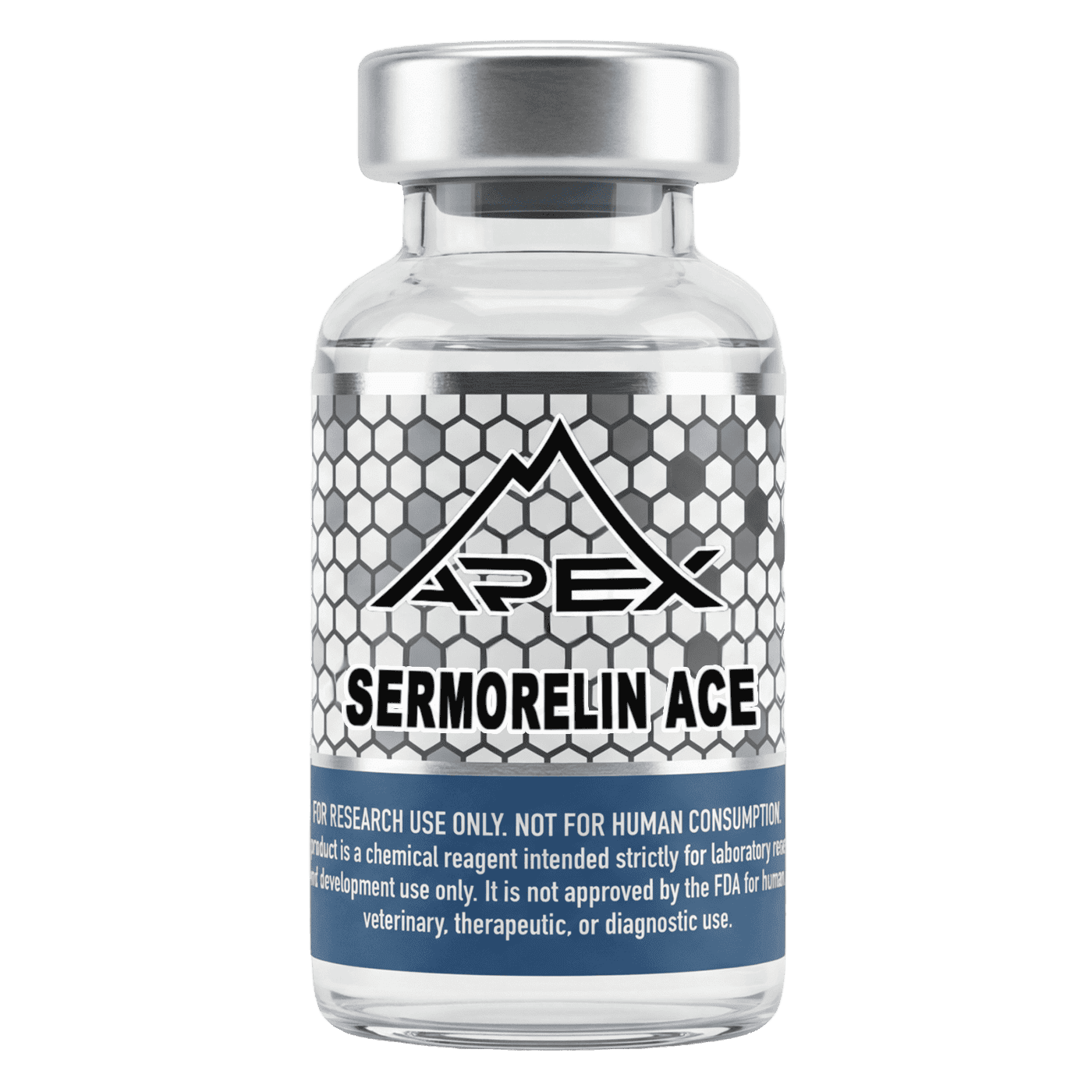
Certificate of Analysis — Sermorelin 10mg
GHRH(1-29) analog – CAS 86168-78-7
Verified by Apex Laboratory in-house HPLC (purity by 220 nm peak area) and ESI mass spectrometry (mass identity confirmation). Data on this page describes the current shipping lot.
- Purity (HPLC, area %): 99.42%
- Mass found (ESI-MS): 3358.17 Da
- Mass expected: 3357.88 Da
- HPLC retention time: 13.5 min
- Batch ID: APX-2026-0317-S
- Test date: March 17, 2026
- Analyst: K. Norwood
View Sermorelin 10mg on the Lab Verified COA archive · Read the Sermorelin Research Guide
Sermorelin Acetate is the acetate salt of GHRH(1-29)-NH₂, the truncated 29-residue N-terminal fragment of human growth hormone-releasing hormone. The HPLC chromatogram and mass spectrometry summary displayed above are drawn from the lot currently leaving our shelves — batch APX-2026-0317-S, released 99.42% pure on 17 March 2026 — not a stock graphic or a representative example. The data you read is the data on the vial you receive. Supplied by Apex Laboratory as a high-purity reagent for in-vitro laboratory research and development use only; not for human consumption, veterinary use, or any therapeutic application.
Compound Overview
Sermorelin reproduces the minimal sequence required for full agonist activity at the growth hormone-releasing hormone receptor (GHRHR), a class B (secretin-family) G-protein-coupled receptor expressed on anterior pituitary somatotrophs. Native GHRH is a 44-amino-acid peptide, but pharmacology studies established decades ago that biological potency resides almost entirely in the first 29 residues; sermorelin is therefore that fragment, capped with a C-terminal amide to slow exopeptidase cleavage. Receptor engagement couples through Gαs, raising intracellular cAMP and triggering pulsatile synthesis and release of endogenous growth hormone rather than substituting for it.
This receptor-level mechanism is what distinguishes sermorelin from its siblings in the growth-hormone-axis toolkit. Unlike the growth hormone secretagogues that act on the ghrelin receptor (GHS-R1a) — ipamorelin and the GHRP series — sermorelin works exclusively on the GHRHR arm. Compared with CJC-1295, which is a tetra-substituted GHRH(1-29) analog engineered for protease resistance, sermorelin is the unmodified parent fragment, giving it a short, native-like profile that makes it a clean reference point for receptor-binding and signaling work. It also sits one structural step below tesamorelin, a stabilized full-length GHRH(1-44) analog, allowing side-by-side comparison of fragment versus full-length GHRH constructs at the same receptor.
Research Background & Published Literature
Sermorelin is one of the most thoroughly characterized GHRH analogs in the endocrinology literature. Marketed historically under the brand name Geref, it was applied as a diagnostic probe for evaluating anterior pituitary somatotroph reserve, and that legacy generated an extensive body of pharmacology describing GHRHR binding affinity, cAMP signaling kinetics, and the pulsatile dynamics of GH secretion in model systems. Apex supplies research-grade material only; the historical clinical use is provided for scientific context and does not constitute any approval of this reagent for human application. Within the laboratory, sermorelin remains a benchmark agonist for probing the secretin-family receptor class and for dissecting the somatotroph signaling cascade.
Researchers reviewing the published record on this fragment can use the following peer-reviewed and database resources for additional context on its receptor mechanism, signaling pathways, and experimental use in controlled laboratory settings:
- PubMed — sermorelin and GHRH receptor pharmacology
- PubChem — sermorelin structure and identifier record
Technical Specifications
| Product Name | Sermorelin Acetate |
| Other Names / Synonyms | GHRH(1-29)-NH₂ · GRF(1-29) · Geref (historical brand) |
| Classification | Growth hormone-releasing hormone (GHRH) fragment / GHRHR agonist |
| CAS Number | 86168-78-7 |
| Molecular Formula | C₁₄₉H₂₄₆N₄₄O₄₂S |
| Molecular Weight | 3357.93 g/mol (batch [M+H]⁺ found 3358.17 vs expected 3357.88) |
| Sequence / Structure | 29-residue N-terminal fragment of GHRH(1-44), C-terminal amide |
| Purity Specification | ≥99% (HPLC + MS verified — this lot 99.42%, see chromatogram above) |
| Physical Form | Lyophilized (freeze-dried) powder · sealed glass vial |
| Recommended Diluent | Bacteriostatic water or sterile laboratory-grade water |
| Available Sizes | 2 mg · 5 mg · 10 mg |
| Intended Use | In-vitro research only — not for human consumption |
Storage, Handling & Stability
As an unmodified native-sequence fragment, sermorelin lacks the fatty-acid or substitution-based protection built into longer-acting analogs, so it is comparatively sensitive to handling and benefits from disciplined cold-chain practice. Store the lyophilized vial at -20°C for long-term stability, where the dry powder is robust for extended periods. Once reconstituted with a sterile diluent, hold working solution at 2–8°C, use it promptly, and divide it into single-use aliquots so the bulk stock is not subjected to repeated freeze-thaw stress. The peptide reconstitution calculator will convert your vial mass and chosen solvent volume into a precise mg/mL working concentration.
- Keep the powder dry and sealed; resuspend only the portion needed for the immediate experiment.
- Limit ambient-temperature exposure during weighing and dilution to preserve the amide-capped C-terminus.
- Avoid aggressive vortexing of the reconstituted solution; swirl gently to dissolve the lyophilizate.
- Label every aliquot with compound name, concentration, reconstitution date, and operator initials for full lot traceability.
- Wear appropriate PPE and follow your institution’s chemical safety protocols at all times.
Quality Assurance & Analytical Verification
Every sermorelin lot passes a dual-verification release protocol before it is added to inventory: reversed-phase High-Performance Liquid Chromatography to quantify chromatographic purity, and Mass Spectrometry to confirm molecular identity against the expected 3357.88 Da monoisotopic-corrected mass. The chromatogram and analytical panel at the top of this page are this batch’s actual release record, not a marketing illustration. For batch APX-2026-0317-S the material eluted as a single dominant peak at a retention time of 13.5 minutes with a measured purity of 99.42%, and the mass spectrometry result (found 3358.17, expected 3357.88) confirms the intact 29-residue fragment with no evidence of truncation or deletion sequences.
At roughly 3,358 Da, sermorelin is large enough that electrospray ionization (ESI+) typically resolves it across several charge states — the doubly and triply protonated ions are used to back-calculate a single consistent parent mass, a more rigorous identity check than relying on one signal alone. For a walkthrough of how this confirmation is performed, see our guide to mass spectrometry for peptide verification, or review how to interpret each field on the document in how to read a Certificate of Analysis. Current and historical batch reports are archived in the Lab Verified collection.
Frequently Asked Questions
What makes sermorelin different from CJC-1295 or tesamorelin?
All three act on the GHRH receptor, but they differ structurally. Sermorelin is the unmodified GHRH(1-29) fragment with a native sequence and a short, native-like profile. CJC-1295 is the same 29-residue backbone with four amino-acid substitutions engineered for protease resistance, while tesamorelin is a stabilized full-length GHRH(1-44) analog. That makes sermorelin a useful unmodified reference compound when researchers want to isolate the effect of those engineering modifications in receptor-binding and signaling assays.
Why does sermorelin act on a different receptor than ipamorelin or the GHRP peptides?
Sermorelin is a GHRH-receptor (GHRHR) agonist. The growth hormone secretagogues — ipamorelin, GHRP-2, and GHRP-6 — instead bind the ghrelin receptor GHS-R1a. The two receptor systems regulate somatotroph activity through distinct signaling arms, which is why GHRH analogs and secretagogues are frequently studied as complementary, mechanistically separate models in growth-hormone-axis research.
What diluent and concentration should be used to reconstitute this fragment?
Bacteriostatic water or sterile laboratory-grade water is the standard diluent for lyophilized GHRH fragments. The exact volume depends on the working concentration your protocol requires; the reconstitution calculator derives mg/mL and mcg/mL from the vial mass and solvent volume. Because sermorelin is an unmodified fragment, prepare only what you need and keep reconstituted solution cold.
What does the 99.42% purity figure on the COA mean for my experiments?
It is the HPLC-integrated chromatographic purity for the specific lot shipping now (APX-2026-0317-S), confirming that 99.42% of the peptide content corresponds to the target GHRH(1-29) sequence. A high, documented purity reduces the chance that signaling artifacts in receptor or cell-based assays arise from synthesis-related impurities rather than the compound itself — see why ≥99% purity matters for the experimental rationale.
Is this product approved for human use?
No. All compounds sold by Apex Laboratory are classified as chemical research reagents intended strictly for in-vitro laboratory research. They are not approved for human consumption, veterinary use, or any therapeutic application. The historical clinical product Geref is referenced only for scientific context; this research-grade sermorelin acetate is not a substitute for it and carries no human-use authorization. Purchasers who imply intended bodily use will have their orders cancelled and their accounts permanently suspended.
Related Research Compounds
Researchers studying the GHRH-receptor arm of the growth-hormone axis may also be interested in related reagents from Apex Laboratory: CJC-1295 No DAC (substituted GHRH(1-29) analog), Tesamorelin (stabilized GHRH(1-44) analog), and Ipamorelin (selective GHS-R1a secretagogue) for cross-receptor comparison. Browse the full Apex Laboratory research catalog to see the complete range of peptides and reagents.
Shipping, Packaging & Delivery
Orders confirmed before 2:00 PM Eastern Time on a business day are dispatched the same day through tracked US domestic carriers. Each sermorelin vial travels in insulated, temperature-appropriate packaging chosen to protect the lyophilized peptide in transit. Move the vial to -20°C storage as soon as it arrives. If your protocol is time-critical or you need a specific delivery window, reach out ahead of ordering and our team will help schedule the shipment around your laboratory’s workflow.
Research Use Disclaimer
For in-vitro research use only. Not for human consumption. All products sold by Apex Laboratory — including Sermorelin Acetate — are intended exclusively for qualified researchers, accredited laboratories, and educational institutions. This material is supplied as a chemical research reagent and is not approved for any human or veterinary therapeutic use. Purchasers assume full responsibility for safe handling, proper storage, and compliance with all applicable federal, state, and local laws, regulations, and institutional policies governing the purchase and use of chemical research reagents.

Reviews
There are no reviews yet.