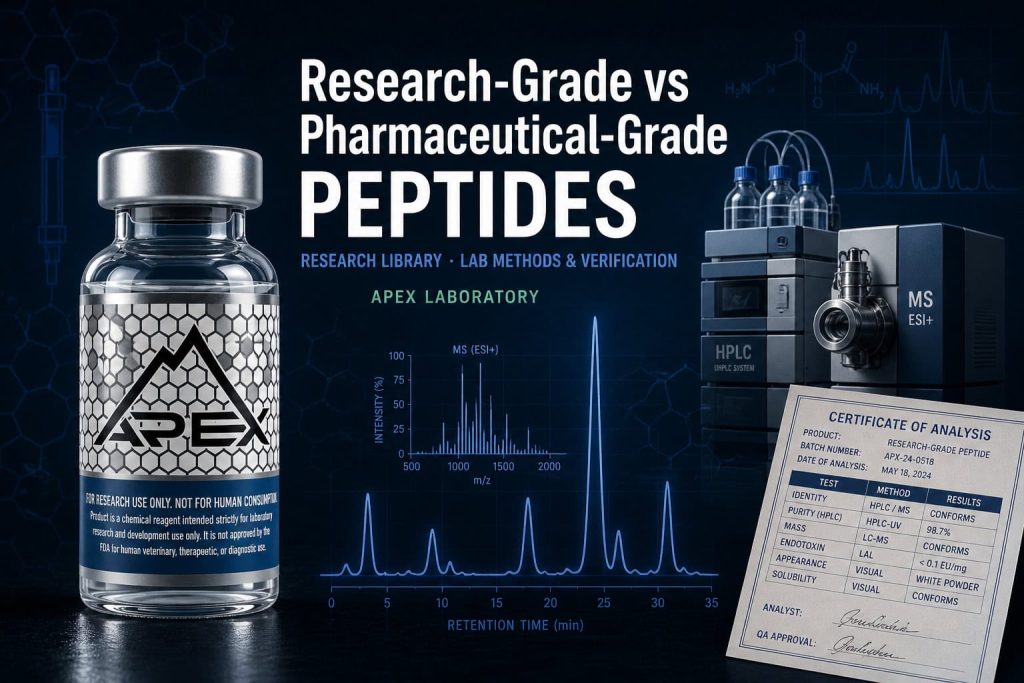
Research-grade and pharmaceutical-grade peptides differ in regulatory pathway, intended use, and quality-control envelope. Pharmaceutical-grade material is manufactured under cGMP for human therapeutic use under FDA, EMA, or equivalent authority, with extensive sterility, endotoxin, and stability validation. Research-grade material is verified under ISO 9001/17025 with HPLC purity and mass-spectrometry identity for in-vitro research only. The peptide structure can be the same; the verified-quality envelope and authorized use are not.
The distinction between research-grade and pharmaceutical-grade peptides is, at root, regulatory-jurisdictional rather than molecular. A pharmaceutical-grade peptide is manufactured under current Good Manufacturing Practice (cGMP) — FDA 21 CFR 211, EMA Annex 1, or analogous national pharmacopoeial frameworks — has cleared a regulatory approval pathway (NDA, IND, ANDA, BLA, or biosimilar), is released lot-by-lot by a Qualified Person, and is intended for human or veterinary therapeutic use.3 A research-grade peptide is a chemical research reagent: manufactured under ISO 9001 / ISO 17025 quality systems, verified for identity and purity by HPLC and mass spectrometry (typically ≥99%), released by vendor QA, and intended exclusively for in-vitro laboratory research — not for human consumption. Same molecule, two categorically distinct regulatory frameworks. The grade is a frame, not a quality verdict.
This guide unpacks the regulatory-framework asymmetry, walks through worked examples (Tirzepatide, Semaglutide, Cerebrolysin) where the same molecule occupies both categories simultaneously, clarifies what overlaps in verification methodology and what diverges, and addresses the common misframing that treats research-grade as “lower quality.” The distinction is categorical, not hierarchical. Apex Laboratory operates in the research-grade chemical reagent category — referenced where useful as one factual illustration of what research-grade verification looks like, not as the article’s central claim. The criteria travel to any vendor in either category.
Research-Grade vs Pharmaceutical-Grade at a Glance
- Research-grade and pharmaceutical-grade peptides differ by regulatory framework and intended use, NOT by quality hierarchy — research-grade is not inferior, it is a different category serving a different purpose
- Pharmaceutical-grade peptides are manufactured under cGMP (FDA 21 CFR 211 / EMA Annex 1 / analogous national pharmacopoeial frameworks), have cleared a regulatory approval pathway (NDA, IND, ANDA, BLA, biosimilar), and are released lot-by-lot by a Qualified Person for human or veterinary therapeutic use
- Research-grade peptides are chemical research reagents manufactured under ISO 9001 / ISO 17025 quality systems, verified by HPLC and mass spectrometry (typically ≥99% purity), released by vendor QA, and intended exclusively for in-vitro laboratory research
- The same peptide molecule (Tirzepatide, Semaglutide, Cerebrolysin) can exist in both categories simultaneously — chemically identical, categorically distinct under each regulatory frame
- Verification methodology (HPLC, mass spectrometry) overlaps across both grades; what diverges is the regulatory framework around the methods (cGMP-validated under ICH guidelines vs ISO-aligned vendor QA)
- Apex Laboratory catalog products are research-grade chemical reagents — for in-vitro laboratory research only, not for human consumption; this is stated as factual category disclosure, not promotional positioning
What “Grade” Actually Means: A Regulatory Distinction, Not a Quality Hierarchy
The word “grade” in the peptide context implies a ranking — better and worse, higher and lower. That intuition is wrong, and it is the most common upstream misunderstanding driving the entire research-grade vs pharmaceutical-grade conversation. “Grade” here names a regulatory category, not a quality tier. A research-grade peptide and a pharmaceutical-grade peptide can be the same molecule at the same purity (≥99% by HPLC + MS) — and yet they are categorically distinct because they are manufactured under different quality systems, released under different authorities, and intended for different uses under different regulatory frameworks.
The therapeutic-peptide-development literature codifies this: pharmaceutical-grade is the regulatory category for peptides developed and manufactured under cGMP for human or veterinary therapeutic use; research-grade is the chemical-reagent category for material supplied to laboratories for in-vitro and preclinical research.3 Neither is “better” in absolute terms. Pharmaceutical-grade is required for human therapeutic administration because the regulatory framework guarantees the chain of evidence — manufacturing controls, lot-to-lot validation, deviation logs, Qualified Person release, regulatory submission packages — that supports a therapeutic claim. Research-grade is appropriate for laboratory research because the regulatory framework matches the use: chemical reagent for in-vitro work, not therapeutic administration.
Treating “pharmaceutical-grade” as a marketing claim outside its regulatory framework — for example, retailers using “pharmaceutical-grade” language without manufacturing-standard backing or marketing authorization — is a definitional contradiction. A vendor-evaluation depth-treatment of the four functionally distinct vendor categories (research-grade reagent supplier, pharmaceutical-grade GMP manufacturer, grey-market reseller, bodybuilding-frame retailer) is the subject of the same-batch sister article How to Evaluate a Peptide Vendor.
Research-Grade vs Pharmaceutical-Grade Across Eight Dimensions
| Attribute | Research-Grade | Pharmaceutical-Grade |
|---|---|---|
| Regulatory framework | Chemical research reagent classification; outside FDA / EMA pharmaceutical-product regulation; subject to research-reagent customs and import classifications | FDA 21 CFR 211 / EMA Annex 1 / ICH Q-series (Q7/Q8/Q9/Q10/Q11) / analogous national pharmacopoeial frameworks; per-jurisdiction marketing authorization required for therapeutic distribution |
| Manufacturing standards | ISO 9001 quality management system; ISO 17025 testing/calibration laboratory accreditation typical; cGMP-aligned reagent practice common but not cGMP-regulated for human use | Current Good Manufacturing Practice (cGMP) under FDA 21 CFR 211 or EMA Annex 1; full pharmaceutical quality system per ICH Q10 |
| Purity standard typical | ≥99% by HPLC, confirmed by mass spectrometry (industry-leading research-grade benchmark) | ≥99% by cGMP-validated analytical methods aligned with USP, Ph.Eur., or JP monograph specifications |
| Verification methods | HPLC for purity; mass spectrometry for identity; per-batch chromatogram and spectrum trace data published or supplied on request | cGMP-validated HPLC and MS methods; ICH-aligned stability testing; full impurity-profile characterization; reference-standard cross-validation |
| Per-batch documentation | Per-batch certificate of analysis (COA) — assay, identity, purity, lot number, manufacturing/release date, analyst signature, methods named | Full batch records — chain of custody, in-process controls, deviation logs, environmental monitoring, ICH-aligned stability data, regulatory submission package |
| Intended use | In-vitro laboratory research only; preclinical and mechanistic research; chemical reagent classification — NOT for human or veterinary consumption | Human or veterinary therapeutic administration under approved indications in jurisdictions where each product carries marketing authorization |
| Lot release authority | Vendor Quality Assurance under ISO procedures; release sign-off by vendor QA (no regulatory-mandated authority) | Qualified Person (QP) under EU regulation, or analogous regulatory-mandated authority elsewhere; release sign-off carries legal accountability |
| Example compounds | Apex Laboratory catalog: BPC-157, Semaglutide, Tirzepatide, Cerebrolysin, and other peptides as research-grade chemical reagents | FDA-approved formulations: Mounjaro / Zepbound (Tirzepatide, Eli Lilly); Ozempic / Wegovy / Rybelsus (Semaglutide, Novo Nordisk); per-jurisdiction approved Cerebrolysin (EVER Neuro Pharma / Ebewe lineage) |
Pharmaceutical-Grade: cGMP, Regulatory Approval, and the Qualified Person
Pharmaceutical-grade is the regulatory category for peptides intended for human or veterinary therapeutic use. It rests on three load-bearing elements operating together: a manufacturing standard (cGMP), a regulatory approval pathway (NDA, IND, ANDA, BLA, biosimilar), and a lot-release authority (the Qualified Person under EU regulation, or analogous mandated authority elsewhere). All three must be in place; none alone is sufficient.
cGMP as a manufacturing standard
Current Good Manufacturing Practice — codified in the United States as FDA 21 CFR 211 and in the European Union as EMA Annex 1 — is a manufacturing-quality framework that prescribes facility design, equipment qualification, personnel training, in-process controls, environmental monitoring, deviation handling, and documentation discipline. The internationally-harmonized ICH Q-series operationalizes the modern pharmaceutical quality system: Q7 covers active substance GMP, Q8 covers pharmaceutical development, Q9 covers quality risk management, Q10 covers the pharmaceutical quality system, and Q11 covers development and manufacture of drug substances.8 A peptide manufactured under cGMP carries documentation supporting every element of that framework — not just a purity number.
Regulatory approval pathway
cGMP manufacturing alone does not authorize therapeutic distribution. A pharmaceutical-grade peptide must additionally clear a regulatory approval pathway in each jurisdiction where it is marketed therapeutically. In the United States, the relevant pathways include the New Drug Application (NDA) for chemically synthesized drugs and peptides, the Investigational New Drug (IND) process for pre-approval clinical research, the Abbreviated New Drug Application (ANDA) for generic equivalents, the Biologics License Application (BLA) for biologic products, and the 351(k) biosimilar pathway. The cross-pharma working-group review by Isidro-Llobet and colleagues documents the manufacturing-scale, GMP-aligned synthesis chemistry that supports peptide-API development at the pharmaceutical scale — distinct from research-grade reagent-scale synthesis.7
The Qualified Person
In the EU regulatory framework, a Qualified Person (QP) is a regulatory-mandated authority responsible for certifying that each batch of a pharmaceutical product has been manufactured and tested in accordance with marketing authorization and cGMP. Equivalent regulatory-mandated release authorities exist in other jurisdictions. The QP carries legal accountability — a signature releasing a non-conforming lot is a regulatory event with personal consequences. This is structurally distinct from research-grade vendor QA release: vendor QA operates under ISO procedures, not under regulatory-mandated authority, and releases material for research-reagent use rather than therapeutic distribution.
Research-Grade: ISO 9001/17025, HPLC + MS Verification, In-Vitro Use
Research-grade is the regulatory category for peptides supplied as chemical research reagents to laboratories for in-vitro and preclinical research. It is not “lower” pharmaceutical-grade. It is a different category with a different framework, different verification expectations, different release authority, and a different intended use.
ISO 9001 / ISO 17025 as quality systems
A research-grade peptide manufacturer typically operates under ISO 9001 (quality management system) and may hold ISO 17025 accreditation (testing and calibration laboratories) for analytical lab credentialing. These standards are not equivalent to cGMP — cGMP is a pharmaceutical-product manufacturing framework with statutory regulatory weight; ISO 9001 / 17025 are general quality and laboratory standards. But ISO-aligned reagent-grade practice is a serious quality framework: it prescribes documented procedures, equipment calibration, analyst training, and method validation in the analytical laboratory.
HPLC and mass spectrometry as verification
Research-grade peptide verification rests on two analytical methods: reverse-phase HPLC for purity assessment and mass spectrometry for identity confirmation. The Coin, Beyermann, and Bienert 2007 Nature Protocols article codifies the standard solid-phase peptide synthesis (SPPS) procedure that underlies modern peptide manufacturing — the same chemistry powers research-grade and pharmaceutical-grade peptide synthesis at different scales.1 Mass spectrometry has been the dominant peptide-identification methodology of contemporary proteomics since the early 2000s; the Aebersold and Mann 2003 Nature review codified MS’s central role.2 A research-grade vendor publishing “≥99% by reverse-phase HPLC, confirmed by mass spectrometry” — with per-batch trace data available — is making a verifiable claim. The depth-treatment of HPLC sits in the Understanding HPLC Testing for Peptide Purity guide; the depth-treatment of MS as a verification tool sits in the same-batch sister article Mass Spectrometry for Peptide Verification.
In-vitro use only — the non-negotiable category constraint
Research-grade peptides are chemical research reagents. They are NOT for human consumption, NOT for veterinary therapeutic use, and NOT for any administration outside in-vitro and preclinical research contexts. This is the load-bearing category constraint that defines the research-grade frame. A research-grade vendor whose product page implies therapeutic administration is making a definitional contradiction; a researcher using research-grade material for any non-research purpose is operating outside the material’s regulatory category. The Apex Laboratory catalog operates in the research-grade reagent category — products are supplied for in-vitro and preclinical research only, with the not-for-human-consumption constraint stated factually on every product page.
Same Molecule, Different Category: Tirzepatide, Semaglutide, Cerebrolysin
The most important question driving research-grade vs pharmaceutical-grade queries is: is the research-grade molecule the same as the pharmaceutical-grade molecule? The answer for chemically synthesized peptides is yes, they are chemically identical molecules. The grade names the regulatory category around the molecule, not the chemistry of the molecule itself. Three worked examples illustrate the principle.
Tirzepatide
Tirzepatide is a dual GIP / GLP-1 receptor agonist discovered at Eli Lilly and disclosed in the literature as LY3298176.5 The pharmaceutical-grade development pathway delivered Mounjaro, FDA-approved for type 2 diabetes on May 13, 2022, and Zepbound, FDA-approved for chronic weight management on November 8, 2023. The phase 3 SURPASS-2 trial documented the registrational clinical evidence supporting Mounjaro’s approval.6 Apex Laboratory’s catalog Tirzepatide is research-grade — chemically the same molecule as the active pharmaceutical ingredient in Mounjaro and Zepbound, but supplied under a categorically distinct regulatory framework: chemical research reagent for in-vitro laboratory research only, NOT for human consumption. The molecule is identical; the regulatory frame is not. Compound-specific regulatory and mechanistic detail sits in the GLP-1 / Metabolic Research Peptide Pillar.
Semaglutide
Semaglutide is a once-weekly GLP-1 analogue discovered at Novo Nordisk.4 The pharmaceutical-grade development pathway delivered three FDA-approved formulations under separate indications: Ozempic (subcutaneous semaglutide for type 2 diabetes, approved 2017), Wegovy (subcutaneous semaglutide for chronic weight management, approved 2021), and Rybelsus (oral semaglutide for type 2 diabetes, approved 2019). Apex Laboratory’s catalog Semaglutide is research-grade — chemically the same molecule, supplied as a research reagent for in-vitro laboratory research only. Apex’s research-grade Semaglutide is distinct from Novo Nordisk’s approved pharmaceutical formulations; research-grade material is not for human consumption.
Cerebrolysin
Cerebrolysin is a porcine-brain-derived peptide preparation manufactured by EVER Neuro Pharma (Ebewe lineage) and approved as an injectable pharmaceutical primarily in Austria and parts of Eastern Europe, in the Russian Federation, and in several Asian markets. It carries no centralized EMA marketing authorization, no FDA approval, and no Cerebrolysin pharmaceutical-grade authorization in the United States. Apex Laboratory’s catalog Cerebrolysin is research-grade — supplied as a chemical research reagent for in-vitro laboratory research, distinct from the per-jurisdiction approved pharmaceutical formulation. The compound-specific regulatory and mechanistic detail sits in the Cerebrolysin Research Guide and the CNS Research Peptide Pillar.
The pattern holds across each example: same molecule (or biological preparation in the Cerebrolysin case), two regulatory frames operating in parallel. The pharmaceutical-grade frame governs human therapeutic distribution under per-jurisdiction approval. The research-grade frame governs in-vitro laboratory research material. Conflating the frames — using research-grade material as if it were pharmaceutical-grade therapeutic, or treating “pharmaceutical-grade” as a marketing claim outside its regulatory framework — is the definitional contradiction the article is written to dissolve.
Verification Methods: What Overlaps and What Doesn’t
The most counterintuitive feature of the research-grade vs pharmaceutical-grade distinction is how much the verification methodology overlaps across both categories. HPLC and mass spectrometry are used in both. The differentiator is not the analytical method; it is the regulatory framework around the method.
What overlaps: HPLC and mass spectrometry
Both research-grade and pharmaceutical-grade peptides are characterized by reverse-phase HPLC for purity assessment and mass spectrometry for identity confirmation.2 The chromatogram resolves the major-component peak from synthesis impurities; the mass spectrum confirms the species in that peak is the intended peptide. The same instrumentation lineage — high-resolution HPLC, electrospray-ionization or MALDI-TOF mass spectrometry — operates in research-grade analytical labs and in pharmaceutical-grade quality control facilities. A research-grade vendor running the same HPLC method on the same instrument class can achieve purity comparable to a pharmaceutical-grade manufacturer characterizing the same peptide.
What overlaps: synthesis chemistry
Solid-phase peptide synthesis using Fmoc chemistry — the Coin / Beyermann / Bienert 2007 standard — is the dominant synthesis method for both research-grade and pharmaceutical-grade peptides.1 The chemistry is the same; what differs is the scale, the manufacturing controls, and the regulatory framework around the synthesis. Research-grade reagent-scale synthesis runs in a research laboratory under ISO procedures. Pharmaceutical-grade peptide-API synthesis runs in cGMP-regulated manufacturing facilities under ICH Q11 development controls.7
What diverges: the regulatory framework around the methods
Pharmaceutical-grade verification adds: cGMP-validated analytical methods aligned with USP / Ph.Eur. / JP monograph specifications; ICH-aligned stability testing programs; full batch records and chain-of-custody documentation; deviation logs and quality risk management under ICH Q9; pharmaceutical quality system documentation under ICH Q10; reference-standard cross-validation; and regulatory submission packages supporting marketing authorization. Research-grade verification emphasizes: vendor-published per-batch trace data; per-batch certificate of analysis; ISO-aligned QA review; and transparent vendor identity and editorial standards. Both frameworks are serious quality systems; they are not interchangeable, and they serve different purposes. The depth-treatment of why ≥99% purity matters as a research-grade verification standard sits in the same-batch sister article Why ≥99% Purity Matters.
Documentation: Per-Batch COA vs Full Batch Records and Regulatory Files
Documentation discipline tracks the regulatory framework. Research-grade verification documentation is anchored to the per-batch certificate of analysis (COA). Pharmaceutical-grade documentation extends to full batch records and regulatory submission files.
What a research-grade COA documents
A research-grade peptide COA is the lot-specific document that records what the vendor actually measured for that batch. At minimum it should show: assay/purity by named analytical instrument with the actual measured value (not a “meets specification” line); the lot or batch number; the manufacturing or release date; the analyst or QA traceable identifier; the analytical methods used; and the sequence-confirmation methodology where applicable. The depth-treatment of COA reading — what each line means, what to look for, how to verify the document corresponds to the lot received — sits in the How to Read a Peptide COA guide. A research-grade vendor without per-batch COAs (only a single perpetual reference-batch document recycled across lots) is not operating at the standard.
What pharmaceutical-grade documentation adds
Pharmaceutical-grade documentation extends beyond the COA to a full batch record system. Each lot carries: in-process control data; environmental monitoring records; equipment qualification cross-references; deviation logs; quality risk management documentation under ICH Q9; ICH-aligned stability data; reference-standard cross-validation records; and the regulatory submission package supporting per-jurisdiction marketing authorization. The Qualified Person reviews this documentation system before lot release. The full batch record is a regulatory-traceability artifact, not just a quality artifact: a regulator inspecting the manufacturer can reconstruct the manufacturing history of any lot from the batch record.
The two documentation frameworks are not in competition. A research-grade COA is the right documentation for research-reagent use; a full batch record is the right documentation for pharmaceutical-grade therapeutic distribution. Each matches its regulatory category.
Lot Release Authority: Vendor QA vs the Qualified Person
The release authority that signs off on each lot is the regulatory tooth of the grade distinction. It is not a paperwork detail.
Research-grade: vendor QA under ISO procedures
A research-grade peptide lot is released by the vendor’s Quality Assurance function under ISO 9001 / 17025 procedures. The QA reviewer applies the vendor’s documented release criteria — assay within spec, purity within spec, identity confirmed, methods validated — and signs the COA. The release authority is the vendor’s QA function operating under an ISO-aligned quality system. There is no regulatory-mandated personal accountability; the release sits within the vendor’s organizational quality framework.
Pharmaceutical-grade: the Qualified Person under regulatory mandate
A pharmaceutical-grade peptide lot is released by a Qualified Person (QP) under EU regulation, or an analogous regulatory-mandated authority elsewhere. The QP certifies that each batch has been manufactured and tested in accordance with the marketing authorization and cGMP. The QP carries personal legal accountability — releasing a non-conforming lot is a regulatory event with statutory consequences. The release authority is regulatory-mandated, not organizational; the QP’s signature is a legal artifact under the pharmaceutical regulatory framework codified through the ICH Q-series and per-jurisdiction implementations.8
The two release authorities are not interchangeable. A research-grade vendor cannot release pharmaceutical-grade product (the release authority is wrong); a pharmaceutical-grade manufacturer can supply research-grade material if the regulatory framing is set correctly (some pharmaceutical companies operate research-reagent supply businesses alongside their cGMP operations), but the release authority for the research-grade material is then the research-reagent vendor QA function, not the pharmaceutical QP. Each regulatory category demands its own release authority.
What This Means for Researchers Choosing Material
The practical implication of the regulatory-grade distinction for research procurement is straightforward. Research-grade peptides are appropriate for in-vitro and preclinical laboratory research — the material’s regulatory category matches the research use. Pharmaceutical-grade peptides are appropriate for clinical contexts requiring regulatory chain — clinical trials with IND-supported research-grade material specifically allocated to the trial, or therapeutic administration of approved products in jurisdictions where they are approved. Neither is universally “better”; they serve different research and clinical contexts under different regulatory frameworks.
Material outside both regulatory frames
Material distributed outside both research-grade and pharmaceutical-grade regulatory frameworks — relabeled bulk material from undisclosed sources, “for human use” claims attached to research-grade language, “pharmaceutical-grade” used as a marketing claim without manufacturing-standard backing — is the unregulated-supply category. The empirical literature documents what happens here. Multi-year forensic-toxicology work in Germany analyzed black-market product seizures from 2010-2013 and documented systematic identity-claim versus actual-content mismatch.9 Forensic analysis of products seized from the bodybuilding black market specifically documented identity-mismatch and undeclared substances at category-level rates.10 The case for regulatory-framework discipline rests on this data: the regulatory grade is what guarantees identity, purity, and use-context — not the marketing claim attached to the package.
The Apex catalog as a research-grade illustration
Apex Laboratory operates in the research-grade chemical reagent category. Apex catalog products — including BPC-157, Semaglutide, Tirzepatide, and other peptides — are research-grade reagents for in-vitro and preclinical research only, NOT for human consumption. This is stated as a factual category disclosure on every product page. The catalog is one example of what research-grade looks like under the regulatory framework described in this article; it is not the article’s central claim. Researchers building broader procurement context may also find the same-batch sister article How to Evaluate a Peptide Vendor useful for vendor-agnostic checklist criteria spanning all four functionally distinct vendor categories.
Research-Grade Catalog Examples
BPC-157
Apex Laboratory BPC-157 is supplied as a research-grade chemical reagent at ≥99% purity, verified by HPLC and mass spectrometry on every batch with per-lot certificate of analysis. Research-only globally — no FDA, EMA, or NMPA marketing authorization. For in-vitro and preclinical research only — not for human consumption.
View Product →Semaglutide
Apex Laboratory research-grade Semaglutide is supplied as a chemical research reagent at ≥99% purity, verified by HPLC and mass spectrometry on every batch with per-lot certificate of analysis. Distinct from FDA-approved pharmaceutical formulations (Ozempic 2017 / Wegovy 2021 / Rybelsus 2019, Novo Nordisk); the Apex catalog product is research-grade and is not for human consumption.
View Product →Tirzepatide
Apex Laboratory research-grade Tirzepatide is supplied as a chemical research reagent at ≥99% purity, verified by HPLC and mass spectrometry on every batch with per-lot certificate of analysis. Distinct from FDA-approved pharmaceutical formulations (Mounjaro May 13, 2022 / Zepbound November 8, 2023, Eli Lilly); the Apex catalog product is research-grade and is not for human consumption.
View Product →Frequently Asked Questions
What is the difference between research-grade and pharmaceutical-grade peptides?
Research-grade peptides are chemical reagents made under ISO 9001 / 17025, verified by HPLC and MS, released by vendor QA, for in-vitro research only — not for human use. Pharmaceutical-grade peptides are made under cGMP (FDA 21 CFR 211 / EMA Annex 1), cleared through a regulatory pathway, and released by a Qualified Person for therapeutic use under marketing authorization.
Is research-grade peptide lower quality than pharmaceutical-grade?
No. The distinction is regulatory-categorical, not quality-hierarchical. Research-grade peptides can achieve purity comparable to pharmaceutical-grade (≥99% by HPLC + MS) under serious ISO-aligned quality systems. The differentiator is the regulatory framework — cGMP plus per-jurisdiction approval for therapeutic use vs ISO-aligned reagent practice for in-vitro research. Neither is universally “better”; they serve different contexts under different frameworks.
Can I take research-grade peptides?
No. Research-grade peptides are chemical reagents intended exclusively for in-vitro lab research. They are not made under cGMP, not cleared through a regulatory pathway, not released by a regulatory-mandated authority, and not for human or veterinary consumption. Apex Laboratory’s catalog products are research-grade reagents and explicitly not for human consumption — this is a category constraint, not a hedge.
Is research-grade tirzepatide the same molecule as Mounjaro?
The chemical molecule is the same. Tirzepatide is a dual GIP / GLP-1 receptor agonist; Mounjaro and Zepbound are FDA-approved pharmaceutical formulations of tirzepatide manufactured under cGMP by Eli Lilly. Apex Laboratory’s research-grade Tirzepatide is the same chemical molecule supplied under a categorically distinct regulatory frame as a chemical research reagent for in-vitro research only — not for human consumption.
What is a Qualified Person, and why do pharmaceutical-grade peptides need one?
A Qualified Person (QP) is a regulatory-mandated authority under EU pharmaceutical law (with analogous authorities elsewhere) responsible for certifying each batch is manufactured and tested per cGMP and the marketing authorization. The QP carries personal legal accountability for lot release. Research-grade vendor QA operates under ISO procedures, not regulatory mandate — a structurally different release authority for a different category.
Is cGMP the same as FDA-approved?
No. cGMP is a manufacturing standard codified in FDA 21 CFR 211 (and analogous frameworks like EMA Annex 1, ICH Q-series). FDA approval is a separate event in which a product clears a specific pathway (NDA, IND, ANDA, BLA, biosimilar) for a specific indication. A pharmaceutical-grade peptide for therapeutic distribution requires both cGMP and regulatory approval — distinct regulatory layers.
What is ISO 17025 and how does it relate to peptide manufacturing?
ISO 17025 is the international standard for testing and calibration laboratories. A research-grade peptide manufacturer with ISO 17025 accreditation operates under documented procedures for method validation, equipment calibration, analyst training, and reporting. ISO 17025 is not equivalent to cGMP — cGMP is a pharmaceutical standard with statutory weight — but it is a serious quality framework for research reagents.
Continue Your Research
Researchers building broader regulatory-grade context across the Apex library may find the following references useful:
- How to Read a Peptide Certificate of Analysis — depth-treatment of COA reading discipline applied to research-grade lot documentation
- Understanding HPLC Testing for Peptide Purity — depth-treatment of the HPLC verification instrument used in both grades
- How to Reconstitute Peptides — post-purchase handling for research-grade lyophilized peptides
- How to Evaluate a Peptide Vendor — same-batch sister article, vendor-agnostic checklist across the four functionally distinct vendor categories
- Mass Spectrometry for Peptide Verification — same-batch sister article, depth-treatment of the MS verification methodology used in both grades
- Why ≥99% Purity Matters — same-batch sister article, depth-treatment of the purity benchmark applicable to research-grade verification
- Tissue Repair Research Peptide Pillar — context for the BPC-157 catalog illustration in Block 10
- GLP-1 / Metabolic Research Peptide Pillar — context for the Tirzepatide and Semaglutide catalog illustrations in Block 10
- Growth Hormone Axis Research Peptide Pillar — lateral pillar covering the GH-axis research-peptide family
- CNS Research Peptide Pillar — lateral pillar covering CNS research peptides including Cerebrolysin
- Cerebrolysin Research Guide — compound-specific Cerebrolysin regulatory and mechanistic detail
- Apex Laboratory Editorial Standards — published editorial-standards document codifying verification criteria
- Apex Laboratory Lab-Verified COA Archive — supply-chain disclosure example for research-grade reagent suppliers
- Apex Laboratory Research Library — full library home
- Tirzepatide Research Guide
- BPC-157 Research Guide
Research Use Disclaimer
This article is provided for educational and research reference purposes only. Research-grade peptides are chemical research reagents intended exclusively for in-vitro laboratory research and are NOT for human consumption. Pharmaceutical-grade peptide examples referenced in this article (Tirzepatide as Mounjaro / Zepbound, Semaglutide as Ozempic / Wegovy / Rybelsus, Cerebrolysin under per-jurisdiction national approvals) are named only as illustrations of the regulatory-grade distinction; nothing in this article constitutes therapeutic guidance, dosing recommendation, or clinical advice for any compound. Apex Laboratory operates in the research-grade chemical reagent category; Apex catalog products are research-grade and not for human therapeutic use. Researchers should consult primary peer-reviewed literature, applicable regulations in their jurisdiction, and their institutional procurement guidelines.