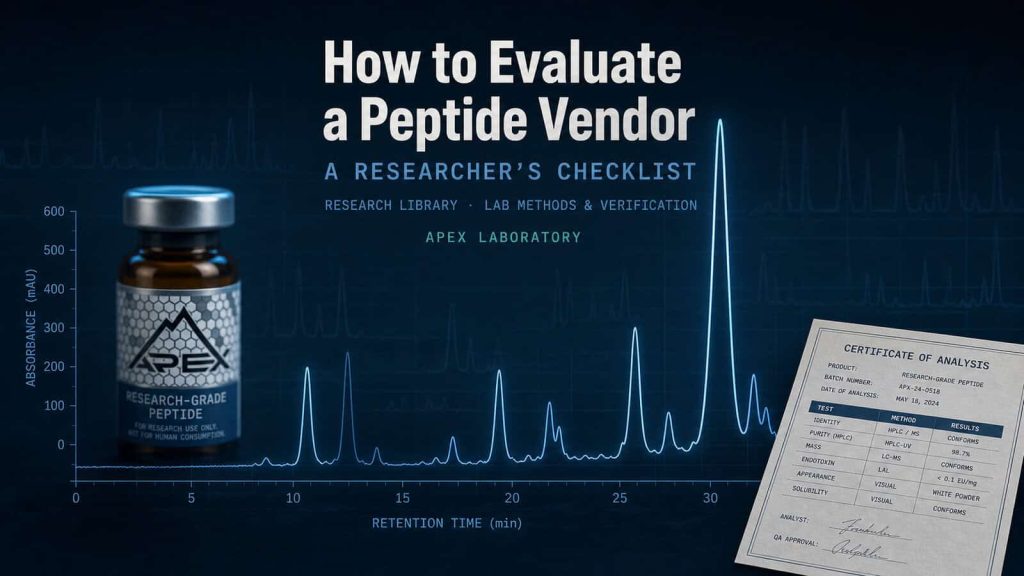
Evaluating a research peptide vendor follows a five-criterion verification procedure: HPLC purity claim with instrument provenance, per-batch Certificate of Analysis discipline, mass-spectrometry sequence-identity confirmation, manufacturing-standards and supply-chain transparency, and editorial framing in research context. Each criterion is verifiable from documentation the vendor must supply on request.
“Peptide vendor” is not a single market category — it is at least four. A researcher purchasing a peptide can be buying from a research-grade chemical reagent supplier (the catalog tier where Apex Laboratory operates), a pharmaceutical-grade GMP manufacturer (regulated for human therapeutic use, with FDA, EMA, or national-agency oversight in the jurisdictions where each product carries marketing authorization), a grey-market reseller (no verification; relabeled bulk material of unknown provenance), or a bodybuilding-frame retailer (research-context absent, dosing language pervasive).5 Each category demands different verification questions, and confusing them is the most common upstream failure in research peptide procurement.
This checklist treats the four categories as the foundation. Once a researcher identifies which vendor type they are evaluating, every downstream question — purity claim, certificate of analysis, sequence verification, manufacturing standards, supply-chain transparency, editorial-standards posture — follows in the right order. Apex’s own verification standards appear in places as one concrete illustration of what “good” looks like in the research-grade reagent category, but the criteria travel to any vendor in any of the four categories. The article is a researcher’s checklist, not a vendor recommendation.
Peptide Vendor Evaluation at a Glance
- “Peptide vendor” is at least four functionally distinct categories: research-grade chemical reagent supplier, pharmaceutical-grade GMP manufacturer, grey-market reseller, and bodybuilding-frame retailer — each demanding different verification questions
- Research-grade and pharmaceutical-grade are different categories serving different research contexts, not a quality hierarchy; pharmaceutical-grade is not automatically “better” for laboratory research, and research-grade material is not for human consumption
- Five core verification criteria apply across categories: purity claim with named instrument (HPLC + MS), per-batch certificate of analysis (COA), sequence-identity confirmation, manufacturing-standards documentation, and editorial-standards posture
- Empirical literature on grey-market and bodybuilding-frame retailers documents systematic identity mismatch, undeclared substances, and label-content discrepancy — the case for verification rests on data, not opinion
- Red-flag signals include missing or undated COA, purity claim without instrument named, anonymous vendor identity, “for human use” claims on research-grade pages, and bodybuilding-frame product language
- Apex Laboratory operates in the research-grade reagent category and is referenced where useful as one example of what good verification looks like; the criteria in this checklist apply to any vendor in any of the four categories
The Four Vendor Categories: What Researchers Are Actually Choosing Between
The first verification question a researcher should ask is not “is this vendor good” but “which kind of vendor is this.” The four categories below are not interchangeable. Each operates under different regulatory expectations, different documentation norms, and different research-context language; treating them as one pool is the most common upstream failure in research peptide procurement.
Research-grade chemical reagent suppliers
This is the catalog tier where Apex Laboratory operates. Products are manufactured (typically by solid-phase peptide synthesis) and supplied as chemical research reagents for in-vitro and preclinical research. Verification expectations: ≥99% purity by HPLC and mass spectrometry, per-batch certificate of analysis, instrument-specified analytical methods, documented editorial-standards page, research-only product framing. These products are NOT regulated for human therapeutic use and NOT for human consumption.
Pharmaceutical-grade GMP manufacturers
These vendors manufacture under FDA, EMA, or national-agency–regulated current good manufacturing practice (cGMP) for human therapeutic use, with marketing authorization in specific jurisdictions where each product has been approved.5 Pharmaceutical-grade is a different category — different regulatory pathway, different price/scale, different distribution restrictions. Critically: cGMP is a manufacturing standard, while regulatory approval is a separate jurisdictional event; the two do not collapse into a single label. Pharmaceutical-grade products are not automatically the right reagent for laboratory research, and research-grade products are not legitimate for human therapeutic administration.
Grey-market resellers
Relabeled bulk material with no verification documentation; provenance unknown; manufacturer identity often anonymous; missing COA, dated COA, or COA copy-pasted from elsewhere. Multi-year analytical work on doping-product seizures and online sellers without prescription has documented systematic identity-claim versus actual-content mismatch in this category.7
Bodybuilding-frame retailers
Peptide retail with bodybuilding/enhancement product framing on product pages — dosing protocols, body-composition imagery, “stack” or “cycle” language, absent research-context framing. The category overlaps with grey-market when verification documentation is also absent. Forensic-toxicology analyses of products seized from this market segment have documented label-content discrepancies and undeclared substances at meaningful rates — the empirical case for category-level verification risk.
The Four Peptide Vendor Categories
| Vendor Type | Verification Standards | Research Context | Examples |
|---|---|---|---|
| Research-grade chemical reagent supplier | ≥99% by HPLC + MS, per-batch COA, instrument-specified methods, editorial-standards page, research-only language | In-vitro and preclinical laboratory research; chemical research reagent classification; not for human consumption | Apex Laboratory and other catalog reagent suppliers operating to the same verification gate |
| Pharmaceutical-grade GMP manufacturer | cGMP manufacturing under FDA / EMA / national-agency oversight; per-jurisdiction marketing authorization for human therapeutic use; full regulatory documentation | Human therapeutic use under approved indications in specific jurisdictions; clinical trial supply; not equivalent to research-reagent suppliers for general laboratory research | Approved pharmaceutical formulations of specific peptides under brand or generic registration |
| Grey-market reseller | No verification documentation; missing or recycled COA; anonymous manufacturer; provenance undisclosed; identity-claim mismatch documented in literature | Outside research-context discipline; not legitimate for institutional research procurement; documented quality variance per forensic-toxicology and market-surveillance data | Anonymous online sellers without verification credentials; relabeled bulk-material distributors |
| Bodybuilding-frame retailer | Verification documentation often absent; product pages present dosing protocols, “stack” or “cycle” framing, body-composition imagery; research-context language absent | Consumer enhancement framing rather than research-reagent context; “for human use” claims sometimes appearing alongside research-grade-claim products (definitional contradiction) | Retailers presenting peptides as enhancement products with body-composition marketing language |
Verification Criterion #1: Purity Claim and the Instruments Behind It
The headline number on a peptide product page — “≥99% purity” or “≥98% purity” — is not by itself a verification claim. It becomes one only when the instrument and method are specified. The analytical philosophy that underlies modern peptide purity claims was codified across the development of biotechnology-process quality control: a purity number is a statement about an analytical method, not an absolute property of the material, and the impurity-profile that the method resolves is part of the claim.10
What the instrument named tells you
A research-grade vendor publishing “≥99% by reverse-phase HPLC, confirmed by mass spectrometry” is making a verifiable claim. The HPLC method resolves the major-component peak from synthesis impurities and process-related contaminants; the mass spectrometry confirms the species in that peak is the intended peptide. Reverse-phase HPLC has been the dominant method for peptide purity characterization since the analytical-philosophy work of the late 1980s and 1990s. Mass spectrometry has been the dominant peptide-identification methodology of modern proteomics since the early 2000s.1
A purity claim that does NOT name an instrument — “≥98% pure” with no method or instrument specified — is not a verification claim. It is a marketing assertion. Researchers comparing vendors should treat instrument-naming as a binary gate: present, the claim can be evaluated; absent, the claim cannot. The depth-treatment of HPLC as the verification instrument sits in the Understanding HPLC Testing for Peptide Purity guide.
What the trace itself tells you
Beyond the headline number, vendors operating at the research-grade reagent standard publish or make available the actual chromatogram and spectrum on request. The chromatogram shows the impurity-peak distribution; the spectrum confirms the intended molecular ion. Researchers asking which vendors meet this bar should look for traces — not claims about traces. Why this standard matters as a separate question is covered in detail in the same-batch sister article Why ≥99% Purity Matters.
Verification Criterion #2: Per-Batch Certificate of Analysis (COA)
A certificate of analysis (COA) is the lot-specific document that records what the vendor actually measured for that batch — not the catalog template. The COA-discipline question is binary: either the vendor issues a COA per batch, dated and lot-numbered, or they do not.10
What a research-grade COA must contain
A research-grade peptide COA should at minimum show: assay/purity by named instrument with the actual measured value (not just a “meets specification” line); the lot or batch number; the manufacturing date or release date; the analyst or QA signature (or equivalent traceable identifier); the test methods used; and the sequence-confirmation methodology where applicable. The depth-treatment of COA reading — what each line means, what to look for, how to verify the document corresponds to the lot you actually received — sits in the How to Read a Peptide COA guide.
Per-batch versus reference-batch
A common grey-market pattern is the reference-batch COA — a single COA from one historical batch posted on the product page in perpetuity. Researchers receiving subsequent shipments cannot verify what they actually received because no per-batch document exists. The verification question to ask: does the COA correspond to the lot number printed on the vial in front of me? If the answer is “the vendor sends one COA per product, not per batch,” the vendor is not operating at the research-grade reagent standard.
Verification Criterion #3: Sequence Identity and Mass Confirmation
Purity tells you what fraction of the material is the intended peptide. Sequence identity tells you whether the intended peptide is in fact what the bottle claims. These are separate verification questions, addressed by separate analytical methods.
Mass spectrometry as the modern identity confirmation
Modern peptide-identity confirmation rests on mass spectrometry. The intended peptide has a calculable monoisotopic mass; the mass spectrum either matches that calculated mass (within instrument accuracy) or it does not. The Aebersold and Mann 2003 Nature review codified mass spectrometry’s role as the dominant peptide-identification methodology of contemporary proteomics, and that role has only deepened since.1 A vendor publishing or supplying on request the mass spectrum trace alongside the calculated-versus-observed mass is making a verifiable identity claim. Why mass spectrometry matters specifically — what the trace shows, how to read peak patterns, what fragmentation data adds — sits in the same-batch sister article Mass Spectrometry for Peptide Verification.
The Edman lineage and current sequencing methods
Older vendors and certain pharmaceutical-grade contexts still cite Edman degradation as a sequence-confirmation technique. The automated gas-phase Edman sequenator was introduced by Hewick, Hunkapiller, Hood, and Dreyer in 1981 and remains a valid methodology for verified N-terminal sequencing.2 Most contemporary research-grade reagent suppliers now use MS/MS-based peptide mapping (the de facto modern equivalent), but the Edman lineage is the conceptual root. Researchers reading vendor documentation that names “peptide-mapping,” “MS/MS,” or “Edman” should treat any of those as legitimate sequence-verification methods. A vendor making no statement at all about sequence verification is making no verifiable identity claim.
Verification Criterion #4: Manufacturing Standards and Supply-Chain Transparency
Once purity and identity are verified for the lot in front of you, the next layer of vendor evaluation concerns how that lot was made and how it reached you.
Synthesis methodology disclosure
Virtually all research-grade peptides on the modern market are produced by solid-phase peptide synthesis (SPPS), most commonly using Fmoc chemistry. The Coin, Beyermann, and Bienert 2007 Nature Protocols article codifies the standard SPPS procedure and the methodology adjustments required for difficult sequences.3 A vendor describing their synthesis as “Fmoc-SPPS” is referencing this lineage; lot-to-lot consistency claims trace to the rigor of the synthesis-and-purification process. The broader landscape of chemical methods for peptide and protein production — Fmoc/tBoc SPPS, native chemical ligation, recombinant expression — is reviewed in Chandrudu, Simerska, and Toth 2013, providing context for evaluating vendor claims about their manufacturing scope.4
Supply-chain transparency
A vendor manufacturing in-house and naming their facility is making a different supply-chain claim than a reseller importing bulk material from undisclosed sources. The verification question: does the product page (or the editorial-standards page, or the lab-verified archive) name the manufacturer or describe the supply-chain model? “Single-source manufactured” and “third-party reseller” are different categories. Apex Laboratory documents its sourcing under the lab-verified archive, as one example of how research-grade reagent suppliers structure this disclosure. The deeper distinction between research-grade and pharmaceutical-grade manufacturing — including how cGMP-aligned reagent practice differs from FDA/EMA-regulated cGMP for human therapeutic products — is the subject of the same-batch sister article Research-Grade vs Pharmaceutical-Grade Peptides.
Verification Criterion #5: Editorial Standards and Research-Context Framing
The last verification layer is editorial. A vendor’s product pages, blog content, and supporting documentation are themselves a verification signal: research-context framing, dosing-language absence, and explicit “for laboratory research only / not for human consumption” statements distinguish a research-grade reagent supplier from a vendor blurring the regulatory line.
What an editorial-standards page tells you
A research-grade vendor publishing an editorial-standards page (for example, the Apex Laboratory editorial standards document) is making three claims at once: that the verification standards above are codified rather than ad-hoc, that the editorial register of supporting content (research-context, no therapeutic claims, no dosing language) is intentional, and that the vendor stands behind a documented review process. Vendors without an editorial-standards page may still operate at the research-grade reagent standard, but the question of “what discipline is the vendor’s content held to” is harder to answer.
The “for human use” red flag inside research-grade contexts
A definitional contradiction: a research-grade product page that also states “for human use” or implies therapeutic administration is making mutually incompatible claims. Research-grade products are by category not for human consumption. Pharmaceutical-grade products are a separate category requiring jurisdictional regulatory approval. A vendor mixing the two registers on a single product page is failing the editorial-standards verification — regardless of whatever their HPLC trace shows.
Red-Flag Signals: What a Failing Vendor Looks Like
The empirical literature on substandard peptide products in unregulated channels is large and consistent. A 2024 J Med Internet Res market-surveillance study of online sellers offering semaglutide without prescription documented substantial quality variance, non-disclosed sourcing, and verification-failure rates in that channel.6 Multi-year forensic-toxicology work in Germany analyzed black-market product seizures from 2010-2013 and documented systematic identity-claim versus actual-content mismatch.8 Border-seizure analysis of doping products at the Swiss border replicated those findings with an independent dataset.9 Forensic analysis of products seized from the bodybuilding black market specifically documented identity-mismatch and undeclared substances at category-level rates.7 The case for verification rests on this data; the red-flag inventory below operationalizes it.
Six red-flag signals (vendor-agnostic)
- Missing or undated certificate of analysis. No COA, or a single perpetual COA recycled across lots, is disqualifying for research-grade reagent use.
- Purity claim without instrument named. “≥98% pure” with no HPLC, MS, or analytical method specified is a marketing assertion, not a verification claim.
- Anonymous vendor identity. No manufacturer named, no editorial-standards page, no contact verification, no business-identity transparency.
- Bodybuilding-frame product language. Dosing protocols, body-composition imagery, “stack” or “cycle” language on product pages — research-context framing absent.
- “For human use” claims on research-grade product pages. A definitional contradiction; research-grade is not for human consumption, pharmaceutical-grade requires separate jurisdictional regulatory approval.
- Claims without trace data. Purity number stated, no chromatogram or spectrum available on request — the headline number is unverifiable.
These signals are descriptive, not accusatory: any reader can apply them to any vendor. Multiple signals on a single vendor are correlated with the documented quality-variance literature cited above.
Putting the Checklist Into Practice: A Worked Example
A worked evaluation runs the verification criteria against a hypothetical product page. Suppose a researcher is sourcing a research-grade reagent — say, BPC-157 for a tissue-repair in-vitro study, semaglutide for a GLP-1 receptor binding assay, or bacteriostatic water as a reconstitution reagent.
Step 1 — Vendor category. What kind of vendor is this? Research-grade reagent supplier, pharmaceutical-grade manufacturer, grey-market reseller, or bodybuilding-frame retailer? The product page register, the supporting documentation, and the editorial-standards posture answer this. For BPC-157 (research-only globally — no FDA, EMA, or NMPA marketing authorization) and bacteriostatic water (chemistry-grade reagent), the right category is research-grade reagent supplier.
Step 2 — Purity claim. Is a number stated? Is an instrument named? “≥99% by HPLC, confirmed by mass spectrometry” passes; “≥98% pure” without method does not.
Step 3 — COA. Is the COA per-batch, dated, lot-numbered? Does it correspond to the vial in front of you? Cross-check against How to Read a COA.
Step 4 — Sequence identity. Is mass spectrometry, peptide-mapping, or Edman-lineage sequencing referenced? Is the trace available?
Step 5 — Manufacturing and supply chain. Is synthesis methodology disclosed (Fmoc-SPPS, etc.)? Is the manufacturer named or supply-chain model declared?
Step 6 — Editorial standards. Is there an editorial-standards page? Is the product framed in research-context language without therapeutic claims or dosing protocols? After reconstitution, is the documented post-purchase handling protocol available — for example via How to Reconstitute Peptides?
A vendor passing all six steps is operating at the research-grade reagent standard. Apex Laboratory is one example of a vendor passing this gate, and the catalog illustrations in the grid below show how that looks for three of the catalog’s most-referenced compounds — but the criteria themselves are vendor-agnostic and apply to any supplier in the research-grade reagent category.
Research-Grade Catalog Examples
BPC-157
Apex Laboratory BPC-157 is supplied as a research-grade chemical reagent at ≥99% purity, verified by HPLC and mass spectrometry on every batch with per-lot certificate of analysis. Research-only globally — no FDA, EMA, or NMPA marketing authorization. For in-vitro and preclinical research only — not for human consumption.
View Product →Semaglutide
Apex Laboratory research-grade Semaglutide is supplied as a chemical research reagent at ≥99% purity, verified by HPLC and mass spectrometry on every batch with per-lot certificate of analysis. Distinct from the approved pharmaceutical formulations of semaglutide; the Apex catalog product is not for human consumption and is supplied for in-vitro and preclinical research only.
View Product →Bacteriostatic Water
Apex Laboratory Bacteriostatic Water is supplied as a research-grade reconstitution reagent with documented supply-chain provenance and per-lot release documentation. For laboratory reconstitution of research-grade peptides during in-vitro and preclinical research only — not for human consumption.
View Product →Frequently Asked Questions
What kinds of peptide vendors are there?
Peptide vendors operate in at least four functionally distinct categories: research-grade chemical reagent suppliers (laboratory reagent products, in-vitro research only), pharmaceutical-grade GMP manufacturers (regulated for human therapeutic use, jurisdiction-specific marketing authorization), grey-market resellers (relabeled bulk material, no verification), and bodybuilding-frame retailers (enhancement product framing, research-context absent). Confusing them is the most common upstream procurement failure.
What should a peptide certificate of analysis (COA) contain?
A research-grade peptide COA should show: measured purity by named analytical instrument (HPLC, MS) with the actual value not just “meets spec”; the lot or batch number; the manufacturing or release date; the analyst or QA traceable identifier; the test methods; and the sequence-confirmation methodology. The COA must correspond to the specific lot received, not a recycled reference-batch document.
Is “≥99% pure” enough to evaluate a peptide vendor?
The number alone is not enough. A purity claim becomes a verification claim only when the analytical instrument and method are named — for example, “≥99% by reverse-phase HPLC, confirmed by mass spectrometry.” A purity number with no instrument specified is a marketing assertion, not a verifiable claim, and should be treated as failing the purity-criterion verification gate.
What are the red flags of a fake or grey-market peptide vendor?
Six vendor-agnostic red flags: missing or undated certificate of analysis; purity claims without an instrument named; anonymous vendor identity (no manufacturer, no editorial-standards page); bodybuilding-frame product language (dosing protocols, “stack” or “cycle” terminology); “for human use” claims on research-grade product pages (a definitional contradiction); and headline claims unsupported by chromatogram or spectrum trace data on request.
What is the difference between research-grade and pharmaceutical-grade peptide vendors?
Research-grade vendors supply chemical reagents for in-vitro and preclinical research — not for human consumption. Pharmaceutical-grade vendors manufacture under regulated cGMP for human therapeutic use, with marketing authorization in jurisdictions where each product is approved. The two categories serve different contexts; pharmaceutical-grade is not automatically “better” for lab research, and research-grade material is not legitimate for human administration.
How can I verify a peptide vendor publishes real HPLC and mass spectrometry data?
Three checks: (1) the analytical method should be named on the product page or COA, with the instrument class specified; (2) the chromatogram and spectrum should be available — published, attached, or supplied on request; (3) the calculated-versus-observed values (purity; monoisotopic mass) should be stated rather than abstracted. Claims without retrievable trace data fail this gate.
Should I trust a vendor without an editorial-standards page?
The absence of a published editorial-standards page is not by itself disqualifying — small research-grade reagent suppliers may meet every analytical criterion without one. However, the page tells you a vendor’s verification standards are codified, the register is intentional, and a documented review process underwrites the content. Vendors without one are harder to evaluate on editorial discipline.
Continue Your Research
Researchers building broader peptide-vendor-evaluation context across the Apex library may find the following references useful:
- How to Reconstitute Peptides — post-purchase handling protocol once vendor evaluation is complete and material is in hand
- How to Read a Peptide Certificate of Analysis — depth-treatment of the COA verification criterion in this checklist
- Understanding HPLC Testing for Peptide Purity — depth-treatment of the HPLC verification instrument
- Mass Spectrometry for Peptide Verification — same-batch sister article, depth-treatment of the mass spectrometry sequence-identity criterion
- Research-Grade vs Pharmaceutical-Grade Peptides — same-batch sister article, depth-treatment of the category distinction
- Why ≥99% Purity Matters — same-batch sister article, depth-treatment of the purity-criterion rationale
- Tissue Repair Research Peptide Pillar — context for the BPC-157 catalog illustration in this article
- GLP-1 / Metabolic Research Peptide Pillar — context for the Semaglutide catalog illustration in this article
- CNS Research Peptide Pillar — lateral pillar covering CNS research-peptide family
- Apex Laboratory Editorial Standards — one example of a published editorial-standards page meeting the H2 6 verification criterion
- Apex Laboratory Lab-Verified COA Archive — one example of how research-grade reagent suppliers structure supply-chain disclosure
- Apex Laboratory Research Library — full library home
- BPC-157 Research Guide
Research Use Disclaimer
This article is provided for educational and research reference purposes only. It is a methodology checklist for evaluating peptide vendors in the research-reagent context — not vendor recommendations, not product endorsements, and not therapeutic guidance. Apex Laboratory operates in the research-grade chemical reagent category; products sold by Apex Laboratory are intended exclusively for in-vitro laboratory research use and are not for human consumption. Pharmaceutical-grade peptide products are a distinct category requiring GMP manufacturing and per-jurisdiction regulatory approval for therapeutic human use; the research-grade and pharmaceutical-grade categories serve different research contexts. Researchers should consult primary peer-reviewed literature, applicable regulations in their jurisdiction, and their institutional procurement guidelines.