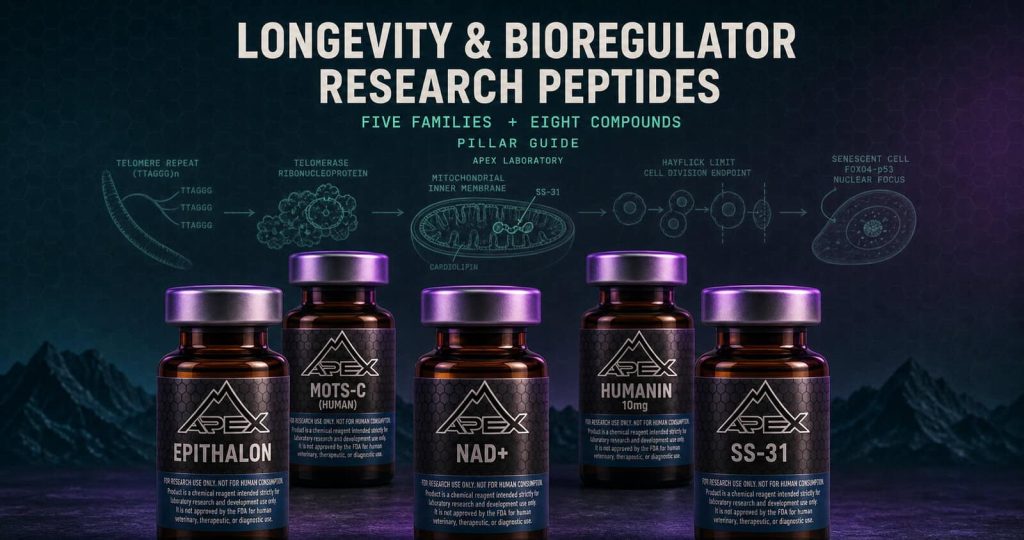
Longevity and bioregulator research peptides are short compounds studied for their effects on cellular aging mechanisms — including telomerase regulation, mitochondrial function, NAD+/sirtuin signaling, and the selective clearance of senescent cells. They include the Khavinson telomerase peptides (Epithalon, Pinealon), mitochondrial-derived peptides (Humanin, MOTS-c), and the FOXO4-DRI senolytic, each grounded in published aging-research literature.
The longevity peptide category exists because aging itself has become a tractable research target. Five distinct research traditions converge here. Telomere biology runs from Hayflick and Moorhead’s 1961 Hayflick limit through Greider and Blackburn’s 1985 telomerase discovery, recognized by the 2009 Nobel Prize in Physiology or Medicine. The Khavinson short-peptide bioregulator program at the St. Petersburg Institute of Bioregulation and Gerontology (Russian Academy of Sciences) has produced Epithalon, Pinealon, and Thymalin across five decades. Imai and Guarente’s NAD+/sirtuin pathway, with the Sinclair laboratory’s downstream sirtuin pharmacology at Harvard Medical School, defines a third tradition. Pinchas Cohen’s group at the USC Leonard Davis School of Gerontology opened the mitochondrial-derived peptide field with Humanin in 2001 and MOTS-c in 2015. The senolytic peptide program from de Keizer and Peeper at the Netherlands Cancer Institute produced FOXO4-DRI in 2017, while Hazel Szeto and Peter Schiller’s cell-permeable cationic peptide program at Cornell Weill produced SS-31. The eight Apex catalog compounds map onto these five traditions, and this guide reads them in that scientific frame.
This pillar guide indexes the eight catalog compounds against twenty-five PubMed-verified primary citations. Five mechanism families are anchored to named research lineages, and the López-Otín hallmarks of aging framework provides the integrative scaffold across which the families sit. The guide closes with a regulatory landscape section that holds all eight compounds within the research-only globally framing — none of the compounds discussed below carries FDA, EMA, or NMPA approval for any human indication.
What Counts as a “Longevity Research Peptide”?
The longevity peptide category, as Apex defines it for catalog purposes, comprises research-grade compounds whose published literature engages aging-pathway pharmacology — telomere biology, sirtuin signaling, mitochondrial-derived signaling, cellular senescence, or mitochondrial inner-membrane bioenergetics — and that are available as research reagents for in-vitro and animal-model investigation. The category is bounded by research lineage rather than by structural class. This is why the eight catalog members are not all peptides in the strict sense.
Six of the eight are unambiguously peptides: Epithalon (a four-residue tetrapeptide), Pinealon (a three-residue tripeptide), Thymalin (a multi-component thymic polypeptide preparation), Humanin (a 24-residue mitochondrial-encoded peptide), MOTS-c (a 16-residue mitochondrial-encoded peptide), FOXO4-DRI (a D-retro-inverso peptide), and SS-31 (a four-residue cell-permeable cationic peptide). NAD+ — β-nicotinamide adenine dinucleotide — is a dinucleotide cofactor, not a peptide. It is included in the catalog because it sits at the structural and mechanistic center of the sirtuin biology characterized by the Imai-Guarente-Sinclair lineage and is studied as a research reagent in the same experimental contexts as the longevity peptides themselves. FOX04-DRI carries an alpha-numerical research-compound designation rather than a trivial peptide name; both naming conventions appear in the literature.
The category is bounded against general anti-aging supplement marketing. None of the eight catalog members is a vitamin, mineral, polyphenol, herbal extract, or consumer-marketed nutraceutical. All eight are research-grade chemical reagents intended exclusively for in-vitro laboratory research. The catalog logic is “aging-pathway research tools available as Apex SKUs” — the unifying frame is mechanism-relevance to aging biology and reagent-grade material status, not commercial supplement positioning.
Longevity Research Peptides at a Glance
- The longevity peptide category exists because aging is now treated as a tractable research target; eight Apex catalog compounds map onto five distinct research traditions converging on aging-pathway pharmacology
- Five mechanism families organize the catalog: Khavinson short-peptide bioregulators (Epithalon, Pinealon, Thymalin), mitochondrial-derived peptides (Humanin, MOTS-c), the NAD+/sirtuin pathway, senolytic peptides (FOXO4-DRI), and the Szeto-Schiller mitochondrial-targeted antioxidant SS-31
- Epithalon’s telomerase-activation evidence is in vitro and in animal models from the Khavinson Russian Academy of Sciences program; published findings should not be extrapolated to human-lifespan claims
- Mitochondrial-derived peptides Humanin (2001) and MOTS-c (2015) were characterized at Pinchas Cohen’s USC Leonard Davis School of Gerontology and are encoded within mitochondrial DNA’s 16S and 12S rRNAs
- The López-Otín hallmarks of aging framework — nine hallmarks in 2013, twelve in the 2023 update — provides the integrative scaffold across which the five mechanism families sit
- All eight Apex catalog compounds are supplied as research-grade chemical reagents intended exclusively for in-vitro laboratory research; none is FDA, EMA, or NMPA approved for any human indication
Foundational Research Programs
The longevity peptide field rests on a multi-decade, multi-tradition genealogy. Five named-investigator research programs supply the scientific spine of the field, and the timeline that follows situates each program against the eight milestones connecting Hayflick’s 1961 cell-culture observation to the 2017 FOXO4-DRI senolytic peptide.
Hayflick and Moorhead at the Wistar Institute: the cellular senescence foundation (1961)
Leonard Hayflick and Paul Moorhead at the Wistar Institute reported in Experimental Cell Research in 1961 that normal human diploid cells in culture undergo a finite number of divisions — approximately fifty — before entering a non-dividing state subsequently named cellular senescence. The Hayflick limit overturned the prevailing assumption that vertebrate somatic cells in culture were intrinsically immortal, and it established the experimental foundation on which every subsequent telomere-aging research program was built.1
Greider and Blackburn at UC Berkeley: telomerase discovery (1985) and the 2009 Nobel Prize
Carol W. Greider, working with Elizabeth H. Blackburn at UC Berkeley, identified in Tetrahymena extracts a specific telomere terminal transferase activity — the enzyme later named telomerase — and reported the discovery in Cell in 1985.2 The work, together with Blackburn’s earlier characterization of telomere repeat sequences and Jack W. Szostak’s parallel structural contributions, was recognized by the 2009 Nobel Prize in Physiology or Medicine awarded to Blackburn, Greider, and Szostak. Telomerase biology is the mechanistic anchor for the Khavinson Epithalon telomerase-activation research program documented in Family 1 below.
Khavinson and Anisimov at the St. Petersburg Institute of Bioregulation and Gerontology
Vladimir Kh. Khavinson, Vyacheslav N. Anisimov, and colleagues at the St. Petersburg Institute of Bioregulation and Gerontology — part of the Russian Academy of Sciences — established the short-peptide bioregulator research program that has produced Epithalon, Pinealon, Thymalin, and the broader family of tri- and tetrapeptide research compounds across more than four decades. The program’s central scientific claim is that short peptides act as gene-expression modulators capable of restoring tissue-specific transcriptional programs in aged cells.3 Khavinson, Popovich, Linkova, Mironova, and Ilina’s 2021 systematic review in Molecules synthesizes the program’s contemporary mechanistic framing across the tetrapeptide, tripeptide, and polypeptide subfamilies.4
Imai, Guarente, and the sirtuin lineage at MIT and Harvard Medical School
Shin-ichiro Imai and Leonard Guarente at MIT reported in Nature in 2000 that Sir2 — the silent-information-regulator-2 gene in Saccharomyces cerevisiae with documented roles in transcriptional silencing and yeast longevity — encodes an NAD+-dependent histone deacetylase.5 The discovery linked cellular NAD+ status directly to chromatin regulation and longevity. The lineage continued through David A. Sinclair, who completed his postdoctoral work in the Guarente lab and now leads the sirtuin pharmacology program at Harvard Medical School. Rajman, Chwalek, and Sinclair’s 2018 Cell Metabolism review documents the in-vivo evidence base for NAD-boosting molecules in the contemporary sirtuin field.6
Cohen lab at USC Leonard Davis School of Gerontology: the mitochondrial-derived peptide field
Pinchas Cohen at the USC Leonard Davis School of Gerontology has anchored the mitochondrial-derived peptide (MDP) field across two foundational discoveries. Yuichi Hashimoto, Takako Niikura, and colleagues first reported Humanin in PNAS in 2001 — a 24-amino-acid peptide encoded within the mitochondrial 16S ribosomal RNA gene that rescues neurons from familial Alzheimer’s disease-related cell death.7 Changhan Lee, working in the Cohen lab at USC, then reported MOTS-c in Cell Metabolism in 2015 — a 16-amino-acid peptide encoded within the mitochondrial 12S rRNA gene that promotes metabolic homeostasis and reduces obesity and insulin resistance in mouse models.8 The Cohen group’s subsequent work has extended the MDP family to the SHLPs (Small Humanin-Like Peptides) characterized as age-dependent regulators of apoptosis, insulin sensitivity, and inflammation.
Peeper and de Keizer at the Netherlands Cancer Institute: FOXO4-DRI senolytic peptide (2017)
Marjolein P. Baar, Peter L.J. de Keizer, and Daniel S. Peeper at the Netherlands Cancer Institute (NKI) in Amsterdam reported in Cell in 2017 the design and characterization of FOXO4-DRI — a D-retro-inverso peptide that disrupts the interaction between FOXO4 and p53 in senescent cells, triggering targeted p53-mediated apoptosis selectively in senescent cells while sparing non-senescent cells.9 The compound is the foundational tool peptide in senolytic research and the primary catalog entry for Family 4 below.
Szeto and Schiller at Weill Cornell and Université de Montréal: SS-31 mitochondrial-targeted peptide
Hazel H. Szeto at Weill Cornell Medical College and Peter W. Schiller at the Clinical Research Institute of Montréal jointly developed the cell-permeable cationic peptide program that produced SS-31 (later named elamipretide, Bendavia, MTP-131). Szeto’s 2014 single-author British Journal of Pharmacology review synthesizes the program around SS-31’s identification as a first-in-class cardiolipin-binding peptide that selectively localizes to the mitochondrial inner membrane and protects mitochondrial bioenergetics under stress conditions.10 Stealth BioTherapeutics has conducted clinical trials of elamipretide for primary mitochondrial myopathy and other indications; SS-31 is not FDA-approved as of 2026.
-
1961
Hayflick & Moorhead establish the Hayflick limit
Leonard Hayflick and Paul Moorhead at the Wistar Institute report that normal human diploid cells in culture undergo approximately fifty divisions before entering cellular senescence — the foundation of telomere-aging biology. Hayflick & Moorhead, Exp Cell Res (1961).
-
1985
Greider & Blackburn discover telomerase in Tetrahymena
Carol Greider and Elizabeth Blackburn at UC Berkeley identify the telomere terminal transferase activity later named telomerase — work recognized in the 2009 Nobel Prize in Physiology or Medicine awarded to Blackburn, Greider, and Szostak. Greider & Blackburn, Cell (1985).
-
1991
Khavinson Epithalon program established at the St. Petersburg Institute of Bioregulation and Gerontology
Vladimir Khavinson, Vyacheslav Anisimov, and colleagues at the St. Petersburg Institute of Bioregulation and Gerontology (Russian Academy of Sciences) establish the short-peptide bioregulator research program that produces Epithalon (AEDG tetrapeptide), Pinealon (EDR tripeptide), and Thymalin across subsequent decades.
-
2000
Imai, Guarente et al. show Sir2 is an NAD+-dependent histone deacetylase
Shin-ichiro Imai and Leonard Guarente at MIT establish the mechanistic linkage between cellular NAD+ status and chromatin regulation through the silent-information-regulator-2 deacetylase activity. Imai, Armstrong, Kaeberlein, Guarente, Nature (2000).
-
2001
Hashimoto, Niikura et al. discover Humanin
Yuichi Hashimoto, Takako Niikura, and colleagues identify Humanin — a 24-amino-acid peptide encoded within the mitochondrial 16S ribosomal RNA gene — that rescues neurons from familial Alzheimer’s disease-related cell death. Foundation for the Cohen-lab MDP research program. Hashimoto et al., PNAS (2001).
-
2008
Coppé & Campisi characterize the senescence-associated secretory phenotype (SASP)
Jean-Philippe Coppé, Christopher Patil, Francis Rodier, and colleagues at the Buck Institute characterize the inflammatory secretome through which senescent cells exert non-cell-autonomous pathological effects — the rationale base for senolytic intervention. Coppé et al., PLoS Biol (2008).
-
2015
Lee, Cohen et al. discover MOTS-c at USC Leonard Davis
Changhan Lee, with senior author Pinchas Cohen at the USC Leonard Davis School of Gerontology, identifies MOTS-c — a 16-amino-acid peptide encoded within the mitochondrial 12S rRNA gene that promotes metabolic homeostasis and reduces obesity and insulin resistance in mouse models. Lee et al., Cell Metab (2015).
-
2017
Baar, de Keizer, Peeper publish FOXO4-DRI senolytic peptide
Marjolein Baar, Peter de Keizer, and Daniel Peeper at the Netherlands Cancer Institute (NKI) in Amsterdam describe the D-retro-inverso peptide that disrupts FOXO4-p53 interaction in senescent cells, triggering targeted apoptosis selectively in senescent cells. Baar et al., Cell (2017).
Family 1 — Telomerase / Khavinson Short Peptides (Epithalon, Pinealon, Thymalin)
The first compound family in the longevity catalog comprises three Khavinson-program short peptides developed at the St. Petersburg Institute of Bioregulation and Gerontology over four decades. The unifying mechanistic frame across the family is short-peptide gene-expression modulation: tri- and tetrapeptide bioregulators are proposed to act as direct transcriptional modulators capable of restoring tissue-specific gene-expression patterns characteristic of younger physiology. The three catalog members occupy distinct positions within the program’s tissue-specific bioregulator portfolio.
Epithalon — AEDG tetrapeptide and the telomerase-activation research literature
Epithalon — also indexed in PubMed as Epitalon, both names referring to the same alanyl-glutamyl-aspartyl-glycine (AEDG) tetrapeptide — is the foundational catalog member of Family 1. The peptide was developed in the Khavinson program as a synthetic short-peptide analog of the Epithalamin pineal extract and characterized across multiple in-vitro and in-vivo studies. Khavinson, Bondarev, and Butyugov reported in Bulletin of Experimental Biology and Medicine in 2003 that Epithalon induces telomerase activity and produces telomere elongation in human somatic cells in vitro.11 The 2004 companion paper by the same group, also in Bull Exp Biol Med, extended this characterization to demonstrate that the tetrapeptide enables human somatic cells to overcome the Hayflick division limit through telomerase induction.12
The published telomerase-activation evidence for Epithalon is in vitro and animal-model. Anisimov, Khavinson, and colleagues’ 2001 Russian Physiological Journal paper documented pineal peptide effects on biological age parameters and lifespan in mice.13 These results constitute the program’s in-vivo evidence base. They should not be extrapolated to human-lifespan claims; published human telomerase-activation or human-lifespan-extension data sufficient to support such claims does not exist in the peer-reviewed literature, and Apex’s editorial framing for Epithalon holds the in-vitro and animal-model qualification at every reference. The dedicated Epithalon research guide covers the per-compound pharmacology, the AEDG sequence chemistry, and the published-literature evidence base in greater depth.
Pinealon — EDR tripeptide pineal-CNS bioregulator
Pinealon is the Khavinson tripeptide bioregulator with the sequence Glu-Asp-Arg (EDR), positioned within the program as the pineal-CNS member of the short-peptide family. Khavinson, Linkova, Kozhevnikova, and Trofimova reported in Molecules in 2020 on the EDR peptide’s possible mechanism of gene expression and protein synthesis regulation in the context of Alzheimer’s disease pathology.14 The CNS-research framing positions Pinealon as a cross-cluster bridge to the broader CNS research peptides pillar; the dedicated PE-22-28 and Pinealon research guide covering both pineal-CNS peptides at greater depth is forthcoming. The product-side reference is Pinealon 10mg.
Thymalin — thymic polypeptide bioregulator preparation
Thymalin is a polypeptide preparation derived from the Khavinson program’s thymic-bioregulator subfamily. Unlike Epithalon and Pinealon, which are single-sequence synthetic peptides, Thymalin is a multi-component preparation distinct from the synthetic Thymogen tripeptide and from Thymosin Alpha 1. Khavinson, Linkova, Kvetnoy, Polyakova, Drobintseva, and Kvetnaia reported in Bulletin of Experimental Biology and Medicine in 2021 on Thymalin’s activation of differentiation in human hematopoietic stem cells.15 The compound bridges Khavinson short-peptide bioregulator framing into the immunosenescence and thymus-axis research literature. Thymalin has historical Russian Federation regulatory recognition as a thymic immunomodulator preparation; Apex’s research-grade Thymalin is supplied as a chemical research reagent intended exclusively for in-vitro laboratory research, distinct from any approved clinical formulation.
Family 2 — Mitochondrial-Derived Peptides (Humanin, MOTS-c)
The second compound family comprises two mitochondrial-derived peptides discovered fourteen years apart and characterized within the Pinchas Cohen lab at the USC Leonard Davis School of Gerontology. The defining feature of the MDP family is that the peptides are encoded within mitochondrial DNA — within the 16S and 12S ribosomal RNA gene sequences of the mitochondrial genome, not within nuclear DNA — and translated through mechanisms that remain partially characterized. This biology positions Humanin and MOTS-c as a structurally distinct class of bioactive peptides with cytoprotective and metabolic-signaling roles.
Humanin — Hashimoto and Niikura 2001 discovery
Humanin is a 24-amino-acid peptide encoded within an open reading frame contained in the mitochondrial 16S ribosomal RNA gene. Yuichi Hashimoto, Takako Niikura, Hirohisa Tajima, Takashi Yasukawa, Hiroaki Sudo, Yuichi Ito, and colleagues reported the discovery in PNAS in 2001 in the context of a screen for factors that rescue neurons from cell death induced by familial Alzheimer’s disease genes and amyloid-beta peptides.7 The discovery work was conducted at Keio University in collaboration with Cohen’s group. Subsequent characterization has extended Humanin’s biology beyond neuroprotection into metabolic and cytoprotective signaling contexts. The forthcoming Humanin and MOTS-c research guide will cover the discovery literature, the receptor and downstream-signaling characterization, and the metabolic-signaling context in greater depth.
MOTS-c — Lee and Cohen 2015 discovery
MOTS-c — Mitochondrial Open reading frame of the Twelve S rRNA-c — is a 16-amino-acid peptide encoded within the mitochondrial 12S rRNA gene. Changhan Lee, with senior author Pinchas Cohen, reported the discovery in Cell Metabolism in 2015, demonstrating that MOTS-c promotes metabolic homeostasis and reduces obesity and insulin resistance in mouse models.8 Lee, Kim, and Cohen’s 2016 Free Radical Biology and Medicine review extended the characterization to MOTS-c’s role in muscle and fat metabolism, providing the first comprehensive Cohen-lab synthesis of the peptide’s biology after the discovery report.16 Apex’s MOTS-c (Human) catalog entry is the research-grade preparation of the human mitochondrial-encoded peptide sequence.
The expanding MDP family — SHLPs and the broader mitochondrial-encoded peptide landscape
The Cohen lab’s work has extended the MDP family beyond Humanin and MOTS-c. Cobb, Lee, Xiao, Yen, Wong, Nakamura, and colleagues reported in Aging (Albany NY) in 2016 the characterization of the SHLPs — Small Humanin-Like Peptides 1 through 6 — as naturally occurring mitochondrial-derived peptides functioning as age-dependent regulators of apoptosis, insulin sensitivity, and inflammatory markers.17 The SHLP literature establishes the framing that Humanin and MOTS-c are members of a broader mitochondrial-encoded peptide family that the Cohen group has been progressively characterizing. The forthcoming dedicated Humanin and MOTS-c research guide covers the per-compound deep-dive treatment beyond this pillar’s family-level coverage.
Family 3 — NAD+ / Sirtuin Pathway (NAD+)
The third compound family contains a single catalog member — NAD+ (β-nicotinamide adenine dinucleotide) — included not as a peptide but as the substrate-tier reagent at the structural and mechanistic center of the sirtuin biology characterized by the Imai-Guarente-Sinclair lineage. The catalog rationale is that NAD+ is studied alongside the longevity peptide family in the same experimental contexts and that the sirtuin-pathway research literature is incoherent without explicit NAD+ representation.
Sir2 to SIRT1 — the NAD+-dependent deacetylase mechanism
Imai, Armstrong, Kaeberlein, and Guarente at MIT demonstrated in Nature in 2000 that Sir2 — the yeast silent-information-regulator-2 gene previously characterized for transcriptional silencing and longevity-promoting activity — encodes an NAD+-dependent histone deacetylase, establishing the mechanistic linkage between cellular NAD+ status and chromatin regulation.5 Vaziri, Dessain, Ng Eaton, Imai, Frye, Pandita, and colleagues extended the mechanism to mammalian biology in Cell in 2001, demonstrating that the human SIRT1 (hSir2) homolog functions as an NAD+-dependent p53 deacetylase — bridging the yeast Sir2 mechanism into mammalian senescence and cancer pathway intersections.18 The Imai-Guarente-Vaziri-Sinclair lineage is the canonical scientific foundation for the contemporary NAD+/sirtuin pharmacology research program.
NAD+ as a research reagent — substrate-tier catalog rationale
Rajman, Chwalek, and Sinclair’s 2018 Cell Metabolism review covers the in-vivo evidence base for NAD-boosting molecules — including NAD+ precursors such as nicotinamide mononucleotide (NMN) and nicotinamide riboside (NR) — and provides the contemporary Sinclair-lab synthesis of the rationale for NAD+-targeting interventions in age-related disease research.6 Apex supplies research-grade NAD+ as a substrate-tier reagent for sirtuin-pathway in-vitro and animal-model research; our companion NAD+ research reagent guide at /nad-plus-research-guide/ covers the per-compound deep-dive treatment of NAD+ as a research reagent. NAD+ is distinct in regulatory framing from the consumer-marketed NAD+ infusion preparations available in some jurisdictions: those preparations are typically compounded products, not FDA-approved drugs, and Apex’s research-grade NAD+ is a chemical research reagent intended exclusively for in-vitro laboratory research.
Family 4 — Senolytic Peptides (FOXO4-DRI)
The fourth compound family is anchored by FOXO4-DRI, the foundational tool peptide in senolytic research. The senolytic field — the experimental strategy of selectively eliminating senescent cells from tissue to delay or reverse aging-associated pathology — has expanded substantially across the last fifteen years. FOXO4-DRI sits within this broader field as the most widely characterized peptide-based senolytic and as the primary catalog entry for senolytic research at the peptide level.
Senescence and SASP — the Coppé and Campisi foundation
Jean-Philippe Coppé, Christopher K. Patil, Francis Rodier, Yu Sun, Denise P. Muñoz, Joshua Goldstein, and colleagues reported in PLoS Biology in 2008 the foundational characterization of the senescence-associated secretory phenotype (SASP) — the inflammatory secretome through which senescent cells exert non-cell-autonomous pathological effects on surrounding tissue.19 The Coppé / Campisi work, conducted at the Buck Institute, established the rationale for senolytic intervention: senescent cells are not merely metabolically inert dropouts from the dividing population but active contributors to age-associated tissue dysfunction through secreted pro-inflammatory cytokines, chemokines, and matrix-remodeling enzymes.
INK-ATTAC and the senolytic-clearance proof-of-concept
Darren J. Baker, Tobias Wijshake, Tamar Tchkonia, Nathan K. LeBrasseur, Bennett G. Childs, Bart van de Sluis, and colleagues at the Mayo Clinic reported in Nature in 2011 the landmark INK-ATTAC paper demonstrating that genetic clearance of p16Ink4a-positive senescent cells delays aging-associated disorders in a mouse model.20 The 2016 follow-up by the same group, also in Nature, extended the demonstration to naturally occurring (not just induced) p16Ink4a-positive senescent cells, showing that they shorten healthy lifespan in mice.21 The two Baker / van Deursen papers are the canonical proof-of-concept references for the broader senolytic-drug field. Tchkonia, Palmer, and Kirkland’s 2021 Journal of Clinical Endocrinology and Metabolism review covers the Mayo Clinic Kogod Center on Aging program and the contemporary senotherapeutics landscape through 2021.22
FOXO4-DRI — the D-retro-inverso senolytic peptide
Marjolein P. Baar, Renata M.C. Brandt, Diana A. Putavet, Julian D.D. Klein, Kasper W.J. Derks, Benjamin R.M. Bourgeois, and colleagues at the Netherlands Cancer Institute (NKI) in Amsterdam — with Peter L.J. de Keizer and Daniel S. Peeper as the senior research-program anchors — reported in Cell in 2017 the design and biological characterization of FOXO4-DRI.9 The compound is a D-retro-inverso peptide engineered to disrupt the FOXO4-p53 interaction in senescent cells. In senescent cells, FOXO4 sequesters p53 in nuclear foci, preventing p53-mediated apoptosis that would otherwise clear the senescent population. FOXO4-DRI competitively disrupts this interaction, releasing p53 and triggering targeted apoptosis selectively in senescent cells while sparing non-senescent cells.
The 2017 paper documented restoration of tissue homeostasis in chemotoxicity models and in aged mouse tissues. FOXO4-DRI is a research tool compound — it is not in clinical development as an approved therapeutic and has no FDA, EMA, or NMPA regulatory approval anywhere globally. Apex catalogs the compound under the alpha-numerical research-compound designation FOX04-DRI; the forthcoming FOXO4-DRI research guide at /foxo4-dri-research-guide/ covers the per-compound mechanism, the D-retro-inverso chemistry, and the senolytic-research context in greater depth.
Family 5 — Mitochondrial-Targeted Antioxidants (SS-31 / Elamipretide)
The fifth and final compound family contains a single catalog member — SS-31, also known as elamipretide, Bendavia, or MTP-131. SS-31 is the lead compound from the Szeto-Schiller cell-permeable cationic peptide program developed jointly by Hazel H. Szeto at Weill Cornell Medical College and Peter W. Schiller at the Clinical Research Institute of Montréal. The compound’s defining property is selective localization to the mitochondrial inner membrane through cardiolipin binding — a mechanism distinct from any other compound in the catalog.
Cardiolipin binding and mitochondrial inner-membrane targeting
SS-31 is a four-residue cationic tetrapeptide with the sequence D-Arg-2′,6′-dimethyl-Tyr-Lys-Phe-NH₂. The combination of alternating aromatic and basic residues with a 2′,6′-dimethyltyrosine modification allows the peptide to cross the plasma membrane and the outer mitochondrial membrane and to bind selectively to cardiolipin — the signature phospholipid of the mitochondrial inner membrane. Hazel Szeto’s 2014 single-author British Journal of Pharmacology review establishes SS-31 as a first-in-class cardiolipin-protective compound capable of restoring mitochondrial bioenergetics in models of oxidative stress and ischemia-reperfusion injury.10
SS-31 in ischemic and oxidative-stress research
Birk, Liu, Soong, Mills, Singh, Warren, and colleagues — with Szeto as the program anchor — reported in the Journal of the American Society of Nephrology in 2013 the mechanistic characterization of SS-31’s interaction with cardiolipin in ischemic mitochondria.23 The work documented that SS-31 binds cardiolipin in the mitochondrial inner membrane and re-energizes mitochondria following ischemic insult by stabilizing electron transport chain function. The cardiolipin-binding mechanism is the load-bearing pharmacological basis for SS-31’s research applications in ischemia, oxidative stress, and mitochondrial bioenergetic dysfunction.
Stealth BioTherapeutics has conducted clinical trials of elamipretide (the development-program designation for SS-31) for primary mitochondrial myopathy, Barth syndrome, and other indications. As of 2026, SS-31 / elamipretide is not FDA-approved. Apex’s research-grade SS-31 is a chemical research reagent intended exclusively for in-vitro laboratory research and is distinct from any clinical-trial elamipretide formulations supplied by Stealth. The forthcoming SS-31 / elamipretide research guide at /ss-31-elamipretide-research-guide/ covers the per-compound development-program detail, the cardiolipin-binding chemistry, and the trial-program literature in greater depth.
Mechanism Family Map — Longevity Research Peptides
| Family | Pathway target | Representative compound | Research context | Catalog availability |
|---|---|---|---|---|
| 1 — Telomerase / Khavinson Short Peptides | Telomerase activation; gene-expression modulation | Epithalon (AEDG tetrapeptide) | Khavinson 2003 telomerase induction in vitro (Bull Exp Biol Med); Anisimov 2001 mice lifespan parameters (Russ Fiziol Zh) | Epithalon / Pinealon 10mg / Thymalin 10mg |
| 2 — Mitochondrial-Derived Peptides | mtDNA-encoded short ORFs; cytoprotective + metabolic signaling | MOTS-c (Human) / Humanin | Cohen lab USC Leonard Davis: Humanin 2001 PNAS (Hashimoto / Niikura); MOTS-c 2015 Cell Metab (Lee / Cohen) | MOTS-c (Human) / Humanin 10mg |
| 3 — NAD+ / Sirtuin Pathway | NAD+-dependent sirtuin deacetylase substrate | NAD+ | Imai / Guarente Sir2 (Nature 2000); Vaziri SIRT1-p53 (Cell 2001); Sinclair NAD-boosting review (Cell Metab 2018) | NAD+ |
| 4 — Senolytic Peptides | FOXO4-p53 interaction disruption in senescent cells | FOXO4-DRI (FOX04-DRI) | Baar / de Keizer / Peeper 2017 Cell, NKI Amsterdam; Tchkonia / Kirkland 2021 senotherapeutics review | FOX04-DRI |
| 5 — Mitochondrial-Targeted Antioxidants | Cardiolipin binding at mitochondrial inner membrane | SS-31 (Elamipretide) | Szeto 2014 Br J Pharmacol cardiolipin-protective review; Birk / Szeto 2013 J Am Soc Nephrol ischemic re-energization | SS-31 |
The mechanism family map indexes the five families along their pathway-engagement points. Rows trace the catalog from telomere biology and Khavinson-program short peptides (Family 1) through mitochondrial-derived signaling peptides (Family 2), the NAD+/sirtuin pathway (Family 3), senolytic peptide design (Family 4), and mitochondrial-targeted bioenergetic-protective peptides (Family 5). The López-Otín hallmarks-of-aging framework synthesized in the next section provides the integrative scaffold across which all five families sit.
Reading the Aging Research Landscape
The five mechanism families above do not exist in isolation. Aging research has organized around a small number of integrative frameworks across the last fifteen years, and the framework that has most decisively shaped contemporary aging research is the hallmarks of aging synthesis from López-Otín, Blasco, Partridge, Serrano, and Kroemer.
The original 2013 Cell paper proposed nine integrative hallmarks: genomic instability, telomere attrition, epigenetic alterations, loss of proteostasis, deregulated nutrient sensing, mitochondrial dysfunction, cellular senescence, stem cell exhaustion, and altered intercellular communication.24 The 2023 update — published a decade later in the same journal — expanded the framework to twelve hallmarks, adding disabled macroautophagy, chronic inflammation, and dysbiosis to the original nine.25 The expansion documents the field’s continued centrality of the hallmarks framework and its capacity to absorb additional mechanistic categories as the underlying biology has become better characterized.
The five Apex catalog families map onto subsets of the López-Otín hallmarks. Family 1 (Khavinson short peptides, with Epithalon’s telomerase-activation literature) engages the telomere attrition hallmark. Family 2 (mitochondrial-derived peptides) engages the mitochondrial dysfunction and altered intercellular communication hallmarks — Humanin and MOTS-c are mitochondrial-encoded signaling peptides that bridge mitochondrial biology with systemic metabolic signaling. Family 3 (NAD+/sirtuin pathway) engages the deregulated nutrient sensing and epigenetic alterations hallmarks — sirtuin-mediated histone deacetylation links cellular NAD+ status to chromatin regulation. Family 4 (FOXO4-DRI senolytic peptide) engages the cellular senescence hallmark directly — FOXO4-DRI is the prototypical senolytic peptide tool compound. Family 5 (SS-31) engages the mitochondrial dysfunction hallmark from the bioenergetic-protection angle.
The cluster bridges to two adjacent Apex pillars. The deregulated nutrient sensing hallmark is the connective tissue between the longevity catalog and the GLP-1 / metabolic research peptides pillar: GLP-1 receptor agonists and the broader incretin family engage nutrient-sensing biology that overlaps the sirtuin and mTOR signaling axes. The somatotrophic-axis decline characteristic of aging biology is the connective tissue to the growth hormone axis research peptides pillar: hypothalamic-pituitary-IGF-1 axis attenuation is one of the hallmarks-of-aging-adjacent biological transitions that the GH-axis catalog research literature engages. The CNS research peptides pillar is the third lateral cluster bridge — Pinealon’s pineal-CNS framing in Family 1 above is the most direct cross-cluster linkage. The tissue repair research peptides pillar rounds out the lateral pillar set, and the Cerebrolysin research guide documents a compound with peptide-based neurotrophic mechanism adjacent to several of these pillar contexts.
Reading the Regulatory Landscape
All eight catalog compounds are research-only globally — no FDA, EMA, NMPA, or other regulatory approval anywhere — and each carries a per-compound regulatory framing that researchers should hold in view when designing experimental work.
Epithalon, Pinealon (10mg), Humanin (10mg), MOTS-c (Human), NAD+, and FOX04-DRI are research-only globally with no approval anywhere. Apex supplies all six as chemical research reagents intended exclusively for in-vitro laboratory research.
Thymalin (10mg) carries a more nuanced regulatory history. Thymalin has historical Russian Federation regulatory recognition as a thymic immunomodulator polypeptide preparation administered through Russian Ministry of Health channels; the compound has no FDA, EMA, NMPA, or other approval outside the Russian Federation. Apex’s research-grade Thymalin is supplied as a chemical research reagent intended exclusively for in-vitro laboratory research and is distinct from any approved Russian Federation clinical formulation. Researchers operating outside the Russian Federation should treat the catalog Thymalin as a research-only compound under standard research-grade reagent framing.
SS-31 / elamipretide carries the most active development history of the eight catalog members. Stealth BioTherapeutics has conducted clinical trials of elamipretide for primary mitochondrial myopathy, Barth syndrome, and additional indications across the last decade. SS-31 / elamipretide is not FDA-approved as of 2026. Apex’s research-grade SS-31 is a chemical research reagent intended exclusively for in-vitro laboratory research and is distinct from any clinical-trial elamipretide formulations supplied through the Stealth program.
FOX04-DRI specifically is a research tool compound with no clinical-development program under any sponsor. The compound was developed at the Netherlands Cancer Institute as a research-grade D-retro-inverso peptide for senolytic biology investigation; no implication of ongoing therapeutic development under any sponsor applies.
The regulatory framing across the eight compounds reflects the Cerebrolysin-precedent template — per-compound clarity, per-jurisdiction precision where relevant, and explicit distinction between Apex’s research-grade chemical reagent material and any approved clinical formulation. None of the eight compounds is intended for human use, veterinary use, diagnostic application, or therapeutic administration.
Sourcing Research-Grade Longevity Peptides
Researchers sourcing longevity peptides for laboratory work navigate a market with substantial quality variance. Apex Laboratory’s research-grade longevity catalog spans the five mechanism families documented above. The flagship trio — Epithalon, NAD+, and SS-31 — represents three of the five families (Khavinson short peptides, NAD+/sirtuin pathway, and mitochondrial-targeted antioxidants), and the broader catalog includes the remaining family members (Pinealon 10mg, Thymalin 10mg, Humanin 10mg, MOTS-c (Human), and FOX04-DRI). The full Apex Research Library indexes this pillar alongside lateral pillars on tissue repair, GLP-1 / metabolic, growth hormone axis, and CNS research peptides. The editorial standards and lab-verified hubs document the COA, HPLC, and mass-spectrometry verification framework that Apex’s research-grade discipline rests on.
Procedural references for laboratory use include the reconstitution guide, the peptide storage guide, the how to read a COA guide, the HPLC purity testing guide, and the peptide dosing calculator guide. The Apex Lab Methods cluster — including the vendor evaluation guide, research grade vs pharmaceutical grade peptides, the 99% purity research guide, and the mass spectrometry peptide identification guide — provides the analytical-quality documentation that research-grade longevity peptide work calls on.
Flagship trio — research-context catalog presentation
Catalog Longevity Research Peptides
Epithalon
AEDG tetrapeptide from the Khavinson short-peptide bioregulator program. Foundational Family-1 catalog member with in-vitro telomerase-activation research literature; supplied as a research-grade chemical reagent for in-vitro laboratory research.
View research-grade EpithalonNAD+
Substrate-tier reagent at the structural and mechanistic center of sirtuin biology. Bridges metabolic and longevity research clusters; the Imai-Guarente-Sinclair lineage substrate for in-vitro and animal-model NAD+/sirtuin pathway research.
View research-grade NAD+SS-31
Szeto-Schiller cell-permeable cardiolipin-binding cationic tetrapeptide. Selectively localizes to the mitochondrial inner membrane in research models; distinct from Stealth BioTherapeutics’ clinical-trial elamipretide formulations.
View research-grade SS-31Frequently Asked Questions
What are longevity research peptides?
Longevity research peptides are research-grade compounds engaging aging-pathway pharmacology — telomere biology, sirtuin signaling, mitochondrial-derived signaling, cellular senescence, or mitochondrial bioenergetics. The Apex catalog covers eight such compounds across five mechanism families: Khavinson short-peptide bioregulators, mitochondrial-derived peptides, the NAD+/sirtuin pathway, senolytic peptides, and the Szeto-Schiller mitochondrial-targeted antioxidant SS-31.
What is Epithalon, and is it FDA-approved?
Epithalon — also indexed as Epitalon — is the AEDG tetrapeptide developed in Vladimir Khavinson’s program at the St. Petersburg Institute of Bioregulation and Gerontology. Published telomerase-activation evidence is in vitro and animal-model only. The compound is not FDA-, EMA-, or NMPA-approved for any human indication and is supplied as a research-grade reagent.
What are mitochondrial-derived peptides (MDPs)?
Mitochondrial-derived peptides are short bioactive peptides encoded within mitochondrial DNA — within open reading frames in the 16S and 12S ribosomal RNA gene sequences. Humanin (24 amino acids, 2001) and MOTS-c (16 amino acids, 2015) are the canonical members, both characterized in Pinchas Cohen’s group at the USC Leonard Davis School of Gerontology.
Are senolytic peptides FDA-approved?
No. As of 2026, no senolytic peptide is FDA-approved for any human indication. FOXO4-DRI — the D-retro-inverso peptide reported by Baar, de Keizer, and Peeper in Cell in 2017 from the Netherlands Cancer Institute — is a research tool compound with no clinical-development program and no regulatory approval anywhere globally.
Is NAD+ a peptide?
No. NAD+ — β-nicotinamide adenine dinucleotide — is a dinucleotide cofactor formed from nicotinamide and adenine joined through a sugar-phosphate backbone. Apex catalogs NAD+ within the longevity research family because it sits at the structural and mechanistic center of sirtuin biology characterized by the Imai-Guarente-Sinclair lineage and is studied alongside the longevity peptides themselves.
What is the Hayflick limit?
The Hayflick limit — characterized by Leonard Hayflick and Paul Moorhead in Experimental Cell Research in 1961 — is the observation that normal human diploid cells in culture undergo a finite number of divisions, approximately fifty, before entering a non-dividing state later named cellular senescence. The finding established the experimental foundation for telomere-aging biology.
What are the hallmarks of aging?
The hallmarks of aging are a synthetic framework introduced by López-Otín, Blasco, Partridge, Serrano, and Kroemer in Cell in 2013, organizing aging biology into nine integrative categories: genomic instability, telomere attrition, epigenetic alterations, proteostasis loss, deregulated nutrient sensing, mitochondrial dysfunction, cellular senescence, stem cell exhaustion, altered intercellular communication. The 2023 update expanded to twelve hallmarks.
Continue Your Research
Researchers continuing into per-compound depth will find dedicated guides for the foundational Family 1 catalog member, alongside lateral pillar references that situate the longevity cluster within the broader Apex research-content architecture. Several down-cluster guides covering the remaining catalog compounds are forthcoming and are referenced below as plain-text URLs until those guides publish.
- Epithalon Research Guide — the foundational AEDG tetrapeptide and the Khavinson telomerase-activation research literature
- Tissue Repair Research Peptides Pillar — the lateral cluster covering BPC-157, TB-500, GHK-Cu, and the broader tissue-recovery catalog
- GLP-1 / Metabolic Research Peptides Pillar — the lateral cluster bridging nutrient-sensing aging biology to incretin pharmacology
- Growth Hormone Axis Research Peptides Pillar — the lateral cluster covering somatotrophic axis research peptides
- CNS Research Peptides Pillar — the lateral cluster covering the broader CNS research-peptide catalog (Pinealon’s pineal-CNS framing in this guide cross-references this pillar)
- Cerebrolysin Research Guide — the related neurotrophic-peptide research compound covered as a standalone Tier 1 lateral entry
- Peptide Vendor Evaluation Guide — the analytical-quality framework for sourcing research-grade peptides
- Research-Grade vs Pharmaceutical-Grade Peptides — the regulatory and analytical distinction relevant to all eight catalog compounds
- ≥99% Purity Standard Guide — the Apex analytical purity standard documentation
- Mass Spectrometry Peptide Identification Guide — the MS-based identity verification methodology
- How to Reconstitute Peptides — the procedural reconstitution protocol
- Peptide Storage Guide — the storage-condition reference for research-grade peptides
- HPLC Testing Peptide Purity Guide — the HPLC-based purity verification methodology
- How to Read a COA Guide — the certificate-of-analysis interpretation reference
- Peptide Dosing Calculator Guide — the research-context reconstitution-dosing calculation reference
- Apex Research Library — the indexed catalog of all Apex research guides, organized by research focus and tier
- NAD+ Research Guide
- BPC-157 Research Guide
- GHK-Cu Research Guide
- TB-500 (Thymosin Beta-4) Research Guide
The forthcoming NAD+ research reagent guide at /nad-plus-research-guide/ publishes simultaneously with this pillar and covers the per-compound deep-dive treatment of NAD+ as a sirtuin-pathway research reagent. Additional forthcoming guides cover Humanin and MOTS-c at /humanin-mots-c-research-guide/, FOXO4-DRI at /foxo4-dri-research-guide/, and SS-31 / elamipretide at /ss-31-elamipretide-research-guide/. The cross-cluster Tier 3 comparison Epithalon vs MOTS-c at /epithalon-vs-mots-c/ is also forthcoming and will index against this pillar’s Family 1 and Family 2 treatments.
Research Use Disclaimer
This article is provided for educational and research reference purposes only. The eight longevity research peptides covered in this guide — Epithalon, Pinealon (10mg), Thymalin (10mg), Humanin (10mg), MOTS-c (Human), NAD+, FOX04-DRI, and SS-31 — are supplied by Apex Laboratory as research-grade chemical reagents intended exclusively for in-vitro laboratory research. None of the eight compounds is FDA-, EMA-, NMPA-, or otherwise regulatory-approved for any human indication anywhere globally. Thymalin (10mg) has historical Russian Federation regulatory recognition as a thymic immunomodulator polypeptide preparation; Apex’s research-grade Thymalin is a chemical research reagent intended exclusively for in-vitro laboratory research and is distinct from any approved Russian Federation clinical formulation. SS-31 / elamipretide has been the subject of clinical trials conducted by Stealth BioTherapeutics for primary mitochondrial myopathy and other indications; SS-31 / elamipretide is not FDA-approved as of 2026, and Apex’s research-grade SS-31 is a chemical research reagent intended exclusively for in-vitro laboratory research and is distinct from any clinical-trial elamipretide formulations. FOX04-DRI is a research tool compound with no clinical-development program under any sponsor, and no implication of ongoing therapeutic development under any sponsor applies. Telomerase-activation claims associated with Epithalon are derived from in vitro and animal-model published literature and are not extrapolable to human-lifespan claims. None of the eight catalog products is intended for human or veterinary use, diagnostic application, or therapeutic administration.