Epithalon (also written Epitalon) is a synthetic tetrapeptide, Ala-Glu-Asp-Gly (AEDG), modeled on a peptide of the pineal gland and developed by Vladimir Khavinson as a short peptide bioregulator. In cell-culture and animal research it is studied chiefly for activation of telomerase and telomere elongation, regulation of the pineal melatonin rhythm, and effects on lifespan and age-related markers in model organisms.
Epithalon is among the most discussed — and most singular — peptides in longevity research. It is a tetrapeptide of just four amino acids, Ala-Glu-Asp-Gly, synthesized as a defined analog of the natural pineal regulator after which it is modeled.[1][2] Its research record is unusually concentrated: a large fraction of the published work originates with Vladimir Khavinson and colleagues at the St. Petersburg Institute of Bioregulation and Gerontology, who developed the broader class of short peptide bioregulators to which Epithalon belongs.[3] That concentration is both the literature’s strength — a coherent, decades-long program — and its principal limitation, since independent replication of the headline findings remains limited.
This guide covers Epithalon‘s molecular identity, the Khavinson bioregulator program it comes from, its reported telomerase, gene-expression, and pineal mechanisms, the animal lifespan and oncostatic literature, and how it sits within the Apex longevity bioregulator research cluster of the Apex Research Library. Every factual claim is referenced to the primary literature, and Epithalon is supplied strictly as a research-grade chemical reagent for in-vitro and preclinical investigation — not a drug, supplement, or therapy for human or veterinary use.
Epithalon at a Glance
- Epithalon (Epitalon) is the tetrapeptide Ala-Glu-Asp-Gly (AEDG); CAS 307297-39-8, MW 390.35 g/mol, formula C14H22N4O9 (PubChem CID 219042).
- It is a synthetic short peptide bioregulator modeled on the natural pineal peptide complex, developed within Vladimir Khavinson’s program.
- Its best-known reported activity is activation of telomerase and elongation of telomeres in cultured human cells, extending their replicative lifespan in vitro.
- It is reported to bind DNA directly and modulate gene expression, and to normalize pineal melatonin and circadian rhythms in animal models.
- Animal studies report increases in mean and maximum lifespan in Drosophila, rats, and tumor-prone mice; much of this evidence comes from the originating research group, with limited independent replication.
- Epithalon is not FDA-approved; Apex supplies it strictly as a ≥99% (HPLC + MS verified) research reagent for in-vitro and preclinical use only.
Epithalon (Epitalon, AEDG)
What Is Epithalon? Molecular Identity

Epithalon (AEDG) structure. The tetrapeptide Ala-Glu-Asp-Gly. Structure image: PubChem CID 219042, U.S. National Library of Medicine (public domain).
Epithalon is the tetrapeptide Ala-Glu-Asp-Gly — four amino acids, molecular weight 390.35 g/mol, formula C14H22N4O9, CAS number 307297-39-8 (PubChem CID 219042). It is a synthetic peptide bioregulator designed to reproduce the activity of a natural peptide of the pineal gland; the AEDG sequence was directly detected within the pineal (epiphyseal) polypeptide complex by mass spectrometry, confirming its biological provenance rather than a purely synthetic origin.[1] An independent review from the Medical University of Warsaw confirms Epitalon as the AEDG tetrapeptide and situates it among synthetic peptides studied for antioxidant and anti-aging activity.[2]
Discovery and the Khavinson Bioregulator Program
Epithalon did not emerge alone but as one product of a systematic program. Khavinson and colleagues developed a family of ultrashort peptide bioregulators — including Epithalon, Vilon, Livagen, and Cortagen — each modeled on a tissue-specific natural peptide and each reported to produce tissue-specific regulatory effects.[3][4] A central hypothesis of the program is that these very short peptides can penetrate the cell and nuclear membranes and act epigenetically, engaging gene expression directly.[5] Epithalon is the pineal/gerontology member of this family, which is why its research clusters around aging, the pineal gland, and the genome.
Mechanism of Action
Three mechanistic threads dominate the Epithalon literature: telomerase activation, direct DNA binding and gene regulation, and pineal/melatonin modulation. They are presented here with their primary sources and with explicit note of where the evidence is strong and where it is contested.
Telomerase induction, direct DNA binding, and pineal regulation
In cultured human cells Epithalon is reported to induce expression of the telomerase catalytic subunit (hTERT) and telomerase activity, elongating telomeres and extending replicative lifespan. Biophysical work describes the tetrapeptide binding DNA in the major groove like a small transcription factor and modulating gene expression. In animal models it normalizes the pineal melatonin rhythm. These mechanisms come substantially from one research program; an independent study found no significant melatonin effect, and that counterpoint is retained below. All findings are from cell and animal research.
Telomerase Activation and Telomere Elongation
The signature claim for Epithalon is telomerase induction. Khavinson and colleagues reported that the AEDG peptide induces expression of the telomerase catalytic subunit and telomerase enzymatic activity in human somatic cells,[6] and in a subsequent study reported that it elongates telomeres in aging human fetal pulmonary fibroblasts and extends their replicative lifespan beyond the usual Hayflick limit in culture.[7] These are in-vitro findings in cultured human cells; they are the basis of Epithalon’s reputation as a “telomerase peptide” and should be read as cell-culture results, not as demonstrated effects in any organism.
DNA Binding and Gene Expression
A complementary mechanism is direct interaction with DNA. Khavinson and colleagues reported that the tetrapeptide binds DNA in the major groove in the manner of a transcription factor, with a specific recognized base-pair sequence,[8] and earlier identified candidate nucleotide binding sites in gene-promoter regions.[9] Downstream, AEDG has been reported to upregulate neuronal-differentiation genes and protein synthesis in human stem cells,[10] and a DNA-microarray screen of more than 15,000 clones found Epithalon specifically modulated the expression of a defined subset of genes in mouse heart tissue.[11] Molecular-docking analyses have been used to argue these ultrashort peptides can be transported into the nucleus to act at this level.[12]
Pineal and Melatonin Regulation (With a Counterpoint)
Consistent with its pineal modeling, Epithalon has been reported to influence melatonin and circadian rhythms. In old female rhesus monkeys it stimulated evening melatonin production and normalized circadian cortisol,[13] and human work reported that the pineal preparation and synthetic Epitalon restored nocturnal melatonin release and the melatonin rhythm in older subjects.[14] Structural studies reported enhanced pineal functional activity at the ultrastructural level.[15] Honesty requires the counterpoint: an independent French-Russian group found that the AEDG tetrapeptide had no significant effect on melatonin in their model,[16] a reminder that the pineal-melatonin claims are not uniformly replicated.
Published Research: Aging and Lifespan
The applied Epithalon literature is dominated by animal lifespan and tumor studies, again largely from the originating program. They are reported here as research findings in the specific models studied.
Lifespan in Model Organisms
Across species, Epithalon has been reported to extend lifespan. In Drosophila it increased lifespan by roughly 11–16%,[17] in female rats it prolonged mean and maximum lifespan under disruptive lighting conditions,[18] and in HER-2/neu transgenic mice it prolonged average and maximum lifespan (by about 13.5% and 13.9%) while decelerating age-related changes.[19] The consistency across model organisms is notable; the concentration of this work in a single program is the corresponding caveat.
Oncostatic Observations in Tumor-Prone Mice
In the same tumor-prone transgenic strain, Epithalon reduced the cumulative number and maximum size of spontaneous mammary tumors,[20] and inhibited the growth of breast adenocarcinoma in accelerated-aging mice.[21] A review by Anisimov and colleagues synthesizes the pineal-preparation and Epitalon evidence across these aging and oncostatic endpoints.[22] These are observations in specific mouse models and are not statements about cancer in any other context.
Neuroendocrine and Immune Effects
Epithalon has also been reported to alter the functional morphology of radiosensitive organs — thymus, spleen, and intestinal lining — in intact and irradiated animals, consistent with the neuroendocrine-immune framing of the Khavinson program.[23] This breadth illustrates the range of endpoints the peptide has been used to probe within that program.
Epithalon vs Other Longevity Research Peptides
Epithalon is one of several reagents in longevity-oriented research, and it occupies a distinct mechanistic niche. For broader context see the longevity bioregulator research peptides hub.
Epithalon vs Other Longevity-Oriented Research Peptides
| Attribute | Epithalon | Other Khavinson bioregulators | GHK-Cu |
|---|---|---|---|
| Size | Tetrapeptide (AEDG) | Di- to tetra-peptides | Tripeptide + Cu(II) |
| Primary reported mechanism | Telomerase / DNA binding | Tissue-specific gene regulation | Copper-dependent ECM & gene expression |
| Research focus | Pineal axis, lifespan, telomeres | Tissue-specific bioregulation | Skin, wound, antioxidant |
| Evidence base | Concentrated in originating program | Concentrated in originating program | Multi-group, decades of data |
| Regulatory status | Research-only; no approved drug | Research-only | Research-only; no approved drug |
Where the copper tripeptide GHK-Cu has a broad, multi-group evidence base spanning matrix biology and gene expression, Epithalon’s distinctive feature is its telomerase/DNA-binding mechanism and its tight association with the pineal axis — alongside the honest caveat that its evidence base is more concentrated. Researchers assembling a longevity-oriented reagent panel often study it next to related bioregulators such as Pinealon.
Stability, Handling, and Reconstitution (Research Use)
The guidance below concerns laboratory handling of Epithalon as a research reagent. Nothing here is a human dosing, administration, or usage instruction; Epithalon is for in-vitro and preclinical research only.
Lyophilized Storage
Store lyophilized Epithalon at −20°C, protected from light and moisture. As a small, hydrophilic tetrapeptide it is reasonably robust in the dry state; well-stored lyophilized material is expected to remain stable over extended periods. See the Apex peptide storage guide.
Reconstitution
Epithalon dissolves readily in bacteriostatic water for laboratory preparation. Researchers planning in-vitro concentrations can use the Apex reconstitution calculator and the how to reconstitute peptides protocol; reconstituted solution is held at 2–8°C with freeze-thaw cycling minimized. These tools support laboratory work and contain no human-use directions.
Identity and Purity Verification (COA, HPLC, MS)
For a tetrapeptide this small, mass-spectrometric confirmation of the 390.35-Da AEDG sequence is a quick and decisive identity check. Apex supplies Epithalon at ≥99% purity, verified by reversed-phase HPLC and mass spectrometry, with a per-lot certificate of analysis through the lab-verified COA archive; see the primers on how to read a certificate of analysis and HPLC testing for peptide purity.
Regulatory Status
Epithalon is not approved by the FDA, EMA, or any other regulatory authority as a drug and has no approved therapeutic indication. Apex supplies it strictly as a research-grade chemical reagent for in-vitro and preclinical laboratory work, not for human or veterinary use.
Sourcing Research-Grade Epithalon
For telomere, pineal-axis, and aging research, Epithalon should be sourced as documented research-grade material with identity confirmed by mass spectrometry. Apex supplies Epithalon as a ≥99%-pure lyophilized tetrapeptide, HPLC- and MS-verified, for in-vitro and preclinical use only.
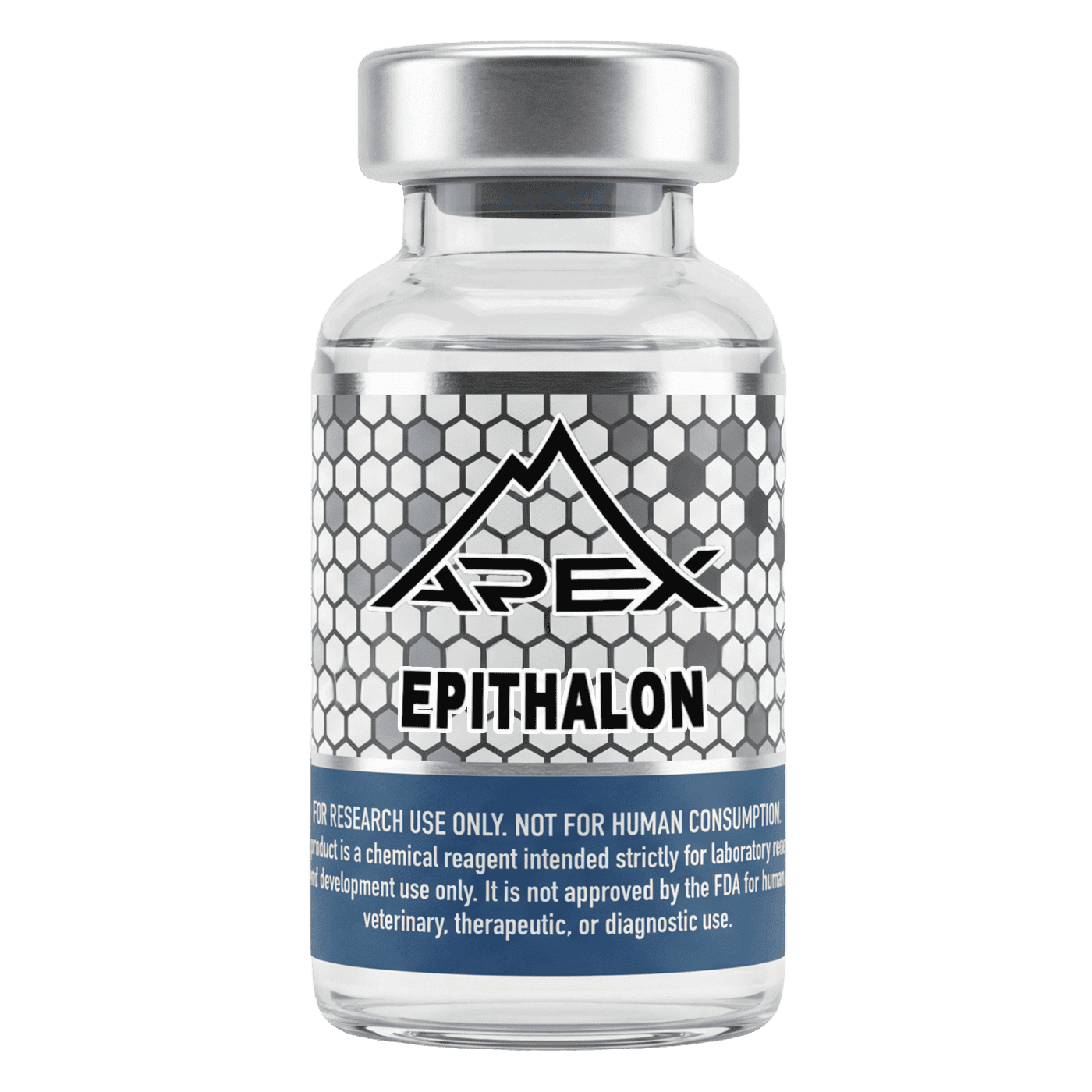
Epithalon (AEDG)
Research-grade Ala-Glu-Asp-Gly — the Khavinson pineal-peptide bioregulator — verified to ≥99% purity by HPLC and mass spectrometry, with a per-lot certificate of analysis. Supplied strictly for in-vitro and preclinical research.
View Epithalon →Frequently Asked Questions
What is Epithalon?
Epithalon, also written Epitalon, is a synthetic tetrapeptide with the sequence Ala-Glu-Asp-Gly (AEDG). It has a molecular weight of 390.35 g/mol and CAS number 307297-39-8 (PubChem CID 219042). It is a short peptide bioregulator modeled on a natural peptide of the pineal gland and developed within Vladimir Khavinson's research program. Apex Laboratory supplies Epithalon as a research-grade chemical reagent for in-vitro and preclinical research only.
Is Epithalon the same as Epitalon?
Yes. Epithalon and Epitalon are two spellings of the same tetrapeptide, Ala-Glu-Asp-Gly (AEDG). Both refer to the synthetic pineal-peptide bioregulator developed by Khavinson and colleagues, modeled on the natural pineal peptide complex known as epithalamin.
How does Epithalon work?
The most cited mechanism is telomerase activation: in cultured human cells Epithalon is reported to induce the telomerase catalytic subunit and telomerase activity, elongating telomeres (Khavinson 2003; Khavinson 2004). It is also reported to bind DNA directly in the major groove and modulate gene expression (Khavinson 2005), and to normalize pineal melatonin rhythms in animals (Goncharova 2001). These are cell-culture and animal findings; an independent study found no significant melatonin effect, so not all claims are uniformly replicated.
Has Epithalon been shown to lengthen telomeres in research?
Telomere elongation has been reported in cultured human cells: Epithalon induced telomerase activity and elongated telomeres in aging human fibroblasts, extending their replicative lifespan in vitro (Khavinson 2004). These are in-vitro results in cell culture, and much of the work comes from the originating research group with limited independent replication. They should be understood as laboratory findings, not as demonstrated effects on telomeres in any living organism, and certainly not as a human anti-aging claim.
What is the molecular weight and sequence of Epithalon?
Epithalon has the sequence Ala-Glu-Asp-Gly (AEDG), a molecular formula of C14H22N4O9, a molecular weight of 390.35 g/mol, and CAS number 307297-39-8 (PubChem CID 219042). It is one of the shortest peptides studied as a bioregulator, which is part of the rationale for the hypothesis that it can enter cells and act at the level of DNA.
Who developed Epithalon and what are Khavinson peptides?
Epithalon was developed by Vladimir Khavinson and colleagues at the St. Petersburg Institute of Bioregulation and Gerontology, as part of a family of short peptide bioregulators that also includes Vilon, Livagen, and Cortagen (Khavinson 2002; Khavinson 2001). Each is modeled on a tissue-specific natural peptide and reported to produce tissue-specific regulatory effects; Epithalon is the pineal and gerontology member of that family.
What does Epithalon do to the pineal gland and melatonin?
In animal research Epithalon has been reported to stimulate evening melatonin production and normalize circadian rhythms in old monkeys (Goncharova 2001) and to restore nocturnal melatonin in older human subjects (Korkushko 2007), consistent with its pineal modeling. However, an independent group reported no significant melatonin effect in their model (Djeridane 2003), so the pineal-melatonin findings are not uniformly replicated. All are research observations, not therapeutic claims.
What lifespan research exists on Epithalon?
Animal studies report lifespan extension: roughly 11 to 16 percent in Drosophila (Khavinson 2000), prolonged mean and maximum lifespan in female rats (Vinogradova 2007), and about a 13 to 14 percent increase in tumor-prone transgenic mice alongside reduced spontaneous tumors (Anisimov 2002). These are findings in specific model organisms, much of it from the originating program; they do not establish any effect on lifespan or aging in humans.
How is Epithalon stored and reconstituted for research?
Lyophilized Epithalon is stored at minus 20 degrees Celsius, protected from light and moisture, where the small tetrapeptide is reasonably stable. For laboratory use it dissolves readily in bacteriostatic water; reconstituted material is held at 2 to 8 degrees Celsius with freeze-thaw cycling minimized, and longer-term aliquots are frozen at minus 20 degrees Celsius. These are laboratory-handling conventions only and are not a human dosing or administration instruction.
Is Epithalon FDA-approved?
No. Epithalon is not approved by the FDA, EMA, or any other regulatory authority as a drug and has no approved therapeutic indication. The research-grade Epithalon supplied by Apex Laboratory is intended strictly for in-vitro and preclinical laboratory research and is not for human or veterinary consumption or any clinical use.
How is research-grade Epithalon purity verified?
Research-grade Epithalon is characterized by reversed-phase HPLC, which quantifies purity by separating the intended peptide from synthesis byproducts, and by mass spectrometry, which confirms identity against the expected mass of 390.35 g/mol for the Ala-Glu-Asp-Gly sequence. Apex supplies Epithalon at greater-than-or-equal-to 99 percent purity with a per-lot certificate of analysis available through its lab-verified archive.
Continue Your Research
Related Longevity & Bioregulator Research Guides
Longevity Bioregulator Research Peptides
The cluster hub situating Epithalon among longevity-oriented bioregulator research reagents.
Open HubGHK-Cu Research Guide
The copper tripeptide studied for gene expression, antioxidant, and tissue-remodeling activity.
Read GuideNAD+ Research Guide
The NAD+ precursor space studied across cellular-energy and longevity research.
Read GuideApex Research Library
The full catalog of mechanism-level research guides across the Apex compound library.
Browse LibraryReferences
All citations were verified against the published record via the NCBI E-utilities API for existence, correct attribution, and support of the associated claim. Each links to its PubMed record.
- Khavinson VK, Kopylov AT, Vaskovsky BV, Ryzhak GA, Lin’kova NS Identification of Peptide AEDG in the Polypeptide Complex of the Pineal Gland. Bull Exp Biol Med. 2017;164(1):41-43. PMID: 29124531
- Araj SK, Brzezik J, Mądra-Gackowska K, Szeleszczuk Ł Overview of Epitalon-Highly Bioactive Pineal Tetrapeptide with Promising Properties. Int J Mol Sci. 2025;26(6). PMID: 40141333
- Khavinson VKh Peptides and Ageing. Neuro Endocrinol Lett. 2002;23 Suppl 3:11-144. PMID: 12374906
- Khavinson VK Tissue-specific effects of peptides. Bull Exp Biol Med. 2001;132(2):807-8. PMID: 11713572
- Khavinson V, Linkova N, Diatlova A, Trofimova S Peptide Regulation of Cell Differentiation. Stem Cell Rev Rep. 2020;16(1):118-125. PMID: 31808038
- Khavinson VKh, Bondarev IE, Butyugov AA Epithalon peptide induces telomerase activity and telomere elongation in human somatic cells. Bull Exp Biol Med. 2003;135(6):590-2. PMID: 12937682
- Khavinson VKh, Bondarev IE, Butyugov AA, Smirnova TD Peptide promotes overcoming of the division limit in human somatic cell. Bull Exp Biol Med. 2004;137(5):503-6. PMID: 15455129
- Khavinson V, Shataeva L, Chernova A DNA double-helix binds regulatory peptides similarly to transcription factors. Neuro Endocrinol Lett. 2005;26(3):237-41. PMID: 15990728
- Khavinson VKh, Shataeva LK, Chernova AA Effect of regulatory peptides on gene transcription. Bull Exp Biol Med. 2003;136(3):288-90. PMID: 14666197
- Khavinson V, Diomede F, Mironova E, Linkova N, Trofimova S, Trubiani O, et al. AEDG Peptide (Epitalon) Stimulates Gene Expression and Protein Synthesis during Neurogenesis: Possible Epigenetic Mechanism. Molecules. 2020;25(3). PMID: 32019204
- Anisimov SV, Bokheler KR, Khavinson VKh, Anisimov VN Studies of the effects of Vilon and Epithalon on gene expression in mouse heart using DNA-microarray technology. Bull Exp Biol Med. 2002;133(3):293-9. PMID: 12360356
- Khavinson VK, Linkova NS, Rudskoy AI, Petukhov MG Feasibility of Transport of 26 Biologically Active Ultrashort Peptides via LAT and PEPT Family Transporters. Biomolecules. 2023;13(3). PMID: 36979488
- Goncharova ND, Khavinson BK, Lapin BA Regulatory effect of Epithalon on production of melatonin and cortisol in old monkeys. Bull Exp Biol Med. 2001;131(4):394-6. PMID: 11550036
- Korkushko OV, Lapin BA, Goncharova ND, Khavinson VKh, Shatilo VB, Vengerin AA, et al. [Normalizing effect of the pineal gland peptides on the daily melatonin rhythm in old monkeys and elderly people]. Adv Gerontol. 2007;20(1):74-85. PMID: 17969590
- Khavinson VK, Yakovleva ND, Popuchiev VV, Kvetnoi IM, Manokhina RP Reparative effect of epithalon on pineal gland ultrastructure in gamma-irradiated rats. Bull Exp Biol Med. 2001;131(1):81-5. PMID: 11329090
- Djeridane Y, Khavinson VKh, Anisimov VN, Touitou Y Effect of a synthetic pineal tetrapeptide (Ala-Glu-Asp-GLy) on melatonin secretion by the pineal gland of young and old rats. J Endocrinol Invest. 2003;26(3):211-5. PMID: 12809170
- Khavinson VK, Izmaylov DM, Obukhova LK, Malinin VV Effect of epitalon on the lifespan increase in Drosophila melanogaster. Mech Ageing Dev. 2000;120(1-3):141-9. PMID: 11087911
- Vinogradova IA, Bukalev AV, Zabezhinski MA, Semenchenko AV, Khavinson VKh, Anisimov VN Effect of Ala-Glu-Asp-Gly peptide on life span and development of spontaneous tumors in female rats exposed to different illumination regimes. Bull Exp Biol Med. 2007;144(6):825-30. PMID: 18856211
- Anisimov VN, Khavinson VKh, Alimova IN, Semchenko AV, Yashin AI Epithalon decelerates aging and suppresses development of breast adenocarcinomas in transgenic her-2/neu mice. Bull Exp Biol Med. 2002;134(2):187-90. PMID: 12459848
- Anisimov VN, Khavinson VK, Provinciali M, Alimova IN, Baturin DA, Popovich IG, et al. Inhibitory effect of the peptide epitalon on the development of spontaneous mammary tumors in HER-2/neu transgenic mice. Int J Cancer. 2002;101(1):7-10. PMID: 12209581
- Anisimov VN, Khavinsov VKh, Alimova IN, Provintsiali M, Manchini R, Francheski K Epithalon inhibits tumor growth and expression of HER-2/neu oncogene in breast tumors in transgenic mice characterized by accelerated aging. Bull Exp Biol Med. 2002;133(2):167-70. PMID: 12428286
- Anisimov VN The role of pineal gland in breast cancer development. Crit Rev Oncol Hematol. 2003;46(3):221-34. PMID: 12791421
- Khavinson VK, Yuzhakov VV, Kvetnoi IM, Malinin VV, Popuchiev VV, Fomina NK Immunohistochemical and morphometric analysis of effects of vilon and epithalon on functional morphology of radiosensitive organs. Bull Exp Biol Med. 2001;131(3):285-92. PMID: 11427924
Research Use Disclaimer
All Epithalon products and the information in this guide are intended strictly for in-vitro and preclinical laboratory research. Epithalon is a research-grade chemical reagent and is not a drug, dietary supplement, or therapeutic product. It is not approved by the FDA, EMA, or any other regulatory authority for therapeutic use and has no approved drug indication. It is not for human or veterinary consumption, diagnosis, treatment, or any clinical use. The telomerase, gene-expression, pineal, and lifespan findings summarized here derive from cell-culture and animal-model studies — much of it from the originating research program, with limited independent replication — and are presented for research context only; they do not constitute therapeutic, efficacy, anti-aging, or safety claims. Researchers are responsible for compliance with all applicable institutional, local, and national regulations governing the acquisition, handling, and use of research chemicals.