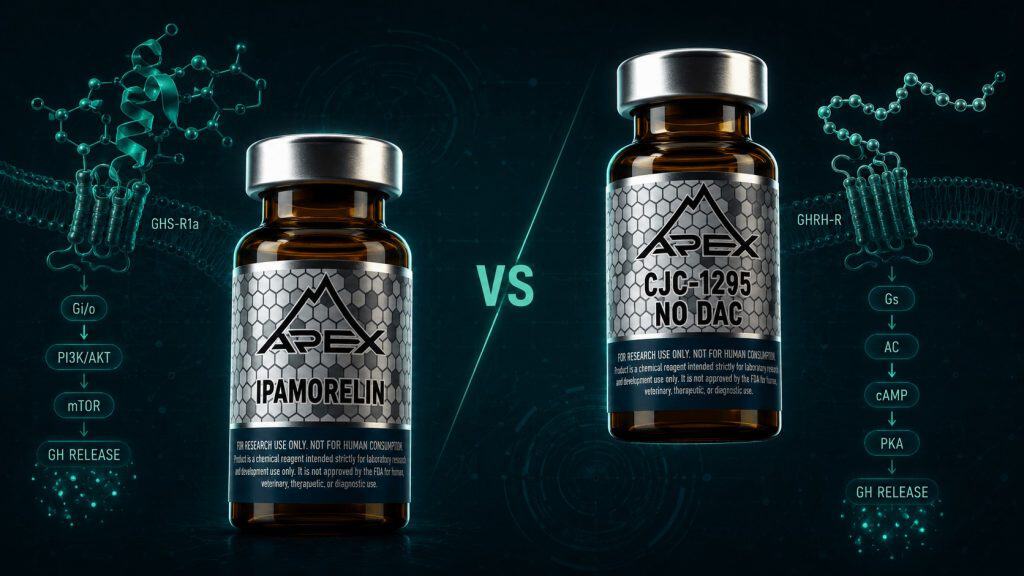
Ipamorelin and CJC-1295 are often discussed in the same breath, yet they engage entirely different receptors on the somatotroph cell — and that distinction is the mechanism researchers care about. Ipamorelin is a selective agonist of GHS-R1a, the ghrelin receptor cloned by Howard and colleagues1 in 1996 and matched to its endogenous acylated peptide ligand by Kojima and colleagues2 in 1999. CJC-1295 is a stabilized GHRH(1-29) analog that engages GHRH-R, the receptor for the hypothalamic releasing factor characterized in parallel 1982 papers by Guillemin and colleagues3 at the Salk Institute and by Rivier, Spiess, Thorner, and Vale4 in Nature. When co-activated on the same somatotroph, the two pathways produce supra-additive — not merely additive — growth hormone release. That two-receptor convergence is the pharmacological logic behind the Apex CJC-1295 No DAC plus Ipamorelin combination preparation.
This guide compares Ipamorelin and CJC-1295 side by side for researchers — covering the GHS-R1a vs GHRH-R receptor distinction, structural class (selective ghrelin-receptor pentapeptide vs tetra-substituted GHRH(1-29) analog with optional DAC stabilization), pharmacokinetic profiles, off-target selectivity, the supra-additive synergy that underwrites combination preparations, and Apex Laboratory’s research-grade catalog availability.
Ipamorelin vs CJC-1295 at a Glance
- Ipamorelin is a selective five-residue pentapeptide GHS-R1a agonist (Aib-His-D-2-Nal-D-Phe-Lys-NH2; Novo Nordisk lineage); CJC-1295 is a tetra-substituted GHRH(1-29) analog (D-Ala2, Gln8, Ala15, Leu27) — two compounds engaging two pharmacologically distinct G-protein-coupled receptors on the same pituitary somatotroph
- The GHS-R1a (ghrelin receptor; Howard 1996, Kojima 1999) and GHRH-R (Guillemin and Rivier-Vale 1982) parallel input channels converge on cAMP and intracellular calcium signaling but diverge in coupling bias — GHRH-R is canonically Gαs-dominant; GHS-R1a has high constitutive activity and significant Gαq/PLC-IP3 contribution
- Plasma half-life diverges sharply across the comparison: Ipamorelin approximately 2 hours in human volunteers (Gobburu 1999); CJC-1295 No DAC approximately 30 minutes; CJC-1295 with DAC approximately 8 days via in-vivo albumin Cys34 conjugation through the maleimidopropionic-acid linker (Teichman 2006)
- Co-engagement of GHRH-R and GHS-R1a produces supra-additive — not additive — GH release in healthy human volunteers per Arvat 2001; this is the pharmacological basis for combination research preparations such as the Apex CJC-1295 No DAC + Ipamorelin Blend, framed throughout as researchers exploring co-engagement rather than performance stacking
- Both compounds are research-grade chemical reagents in the Apex Laboratory catalog at ≥99% purity verified by HPLC and mass spectrometry; neither carries FDA, EMA, NMPA, or other regulatory marketing authorization in any jurisdiction; supplied for in-vitro and preclinical research only — not for human consumption
The Two Compounds at a Glance
Ipamorelin and CJC-1295 are both members of the broader growth-hormone-secretagogue research family but sit on opposite sides of the somatotroph’s two-receptor input architecture. The 9-row comparison table below summarizes the load-bearing distinctions; the article’s H2 sections then unpack each row in turn. Throughout, this guide treats Ipamorelin and CJC-1295 as complements rather than alternatives — researchers select between them based on which receptor pathway the study addresses, and combination research preparations exist precisely because the two pathways amplify each other when co-engaged. The contemporary review by Sigalos and Pastuszak16 in Sexual Medicine Reviews covers the GH-secretagogue safety and efficacy literature in which both compounds appear and frames the GHRH + GHRP combination paradigm in research-context terms.
Ipamorelin vs CJC-1295
| Attribute | Ipamorelin | CJC-1295 |
|---|---|---|
| Origin / discovery program | Novo Nordisk peptide medicinal chemistry program (Raun, Hansen, Johansen, Thøgersen, Madsen, Ankersen; originally NN703); descends from the Bowers and Momany GHRP-6 lineage from 1976-1984 | ConjuChem Biotechnologies (Jetté, Léger, Thibaudeau, Castaigne, Bridon); first-in-human clinical pharmacokinetic characterization by Teichman with the Frohman group at the University of Cincinnati |
| Structural class | Pentapeptide (Aib-His-D-2-Nal-D-Phe-Lys-NH2); five residues with D-amino-acid and Aib substitutions for protease resistance; C-terminal amide | Tetra-substituted GHRH(1-29) analog (D-Ala2, Gln8, Ala15, Leu27); 29-residue N-terminal-fragment-derived |
| Sequence length (residues) | 5 amino acids | 29 amino acids; with-DAC form additionally bears the maleimidopropionic-acid linker for albumin Cys34 conjugation in vivo |
| Receptor target | Selective GHS-R1a agonist — the ghrelin receptor (Howard 1996 cloning; Kojima 1999 endogenous-ligand identification) | GHRH-R agonist — the hypothalamic GHRH receptor (Guillemin 1982 + Rivier-Vale 1982 parent-ligand characterization) |
| Half-life | Approximately 2 hours plasma half-life in human volunteers (Gobburu 1999) | No DAC approximately 30 minutes; with DAC approximately 8 days via albumin Cys34 conjugation (Teichman 2006) |
| Off-target profile (cortisol / prolactin / ACTH) | Selective for GH release; no measurable cortisol, prolactin, or ACTH elevations characteristic of GHRP-6 and Hexarelin (Raun 1998 selectivity differentiator) | GHRH-R-class-selective; native GHRH does not raise cortisol, prolactin, or ACTH at physiologic dosing because corticotropes and lactotropes do not express functional GHRH-R |
| Administration route | Subcutaneous injection in research protocols; PK/PD modeling supports once- or twice-daily research-context administration | Subcutaneous injection in research protocols; with-DAC multi-day half-life supports less frequent dosing intervals than No-DAC |
| Apex catalog availability | Available as research-grade chemical reagent at ≥99% purity verified by HPLC and mass spectrometry | Available as CJC-1295 No DAC (research-grade) and as the CJC-1295 No DAC + Ipamorelin Blend combination research preparation; CJC-1295 with DAC available as separate SKU |
| Research-context use cases | Selective GHS-R1a probe pharmacology, ghrelin-system research, GH-axis selectivity SAR, postoperative-ileus model literature | GHRH-R agonism research, stabilized-GHRH-analog SAR, pulsatility-on-continuous-stimulation research per Ionescu and Frohman 2006 |
Receptor Pathway Distinction: GHS-R1a vs GHRH-R
The single mechanistic distinction that defines this comparison is the receptor each compound engages. Pituitary somatotrophs express two parallel input GPCRs that converge on growth hormone secretion: the GHRH receptor (GHRH-R, the canonical hypothalamic releasing-factor target) and the growth hormone secretagogue receptor 1a (GHS-R1a, the ghrelin receptor). Ipamorelin engages GHS-R1a selectively; CJC-1295 engages GHRH-R. The two compounds are not redundant alternatives — they are complements of two distinct receptor systems converging on the same somatotroph population.
GHS-R1a — The Ghrelin Receptor
GHS-R1a was cloned in 1996 by Howard and colleagues1 at Merck Research Laboratories in Science, using the synthetic non-peptide GH secretagogue MK-0677 as the affinity ligand. The same Merck program had earlier produced MK-0677 itself, characterized by Patchett and colleagues5 in 1995 in PNAS as a potent orally active GH secretagogue — the medicinal-chemistry success that licensed the receptor-cloning effort. The orphan receptor remained ligand-less until 1999, when Kojima and colleagues2 identified ghrelin in Nature — a 28-residue acylated peptide from gastric tissue, with an essential n-octanoyl modification at Ser3. Ipamorelin acts as a selective synthetic agonist at this receptor.
GHS-R1a is also notable for its receptor pharmacology: Holst and colleagues6 characterized in 2007 the receptor’s high constitutive activity and the structural basis for the agonism / inverse-agonism interchange via an efficacy-switch region. The constitutive activity and Gαq/PLC-IP3 coupling bias contribute to the receptor’s distinct intracellular signature relative to GHRH-R.
GHRH-R — The Hypothalamic Releasing-Factor Receptor
GHRH-R is the receptor for the 44-residue hypothalamic peptide GHRH, characterized in two parallel 1982 papers from the human pancreatic islet tumors that caused acromegaly. Guillemin and colleagues3 reported the structure in Science from the Salk Institute; Rivier, Spiess, Thorner, and Vale4 reported the parallel characterization in Nature. GHRH-R is a class B G-protein-coupled receptor predominantly Gαs-coupled; ligand binding initiates cAMP/PKA signaling that drives growth hormone secretion. CJC-1295 engages this receptor as a stabilized N-terminal-fragment analog.
Why the Receptor Distinction Matters
Both receptors converge on growth hormone secretion, but they signal through partially distinct intracellular cascades. GHRH-R-driven Gαs/cAMP/PKA activation and GHS-R1a-driven Gαq/PLC-IP3 activation produce overlapping but non-identical somatotroph responses. When both receptors are engaged simultaneously, the response is supra-additive — a topic developed in detail at the combination-pharmacology section below. For the receptor-distinction question itself, the load-bearing point is simply that Ipamorelin and CJC-1295 are not interchangeable: they are pharmacologically orthogonal probes of two parallel input systems.
Ipamorelin: Selective Pentapeptide GHS-R1a Agonist (Novo Nordisk Lineage)
Ipamorelin descends from the synthetic GHRP medicinal-chemistry lineage that began with Bowers and Momany’s GHRP-6 — characterized by Bowers, Momany, Reynolds, and Hong8 in 1984 in Endocrinology as the foundational hexapeptide GH-secretagogue. Bowers’s own 1998 retrospective9 in Cellular and Molecular Life Sciences traces the GHRP family from the 1976 GHRP-6 work through GHRP-2, Hexarelin, and the second-generation selective compounds. Ipamorelin emerged from this lineage at Novo Nordisk and was characterized by Raun, Hansen, Johansen, Thøgersen, Madsen, Ankersen, and Andersen7 in 1998 in the European Journal of Endocrinology as “the first selective growth hormone secretagogue” — the framing of selective on which the entire ipamorelin research story rests.
Structure and Selectivity
Ipamorelin is a five-residue pentapeptide with sequence Aib-His-D-2-Nal-D-Phe-Lys-NH2 — α-aminoisobutyric acid at position 1 (a non-natural conformationally-restricted residue), histidine, D-2-naphthylalanine, D-phenylalanine, and lysine, with C-terminal amidation. The D-amino-acid and Aib substitutions confer protease resistance; the N-terminal Aib in particular blocks the broad-spectrum aminopeptidase activity that degrades many natural peptide GH-secretagogues. The compound’s defining pharmacological property is selectivity: Raun et al. 1998 demonstrated that ipamorelin releases GH with potency comparable to GHRP-6 and Hexarelin, but does so without the cortisol, prolactin, or ACTH elevations that characterize the older GHRP family. This selectivity is the load-bearing differentiator that separates ipamorelin from its medicinal-chemistry predecessors.
Pharmacokinetics in Human Volunteers
Gobburu, Agersø, Jusko, and Ynddal10 published in 1999 in Pharmaceutical Research a detailed pharmacokinetic-pharmacodynamic modeling study of ipamorelin in human volunteers (Agersø is the Novo Nordisk PK group, reflecting the program’s continuity from the Raun discovery work). The plasma half-life in humans is approximately 2 hours, and the PK/PD model supports once- or twice-daily subcutaneous research-context administration. The 2-hour half-life is intermediate between native ghrelin (very short) and CJC-1295 with DAC (multi-day) — suitable for pulsatile-stimulus-preserving research protocols.
Full single-compound depth on Ipamorelin sits at the Ipamorelin research guide, which covers the Novo Nordisk discovery program, full PK/PD profile, and single-compound research context including the Beck postoperative-ileus trial literature.
CJC-1295: Tetra-Substituted GHRH(1-29) Analog with Optional DAC Stabilization
CJC-1295 is a tetra-substituted analog of GHRH(1-29) — the 29-residue N-terminal fragment of native GHRH that retains GHRH-R binding affinity. The compound bears four amino-acid substitutions on this fragment scaffold: D-Ala at position 2, Gln at position 8, Ala at position 15, and Leu at position 27. Each substitution serves a structural purpose related to plasma stability and receptor engagement.
The DPP-IV Resistance Strategy
The most consequential of the four substitutions is the D-Ala2 substitution, which addresses the rapid plasma degradation of native GHRH. Frohman, Downs, Williams, Heimer, Pan, and Felix13 demonstrated in 1986 in the Journal of Clinical Investigation that native GHRH is rapidly cleaved at the N-terminal Tyr-Ala bond by plasma dipeptidyl peptidase IV (DPP-IV), producing the inactive GHRH(3-44) fragment within minutes. The D-Ala2 substitution in CJC-1295 (and similar substitutions in tesamorelin and other stabilized GHRH analogs) blocks DPP-IV access to that bond, extending plasma half-life relative to native GHRH and unmodified GHRH(1-29) fragments. The Ala15 and Leu27 substitutions further enhance proteolytic stability against broader-spectrum endopeptidases.
CJC-1295 with DAC: Albumin Bioconjugation
The “with DAC” form bears an additional modification beyond the tetra-substituted backbone — a maleimidopropionic-acid (MPA) drug-affinity-complex linker engineered to conjugate covalently to albumin Cys34 in the bloodstream after subcutaneous injection. Jetté, Léger, Thibaudeau, Benquet, Robitaille, Pellerin, Paradis-Bleau, Castaigne, and Bridon12 at ConjuChem Biotechnologies in Montreal published the preclinical bioconjugate rationale in 2005 in Endocrinology, demonstrating that the GHRH(1-29)-albumin bioconjugate retains GRF-receptor activity at the anterior pituitary in rats while gaining the plasma-residency of albumin itself. Teichman, Neale, Lawrence, Gagnon, Castaigne, and Frohman11 then published the first-in-human clinical PK characterization in 2006 in JCEM, demonstrating that single subcutaneous doses of CJC-1295 with DAC produce sustained elevation of GH and IGF-1 secretion over 6–11 days in healthy adults — the data supporting the canonical “approximately 8-day half-life” claim.
CJC-1295 No DAC: The Pulsatility-Preserving Form
The “No DAC” form of CJC-1295 lacks the MPA linker and does not undergo in-vivo albumin conjugation. Its plasma half-life is approximately 30 minutes — short enough that the compound preserves the natural pulsatile stimulus pattern that characterizes endogenous GH-axis architecture. For research designs anchored to pulsatility-preservation paradigms, the No-DAC form is the relevant CJC-1295 variant; for research designs anchored to sustained-stimulus pharmacology, the with-DAC form is the relevant variant. Full single-compound depth on the with-DAC form sits at the CJC-1295 with DAC research guide. For lateral GHRH-analog context, the Sermorelin research guide covers the unmodified GHRH(1-29)NH2 fragment that anchors the family lineage.
Pharmacokinetic Profiles: Half-Life, Pulsatility, and Stimulus Architecture
Pharmacokinetic profile is one of the principal axes along which researchers select between Ipamorelin and CJC-1295 — and between the two CJC-1295 forms. Three reference points anchor the comparison: ipamorelin at approximately 2 hours, CJC-1295 No DAC at approximately 30 minutes, and CJC-1295 with DAC at approximately 8 days per Teichman 200611. The three values span more than two orders of magnitude, and each reflects a different structural strategy.
The Pulsatility Paradigm
Endogenous growth hormone secretion is pulsatile, not tonic. Veldhuis, Keenan, and Pincus15 provided the canonical methodological synthesis on deconvolution analysis of pulsatile hormone secretion in their 2008 Endocrine Reviews paper. Most GHRH analogs and ghrelin mimetics preserve the pulsatile-stimulus paradigm by acting upstream of the pituitary on a kinetic timescale matching the natural pulse architecture — Ipamorelin’s 2-hour half-life and CJC-1295 No DAC’s 30-minute half-life both fit this regime.
Continuous Stimulation Does Not Flatten the Pulse
A non-obvious finding that distinguishes the with-DAC form from common vendor-blog mis-characterizations: pulsatile GH secretion persists during continuous CJC-1295 stimulation. Ionescu and Frohman14 demonstrated this directly in their 2006 JCEM paper. The long-acting GHRH-R agonist does not abolish the natural GH pulse — somatostatin tone, IGF-1 negative feedback, and the somatotroph’s intrinsic refractoriness continue operating, and pulse architecture is retained even during sustained agonist exposure. This finding is critical for research designs that depend on preserved pulsatility despite long-acting pharmacology.
Ipamorelin’s PK in the Combination Context
Ipamorelin’s 2-hour half-life per Gobburu 199910 matches well with both CJC-1295 No DAC’s 30-minute half-life and CJC-1295 with DAC’s multi-day half-life when the two are administered together. In the No-DAC + Ipamorelin combination preparation, both half-lives are in the single-digit-hour range, and the combination preserves a pulsatile-stimulus architecture; in the with-DAC + Ipamorelin paradigm, the GHRH-R signal is sustained while the GHS-R1a signal is intermittent, mirroring the endogenous mismatch between hypothalamic GHRH (continuous) and ghrelin (pulsatile-circadian). Both arrangements are research-context, not therapeutic.
Combination Pharmacology: Supra-Additive Synergy on the Somatotroph
The pharmacological property that elevates the Ipamorelin / CJC-1295 comparison from a binary head-to-head into a combination-research framework is supra-additive synergy. When GHRH-R and GHS-R1a are co-engaged on the same somatotroph cell, the GH-release response is greater than the sum of the responses to each agonist alone. This is not a vendor-marketing claim — it is a documented finding in healthy human volunteers, with a mechanistic explanation rooted in the receptor architecture described above.
The Human Data
Arvat, Maccario, Di Vito, Broglio, Benso, Gottero, Papotti, Muccioli, Dieguez, Casanueva, Deghenghi, Camanni, and Ghigo17 at the University of Turin published in 2001 in JCEM a direct comparison of ghrelin (the endogenous GHS-R1a ligand), hexarelin (a peptide GHS), and GHRH in healthy human volunteers — including combination administrations. The combined ghrelin + GHRH challenge produced a GH response substantially greater than the sum of the two individual responses. Bowers’s earlier GHRP + GHRH combination work in the late 1980s and early 1990s — summarized in the 1998 retrospective9 — established the same synergy paradigm with synthetic GHRP analogs. The Sigalos and Pastuszak16 2018 Sex Med Rev contemporary review covers this combination paradigm in the safety-and-efficacy framing relevant to current GH-secretagogue research literature.
Mechanistic Basis
The pharmacological rationale for the supra-additive response traces back to the partial intracellular pathway distinction described above. GHRH-R activates Gαs-cAMP-PKA signaling; GHS-R1a (per Holst 20076) couples through Gαq-PLC-IP3 with high constitutive activity contributing to baseline tone. When both pathways are engaged, the cAMP and IP3/calcium signals integrate at the somatotroph secretory machinery, amplifying GH release beyond what either pathway delivers alone. This convergent two-receptor logic is what makes the combination “supra-additive” rather than “redundant.”
Apex Combination Research Preparation
The Apex Laboratory catalog includes a CJC-1295 No DAC + Ipamorelin Blend — a combination research preparation supplied for investigators exploring co-engagement of GHRH-R and GHS-R1a in research contexts. The pharmacological basis for the blend is the supra-additive somatotroph response documented in the literature above; the blend is not framed as a “stack” or as a performance-enhancement preparation, and Apex’s research-context discipline applies throughout. Researchers using the blend should consult the primary peer-reviewed combination literature (Arvat 2001, Bowers 1998 retrospective, Sigalos 2018 review) for protocol design and effect-size expectations.
For broader cluster context, Apex’s parallel comparison of Tesamorelin and Sermorelin — two GHRH analogs of distinct lineage with separate FDA registrational pedigree — covers the GHRH-analog family from an entirely different angle and ships in the same batch as this guide. The GH-axis research peptide pillar covers the full receptor-system taxonomy across both GHRH analogs and ghrelin mimetics.
Off-Target Selectivity: Cortisol, Prolactin, and ACTH Profiles
The off-target selectivity profile is the secondary load-bearing differentiator separating Ipamorelin from its older GHRP-family medicinal-chemistry predecessors and from compounds like Hexarelin. Where many vendor blogs gesture at “ipamorelin is selective” without specifying what the compound is selective against, the pharmacology literature is precise.
What Ipamorelin Is Selective Against
Raun and colleagues7 1998 demonstrated that ipamorelin releases GH with potency comparable to GHRP-6 — but does so without elevating cortisol, prolactin, or adrenocorticotropic hormone (ACTH). GHRP-6 itself, as characterized in the foundational Bowers, Momany, Reynolds, and Hong8 1984 Endocrinology paper, raises cortisol, prolactin, and ACTH at GH-effective doses. Hexarelin, characterized by Deghenghi, Cananzi, Torsello, Battisti, Muller, and Locatelli18 in 1994 in Life Sciences, exhibits a similar non-selective off-target profile. Ipamorelin’s medicinal-chemistry achievement was retaining GHS-R1a-driven GH release while eliminating the spillover into the corticotrope (ACTH/cortisol) and lactotrope (prolactin) populations.
CJC-1295’s GHRH-R-Class Selectivity
CJC-1295 is selective by class rather than by within-family medicinal-chemistry refinement — native GHRH and its analogs do not raise cortisol, prolactin, or ACTH at physiologic dosing. The receptor target itself (GHRH-R) is somatotroph-specific in the anterior pituitary; corticotropes and lactotropes do not express functional GHRH-R. The off-target-selectivity question for CJC-1295 is therefore a different one — concerned with proteolytic-cleavage product activity rather than with within-pituitary cell-type spillover.
Why Selectivity Matters for Research Design
The selectivity differential between Ipamorelin and the older GHRPs is a research-design lever: studies that need a clean GH-axis signal without confounding HPA-axis or prolactin-axis perturbations choose ipamorelin precisely because the off-target signals are absent. Studies that explicitly want HPA-axis cross-talk (for example, work on GHRP-6’s ACTH effects) choose the older compounds. Within the canonical Ipamorelin-vs-CJC-1295 comparison, both compounds are clean on the off-target axis — the selectivity story is each compound’s separate medicinal-chemistry achievement, not a head-to-head differentiator.
Research-Context Use Cases: When Investigators Choose One, the Other, or Both
Because Ipamorelin and CJC-1295 engage different receptors and produce a supra-additive response when co-engaged, the research-design question is rarely “which compound is better” — it is “which receptor pathway, or combination, matches the experimental question.” A few framings:
For studies of selective GHS-R1a agonism or ghrelin-system pharmacology, Ipamorelin is the obvious selective probe. Its receptor-class selectivity (no GHRH-R cross-reactivity) and its within-class selectivity (no cortisol/prolactin/ACTH spillover) make it the cleanest pharmacological tool for studies that need to isolate GHS-R1a-driven somatotroph response from GHRH-R-driven response.
For studies of stabilized-GHRH-analog pharmacology or GHRH-R agonism, CJC-1295 is the relevant compound — choice of the No-DAC versus with-DAC form depends on whether the experimental question concerns short-half-life pulsatile-stimulus pharmacology (No DAC) or sustained-stimulus pharmacology (with DAC). The Frohman 1986 DPP-IV degradation paper anchors the structural rationale for the tetra-substituted backbone in either form.
For studies of supra-additive two-receptor convergence on the somatotroph, combination research is the relevant frame. The Apex CJC-1295 No DAC + Ipamorelin Blend is the catalog product for investigators exploring co-engagement; the Arvat 2001 JCEM paper is the most direct human-data anchor; the Sigalos 2018 review is the contemporary safety-and-efficacy reference. Combination work is not “stacking” — it is research into the pharmacological logic by which the somatotroph integrates two parallel input signals.
For studies of pulsatility preservation under continuous agonist exposure, CJC-1295 with DAC is the relevant compound and the Ionescu and Frohman 2006 finding is the relevant literature anchor — the documentation that pulsatility persists despite multi-day-half-life agonism counters a common vendor-blog misconception and provides a research-design lever for pulsatility-architecture studies.
For broader cross-cluster research-design context, the tissue-repair research peptide pillar, the GLP-1 metabolic research peptide pillar, and the CNS research peptide pillar each cover adjacent compound families with their own receptor-pathway distinctions.
Apex Catalog Availability and Quality Verification
Apex Laboratory carries Ipamorelin, CJC-1295 No DAC, and the CJC-1295 No DAC + Ipamorelin Blend as research-grade chemical reagents at ≥99% purity, verified by HPLC and mass spectrometry on every batch and documented in the lab-verified COA archive under the editorial standards framework. CJC-1295 with DAC is available as a separate catalog SKU. Neither Ipamorelin nor CJC-1295 (with or without DAC) carries FDA, EMA, NMPA, or other regulatory marketing authorization in any jurisdiction — both are research-grade chemical reagents only. The combination preparation is supplied for investigators exploring co-engagement of GHRH-R and GHS-R1a in research contexts and is not framed as a clinical or performance product. All three compounds are catalog members within the growth hormone axis research peptide pillar and accessible through the Apex Research Library under the Growth Hormone Axis Research focus filter.
Research-Grade GH-Axis Compounds
Ipamorelin
Apex Laboratory Ipamorelin is supplied as a research-grade chemical reagent at ≥99% purity, verified by HPLC and mass spectrometry on every batch. Selective five-residue pentapeptide GHS-R1a agonist; selective for GH release without cortisol, prolactin, or ACTH spillover. For in-vitro and preclinical research only — not for human consumption.
View Product →CJC-1295 No DAC
Apex Laboratory CJC-1295 No DAC is supplied as a research-grade chemical reagent at ≥99% purity, verified by HPLC and mass spectrometry on every batch. Tetra-substituted GHRH(1-29) analog without the maleimidopropionic-acid albumin-binding linker; approximately 30-minute plasma half-life preserves pulsatile-stimulus architecture. For in-vitro and preclinical research only — not for human consumption.
View Product →CJC-1295 No DAC + Ipamorelin Blend
Apex Laboratory CJC-1295 No DAC + Ipamorelin Blend is a combination research preparation supplied for investigators exploring co-engagement of GHRH-R and GHS-R1a. Pharmacological basis is the supra-additive somatotroph response documented by Arvat 2001 and Sigalos 2018; ≥99% purity HPLC/MS verified per component. For in-vitro and preclinical research only — not for human consumption.
View Product →Frequently Asked Questions
What is the difference between ipamorelin and CJC-1295?
Ipamorelin and CJC-1295 engage different somatotroph receptors. Ipamorelin is a selective GHS-R1a (ghrelin receptor) pentapeptide agonist; CJC-1295 is a tetra-substituted GHRH(1-29) analog that engages GHRH-R. The two pathways produce supra-additive — not additive — GH release when co-engaged on the same somatotroph, which is the pharmacological basis for combination research preparations.
Do ipamorelin and CJC-1295 engage the same receptor?
No. Ipamorelin engages GHS-R1a, the ghrelin receptor cloned by Howard 1996 and matched to its endogenous acylated peptide ligand by Kojima 1999. CJC-1295 engages GHRH-R, the receptor for the hypothalamic releasing factor characterized by Guillemin and Rivier-Vale in parallel 1982 papers. Both receptors sit on pituitary somatotrophs and converge on growth hormone secretion through partially distinct intracellular pathways.
Why are ipamorelin and CJC-1295 often combined?
Co-engagement of GHRH-R and GHS-R1a produces supra-additive — not merely additive — GH release. Arvat 2001 documented combined ghrelin plus GHRH administration generating a synergistic response in healthy humans, and Bowers’s earlier GHRP plus GHRH combination work established the same paradigm with synthetic analogs. Researchers explore this co-engagement in combination research preparations such as the CJC-1295 No DAC plus Ipamorelin Blend.
What is the half-life of CJC-1295 No DAC vs CJC-1295 with DAC?
CJC-1295 No DAC has a plasma half-life of approximately 30 minutes — short enough to preserve natural pulsatile GH-axis architecture. CJC-1295 with DAC bears a maleimidopropionic-acid linker that conjugates covalently to albumin Cys34 in vivo, extending plasma half-life to approximately 8 days per Teichman 2006. The two forms address fundamentally different research-design questions despite sharing the same tetra-substituted backbone.
Does ipamorelin raise cortisol like other GHRPs?
No. Raun and colleagues 1998 characterized ipamorelin as the first selective growth hormone secretagogue precisely because it releases GH with potency comparable to GHRP-6 but without the cortisol, prolactin, or ACTH elevations that characterize GHRP-6 and Hexarelin. The selectivity is the load-bearing differentiator separating ipamorelin from older medicinal-chemistry predecessors in the GHRP family.
What is the half-life of ipamorelin?
Ipamorelin’s plasma half-life in human volunteers is approximately 2 hours per the Gobburu, Agersø, Jusko, and Ynddal 1999 PK/PD modeling study in Pharmaceutical Research. The 2-hour half-life supports once- or twice-daily subcutaneous research-context administration and falls between native ghrelin (very short) and CJC-1295 with DAC (multi-day) on the GH-secretagogue half-life spectrum.
Is the CJC-1295 plus Ipamorelin Blend a stack?
No. Apex frames the CJC-1295 No DAC plus Ipamorelin Blend as a combination research preparation for investigators exploring co-engagement of GHRH-R and GHS-R1a, not as a stack or performance-enhancement product. The blend’s pharmacological basis is the supra-additive somatotroph response documented in the human and preclinical combination-pharmacology literature. The product is supplied for in-vitro laboratory research only — not for human consumption.
Continue Your Research
Researchers building broader Ipamorelin vs CJC-1295 context across the Apex library may find the following references useful:
- Growth Hormone Axis Research Peptide Pillar — category umbrella covering GHRH analogs, ghrelin mimetics, and the broader GH-axis research family
- Ipamorelin Research Guide — full single-compound deep-dive on the Novo Nordisk pentapeptide GHS-R1a agonist
- CJC-1295 with DAC Research Guide — full single-compound deep-dive on the long-acting albumin-bioconjugate GHRH analog
- Sermorelin Research Guide — adjacent unmodified GHRH(1-29)NH2 fragment that anchors the GHRH-analog family lineage
- Apex’s parallel Tesamorelin vs Sermorelin GHRH-analog comparison — same-batch sister Tier 3 comparison covering the dual-FDA-registrational-pedigree GHRH-analog pair
- Tissue Repair Research Peptide Pillar — lateral pillar covering BPC-157, TB-500, and the tissue-repair family
- GLP-1 / Metabolic Research Peptide Pillar — lateral pillar covering Semaglutide, Tirzepatide, and the broader incretin landscape
- CNS Research Peptide Pillar — lateral pillar covering Selank, Semax, and the CNS research-peptide family
- Cerebrolysin Research Guide — adjacent neurotrophic-peptide-mixture research compound
- Sermorelin vs CJC-1295 — sibling GHRH comparison involving Sermorelin and the CJC-1295 lineage
Research Use Disclaimer
This article is provided for educational and research reference purposes only. Ipamorelin, CJC-1295 No DAC, the CJC-1295 No DAC + Ipamorelin Blend, and all products sold by Apex Laboratory are intended exclusively for in-vitro laboratory research use and are not for human consumption. Ipamorelin and CJC-1295 (with or without DAC) carry no FDA, EMA, NMPA, or other regulatory marketing authorization in any jurisdiction; both are research-grade chemical reagents. The CJC-1295 No DAC + Ipamorelin Blend is a combination research preparation; its pharmacological basis is the supra-additive GH-release response of GHRH-R and GHS-R1a co-engagement, not a clinical use claim. Researchers should consult the primary peer-reviewed literature for trial protocols and findings.