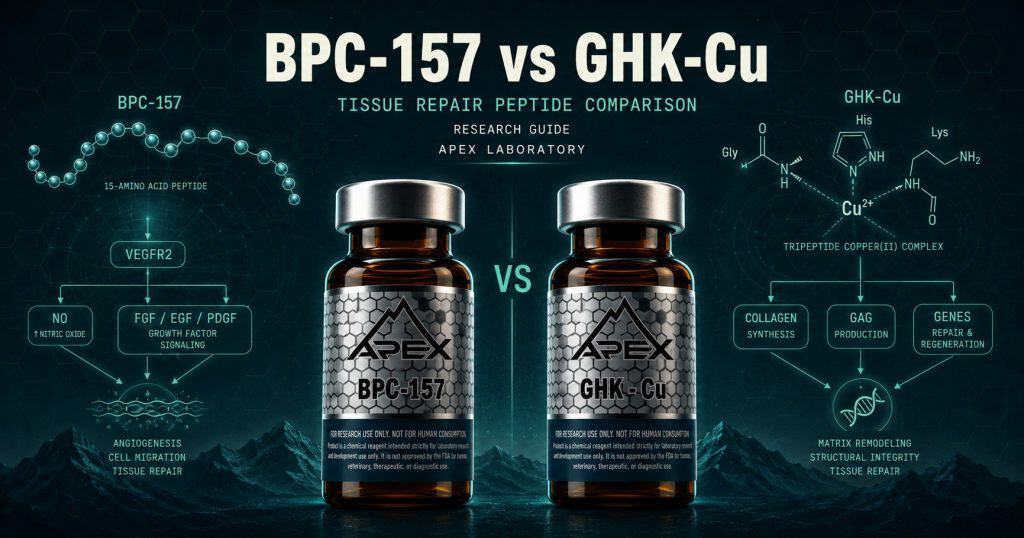
Search-marketing pages and bodybuilding forums lump BPC-157 and GHK-Cu together as interchangeable “healing peptides.” They aren’t. BPC-157 is a 15-residue gastric pentadecapeptide (GEPPPGKPADDAGLV) characterized by the Sikiric group at the University of Zagreb across more than three decades1, signaling through VEGF/VEGFR2, nitric oxide, dopaminergic and serotonergic pathways, and angiogenic growth factors. GHK-Cu is a 3-residue copper-binding tripeptide (Gly-His-Lys-Cu²⁺) characterized by Loren Pickart at the University of Washington since 197312, operating through copper homeostasis, ECM remodeling, fibroblast collagen synthesis, and broad gene-expression modulation. They share a research interest in tissue repair, but they engage fundamentally different molecular machinery. This comparison ignores the marketing frame entirely and reads the peer-reviewed Sikiric and Pickart literature on its own terms.
This guide provides a research-context, mechanism-distinct comparison of BPC-157 and GHK-Cu — structural lineage, signaling-pathway divergence, a side-by-side comparison table, combination-research context, and a mechanism-of-interest decision framework drawn from the published Sikiric and Pickart literature, positioned within the broader Apex Research Library.
BPC-157 vs GHK-Cu at a Glance
- BPC-157 and GHK-Cu engage fundamentally different molecular machinery — BPC-157 is a 15-residue protein-derived pentadecapeptide signaling through VEGF/NO/growth-factor pathways; GHK-Cu is a 3-residue copper-coordinated tripeptide modulating ECM accumulation and broad gene expression. Lumping them as generic “healing peptides” misses the mechanism-distinction that defines each compound’s research relevance.
- BPC-157 traces to the Sikiric research group at the University of Zagreb (canonical 1991+ lineage); GHK-Cu traces to Loren Pickart at the University of Washington (1973+ lineage), with foundational in-vivo wound-healing work from the Maquart group at Reims, France.
- The two compounds are sequence-identity opposites — BPC-157’s GEPPPGKPADDAGLV is a 15-residue partial sequence of human gastric juice protein BPC; GHK-Cu’s Gly-His-Lys is the simplest possible copper-binding tripeptide motif, with copper(II) coordinated through the histidine imidazole and the N-terminal amine.
- Combination-research context differs: Apex catalog includes Glow Blend 70mg (a multi-peptide preparation containing GHK-Cu alongside BPC-157 and TB-500); BPC-157 also appears in BPC+TB-500 combination research independent of GHK-Cu.
- Both compounds are research-only globally — neither carries FDA, EMA, or NMPA marketing authorization in any jurisdiction. Apex Laboratory’s research-grade BPC-157, GHK-Cu, and Glow Blend 70mg are chemical reagents supplied at ≥99% purity for in-vitro laboratory research only.
Why the “Healing Peptides” Framing Fails This Comparison
The phrase “healing peptides” carries no mechanistic content. It compresses two compounds with non-overlapping signaling architectures into a single marketing category, which is convenient for affiliate-blog ranking and useless for research-design decisions. BPC-157 and GHK-Cu both have published preclinical literature touching on tissue-repair endpoints — but the molecular pathways through which they reach those endpoints share almost nothing.
BPC-157, characterized by the Sikiric group as the “stable gastric pentadecapeptide” in their 2011 Current Pharmaceutical Design review1, is a 15-residue partial sequence of a protective protein identified in human gastric juice. The Zagreb program’s work emphasizes pleiotropic protein-derived signaling: VEGFR2 activation, nitric oxide axis modulation, growth-factor stabilization, and cross-system interaction with dopaminergic, serotonergic, and GABAergic pathways. GHK-Cu, by contrast, is a 3-residue tripeptide whose biology is inseparable from its copper coordination — Pickart’s foundational 2008 Journal of Biomaterials Science review12 frames the compound as an extracellular-matrix-remodeling and gene-expression-modulating copper carrier rather than a peptide signaling at any conventional receptor.
This article disavows the bodybuilding-frame treatment that conflates them. The comparison’s reason for existing is mechanism-distinction, not “which is better for muscle recovery.” Researchers select between BPC-157 and GHK-Cu based on the mechanism of interest — multi-pathway protein-derived signaling versus copper-coordinated ECM remodeling — not relative potency on a single endpoint.
The Two Tissue-Repair Peptides at a Glance
BPC-157 and GHK-Cu diverge sharply on origin program, structural class, sequence length, mechanism class, and research-context use cases. Both are research-grade chemical reagents in the Apex Laboratory catalog. The 9-row comparison table below summarizes the load-bearing distinctions; the article’s H2 sections then unpack each row in turn. Cushman and colleagues15 covered both compounds in their 2024 Yale Journal of Biology and Medicine narrative review on local and systemic peptide therapies for soft-tissue regeneration — useful comparative-context anchoring for researchers approaching the pair without prior exposure to either.
BPC-157 vs GHK-Cu
| Attribute | BPC-157 | GHK-Cu |
|---|---|---|
| Origin / discovery program | Sikiric research group, University of Zagreb School of Medicine, Croatia (canonical 1991+ lineage); 15-residue partial sequence derived from human gastric juice protective protein BPC | Loren Pickart, University of Washington (initial isolation 1973); foundational in-vivo wound-healing program with Maquart group at Université de Reims Champagne-Ardenne, France |
| Structural class | 15-residue protein-derived pentadecapeptide; Body Protection Compound; partial sequence of human gastric juice protein BPC | 3-residue tripeptide (Gly-His-Lys) coordinated to copper(II) in square-planar geometry via histidine imidazole and N-terminal amine |
| Sequence / formula | GEPPPGKPADDAGLV (15 residues; 1419.53 g/mol) | Gly-His-Lys + Cu²⁺ complex (3 residues; 403.93 g/mol) |
| Half-life / pharmacokinetic context | Acid-stable in human gastric juice; multi-route administration tolerance documented across animal models; limited published plasma-PK data | Active in femto-to-nanomolar concentration windows in fibroblast cultures (10⁻¹² to 10⁻¹¹ M; max 10⁻⁹ M); ECM-remodeling kinetics dominate over circulating-plasma half-life framing |
| Mechanism class | Multi-pathway protein-derived signaling: VEGF/VEGFR2 activation, nitric oxide axis (Src-Caveolin-1-eNOS), angiogenic growth factors (FGF, EGF, PDGF), dopaminergic/serotonergic/GABAergic cross-system interactions | Copper-coordinated ECM remodeling: fibroblast collagen synthesis, Type I/III collagen mRNA elevation, glycosaminoglycan accumulation, broad gene-expression network modulation across tissue-repair, antioxidant, and anti-inflammatory programs |
| Administration route (animal models) | Intraperitoneal, oral, and topical administration documented in published animal models | Topical and parenteral administration documented in published in-vivo wound-chamber and skin models |
| Research-context use cases | Tendon, ligament, gastrointestinal mucosa, vascular endothelium, central nervous system axis | Skin, dermal wound chambers, aged-tissue remodeling, hepatic/gastric/intestinal tissue protection, cosmetic-aging research |
| Apex catalog availability | Available as research-grade chemical reagent at ≥99% purity; for in-vitro and preclinical research only | Available as research-grade chemical reagent at ≥99% purity; for in-vitro and preclinical research only |
| Combination research context | Apex Glow Blend 70mg combines BPC-157 + GHK-Cu + TB-500 in a single lyophilized vial; BPC-157 also appears separately in BPC+TB-500 combination research; GHK-Cu studied independently in skin and aged-tissue protocols | |
BPC-157: The Sikiric Pentadecapeptide Research Base
BPC-157 (Body Protection Compound-157) is a synthetic 15-residue pentadecapeptide derived from a partial sequence of a protective protein originally identified in human gastric juice. The compound’s full sequence is Gly-Glu-Pro-Pro-Pro-Gly-Lys-Pro-Ala-Asp-Asp-Ala-Gly-Leu-Val (GEPPPGKPADDAGLV), with a molecular weight of 1419.53 g/mol. The canonical “stable gastric pentadecapeptide” framing — which anchors the sequence, molecular weight, and acid-stability characterization that defines the compound’s pharmacology — was consolidated by Sikiric and colleagues1 in their 2011 Current Pharmaceutical Design review.
Multi-Pathway Signaling
The Sikiric group’s work over three decades established BPC-157 as a multi-pathway signaling compound rather than a single-receptor agonist. Sikiric and colleagues2 in their 2016 Current Neuropharmacology brain-gut axis review documented cross-system interactions with dopaminergic, serotonergic, and GABAergic neurotransmitter systems, framing BPC-157 as a pleiotropic mediator rather than a peptide localized to any one signaling axis. Seiwerth and colleagues3 extended this framing in their 2018 Current Pharmaceutical Design synthesis on standard angiogenic growth factors, positioning BPC-157 as a “novel cytoprotective mediator” interacting with the VEGF, FGF, EGF, and PDGF cascades drawn from gastrointestinal tract healing alongside tendon, ligament, muscle, and bone healing literature.
Vascular Recruitment as the Mechanistic Spine
Sikiric and colleagues4 consolidated the vascular-recruitment framing in a parallel 2018 Current Pharmaceutical Design paper, characterizing BPC-157 as engaging VEGF/NO axis activation as the spine of its tissue-repair pharmacology. The unifying observation across the Zagreb literature is that BPC-157’s effects across diverse tissue-repair endpoints — gastrointestinal mucosa, tendon, ligament, muscle, bone — trace to a recurring vascular-and-growth-factor signaling pattern rather than to tissue-specific receptor agonism.
The distinctive editorial point is that BPC-157’s research lineage is dominated by a single program: the Sikiric group’s outputs at Zagreb constitute the bulk of the foundational preclinical literature, with Cerovecki, Brcic, Staresinic, Seiwerth, and other co-authors contributing across dozens of papers. Full single-compound depth on BPC-157 sits at the BPC-157 research guide.
GHK-Cu: The Pickart Copper-Tripeptide Research Base
GHK-Cu is the 3-residue tripeptide glycyl-L-histidyl-L-lysine bound to copper(II) — the simplest copper-binding tripeptide motif characterized in tissue-repair pharmacology. The molecular weight of the GHK-Cu complex is 403.93 g/mol. The biology is inseparable from the copper coordination: copper(II) is held in a square-planar geometry by the imidazole nitrogen of histidine and the N-terminal amine, with carbonyl oxygens completing the coordination sphere. Loren Pickart at the University of Washington identified GHK-Cu in 1973; the modern research lineage extends from that initial isolation through more than five decades of mechanism work.
Foundational Fibroblast Collagen-Synthesis Evidence
The foundational mechanism evidence comes from the Maquart group at the Université de Reims Champagne-Ardenne in France. Maquart, Pickart, Laurent, Gillery, Monboisse, and Borel10 demonstrated in 1988 in FEBS Letters that GHK-Cu stimulates collagen synthesis in fibroblast cultures at concentrations between 10⁻¹² and 10⁻¹¹ M, with maximum effect around 10⁻⁹ M — establishing the femto-to-nanomolar potency range that defines the compound’s mechanism. The same Reims group then demonstrated in-vivo connective-tissue accumulation in 1993 in the Journal of Clinical Investigation: Maquart and colleagues11 documented Type I and Type III collagen mRNA elevation, glycosaminoglycan synthesis, and connective-tissue accumulation in rat experimental wound chambers.
Pickart’s Tissue-Remodeling Synthesis
Pickart12 produced the canonical single-author synthesis of the GHK research lineage in 2008 in the Journal of Biomaterials Science Polymer Edition, covering wound healing across multiple animal models, controlled aged-skin studies in skin tightening and fine-line reduction, and tissue-protection effects in hepatic injury, gastric ulcer, intestinal ulcer, and bone-tissue contexts. Pickart, Vasquez-Soltero, and Margolina13 extended the framing in 2012 in Oxidative Medicine and Cellular Longevity, anchoring antioxidant-defense and oxidative-stress prevention pathways in the GHK-Cu mechanism profile.
Gene-Expression Network Breadth
The most recent synthesis comes from Pickart and Margolina14 in their 2018 International Journal of Molecular Sciences review on GHK-Cu regenerative and protective actions in light of new gene data. The gene-expression-analysis evidence reveals broad regulation of human genes critical for tissue repair, antioxidant defense, anti-inflammatory action, and neuronal development — a network-level breadth that sits orthogonally to BPC-157’s vascular-and-growth-factor multi-pathway framing. Full single-compound depth on GHK-Cu sits at the GHK-Cu research guide.
Mechanism Comparison: Multi-Pathway Protein vs Copper-Coordinated ECM
Once the two compounds’ research bases are framed correctly, the mechanism-distinction comparison resolves into a clean structural-functional contrast. BPC-157’s signaling architecture is built on protein-derived multi-pathway interaction with vascular and growth-factor cascades. GHK-Cu’s signaling architecture is built on copper-coordinated extracellular matrix remodeling and broad gene-expression modulation. The two architectures barely share molecular targets.
BPC-157’s Vascular and Growth-Factor Axis
BPC-157’s pro-angiogenic signaling has been independently confirmed outside the Zagreb program. Hsieh and colleagues5 at Chang Gung Memorial Hospital in Taiwan demonstrated in 2017 in the Journal of Molecular Medicine that BPC-157’s therapeutic potential associates with VEGFR2 activation and upregulation — non-Zagreb independent replication of the angiogenesis mechanism claim. Hsieh and colleagues6 extended this in 2020 in Scientific Reports, characterizing BPC-157 modulation of vasomotor tone via the Src-Caveolin-1-eNOS pathway. The vascular-and-growth-factor axis is therefore not a Zagreb-only claim — independent groups reach the same mechanism conclusions through receptor-level and pathway-level experiments.
GHK-Cu’s ECM and Gene-Expression Axis
GHK-Cu’s mechanism does not converge on VEGFR2, NO, or any of the BPC-157 pathway targets. The compound’s biology is dominated by ECM remodeling — collagen Type I and III mRNA elevation, glycosaminoglycan synthesis, fibroblast activation — and broad gene-expression modulation that touches anti-inflammatory and antioxidant gene networks alongside tissue-repair gene programs. The Pickart-Margolina14 2018 gene-expression synthesis frames this network breadth explicitly: GHK-Cu does not act through a single receptor or signaling cascade but instead operates as a copper-carrier modulator of transcriptional networks at the femto-to-nanomolar concentrations characteristic of its in-vitro and in-vivo activity windows.
Why the Contrast Matters for Research Design
The mechanism-class contrast — multi-pathway protein-derived signaling versus copper-coordinated ECM and gene-network modulation — is the load-bearing distinction researchers need when selecting between the two compounds. Studies anchored to vascular-and-growth-factor pharmacology, dopaminergic-serotonergic cross-system effects, or VEGFR2-axis structure-activity relationships will gravitate toward BPC-157. Studies anchored to ECM accumulation, fibroblast biology, copper-homeostasis pharmacology, or transcriptional-network modulation in tissue-repair gene programs will gravitate toward GHK-Cu. Neither compound substitutes for the other.
Research-Context Use Cases: Where Each Compound Is Studied
The mechanism-class contrast translates directly into research-context use-case patterns visible in the published preclinical literature.
BPC-157: Tendon, Ligament, Gastrointestinal Mucosa, Vascular Endothelium
The BPC-157 literature is concentrated on musculoskeletal and gastrointestinal tissue-repair endpoints. Cerovecki and colleagues7 demonstrated in 2010 in the Journal of Orthopaedic Research that BPC-157 (as PL 14736) improves ligament healing in the rat — the canonical Zagreb ligament-healing paper anchoring the orthopedic-research-context use case. Staresinic and colleagues9 earlier established Achilles-tendon healing acceleration in 2003 in the same journal, with in-vitro tendocyte growth stimulation as the mechanism leg. Brcic and colleagues8 documented angiogenesis modulation in muscle and tendon healing models in 2009 in the Journal of Physiology and Pharmacology, supporting the angiogenesis mechanism leg in the specific tissue-repair contexts where BPC-157 is most heavily studied.
GHK-Cu: Skin, Wound Chambers, Aged-Tissue Remodeling
The GHK-Cu literature is concentrated on skin, wound, and aged-tissue endpoints — the ECM-remodeling and copper-coordination biology fits naturally with these tissues. Maquart and colleagues11 1993 in-vivo wound chamber work anchors the mammalian wound-healing use-case directly: GHK-Cu administration into rat experimental wound chambers produced collagen synthesis exceeding non-collagen-protein synthesis by 2× alongside Type I/III collagen mRNA elevation and glycosaminoglycan accumulation. Pickart’s broader review literature extends the use-case set to controlled aged-skin studies (skin tightening, elasticity, fine-line reduction, photodamage, hyperpigmentation) and tissue-protection contexts in hepatic, gastric, and intestinal injury models.
The Pattern Is Mechanistically Coherent
The use-case divergence tracks directly back to the mechanism-class contrast. BPC-157’s vascular-and-growth-factor axis matches tissues with high vascular-recruitment requirements during repair (tendon, ligament, GI mucosa). GHK-Cu’s ECM-remodeling-and-copper-coordination axis matches tissues where collagen synthesis and matrix accumulation dominate the repair process (skin, wound chambers, aged tissue). Each compound is better characterized for the tissue and mechanism axis that fits its molecular machinery.
Combination-Research Context: Glow Blend 70mg and BPC+TB-500
Combination-research frames are notable in the tissue-repair literature, but the rationale for combining these specific compounds is mechanism-of-interest, not bodybuilding-frame “faster recovery” pairing. Cushman and colleagues15 covered BPC-157 and GHK-Cu side-by-side in their 2024 narrative review on local and systemic peptide therapies for soft-tissue regeneration, treating each as a distinct mechanism-class candidate within the broader tissue-repair peptide family.
Glow Blend 70mg — Apex Catalog Combination
Apex Laboratory’s catalog includes Glow Blend 70mg, a multi-peptide research preparation that combines BPC-157, GHK-Cu, and TB-500 in a single lyophilized vial. The product page is at Glow Blend 70mg. The combination’s editorial framing follows from the mechanism-distinction logic of this comparison: BPC-157’s vascular-and-growth-factor axis, GHK-Cu’s copper-coordinated ECM remodeling, and TB-500’s actin-cytoskeletal binding are mechanistically non-overlapping rather than redundant. Researchers studying tissue-repair endpoints across multiple mechanism classes can use Glow Blend 70mg as a research reagent for combination-pharmacology study designs.
BPC+TB-500 Separate Combination Context
A second combination-research frame — BPC-157 with TB-500 alone — occupies a separate niche from Glow Blend 70mg. The mechanism-distinction analysis between BPC-157 and TB-500 is covered in the BPC-157 vs TB-500 research comparison sister Tier 3 article.
Regulatory and Safety Landscape
Both BPC-157 and GHK-Cu remain research-only globally. Neither compound carries FDA, EMA, or NMPA marketing authorization in any jurisdiction. The Apex Laboratory catalog lists both as research-grade chemical reagents distinct from any clinical drug formulation. Rahman and colleagues16 reviewed both compounds alongside other therapeutic peptides in orthopaedics in their 2026 JAAOS Global Research and Reviews synthesis, framing the entire class within the explicit “research-only, applications-and-future-directions” research-context narrative that this regulatory landscape requires.
The honest framing is that the research literature is real and substantive — Sikiric’s three decades of Zagreb work, Pickart’s five decades of UW work, and the Maquart Reims program’s foundational ECM evidence — but it is preclinical and exploratory, not registrational. Apex Laboratory’s quality program — documented in the lab-verified COA archive under the editorial standards framework — applies to the research-grade material itself, distinct from any safety claim about the compounds in human use.
How to Choose for a Research Program
The mechanism-of-interest decision framework that Apex applies to research-grade peptide selection makes the BPC-157 vs GHK-Cu choice tractable. Neither compound is “better.” Each is matched to a different mechanism axis.
For studies of vascular-and-growth-factor axis pharmacology, VEGFR2-axis structure-activity relationships, NO-axis modulation, or dopaminergic-serotonergic cross-system tissue-repair effects, BPC-157 is the obvious candidate — the Sikiric program’s three decades of multi-pathway signaling characterization, plus Hsieh’s independent VEGFR2 replication, anchor the compound’s research-context relevance to these mechanism axes.
For studies of ECM remodeling, fibroblast collagen synthesis, copper-homeostasis biology, or transcriptional-network modulation in tissue-repair gene programs, GHK-Cu is the obvious candidate — the Maquart Reims program’s foundational fibroblast and wound-chamber work, plus Pickart’s broad gene-expression synthesis, anchor the compound’s relevance to these axes.
For studies that span both axes — for example, a combined study of vascular recruitment and ECM accumulation in a single tissue model — the Apex catalog offers Glow Blend 70mg as a multi-peptide research preparation. Cushman and colleagues15 framed this multi-mechanism approach explicitly in the 2024 narrative review.
The mechanism-of-interest framework treats the two compounds as engaging fundamentally different molecular machinery, not as competing for the same research niche. Both are research-grade chemical reagents available through the Apex Research Library under the Tissue Repair Research focus filter, alongside the broader Tissue Repair Research Peptide Pillar for cluster-context background.
Research-Grade Tissue-Repair Peptides
BPC-157
Apex Laboratory BPC-157 is supplied as a research-grade chemical reagent at ≥99% purity, verified by HPLC and mass spectrometry on every batch. 15-residue Body Protection Compound (GEPPPGKPADDAGLV); Sikiric Zagreb research-base lineage; multi-pathway VEGF/NO/growth-factor signaling. For in-vitro and preclinical research only — not for human consumption.
View Product →GHK-Cu
Apex Laboratory GHK-Cu is supplied as a research-grade chemical reagent at ≥99% purity, verified by HPLC and mass spectrometry on every batch. 3-residue copper-binding tripeptide (Gly-His-Lys-Cu²⁺); Pickart UW research-base lineage; ECM remodeling and broad gene-expression modulation. For in-vitro and preclinical research only — not for human consumption.
View Product →Glow Blend 70mg
Apex Laboratory Glow Blend 70mg combines BPC-157, GHK-Cu, and TB-500 in a single lyophilized vial as a multi-peptide research preparation. Mechanistically non-overlapping signaling axes — vascular, ECM, and actin-cytoskeletal — for combination-pharmacology study designs. For in-vitro and preclinical research only — not for human consumption.
View Product →Frequently Asked Questions
What is the difference between BPC-157 and GHK-Cu?
BPC-157 is a 15-residue protein-derived pentadecapeptide (GEPPPGKPADDAGLV) characterized by the Sikiric group at Zagreb; it signals through VEGF/NO/growth-factor and dopaminergic-serotonergic pathways. GHK-Cu is a 3-residue copper-binding tripeptide (Gly-His-Lys-Cu²⁺) characterized by Pickart at the University of Washington; it operates through copper-coordinated ECM remodeling and broad gene-expression modulation.
Is BPC-157 better than GHK-Cu for research?
Neither compound is “better.” Researchers select between BPC-157 and GHK-Cu based on the mechanism axis their study addresses — multi-pathway protein-derived signaling for BPC-157, copper-coordinated extracellular matrix remodeling for GHK-Cu. The compounds engage fundamentally different molecular machinery, so the comparison resolves into mechanism-of-interest matching rather than relative-potency ranking.
What are the molecular mechanisms of BPC-157 and GHK-Cu?
BPC-157 modulates VEGF/VEGFR2 signaling, nitric oxide axis activation via Src-Caveolin-1-eNOS, angiogenic growth factors (FGF, EGF, PDGF), and dopaminergic, serotonergic, and GABAergic cross-system pathways. GHK-Cu modulates copper homeostasis, fibroblast collagen synthesis, glycosaminoglycan accumulation, and broad gene-expression networks covering tissue repair, antioxidant defense, and anti-inflammatory pathways.
Can BPC-157 and GHK-Cu be combined in research?
Yes. Apex Laboratory’s catalog includes Glow Blend 70mg, a multi-peptide research preparation combining BPC-157, GHK-Cu, and TB-500 in a single lyophilized vial. The mechanism-distinction logic supports combination-research framing because BPC-157’s vascular signaling axis and GHK-Cu’s copper-coordinated ECM axis are non-overlapping rather than redundant. Combination-research designs remain in-vitro laboratory work only.
How do BPC-157 and GHK-Cu differ structurally?
BPC-157 is a 15-residue peptide with sequence GEPPPGKPADDAGLV and molecular weight 1419.53 g/mol — a partial sequence of human gastric juice protein BPC. GHK-Cu is a 3-residue tripeptide Gly-His-Lys coordinated to copper(II) with molecular weight 403.93 g/mol; copper is held in square-planar geometry by the histidine imidazole and the N-terminal amine. The size and coordination chemistry both differ.
Which compound is studied for tendon healing — BPC-157 or GHK-Cu?
BPC-157 has the larger tendon-healing research literature. Staresinic and colleagues 2003 documented Achilles tendon healing acceleration; Cerovecki and colleagues 2010 documented ligament healing in the rat; Brcic and colleagues 2009 documented angiogenesis modulation in muscle and tendon models. GHK-Cu’s literature concentrates on skin, wound-chamber, and aged-tissue remodeling endpoints rather than tendon-specific mechanism work.
Are BPC-157 and GHK-Cu approved by the FDA?
No. Neither BPC-157 nor GHK-Cu carries FDA, EMA, or NMPA marketing authorization in any jurisdiction. Both compounds remain research-only globally. Apex Laboratory supplies both as research-grade chemical reagents at ≥99% purity verified by HPLC and mass spectrometry on every batch; both products are intended for in-vitro laboratory research only and are not for human consumption.
Continue Your Research
Researchers building broader BPC-157 vs GHK-Cu context across the Apex library may find the following references useful:
- Tissue Repair Research Peptide Pillar — category umbrella covering BPC-157, TB-500, GHK-Cu, KPV, and the broader tissue-repair research family
- BPC-157 Research Guide — full single-compound deep-dive on the Sikiric pentadecapeptide and its multi-pathway signaling architecture
- GHK-Cu Research Guide — full single-compound deep-dive on the Pickart copper tripeptide and its ECM-and-gene-network mechanism
- BPC-157 vs TB-500 Research Comparison — sister Tier 3 comparison covering BPC-157 alongside the actin-cytoskeletal-binding TB-500 active fragment
- GLP-1 / Metabolic Research Peptide Pillar — lateral pillar covering Semaglutide, Tirzepatide, and the broader incretin landscape
- Growth Hormone Axis Research Peptide Pillar — lateral pillar covering GHRH analogs and ghrelin mimetics
- Nootropic and CNS Research Peptide Pillar — lateral pillar covering Selank, Semax, and the CNS research-peptide family
- Cerebrolysin Research Guide — lateral compound guide covering the porcine-derived neurotrophic peptide preparation
Research Use Disclaimer
This article is provided for educational and research reference purposes only. BPC-157, GHK-Cu, Glow Blend 70mg, and all products sold by Apex Laboratory are intended exclusively for in-vitro laboratory research use and are not for human consumption. Neither BPC-157 nor GHK-Cu carries FDA, EMA, or NMPA marketing authorization in any jurisdiction; both remain research-only globally. Apex Laboratory’s research-grade BPC-157, GHK-Cu, and Glow Blend 70mg are chemical research reagents supplied at ≥99% purity verified by HPLC and mass spectrometry on every batch. Researchers should consult the primary peer-reviewed literature for trial protocols and findings.