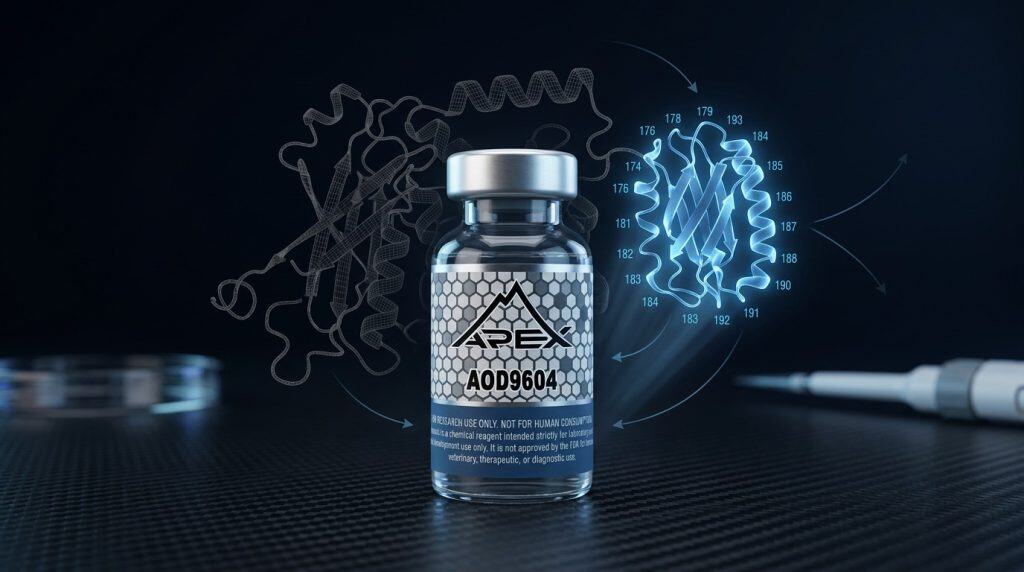
AOD9604 is a synthetic 16-amino-acid peptide built from the C-terminal lipolytic region of human growth hormone — residues 177 to 191 with an added N-terminal tyrosine — commonly written as the modified hGH fragment 176-191. In animal and cell research it is studied for stimulation of fat metabolism and lipolysis that, unlike intact growth hormone, has been reported without raising IGF-1 or impairing glucose control in the models tested.
AOD9604 — the name abbreviates “Anti-Obesity Drug 9604” — is a small synthetic peptide derived from the fat-metabolizing tail of human growth hormone (hGH). The interest behind it is a simple research question: can the lipolytic activity that resides in the C-terminal region of growth hormone be separated from the broader, IGF-1-driven metabolic effects of the whole hormone?[1][2] In preclinical models, AOD9604 and its antecedent analogs reproduced growth hormone’s effect on fat metabolism while, in the systems studied, leaving markers such as IGF-1 and blood glucose largely unchanged.[3][4]
This guide covers AOD9604‘s molecular identity and how it relates to human growth hormone, the lipolytic mechanism it was designed around, the preclinical and human clinical-development record, emerging cartilage research, and how it compares with other metabolic and growth-hormone-axis reagents in the Apex Research Library. Every factual claim is referenced to the primary literature, and AOD9604 is supplied strictly as a research-grade chemical reagent for in-vitro and preclinical investigation — not a drug, supplement, or therapy for human or veterinary use.
AOD9604 at a Glance
- AOD9604 is a synthetic 16-residue peptide: the human growth hormone C-terminal fragment (residues 177–191) with an added N-terminal tyrosine, commonly written as the modified hGH fragment 176-191. Researchers comparing adjacent hGH-fragment reagents can also review HGH Fragment 176-191.
- Its molecular weight is approximately 1,815 g/mol and its CAS number is 221231-10-3 (PubChem CID 71300630).
- It was developed from the lipolytic domain of growth hormone, building on an earlier antecedent analog (AOD9401); the work localized hGH’s fat-metabolizing activity to this C-terminal region.
- In rodent models AOD9604 reduced body fat and stimulated lipolysis and fat oxidation, reportedly without the hyperglycemia, IGF-1 rise, or insulin-related changes associated with intact growth hormone.
- AOD9604 was advanced into human clinical development for obesity by Metabolic Pharmaceuticals and has more recently been studied in cartilage and osteoarthritis models.
- AOD9604 has no FDA-approved drug formulation and is a substance monitored in anti-doping control; Apex supplies it strictly as a ≥99% (HPLC + MS verified) research reagent for in-vitro and preclinical use only.
AOD9604 (Modified hGH Fragment 176-191)
What Is AOD9604? Molecular Identity
AOD9604 is a synthetic peptide of sixteen amino acids. Fifteen of them reproduce the C-terminal sequence of human growth hormone, residues 177 through 191, and a single tyrosine is added at the N-terminus — an addition made to aid synthesis and characterization. Because the numbering is sometimes given inclusively, the molecule is widely catalogued as the “modified hGH fragment 176-191.” The definitive identity description comes from analytical work by Cox and colleagues, who define AOD9604 as the C-terminal hGH fragment (amino acids 177–191) bearing an additional tyrosine.[2] Its molecular weight is approximately 1,815 g/mol, its CAS number is 221231-10-3, and it is catalogued as PubChem CID 71300630.

AOD9604 structure. The modified hGH 176-191 fragment — hGH residues 177–191 plus an N-terminal tyrosine, with a disulfide-bridged loop. Structure image: PubChem CID 71300630, U.S. National Library of Medicine (public domain).
The C-Terminal Lipolytic Domain of Growth Hormone
The biological logic of AOD9604 rests on an older observation: growth hormone’s effect on fat is not spread evenly across the molecule but concentrates in its C-terminal region. Wu and colleagues established that the C-terminal hGH 177–191 fragment carries the antilipogenic activity of the intact hormone,[1] building on foundational work by Ng and colleagues showing that growth hormone inhibits lipogenesis through suppression of acetyl-CoA carboxylase.[5] AOD9604 is, in essence, that lipolytic domain rebuilt as a stand-alone synthetic peptide.
Naming and the AOD9401 Antecedent
AOD9604 did not appear in isolation. It was preceded by AOD9401, an earlier synthetic hGH C-terminal analog used to characterize the lipolytic domain. Studies of AOD9401 reported that the hGH lipolytic-domain peptide reduced lipogenic activity and stimulated hormone-sensitive lipase (HSL) in adipose tissue,[6][7] work that directly informed the design of AOD9604. Keeping the two names distinct matters when reading the literature: some mechanistic findings attributed loosely to “the hGH fragment” were generated with AOD9401, the antecedent, rather than AOD9604 itself.
AOD9604 vs Human Growth Hormone
The entire research rationale for AOD9604 is a separation of activities. Intact human growth hormone is a 191-residue protein with broad metabolic actions, including the IGF-1-mediated growth and the insulin-antagonizing (diabetogenic) effects that complicate its use. AOD9604 was designed to retain the fat-metabolizing activity localized to the C-terminus while leaving those other actions behind.
AOD9604 vs Intact Human Growth Hormone
| Attribute | AOD9604 | Human growth hormone (hGH) |
|---|---|---|
| Size | 16-residue C-terminal fragment analog | 191-residue full protein |
| Reported lipolytic activity | Present (the design objective) | Present (localized to C-terminus) |
| IGF-1 elevation | Not reported in the models studied | Yes (growth-promoting axis) |
| Effect on blood glucose / insulin | Not reported in the models studied | Diabetogenic / insulin-antagonizing |
| Regulatory status | Research-only; no approved drug | Approved hormone (separate framework) |
Discovery and Research History
The AOD9604 story runs from basic endocrinology to a commercial obesity program. The foundational work by Ng and colleagues characterized how growth hormone acts on lipid metabolism;[5] Wu and colleagues then localized the antilipogenic activity to the C-terminal 177–191 fragment.[1] The antecedent analog AOD9401 was used to confirm that a synthetic version of this domain reproduced the lipolytic and antilipogenic effects.[6][7] AOD9604 was subsequently developed and advanced by Metabolic Pharmaceuticals into a human obesity program, a development history documented in the drug-profile and review literature.[8]
Mechanism of Action: Lipolysis Without the Growth-Hormone Side Effects
AOD9604’s mechanism is the lipolytic mechanism of growth hormone’s C-terminus: it shifts adipocyte metabolism toward fat breakdown and oxidation, reportedly without engaging the growth and glucose pathways of the intact hormone in the models studied.
Lipolysis and fat oxidation, reportedly uncoupled from IGF-1 and glucose effects
In adipose-tissue and rodent research models, AOD9604 and its antecedent analog stimulate lipolysis and inhibit lipogenesis — reducing acetyl-CoA carboxylase activity and increasing hormone-sensitive-lipase activity — and increase whole-body fat oxidation. Some studies report changes in beta-3-adrenergic-receptor expression. Distinctively, these fat-metabolism effects were observed without the hyperglycemia, IGF-1 elevation, or insulin-related changes characteristic of intact growth hormone in the systems tested. All findings are from cell-culture and animal research.
Stimulation of Lipolysis and Fat Oxidation
The core activity is a shift in adipocyte energy metabolism. Studies of the hGH lipolytic-domain peptide reported stimulation of hormone-sensitive lipase and suppression of lipogenesis,[7] and chronic AOD9604 treatment reduced body-weight gain by more than half in obese Zucker rats while increasing adipose lipolytic activity.[4] In obese mice, AOD9604 increased fat oxidation and stimulated lipolysis.[3]
Beta-3-Adrenergic Receptor Involvement
Heffernan and colleagues examined the receptor context of these effects, reporting that AOD9604 reduced body weight and body fat in obese mice and increased beta-3-adrenergic receptor (β3-AR) expression, using β3-AR knockout mice to probe the pathway’s contribution; that knockout work indicated the lipolytic action is not mediated directly through the β3-AR.[9] The beta-3-adrenergic system is a recognized regulator of adipose-tissue lipolysis and thermogenesis, which makes it a mechanistically plausible node for a fat-metabolizing peptide.
Reported Lack of Effect on IGF-1, Glucose, and Insulin Secretion
The feature that distinguishes AOD9604 from intact growth hormone in the research literature is what it did not do. Heffernan and colleagues reported that AOD9604 increased fat oxidation and stimulated lipolysis in obese mice without inducing hyperglycemia or reducing insulin secretion,[3] and the obese-Zucker-rat work similarly reported lipolytic effects without the IGF-1-linked growth signaling of the whole hormone.[4] This reported uncoupling — fat metabolism on, growth-and-glucose axis off — is the central reason the fragment was pursued as a research and drug-development candidate, though it should be read strictly as a finding in the specific animal models tested.
Published Research: Key Application Areas
The AOD9604 literature concentrates in metabolic/obesity research, extends into human clinical development, and more recently includes cartilage work. All findings below are research results in cells, animals, or clinical trials of AOD9604 as an investigational agent — not endorsements of any use of the research reagent.
Obesity and Fat-Metabolism Research (Preclinical)
The preclinical obesity record is the foundation. Across mouse and rat models, AOD9604 and the antecedent AOD9401 reduced body fat, stimulated lipolysis and fat oxidation, and suppressed lipogenic activity,[4][3][7] with the beta-3-adrenergic work adding receptor-level context.[9] These rodent results, framed as research findings, established AOD9604’s profile as a fat-metabolizing peptide distinct from growth hormone.
Human Clinical Development
AOD9604 was advanced into human trials for obesity by Metabolic Pharmaceuticals, and the drug-development and review literature documents this program.[8][10][11] The clinical obesity efficacy ultimately did not meet the program’s endpoints, and AOD9604 was not approved as a weight-loss drug — an outcome that is itself part of the factual research record. These references are cited as development history, not as evidence of efficacy.
Osteoarthritis and Cartilage Research
A more recent and distinct line of work examines AOD9604 in joint tissue. Kwon and colleagues studied intra-articular AOD9604, alone and combined with hyaluronic acid, in a rabbit osteoarthritis model, reporting effects on cartilage in that system.[12] This cartilage research is preliminary and mechanistically separate from the metabolic literature; it is noted here as an emerging area rather than an established application.
AOD9604 vs Other Metabolic and GH-Axis Research Peptides
AOD9604 is often studied alongside other peptides in the growth-hormone-axis and metabolic space, which reach their effects through entirely different mechanisms. For broader context see the growth-hormone-axis research peptides hub.
AOD9604 vs CJC-1295 vs Ipamorelin: Mechanistic Contrast
| Attribute | AOD9604 | CJC-1295 | Ipamorelin |
|---|---|---|---|
| Class | hGH C-terminal lipolytic fragment | GHRH-receptor analog | Ghrelin-receptor (GHS-R1a) agonist |
| Primary research focus | Direct adipocyte lipolysis / fat metabolism | Stimulating endogenous GH release (GHRH arm) | Stimulating endogenous GH release (ghrelin arm) |
| Effect on IGF-1 (reported) | Not reported in models studied | Raises GH and IGF-1 | Raises GH (and IGF-1 downstream) |
| Acts via GH release? | No — acts directly on fat metabolism | Yes | Yes |
| Regulatory status | Research-only; no approved drug | Research-only; no approved drug | Research-only; no approved drug |
The key conceptual difference: AOD9604 acts directly on fat metabolism as a fragment of growth hormone, whereas the secretagogues CJC-1295 and Ipamorelin work upstream by stimulating the body’s own growth-hormone release through the GHRH and ghrelin-receptor systems respectively. See the CJC-1295 and Ipamorelin research guides for those mechanisms.
Stability, Handling, and Reconstitution (Research Use)
The guidance below concerns laboratory handling of AOD9604 as a research reagent. Nothing here is a human dosing, administration, or usage instruction; AOD9604 is for in-vitro and preclinical research only.
Lyophilized Storage
Store lyophilized AOD9604 at −20°C, protected from light and moisture. As a disulfide-containing peptide it should be handled to avoid oxidative degradation; well-stored lyophilized material is expected to remain stable over extended periods. See the Apex peptide storage guide.
Reconstitution
AOD9604 dissolves in bacteriostatic water for laboratory preparation. Researchers planning in-vitro concentrations can use the Apex reconstitution calculator and the how to reconstitute peptides protocol; reconstituted solution is held at 2–8°C with freeze-thaw cycling minimized. These tools support laboratory work and contain no human-use directions.
Identity and Purity Verification (COA, HPLC, MS)
Reproducible research depends on confirmed identity, which for AOD9604 includes verifying the intact disulfide-bridged 16-residue sequence against the expected mass near 1,815 g/mol. Apex supplies AOD9604 at ≥99% purity, verified by reversed-phase HPLC and mass spectrometry, with a per-lot certificate of analysis through the lab-verified COA archive; see the primers on how to read a certificate of analysis and HPLC testing for peptide purity.
Regulatory Status
AOD9604 is not an FDA-approved drug and was not approved as a weight-loss therapy. It is a peptide monitored in anti-doping control,[13][14] and recent reviews note it among unapproved peptides marketed direct-to-consumer.[15] These are factual regulatory points. Apex supplies AOD9604 strictly as a research-grade chemical reagent for in-vitro and preclinical work, not for human or veterinary use.
Sourcing Research-Grade AOD9604
For fat-metabolism and growth-hormone-fragment research, AOD9604 should be sourced as documented research-grade material with its identity confirmed by mass spectrometry. Apex supplies AOD9604 as a ≥99%-pure lyophilized peptide, HPLC- and MS-verified, for in-vitro and preclinical use only.
AOD9604 (hGH Fragment 176-191)
Research-grade modified human growth hormone fragment 176-191 — the 16-residue C-terminal lipolytic-domain analog — verified to ≥99% purity by HPLC and mass spectrometry, with a per-lot certificate of analysis. Supplied strictly for in-vitro and preclinical research.
View AOD9604 →Frequently Asked Questions
What is AOD9604?
AOD9604 is a synthetic 16-amino-acid peptide derived from the C-terminal lipolytic region of human growth hormone: residues 177 to 191 with an added N-terminal tyrosine, commonly written as the modified hGH fragment 176-191. It has a molecular weight of about 1,815 g/mol and CAS number 221231-10-3. In research it is studied for stimulating fat metabolism and lipolysis. Apex Laboratory supplies AOD9604 as a research-grade chemical reagent for in-vitro and preclinical research only.
Is AOD9604 the same as HGH or HGH fragment 176-191?
AOD9604 is not human growth hormone; it is a small fragment-based analog of it. Intact hGH is a 191-residue protein, whereas AOD9604 reproduces only the C-terminal lipolytic region (residues 177 to 191) plus an added tyrosine. The names AOD9604 and modified hGH fragment 176-191 refer to the same molecule. The design intent was to keep growth hormone's fat-metabolizing activity while leaving its IGF-1-driven and glucose-related actions behind.
What is the molecular weight and sequence of AOD9604?
AOD9604 has the sequence Tyr-Leu-Arg-Ile-Val-Gln-Cys-Arg-Ser-Val-Glu-Gly-Ser-Cys-Gly-Phe, sixteen residues with an internal cysteine-cysteine disulfide loop, a molecular weight of approximately 1,815.08 g/mol, and CAS number 221231-10-3 (PubChem CID 71300630). Fifteen residues correspond to human growth hormone 177 to 191, with the N-terminal tyrosine added.
How does AOD9604 work?
AOD9604 is built from growth hormone's C-terminal lipolytic domain and is studied for direct effects on fat metabolism. In research models it stimulates lipolysis and fat oxidation and inhibits lipogenesis, with reported changes in beta-3-adrenergic-receptor expression (Heffernan 2001). Distinctively, these effects were observed without raising IGF-1 or impairing glucose control in the animal models tested (Heffernan 2001; Ng 2000). All of these are cell-culture and animal findings, not demonstrated effects in humans.
Does AOD9604 raise IGF-1 or affect blood sugar?
In the published animal research, AOD9604 stimulated fat metabolism without inducing the hyperglycemia, IGF-1 elevation, or insulin-related changes associated with intact growth hormone (Heffernan 2001; Ng 2000). This reported separation of fat-metabolizing activity from the growth and glucose effects of the whole hormone is the central rationale for studying the fragment. These are findings in specific animal models and are not statements about effects in humans.
What is the difference between AOD9604 and AOD9401?
AOD9401 is an earlier antecedent analog of the human growth hormone lipolytic domain that was used to characterize the fragment's fat-metabolizing activity before AOD9604 was developed (Heffernan 2000; Ng 2000). The two are distinct molecules, and some mechanistic findings in the literature were generated with AOD9401 rather than AOD9604. Keeping them separate is important when interpreting the hGH-fragment research record.
Was AOD9604 ever tested in humans?
Yes. AOD9604 was advanced into human clinical development for obesity by Metabolic Pharmaceuticals (Wilding 2004), and it appears in obesity-drug development reviews of the period (Jensen 2006; Khan 2012). The clinical obesity program did not meet its efficacy endpoints and AOD9604 was not approved as a weight-loss drug. These references document development history and are not evidence of efficacy or a basis for any human use.
Has AOD9604 been studied for joints or cartilage?
Yes, in a separate and more recent line of research. Kwon and colleagues studied intra-articular AOD9604, alone and combined with hyaluronic acid, in a rabbit osteoarthritis model (Kwon 2015). This cartilage work is preliminary and mechanistically distinct from the metabolic literature, and it is described here as an emerging research area rather than an established application.
How is AOD9604 stored and reconstituted for research?
Lyophilized AOD9604 is stored at minus 20 degrees Celsius, protected from light and moisture, with care to avoid oxidative degradation of its disulfide bond. For laboratory use it dissolves in bacteriostatic water; reconstituted material is held at 2 to 8 degrees Celsius with freeze-thaw cycling minimized, and longer-term aliquots are frozen at minus 20 degrees Celsius. These are laboratory-handling conventions only and are not a human dosing or administration instruction.
Is AOD9604 approved or legal?
AOD9604 is not approved by the FDA, EMA, or any other regulatory authority as a drug and was not approved as a weight-loss therapy. It is a peptide monitored in anti-doping control (Thevis 2014). The research-grade AOD9604 supplied by Apex Laboratory is intended strictly for in-vitro and preclinical laboratory research and is not for human or veterinary consumption or any clinical use.
How is research-grade AOD9604 purity verified?
Research-grade AOD9604 is characterized by reversed-phase HPLC, which quantifies purity by separating the intended peptide from synthesis byproducts, and by mass spectrometry, which confirms identity against the expected mass near 1,815 g/mol, including the intact disulfide-bridged sequence. Apex supplies AOD9604 at greater-than-or-equal-to 99 percent purity with a per-lot certificate of analysis available through its lab-verified archive.
Continue Your Research
Related Metabolic & GH-Axis Research Guides
Growth-Hormone-Axis Research Peptides
The cluster hub situating AOD9604 among growth-hormone-axis and metabolic research reagents.
Open HubIpamorelin Research Guide
The selective ghrelin-receptor agonist studied for stimulating endogenous growth-hormone release.
Read GuideCJC-1295 Research Guide
The GHRH-receptor analog studied as the GHRH arm of growth-hormone secretagogue research.
Read GuideIGF-1 LR3 Research Guide
The long-acting IGF-1 analog studied downstream of the growth-hormone axis.
Read GuideReferences
All citations were verified against the published record via the NCBI E-utilities API for existence, correct attribution, and support of the associated claim. Each links to its PubMed record.
- Wu Z, Ng FM Antilipogenic action of synthetic C-terminal sequence 177-191 of human growth hormone. Biochem Mol Biol Int. 1993;30(1):187-96. PMID: 8358331
- Cox HD, Smeal SJ, Hughes CM, Cox JE, Eichner D Detection and in vitro metabolism of AOD9604. Drug Test Anal. 2015;7(1):31-8. PMID: 25208511
- Heffernan MA, Thorburn AW, Fam B, Summers R, Conway-Campbell B, Waters MJ, et al. Increase of fat oxidation and weight loss in obese mice caused by chronic treatment with human growth hormone or a modified C-terminal fragment. Int J Obes Relat Metab Disord. 2001;25(10):1442-9. PMID: 11673763
- Ng FM, Sun J, Sharma L, Libinaka R, Jiang WJ, Gianello R Metabolic studies of a synthetic lipolytic domain (AOD9604) of human growth hormone. Horm Res. 2000;53(6):274-8. PMID: 11146367
- Ng FM, Adamafio NA, Graystone JE Effects of exogenous growth hormone on lipid metabolism in the isolated epididymal fat pad of the growth hormone-deficient little mouse. J Mol Endocrinol. 1990;4(1):43-9. PMID: 1969738
- Heffernan MA, Jiang WJ, Thorburn AW, Ng FM Effects of oral administration of a synthetic fragment of human growth hormone on lipid metabolism. Am J Physiol Endocrinol Metab. 2000;279(3):E501-7. PMID: 10950816
- Ng FM, Jiang WJ, Gianello R, Pitt S, Roupas P Molecular and cellular actions of a structural domain of human growth hormone (AOD9401) on lipid metabolism in Zucker fatty rats. J Mol Endocrinol. 2000;25(3):287-98. PMID: 11116208
- Wilding J AOD-9604 Metabolic. Curr Opin Investig Drugs. 2004;5(4):436-40. PMID: 15134286
- Heffernan M, Summers RJ, Thorburn A, Ogru E, Gianello R, Jiang WJ, et al. The effects of human GH and its lipolytic fragment (AOD9604) on lipid metabolism following chronic treatment in obese mice and beta(3)-AR knock-out mice. Endocrinology. 2001;142(12):5182-9. PMID: 11713213
- Jensen MD Potential role of new therapies in modifying cardiovascular risk in overweight patients with metabolic risk factors. Obesity (Silver Spring). 2006;14 Suppl 3:143S-149S. PMID: 16931496
- Khan A, Raza S, Khan Y, Aksoy T, Khan M, Weinberger Y, et al. Current updates in the medical management of obesity. Recent Pat Endocr Metab Immune Drug Discov. 2012;6(2):117-28. PMID: 22435392
- Kwon DR, Park GY Effect of Intra-articular Injection of AOD9604 with or without Hyaluronic Acid in Rabbit Osteoarthritis Model. Ann Clin Lab Sci. 2015;45(4):426-32. PMID: 26275694
- Thevis M, Schänzer W Analytical approaches for the detection of emerging therapeutics and non-approved drugs in human doping controls. J Pharm Biomed Anal. 2014;101:66-83. PMID: 24906629
- Thevis M, Thomas A, Schänzer W Detecting peptidic drugs, drug candidates and analogs in sports doping: current status and future directions. Expert Rev Proteomics. 2014;11(6):663-73. PMID: 25382550
- Mendias CL, Awan TM Safety and Efficacy of Approved and Unapproved Peptide Therapies for Musculoskeletal Injuries and Athletic Performance. Sports Med. 2026. PMID: 41966639
Research Use Disclaimer
All AOD9604 products and the information in this guide are intended strictly for in-vitro and preclinical laboratory research. AOD9604 is a research-grade chemical reagent and is not a drug, dietary supplement, or therapeutic product. It is not approved by the FDA, EMA, or any other regulatory authority for therapeutic use, was not approved as a weight-loss therapy, and is monitored in anti-doping control. It is not for human or veterinary consumption, diagnosis, treatment, or any clinical use. The mechanistic, metabolic, clinical-development, and cartilage findings summarized here derive from cell-culture, animal-model, and investigational-drug studies; they are presented for research context only and do not constitute therapeutic, efficacy, or safety claims. Researchers are responsible for compliance with all applicable institutional, local, and national regulations governing the acquisition, handling, and use of research chemicals.