
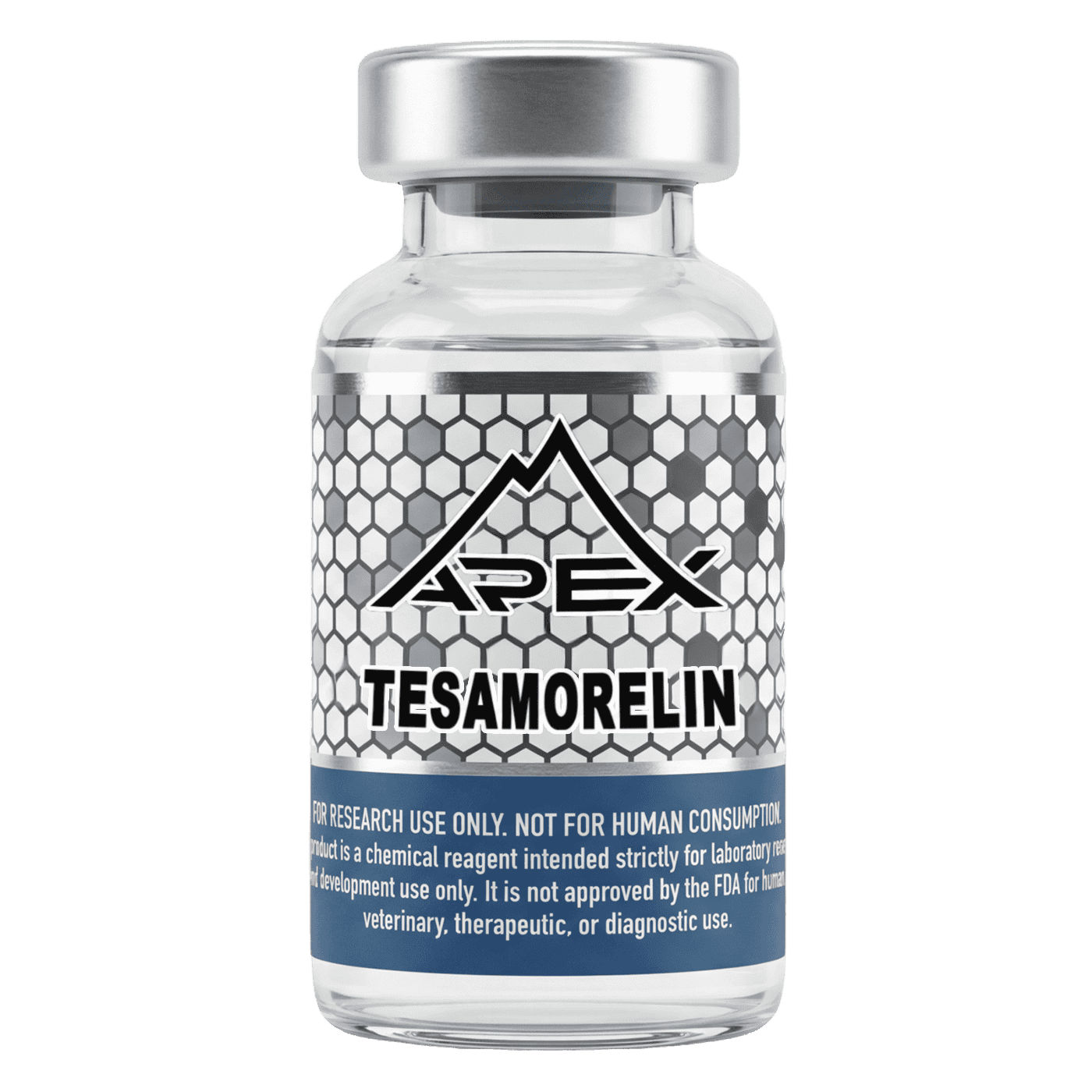
Certificate of Analysis — Tesamorelin 10mg
GHRH analog – CAS 218949-48-5
Verified by Apex Laboratory in-house HPLC (purity by 220 nm peak area) and ESI mass spectrometry (mass identity confirmation). Data on this page describes the current shipping lot.
- Purity (HPLC, area %): 99.51%
- Mass found (ESI-MS): 5135.78 Da
- Mass expected: 5135.85 Da
- HPLC retention time: 18.0 min
- Batch ID: APX-2026-0414-T
- Test date: April 14, 2026
- Analyst: K. Norwood
View Tesamorelin 10mg on the Lab Verified COA archive · Read the Tesamorelin Research Guide
Tesamorelin is a synthetic, stabilized analog of growth-hormone-releasing hormone, GHRH(1-44), supplied by Apex Laboratory as a high-purity research peptide. The HPLC chromatogram and mass spectrometry summary displayed above are drawn from the lot currently shipping (batch APX-2026-0414-T) — not a stock graphic or a representative example. There is no email gate or document request: the analytical data you see is the data for the vial you receive.
This material is offered strictly for in-vitro laboratory research and development. It is not approved for human consumption, veterinary use, or any therapeutic application.
Compound Overview
Tesamorelin is a 44-residue peptide built on the sequence of GHRH(1-44), the hypothalamic releasing factor studied for its role at the GHRH receptor. The single defining modification is an N-terminal acylation: a trans-3-hexenoyl group is attached to the tyrosine-1 residue. Unmodified GHRH is a notoriously short-lived peptide in vitro because dipeptidyl peptidase-4 (DPP-4) rapidly cleaves the Tyr1–Ala2 bond at the N-terminus, abolishing receptor activity within minutes of incubation. The hexenoic acid cap sterically protects that scissile bond, and this single change is what separates tesamorelin from the unmodified parent peptide in benchtop stability assays.
Mechanistically, tesamorelin is characterized as an agonist at the GHRH receptor (GHRHR), a class B G-protein-coupled receptor used as a model target in pituitary-cell and recombinant-receptor systems. In these in-vitro models, receptor engagement is reported to activate adenylate cyclase and raise intracellular cAMP, the canonical second-messenger readout for this receptor class. Because the molecule acts at the receptor level rather than as an exogenous hormone, it is studied as a tool for probing GHRHR coupling and downstream signaling in cell-based assays. This places it in the GHRH-analog family alongside sermorelin (a truncated GHRH(1-29) fragment) and the CJC-1295 analogs; what distinguishes tesamorelin is that it retains the full 44-residue backbone, giving it a receptor-binding profile closest to the natural ligand while still carrying a stabilizing modification.
Research Background & Published Literature
Tesamorelin is among the more thoroughly characterized GHRH analogs in the published pharmacology record, and its in-vitro behavior at the GHRH receptor has been studied extensively. The peer-reviewed literature documents its structure, its resistance to DPP-4 cleavage relative to the unmodified parent peptide, and its GHRHR-mediated cAMP signaling profile in cell-based systems. Apex’s research-grade material is supplied for in-vitro use only; it is not a clinical or pharmaceutical product and carries no human-use authorization. The references below are provided purely for structural and mechanistic context.
Researchers exploring the published literature on this compound can review the following sources for additional context on its structure, GHRH-receptor signaling, and experimental applications in controlled laboratory settings:
- PubMed — tesamorelin GHRH receptor signaling (literature search)
- PubChem — tesamorelin compound record and structural data
Technical Specifications
| Product Name | Tesamorelin |
| Other Names | Tesamorelin acetate; TH9507; stabilized GHRH(1-44) analog |
| Classification | Modified GHRH receptor (GHRHR) agonist — growth hormone secretagogue |
| CAS Number | 218949-48-5 |
| Molecular Formula | C₂₂₁H₃₆₆N₇₂O₆₇S |
| Molecular Weight | 5135.9 g/mol |
| Sequence / Structure | 44-amino-acid GHRH(1-44) backbone with N-terminal trans-3-hexenoyl modification at Tyr1 |
| Purity Specification | ≥99% (HPLC + MS verified — see chromatogram above; this lot 99.51%) |
| Physical Form | Lyophilized (freeze-dried) powder · sealed glass vial |
| Recommended Diluent | Bacteriostatic water or sterile laboratory-grade water |
| Available Sizes | 2mg · 5mg · 10mg · 20mg |
| Intended Use | In-vitro research only — not for human consumption |
Storage, Handling & Stability
As a 44-residue peptide carrying a labile N-terminal modification, tesamorelin is best protected by keeping the lyophilized powder cold and dry until the moment of use. Store sealed vials at -20°C for long-term stability, shielded from light and humidity. Once reconstituted with a sterile laboratory diluent, hold the solution at 2–8°C and aliquot working volumes so the stock is not subjected to repeated freeze-thaw, which is a primary driver of aggregation and N-terminal degradation in GHRH-class peptides.
- Reconstitute gently by directing the diluent against the vial wall; avoid vigorous shaking, which can shear and denature the peptide chain.
- Minimize time at room temperature during weighing and handling to limit hydrolysis of the hexenoyl-protected N-terminus.
- Reseal the vial promptly after each withdrawal to keep the lyophilizate dry and away from atmospheric moisture.
- Label every aliquot with compound name, concentration, reconstitution date, and operator initials for complete lot traceability, and follow your institution’s chemical safety protocols with appropriate PPE.
Quality Assurance & Analytical Verification
Every tesamorelin lot is released only after a two-step analytical workup, and the results for the current batch are published directly to this page rather than held behind a request form. High-Performance Liquid Chromatography establishes chromatographic purity — this lot resolved as a single dominant peak at a retention time near 18.0 minutes, consistent with the moderate hydrophobicity expected from the N-terminal hexenoyl cap — while mass spectrometry confirms molecular identity against the calculated mass.
At roughly 5,136 Da, tesamorelin is large enough that electrospray ionization (ESI+) generates a family of multiply-charged ions rather than a single protonated molecule. Identity is confirmed by deconvoluting that charge-state envelope back to one parent mass: this batch returned a measured mass of 5135.78 against an expected 5135.85, well within tolerance for an intact peptide of this size. Cross-checking several charge states that all reconstruct to the same neutral mass is a more rigorous identity test than reading a single ion, and is standard practice for peptides above ~3,000 Da. For the underlying method, see our guide on mass spectrometry for peptide verification, and browse released batch reports in the Lab Verified archive.
Frequently Asked Questions
What distinguishes tesamorelin from sermorelin and other GHRH analogs?
Tesamorelin retains the complete 44-residue GHRH(1-44) backbone, whereas sermorelin is a truncated GHRH(1-29) fragment containing only the minimum sequence needed for receptor activity. Tesamorelin also adds a trans-3-hexenoyl group at the N-terminus to resist DPP-4 cleavage. The result is a longer, full-length analog with greater in-vitro enzymatic stability than the unmodified parent peptide. The Tesamorelin vs Sermorelin comparison guide covers these structural differences in detail.
Why does tesamorelin have such a high molecular weight?
At 5135.9 g/mol it is one of the larger peptides in the GHRH class because it carries all 44 amino acids of the GHRH(1-44) sequence plus the N-terminal hexenoic acid modification, rather than the shortened 29-residue sequence used by smaller analogs. The extra length and the acyl cap together account for the mass observed in the chromatogram and the mass spectrum above.
How should this compound be reconstituted for in-vitro work?
The lyophilized powder is typically brought into solution with bacteriostatic water or sterile laboratory-grade water, added slowly down the vial wall and swirled rather than shaken. To calculate mg/mL and mcg/mL from your vial mass and chosen solvent volume, use the peptide reconstitution calculator. Concentrations and protocols are determined by your own experimental design.
What does the trans-3-hexenoic acid modification actually do?
In benchtop stability assays, the unmodified GHRH peptide is inactivated almost immediately by DPP-4, which cleaves the bond between the first two residues. The hexenoyl group esterified to the N-terminal tyrosine shields that cleavage site, slowing enzymatic degradation and extending the measured in-vitro half-life of the molecule in the experimental systems where it is characterized. It is a stability modification, not a change to the receptor-binding pharmacophore.
Is this product approved for human use?
No. All compounds sold by Apex Laboratory are classified as chemical research reagents intended strictly for in-vitro laboratory research. They are not approved for human consumption, veterinary use, or any therapeutic application. The research-grade material supplied here is a chemical reagent only and carries no human-use authorization of any kind. Purchasers who imply intended bodily use will have their orders cancelled and their accounts permanently suspended.
Where can I see the Certificate of Analysis for this batch?
It is published at the top of this page. The HPLC purity value, the retention time, the measured-versus-expected mass, and the analyst signoff for the current shipping lot (APX-2026-0414-T) are all visible without a login or email request. For prior lots, see the Lab Verified archive or request specific batch documentation through our contact page.
Related Research Compounds
Researchers studying GHRH-receptor signaling and the growth hormone axis may also be interested in related compounds from Apex Laboratory: Sermorelin Acetate (GHRH(1-29) fragment), CJC-1295 No DAC, CJC-1295 with DAC, and the growth hormone secretagogue Ipamorelin. For the broader category, see the Growth Hormone Peptides pillar guide, or browse the full Apex Laboratory research catalog.
Shipping, Packaging & Delivery
Domestic orders confirmed before 2:00 PM Eastern Time on a business day are dispatched the same day through tracked US carriers. Each tesamorelin vial travels in insulated, temperature-conscious packaging built to keep the lyophilizate stable in transit. As soon as the parcel arrives, move the vial into -20°C storage. If your protocol is time-sensitive or you need a specific delivery window, reach out ahead of ordering and our team will help coordinate the timing around your lab schedule.
Research Use Disclaimer
For in-vitro research use only. Not for human consumption. All products sold by Apex Laboratory — including Tesamorelin — are intended exclusively for qualified researchers, accredited laboratories, and educational institutions. This research-grade tesamorelin is supplied as a chemical reagent and is not a pharmaceutical product; it carries no human-use or veterinary authorization. Purchasers assume full responsibility for safe handling, proper storage, and compliance with all applicable federal, state, and local laws, regulations, and institutional policies governing the purchase and use of chemical research reagents.

Reviews
There are no reviews yet.