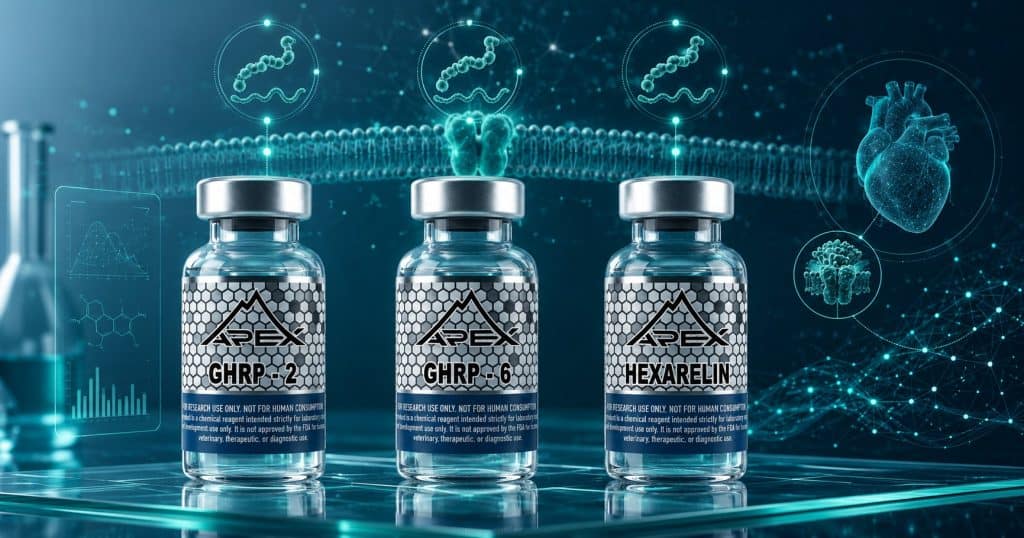
GHRP-2, GHRP-6, and Hexarelin are three synthetic hexapeptide growth hormone secretagogues that act as agonists of the ghrelin receptor (GHSR-1a) and trace to Cyril Bowers’ growth-hormone-releasing peptide research. GHRP-6 most strongly drives ghrelin-like appetite signaling, GHRP-2 (pralmorelin) is studied as a pituitary GH-secretion diagnostic agent, and Hexarelin shows the highest GHSR potency plus distinct CD36-mediated cardiac binding, with all three supplied as research-grade reagents for in-vitro and preclinical use only.
GHRP-2, GHRP-6, and Hexarelin are three synthetic hexapeptides that a researcher will repeatedly encounter together, because they belong to the same pharmacological family: the growth-hormone-releasing peptides (GHRPs). Each is a ghrelin mimetic — an agonist of the growth hormone secretagogue receptor type 1a (GHSR-1a), the pituitary and hypothalamic receptor cloned in 1996[1] whose endogenous ligand, ghrelin, was identified three years later.[2] They share a core mechanism, yet diverge in potency, appetite signaling, cross-axis hormone effects, and — in Hexarelin’s case — a second receptor entirely.
This guide compares the three side by side for laboratory context: their shared ghrelin-receptor mechanism, the Cyril Bowers discovery lineage they descend from, the residue-level structural differences that distinguish them, and the research profile of each. The three sit within the broader Apex growth hormone axis research peptides cluster, and all are supplied strictly as research-grade chemical reagents for in-vitro and preclinical investigation — not as drugs, dietary products, or therapies for human or veterinary use. The comparison table below is the primary quick-reference; the sections that follow expand each row.
GHRP-2 vs GHRP-6 vs Hexarelin at a Glance
- All three are synthetic hexapeptide ghrelin-receptor (GHSR-1a) agonists from the Cyril Bowers GHRP discovery lineage; GHRP-6 is the parent compound and GHRP-2 and Hexarelin are later super-analogs.
- They differ at position 2: GHRP-6 has D-Trp, GHRP-2 has D-2-naphthylalanine (D-2-Nal), and Hexarelin has 2-methyl-Trp — substitutions that track with potency and metabolic stability differences in preclinical research.
- GHRP-6 shows the most pronounced ghrelin-like appetite and food-intake stimulation in animal models, activating hypothalamic feeding centers.
- GHRP-2 (pralmorelin) is characterized in clinical research as a pituitary GH-secretion provocative/diagnostic agent and also raises food intake like ghrelin.
- Hexarelin shows the highest GHSR potency among the classic GHRPs and a distinct non-GHSR cardiac mechanism via scavenger receptor CD36, with partial, reversible receptor desensitization on repeated exposure.
- Unlike the selective secretagogue Ipamorelin, GHRP-2 and GHRP-6 can stimulate ACTH, cortisol, and prolactin in human research — a non-selectivity consideration; all three are research-use-only reagents with no approved formulation.
GHRP-2 vs GHRP-6 vs Hexarelin
Shared Mechanism: The Ghrelin Receptor (GHSR-1a)
Everything that GHRP-2, GHRP-6, and Hexarelin have in common begins at a single molecular target. Each binds and activates the growth hormone secretagogue receptor type 1a (GHSR-1a), a G-protein-coupled receptor cloned by Howard and colleagues in 1996 from pituitary and hypothalamus and shown to function in growth hormone release.[1] At the time the receptor was identified, its natural ligand was unknown; the synthetic GHRPs were the tools that revealed it existed.
GHRP binding → GHSR-1a activation → pituitary GH release (Hexarelin also → CD36)
GHRP-2, GHRP-6, and Hexarelin are synthetic ghrelin mimetics that bind and activate the growth hormone secretagogue receptor type 1a (GHSR-1a), the G-protein-coupled receptor cloned from pituitary and hypothalamus and shown to function in GH release. Activating GHSR-1a on pituitary somatotrophs drives growth hormone secretion, an action that synergizes with the distinct GHRH receptor pathway. The endogenous ligand of GHSR-1a is ghrelin, which is why all three peptides are described as ghrelin mimetics. Hexarelin additionally engages the scavenger receptor CD36 in the myocardium, a GH-independent interaction not shared by the GHRH-analog secretagogues. All steps are characterized in receptor-biology, cell, and animal systems. Howard et al. (1996), Science.
From an orphan receptor to ghrelin
The endogenous ligand was filled in by Kojima and colleagues in 1999, who isolated ghrelin — an acylated 28-amino-acid peptide from stomach — and identified it as the natural agonist of the GHSR.[2] This is the fact that makes all three GHRPs “ghrelin mimetics”: they are synthetic peptides that engage the same receptor as the natural hormone, which is why their downstream GH-releasing actions overlap so strongly in the research literature.
Receptor characterization and tissue distribution
The receptor pharmacology underpinning the GHRPs was refined through photoaffinity-labeling work that identified a pituitary GHRP receptor subtype, part of the receptor-characterization lineage that grounds the class. Gnanapavan and colleagues subsequently mapped GHSR mRNA distribution in humans, reporting that GHSR-1a is predominantly expressed in the pituitary, with lower expression in peripheral tissues including the myocardium.[3] That anatomy is the structural basis for the central GH-secretion action the three peptides share — and a hint, expanded later, that peripheral actions may run through targets other than GHSR-1a. A historical appraisal by Berlanga-Acosta and colleagues frames the family as having dual-receptor pharmacology, engaging both GHSR-1a and the scavenger receptor CD36 across preclinical models.[4] These are characterizations from receptor-biology and animal research, not clinical claims.
Discovery Lineage: Cyril Bowers and the Birth of the GHRPs
The three peptides are not independent inventions; they are points on a single research trajectory that began before the ghrelin receptor was even known to exist. The originating insight came from Cyril Y. Bowers and Frank Momany, whose structure-activity work derived growth-hormone-releasing peptides from analogs of the opioid peptide met-enkephalin.
The Momany–Bowers enkephalin-analog origin
Momany, Bowers, and colleagues reported the design, synthesis, and biological activity of peptides that release growth hormone in vitro, the foundational structure-activity study that defined the GHRP concept.[5] That work established that small synthetic peptides could specifically trigger GH release — a finding that seeded the entire class.
The prototype hexapeptide: the GHRP-6 scaffold
The prototype that became GHRP-6 was characterized by Bowers and colleagues in 1984, who described a new synthetic hexapeptide (His-D-Trp-Ala-Trp-D-Phe-Lys-NH2) that acts on the pituitary to specifically release growth hormone in vitro and in vivo.[6] This hexapeptide scaffold is the structural parent from which GHRP-2 and Hexarelin were later engineered as super-analogs.
Confirmation in human physiology
The pathway was validated in human research by Bowers and colleagues in 1990, who reported that GHRP-6 stimulates GH release in normal men and acts synergistically with growth-hormone-releasing hormone (GHRH).[7] The synergy point matters for interpretation: GHRPs and GHRH act through distinct receptors, so the two together produce a larger GH response than either alone — a distinction that recurs across the GH-axis literature. Readers comparing the GHRP (ghrelin-receptor) arm with the GHRH-analog arm of the axis may consult the Apex Sermorelin vs CJC-1295 comparison and the CJC-1295 research guide.
Structural Differences Across the Three Hexapeptides
Although the three peptides converge on one receptor, their differences are written into their sequences. All three are C-terminally amidated hexapeptides built on the same general framework, and the most informative comparison is residue-by-residue — especially at position 2, where each carries a different aromatic substitution.
Three sequences, one scaffold
GHRP-6, the parent, is His-D-Trp-Ala-Trp-D-Phe-Lys-NH2.[6] GHRP-2 (pralmorelin) is D-Ala-D-2-Nal-Ala-Trp-D-Phe-Lys-NH2, with molecular formula C45H55N9O6, a molecular weight near 817.97 g/mol, and CAS number 158861-67-7 (PubChem CID 6918245). Hexarelin is His-D-2-methyl-Trp-Ala-Trp-D-Phe-Lys-NH2, with a free-base molecular weight near 887.04 g/mol and CAS number 140703-51-1 (PubChem CID 6918297). The position-4 Trp, position-5 D-Phe, and position-6 Lys-amide are shared across the family; the divergence sits chiefly at positions 1 and 2.
Position-2 substitutions and metabolic stability
The position-2 residue is the design variable. GHRP-6 carries D-tryptophan; GHRP-2 substitutes D-2-naphthylalanine (D-2-Nal); and Hexarelin substitutes 2-methyl-tryptophan, a modification introduced specifically to improve metabolic stability. Deghenghi and colleagues introduced Hexarelin precisely as this 2-methyl-Trp analog and characterized its GH-releasing activity in infant and adult rats.[8] These structural distinctions are the molecular basis for the potency and stability differences detailed in the per-compound sections that follow; the formula and mass values here are catalog and PubChem references and should be confirmed against the lot-specific certificate of analysis before use.
GHRP-6 Research Profile: The Ghrelin-Like Appetite Signal
As the parent compound, GHRP-6 is the reference point for the family, and its most distinctive research signature is not its GH release but its appetite effect. Of the three peptides, GHRP-6 is the one most consistently associated in the literature with pronounced ghrelin-like food-intake stimulation.
Activation of hypothalamic appetite centers
Lawrence and colleagues reported that acute central administration of ghrelin and GH secretagogues, including GHRP-6, induces feeding and activates brain appetite centers in rodent models.[9] The activation of hypothalamic feeding circuitry is the mechanistic correlate of GHRP-6’s orexigenic reputation and mirrors the action of the natural ligand ghrelin. This is a preclinical, animal-model finding and is not a claim about appetite effects in humans.
GH release and synergy with GHRH
On the growth-hormone side, GHRP-6 is the compound in which the GHRP–GHRH synergy was first demonstrated in humans, releasing GH and amplifying the GHRH response.[7] Like the other classic GHRPs, GHRP-6 is not purely GH-selective: human research on GHRP-6 documents stimulation of prolactin and cortisol alongside the GH response,[7] and additional ACTH stimulation is inferred at the family level from comparative GHRP-2/Hexarelin research.[10] That cross-axis activity, examined in detail later, is a defining property of the classic GHRPs and a key contrast with selective secretagogues.
GHRP-2 (Pralmorelin) Research Profile: GH-Secretion Diagnostic Agent
GHRP-2, assigned the generic name pralmorelin and the development codes KP-102 and GPA-748, occupies a distinct niche within the family: it is the GHRP most developed as a research and clinical-research diagnostic tool for pituitary GH secretion. A drug-profile monograph on pralmorelin documents this development trajectory and the compound’s several alternative designations.[11]
High GH-releasing potency in preclinical pharmacology
Furuta and colleagues characterized the general pharmacology of KP-102 (GHRP-2) as a potent GH-releasing peptide across preclinical assays, establishing the high-potency profile that motivated its diagnostic development.[12] The potency is what makes it a useful provocative agent: a robust, reproducible GH rise is exactly what a diagnostic stimulation test requires.
A pituitary GH-secretion provocative test
Chihara and colleagues described a simple diagnostic test using GH-releasing peptide-2 in adult GH deficiency, in which GHRP-2 provokes a sharp GH rise in subjects with intact pituitary function and a markedly blunted response in GH-deficient subjects.[13] This is the property that distinguishes GHRP-2’s research role from that of GHRP-6 and Hexarelin; it is described here strictly as a clinical-research diagnostic use, and Apex supplies GHRP-2 only as a research reagent, not as a diagnostic product.
The shared orexigenic dimension
GHRP-2 is not exclusively a GH agent, however. Laferrère and colleagues reported that GHRP-2, like ghrelin, increases food intake in healthy men, demonstrating that the orexigenic dimension so prominent in GHRP-6 is also present in GHRP-2.[14] The two peptides differ in emphasis rather than in kind on the appetite axis, consistent with their shared ghrelin-mimetic identity.
Hexarelin Research Profile: Highest GHSR Potency and Receptor Desensitization
Hexarelin is the most pharmacologically aggressive of the three at the ghrelin receptor and, partly as a consequence, the one with the most distinctive handling considerations. Its 2-methyl-Trp substitution at position 2 confers both high potency and metabolic stability relative to the parent GHRP-6.
High GH-releasing potency in animal and human research
In its introductory characterization, Deghenghi and colleagues reported Hexarelin’s GH-releasing activity in infant and adult rats, finding it as effective as GHRP-6 and slightly more effective on subcutaneous administration.[8] Imbimbo and colleagues conducted a placebo-controlled dose-response study of Hexarelin’s GH-releasing activity in healthy human subjects, reporting a dose-dependent GH rise.[15] The cross-species potency is one reason Hexarelin became a heavily studied research tool for probing the GH axis.
Partial, reversible receptor desensitization
High receptor affinity carries a corollary that distinguishes Hexarelin from the other two in a practical sense. Rahim and colleagues addressed the question “does desensitization to hexarelin occur?” and reported that repeated Hexarelin exposure produces partial, reversible attenuation of the GH response.[16] For researchers, this receptor-desensitization behavior is a study-design consideration unique among the three: experimental schedules that involve repeated exposure may see a diminishing GH response that is a property of the receptor system, not of reagent quality. Like the other classic GHRPs, Hexarelin also produces the cross-axis prolactin, ACTH, and cortisol stimulation documented in the comparative human literature.[10]
The Hexarelin Exception: CD36 and Non-GHSR Cardiac Effects
The single biggest divergence in this comparison is not a matter of degree but of mechanism: Hexarelin engages a second receptor that the GH-axis story does not require at all. Where GHRP-2 and GHRP-6 are studied almost entirely through the GHSR-1a lens, Hexarelin has an extensively characterized non-GHSR cardiac dimension.
GHRP-2 vs GHRP-6 vs Hexarelin (with Ipamorelin reference)
| Attribute | GHRP-2 (Pralmorelin) | GHRP-6 | Hexarelin |
|---|---|---|---|
| Sequence | D-Ala-D-2-Nal-Ala-Trp-D-Phe-Lys-NH2 | His-D-Trp-Ala-Trp-D-Phe-Lys-NH2 (parent) | His-D-2-methyl-Trp-Ala-Trp-D-Phe-Lys-NH2 |
| Position-2 residue | D-2-naphthylalanine (D-2-Nal) | D-tryptophan (D-Trp) | 2-methyl-tryptophan (stability-enhancing) |
| Molecular weight / CAS | 817.97 g/mol / 158861-67-7 | 873.01 g/mol / 87616-84-0 | 887.04 g/mol (free base) / 140703-51-1 |
| PubChem CID | 6918245 | 4345065 | 6918297 |
| GHSR-1a potency (classic GHRPs) | High GH-releasing potency | Moderate (parent reference compound) | Highest among classic GHRPs in early reports |
| Appetite / food-intake signal | Increases food intake like ghrelin (human research) | Most pronounced; activates hypothalamic feeding centers | Ghrelin-mimetic; appetite less emphasized than GHRP-6 |
| Cortisol / ACTH / prolactin | Slight stimulation reported (non-selective) | Slight stimulation reported (non-selective) | Slight stimulation reported (non-selective) |
| Distinctive feature | Studied as a pituitary GH-secretion diagnostic agent (pralmorelin) | Strongest ghrelin-like appetite signal; the parent GHRP | Highest potency + CD36 cardiac binding + receptor desensitization |
| Reference: Ipamorelin (selective) | Pentapeptide Aib-His-D-2-Nal-D-Phe-Lys-NH2; releases GH without raising ACTH/cortisol above GHRH levels | — | — |
| Research role | GH-secretion provocative/diagnostic research tool | Appetite-signaling and GH-axis research reference | High-potency GH-axis + GH-independent cardiac research tool |
| Regulatory status | Research-only; diagnostic registration in Japan only, no US formulation | Research-only; no approved formulation | Research-only; no approved formulation |
CD36 as a second, GH-independent target
Bodart and colleagues reported that the scavenger receptor CD36 — not GHSR-1a — mediates the cardiovascular action of growth-hormone-releasing peptides in the heart.[17] This is a genuinely distinct receptor interaction: CD36 is a fatty-acid-translocase and scavenger receptor expressed in myocardium, and its engagement by GHRPs is independent of the GH-releasing pathway. Demers and colleagues subsequently mapped the GHRP binding site on CD36 by photoaffinity cross-linking, molecularly defining the interaction at the protein level.[18]
GH-independent cardioprotection in preclinical and human research
The functional consequence of CD36 engagement has been studied directly. Locatelli and colleagues reported growth-hormone-independent cardioprotective effects of Hexarelin in the rat, demonstrating that the cardiac action persists where the GH pathway is excluded.[19] Broglio and colleagues extended this into human-research populations, reporting GH-independent cardiotropic activities of GHRPs in normal subjects, GH-deficient subjects, and patients with dilated cardiomyopathy.[20] A review by Mao and colleagues synthesizes Hexarelin’s combined GHSR- and CD36-mediated cardiovascular actions across preclinical and translational research. Every one of these is a preclinical or human-research finding reported as research context; none establishes a therapeutic effect, and none applies to the research-grade reagent as anything other than experimental subject matter.
Cross-Axis Effects: Cortisol, ACTH, and Prolactin
A recurring theme across this comparison is that the classic GHRPs are not GH-selective. Beyond growth hormone, they engage the hypothalamic-pituitary-adrenal (HPA) axis and the lactotroph (prolactin) system, and this non-selectivity is a defining feature that the comparison table summarizes and the next section sharpens against a selective benchmark.
The direct human comparison
The clearest single source is Arvat and colleagues, who compared GHRP-2 and Hexarelin in man against GHRH, TRH, and hCRH. They reported that both GHRP-2 and Hexarelin release more GH than GHRH and also produce slight stimulation of prolactin, ACTH, and cortisol.[10] The word “slight” matters: the cross-axis effect is modest relative to the GH response, but it is reproducible and is the property that defines these peptides as non-selective secretagogues. GHRP-6, the parent, shares this cross-axis profile, consistent with the family acting through a common receptor system.[7]
Why cross-axis activity matters for research design
For a researcher selecting among these reagents, the cross-axis signature is an experimental variable, not a side-effect: a study reading out ACTH, cortisol, or prolactin must account for the fact that GHRP-2, GHRP-6, and Hexarelin all perturb those readouts, whereas a selective agonist would not. This is the practical meaning of “selectivity” in the GH-secretagogue field, and it sets up the Ipamorelin contrast that follows.
Contrast With the Selective Secretagogue Ipamorelin
The three classic GHRPs are best understood against a benchmark that does what they do at GHSR-1a without the cross-axis baggage. That benchmark is Ipamorelin, the compound that defined what “selective” means in this peptide family.
The first selective growth hormone secretagogue
Raun and colleagues introduced Ipamorelin as the first selective growth hormone secretagogue, reporting that it releases GH without raising ACTH or cortisol above the levels produced by GHRH itself.[21] Structurally Ipamorelin is a pentapeptide (Aib-His-D-2-Nal-D-Phe-Lys-NH2), one residue shorter than the hexapeptide GHRPs, and that design achieves GHSR-1a agonism while leaving the HPA axis essentially undisturbed.
What the contrast clarifies
Placed against Ipamorelin, the three classic GHRPs are defined by what they additionally do: GHRP-2, GHRP-6, and Hexarelin all stimulate the HPA axis and prolactin to some degree, whereas Ipamorelin does not above the GHRH baseline.[10][7] Selectivity, in this field, is precisely the absence of that cross-axis stimulation. Researchers using Ipamorelin as a selective reference point can consult the Apex Ipamorelin research guide for the full profile of the benchmark compound.
Side-by-Side Comparison Table
The table below consolidates the comparison into a single reference, with a fourth reference column for the selective benchmark Ipamorelin. Each cell reflects characterizations from the preclinical and clinical-research literature cited throughout this guide; none is a therapeutic, efficacy, or safety claim. Catalog values for mass and formula should be verified against the lot-specific certificate of analysis before use.
GHRP-2 vs GHRP-6 vs Hexarelin (with Ipamorelin reference)
| Attribute | GHRP-2 (Pralmorelin) | GHRP-6 | Hexarelin |
|---|---|---|---|
| Sequence | D-Ala-D-2-Nal-Ala-Trp-D-Phe-Lys-NH2 | His-D-Trp-Ala-Trp-D-Phe-Lys-NH2 (parent) | His-D-2-methyl-Trp-Ala-Trp-D-Phe-Lys-NH2 |
| Position-2 residue | D-2-naphthylalanine (D-2-Nal) | D-tryptophan (D-Trp) | 2-methyl-tryptophan (stability-enhancing) |
| Molecular weight / CAS | 817.97 g/mol / 158861-67-7 | 873.01 g/mol / 87616-84-0 | 887.04 g/mol (free base) / 140703-51-1 |
| PubChem CID | 6918245 | 4345065 | 6918297 |
| GHSR-1a potency (classic GHRPs) | High GH-releasing potency | Moderate (parent reference compound) | Highest among classic GHRPs in early reports |
| Appetite / food-intake signal | Increases food intake like ghrelin (human research) | Most pronounced; activates hypothalamic feeding centers | Ghrelin-mimetic; appetite less emphasized than GHRP-6 |
| Cortisol / ACTH / prolactin | Slight stimulation reported (non-selective) | Slight stimulation reported (non-selective) | Slight stimulation reported (non-selective) |
| Distinctive feature | Studied as a pituitary GH-secretion diagnostic agent (pralmorelin) | Strongest ghrelin-like appetite signal; the parent GHRP | Highest potency + CD36 cardiac binding + receptor desensitization |
| Reference: Ipamorelin (selective) | Pentapeptide Aib-His-D-2-Nal-D-Phe-Lys-NH2; releases GH without raising ACTH/cortisol above GHRH levels | — | — |
| Research role | GH-secretion provocative/diagnostic research tool | Appetite-signaling and GH-axis research reference | High-potency GH-axis + GH-independent cardiac research tool |
| Regulatory status | Research-only; diagnostic registration in Japan only, no US formulation | Research-only; no approved formulation | Research-only; no approved formulation |
Reading the table
The structural rows trace the family resemblance and the position-2 design variable;[6] the potency and appetite rows separate Hexarelin’s high GHSR potency[8] and GHRP-6’s appetite emphasis;[9] the cross-axis row captures the shared HPA/prolactin stimulation;[10] and the cardiac and desensitization rows isolate Hexarelin’s distinctive CD36 dimension[17] and receptor desensitization,[16] against the selective Ipamorelin reference.[21]
Research-Grade Sourcing, Reconstitution, and Storage
For any comparison study across GHRP-2, GHRP-6, and Hexarelin, reproducibility depends on knowing exactly what is in each vial. Because these are closely related hexapeptides that differ at only one or two positions, identity confirmation is not a formality — a position-2 substitution is precisely the kind of difference that distinguishes the three compounds from one another, so confirming the intended sequence is essential before any cross-reagent comparison is interpretable.
Purity, identity, and per-lot documentation
Apex supplies GHRP-2, GHRP-6, and Hexarelin Acetate as lyophilized powders at research-grade, vendor-verified high HPLC purity, with identity and purity documented per lot. Researchers should review the lot-specific certificate of analysis through the lab-verified COA archive rather than relying on a generic specification, and should confirm the catalog mass and formula values reported in this guide against that documentation. The Apex editorial standards and research library document how each guide is sourced and reviewed.
Reconstitution and storage for laboratory use
As lyophilized peptides, all three are generally stored dry, cold, and protected from light, with reconstituted aliquots refrigerated and freeze-thaw cycles minimized to preserve integrity; these are general peptide-handling conventions rather than compound-specific stability data. For protocol detail, consult the Apex guides on how to reconstitute peptides and the peptide storage guide. Nothing in this section is a dosing or administration instruction: no human dosing protocol for GHRP-2, GHRP-6, or Hexarelin is provided here, all administration data in the cited literature are from animal studies and clinical-research provocation tests, and these reagents are for in-vitro and preclinical research only. For the full treatment of why research-grade reagents are categorically distinct from finished pharmaceutical products, see research-grade vs pharmaceutical-grade peptides.
GHRP-2, GHRP-6, Hexarelin, and the Selective Reference Ipamorelin
GHRP-2 (Pralmorelin)
Research-grade GHRP-2 lyophilized powder — GHSR-1a agonist studied as a pituitary GH-secretion diagnostic agent. In-vitro / preclinical research only.
View ProductGHRP-6
Research-grade GHRP-6 lyophilized powder — the parent ghrelin-mimetic hexapeptide noted for pronounced appetite signaling in preclinical models. Research use only.
View ProductHexarelin Acetate
Research-grade Hexarelin Acetate lyophilized powder — high-potency GHRP with distinct CD36 cardiac binding studied in preclinical research. Research use only.
View ProductIpamorelin
Research-grade Ipamorelin — the selective GHSR-1a benchmark referenced in this comparison. In-vitro / preclinical research only.
View ProductFrequently Asked Questions
What do GHRP-2, GHRP-6, and Hexarelin have in common?
All three are synthetic hexapeptide growth-hormone-releasing peptides that act as agonists at the growth hormone secretagogue receptor type 1a (GHSR-1a), the same receptor whose endogenous ligand is ghrelin (Howard 1996; Kojima 1999). They share the Cyril Bowers GHRP research lineage and, in preclinical and clinical-research settings, stimulate pituitary GH secretion. Apex Laboratory supplies all three strictly as research-grade chemical reagents for in-vitro and preclinical use only.
How do the three peptides differ structurally?
They share a common hexapeptide framework but differ at position 2: GHRP-6 carries D-tryptophan, GHRP-2 carries D-2-naphthylalanine, and Hexarelin carries 2-methyl-tryptophan. These substitutions are associated with differences in receptor potency and metabolic stability reported in the research literature; Hexarelin’s 2-methyl-Trp was introduced specifically to enhance metabolic stability (Deghenghi 1994).
Which one is most associated with appetite stimulation in research?
GHRP-6 is the most noted for ghrelin-like appetite and food-intake stimulation; preclinical studies show central administration activates hypothalamic feeding centers (Lawrence 2002). GHRP-2 has also been shown in human research to increase food intake, consistent with its ghrelin-mimetic activity (Laferrere 2005). These are research findings, not claims about appetite effects in any clinical use.
Why is GHRP-2 described as a diagnostic agent?
In clinical research, GHRP-2 (pralmorelin) has been characterized as a pituitary GH-secretion provocative agent: it produces a robust GH rise in subjects with intact pituitary function and a markedly lower response in growth-hormone-deficient subjects (Chihara 2007). Its high GH-releasing potency was characterized in preclinical pharmacology (Furuta 2004). This use is described in the literature; Apex supplies GHRP-2 strictly as a research reagent, not as a diagnostic product.
What makes Hexarelin different from the other two?
Hexarelin is a high-potency GHRP whose GH-releasing activity has been characterized in animal and human research (Deghenghi 1994; Imbimbo 1994) and that has a distinct second binding target, the scavenger receptor CD36, that mediates growth-hormone-independent cardiac actions in preclinical models (Bodart 2002; Locatelli 1999). It also shows partial, reversible receptor desensitization on repeated exposure in research settings (Rahim 1998), a study-design consideration unique among the three.
Do these peptides affect hormones other than growth hormone?
In human research, GHRP-2, GHRP-6, and Hexarelin can produce slight stimulation of ACTH, cortisol, and prolactin in addition to growth hormone (Arvat 1997; Bowers 1990). This cross-axis activity distinguishes them from more selective secretagogues studied in the same literature and is an experimental variable researchers must account for when measuring those hormones.
How do these compare to Ipamorelin?
Ipamorelin is described as the first selective growth hormone secretagogue: in research it releases GH without raising ACTH or cortisol above the levels seen with GHRH (Raun 1998). By contrast, the three classic GHRPs in this comparison can stimulate the HPA axis and prolactin, which is the practical meaning of selectivity in this peptide family. Ipamorelin is a pentapeptide, one residue shorter than the hexapeptide GHRPs.
Are GHRP-2, GHRP-6, and Hexarelin approved for human use?
No. None has an approved pharmaceutical formulation in the United States, and Apex Laboratory supplies all three as research-grade chemical reagents for in-vitro and preclinical laboratory research only, not for human consumption, diagnosis, or therapy. Pralmorelin (GHRP-2) has a diagnostic registration in Japan only, mentioned here strictly as research context.
Continue Your Research
Researchers building broader context across the Apex Research Library may find the following references useful:
- Growth Hormone Axis Research Peptides — the cluster hub situating the GHRPs among growth hormone secretagogues and GHRH analogs
- Ipamorelin Research Guide — the selective GHSR-1a benchmark that defines what selectivity means in this peptide family
- CJC-1295 Research Guide — a GHRH-analog secretagogue acting through a receptor distinct from the GHRP/ghrelin receptor
- Sermorelin vs CJC-1295 — a sibling GH-axis comparison covering the GHRH-analog arm of the secretagogue field
- Research-Grade vs Pharmaceutical-Grade Peptides — why research-grade reagents are categorically distinct from finished pharmaceutical products
- How to Reconstitute Peptides — general protocol for preparing lyophilized hexapeptides like the GHRPs for in-vitro work
- Peptide Storage Guide — lyophilized and reconstituted storage practices that preserve peptide integrity
- Research Library — the broader cited-literature index across the Apex research clusters
Research Use Disclaimer
All GHRP-2, GHRP-6, and Hexarelin products and the information in this guide are intended strictly for in-vitro and preclinical laboratory research. Each is a research-grade chemical reagent and is not a drug, dietary supplement, or therapeutic product. None of the three has an approved pharmaceutical formulation in the United States; pralmorelin (GHRP-2) holds a diagnostic registration in Japan only, noted here as research context. These reagents are not for human or veterinary consumption, diagnosis, treatment, or any clinical use. The mechanistic, GH-releasing, appetite, cross-axis, and cardiac findings summarized here derive from cell-culture, animal-model, and clinical-research studies and are presented for research context only; they do not constitute therapeutic, efficacy, or safety claims, and no human dosing protocol is provided or implied. Researchers are responsible for compliance with all applicable institutional, local, and national regulations governing the acquisition, handling, and use of research chemicals. See research-grade versus pharmaceutical-grade peptides for the full distinction.