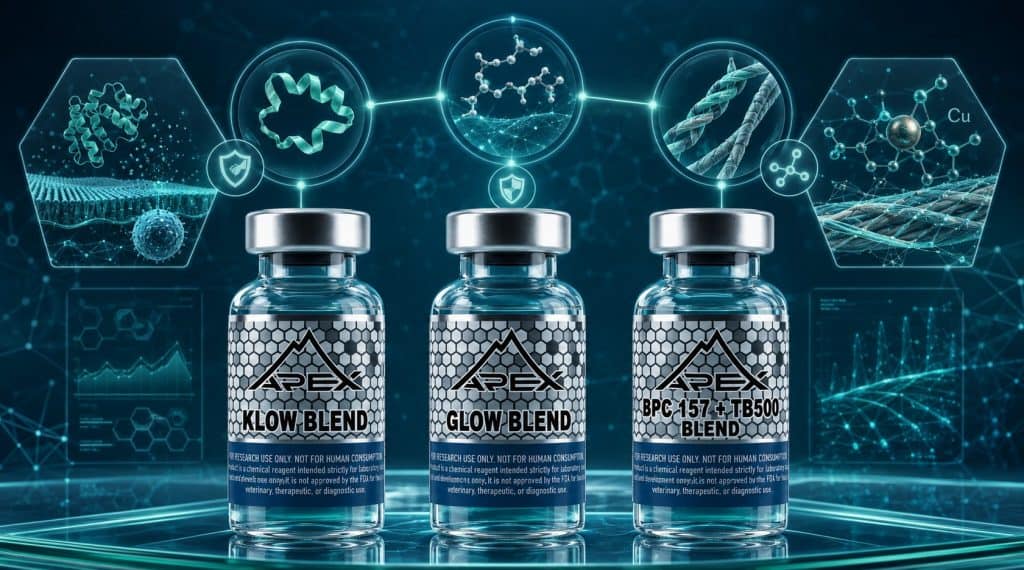
KLOW, GLOW, and the BPC-157/TB-500 Blend are research-grade multi-peptide reagents built on a shared tissue-repair core of BPC-157 and TB-500; the BPC-157/TB-500 Blend is the two-component core, GLOW adds GHK-Cu for extracellular-matrix and collagen pathways, and KLOW further adds KPV, the alpha-MSH C-terminal anti-inflammatory tripeptide. No blend-specific clinical data exist, so the pathway coverage compared here is inferred entirely from separate preclinical, in-vitro, and animal-model studies of each individual component for in-vitro research use only.
Pre-mixed multi-peptide research blends have become a common way for laboratories to interrogate several tissue-repair pathways within a single in-vitro or preclinical system. Three of the most frequently compared are the BPC-157/TB-500 Blend, the GLOW Blend, and the KLOW Blend — a family related by a shared structural logic. Each is built on the same two-component repair core of BPC-157 and TB-500, with GLOW and KLOW layering additional peptides on top of that core rather than substituting for it. Comparing these peptide blends is therefore less a contest between unrelated products and more an exercise in mapping which biological axes each formulation touches.
One point must be stated at the outset and is repeated throughout this guide: there is no blend-specific clinical literature for KLOW, GLOW, or the BPC-157/TB-500 Blend. No controlled combination study of any of these mixtures has been published. Everything described here is synthesized from separate preclinical, in-vitro, and animal-model studies of the individual components, and the pathway coverage attributed to each blend is inferred from that per-component work — not demonstrated for the mixture itself. These blends sit within the Apex tissue-repair research peptides cluster and are supplied strictly as research-grade chemical reagents for in-vitro and preclinical investigation — not as drugs, dietary products, or therapies for human or veterinary use.
Three Tissue-Repair Blends at a Glance
- All three blends share a BPC-157 + TB-500 repair core; GLOW and KLOW are extensions of that core, not replacements for it.
- The BPC-157/TB-500 Blend is the two-component core (1:1 BPC-157 + TB-500); the catalog lists 10mg (5mg/5mg) and 20mg (10mg/10mg) vials.
- GLOW adds GHK-Cu, introducing a copper-dependent collagen and extracellular-matrix (ECM) remodeling axis on top of the repair core.
- KLOW adds KPV — the alpha-MSH C-terminal tripeptide — contributing an NF-κB-targeting anti-inflammatory melanocortin axis; its published composition is GHK-Cu 50mg + BPC-157 10mg + TB-500 10mg + KPV 10mg (the GLOW core plus 10mg KPV), confirmed against the lot COA.
- TB-500 is the synthetic acetylated 7-residue fragment Ac-Leu-Lys-Lys-Thr-Glu-Thr-Gln (Ac-LKKTETQ) of Thymosin β4, acting through actin sequestration and cell migration.
- No blend-specific clinical literature exists; every mechanistic claim here is synthesized from separate per-component preclinical and in-vitro studies, and each component is verified separately by HPLC + ESI-MS.
BPC-157/TB-500 Blend vs GLOW vs KLOW
Three Tissue-Repair Blends at a Glance: BPC-157/TB-500 vs GLOW vs KLOW
The simplest way to understand these three blends is as a nested set. The BPC-157/TB-500 Blend is the minimal repair core: two peptides, BPC-157 and TB-500, combined in a 1:1 ratio (the catalog lists a 10mg vial as 5mg of each and a 20mg vial as 10mg of each). GLOW takes that same core and adds a third peptide, GHK-Cu, extending coverage into copper-dependent extracellular-matrix biology. KLOW builds on the GLOW arrangement and adds a fourth peptide, KPV — the ‘K’ in the name — contributing an anti-inflammatory melanocortin axis.
A shared repair core with layered additions
The BPC-157 component anchors a broad cytoprotective and organoprotective profile documented across many preclinical organ systems,[1] while the TB-500 component is the active fragment of Thymosin β4, a multifunctional regenerative peptide whose reported activities include cell migration, angiogenesis, and survival signaling.[2] GLOW’s added GHK-Cu is a copper tripeptide studied for collagen and matrix remodeling,[3] and KLOW’s added KPV is the C-terminal tripeptide of alpha-melanocyte-stimulating hormone (alpha-MSH) studied for NF-κB-modulating anti-inflammatory signaling.[4]
What the product pages publish
The product pages publish the per-component composition of each blend. The BPC-157/TB-500 Blend is a 1:1 pairing (a 10mg vial is 5mg of each). GLOW Blend 70mg is published as GHK-Cu 50mg + BPC-157 10mg + TB-500 10mg, and KLOW Blend 80mg as GHK-Cu 50mg + BPC-157 10mg + TB-500 10mg + KPV 10mg — the same GLOW core with 10mg of KPV added. Researchers should still confirm composition against the lot-specific certificate of analysis (COA), which documents the actual per-component amounts for each batch, and should read those values rather than assume an equal split — the components are not present in equal amounts.
How the Three Blends Differ in Pathway Coverage
Because the three blends are nested, their differences are best framed as differences in pathway coverage rather than as competing claims. Each added component opens a distinct biological axis that the component literature describes independently.
BPC-157/TB-500 Blend vs GLOW Blend vs KLOW Blend — Composition and Research Pathway Coverage
| Attribute | BPC-157/TB-500 Blend | GLOW Blend 70mg | KLOW Blend 80mg |
|---|---|---|---|
| Components | BPC-157 + TB-500 (2-component) | GHK-Cu 50mg + BPC-157 10mg + TB-500 10mg | GHK-Cu 50mg + BPC-157 10mg + TB-500 10mg + KPV 10mg |
| Stated total | 10mg (5/5) or 20mg (10/10) | 70mg (GHK-Cu 50 / BPC-157 10 / TB-500 10) | 80mg (GHK-Cu 50 / BPC-157 10 / TB-500 10 / KPV 10) |
| Repair core (cytoprotection + actin migration) | Yes | Yes | Yes |
| Added GHK-Cu ECM / collagen axis | No | Yes | Yes |
| Added KPV anti-inflammatory melanocortin axis | No | No | Yes (KPV 10mg; confirm per COA) |
| BPC-157 mechanism | Cytoprotection, angiogenic GF modulation, tendon fibroblast migration | Same | Same |
| TB-500 mechanism | Actin sequestration via LKKTETQ; cell migration | Same | Same |
| GHK-Cu mechanism | Not present | Collagen/GAG synthesis, MMP/TIMP modulation, copper delivery | Same |
| KPV mechanism | Not present | Not present | PepT1 uptake; NF-κB / MAP-kinase inhibition; cytokine reduction |
| Blend-specific clinical data | None (component literature only) | None (component literature only) | None (component literature only) |
| Identity verification | Per-component HPLC + ESI-MS per lot COA | Per-component HPLC + ESI-MS per lot COA | Per-component HPLC + ESI-MS per lot COA |
| Regulatory status | Research reagent; not for human use | Research reagent; not for human use | Research reagent; not for human use |
The repair core: cytoprotection, angiogenesis, and actin-driven migration
The BPC-157/TB-500 core covers two complementary repair axes. BPC-157 contributes cytoprotection and modulation of angiogenic growth-factor pathways — including EGF, FGF, and VEGF-associated signaling reported across tendon, ligament, muscle, and bone healing models.[5] TB-500 contributes actin regulation and cell migration, the mechanistic hallmark of its parent protein Thymosin β4.[6] Together these define the ‘repair core’ present in all three blends.
GLOW adds the GHK-Cu ECM and collagen axis
GLOW’s distinguishing feature is GHK-Cu, which introduces copper-dependent extracellular-matrix biology. In fibroblast culture and gene-expression studies, GHK-Cu is associated with collagen and glycosaminoglycan synthesis and with modulation of the matrix-metalloproteinase / tissue-inhibitor (MMP/TIMP) balance.[3] This is an axis the bare repair core does not cover.
KLOW adds the KPV anti-inflammatory melanocortin axis
KLOW’s distinguishing feature is KPV, which adds anti-inflammatory melanocortin signaling. In intestinal research models KPV is taken up via the PepT1 transporter and is associated with inhibition of NF-κB and MAP-kinase pathways and reduced pro-inflammatory cytokine output.[7] Critically, the overlapping coverage described here is a map of which pathways each blend can touch in principle — not a claim of demonstrated combination synergy, which no published study of these mixtures has tested.
BPC-157: Cytoprotection, Angiogenesis and Tendon Repair (Shared Core Component)
BPC-157 is the gastric pentadecapeptide present in all three blends, so its component profile applies to every formulation in this comparison. It is a 15-residue peptide (Gly-Glu-Pro-Pro-Pro-Gly-Lys-Pro-Ala-Asp-Asp-Ala-Gly-Leu-Val) described as a partial sequence derived from a protein, BPC, found in human gastric juice.
A pleiotropic cytoprotective and organoprotective profile
The defining characterization of BPC-157 in the literature is breadth: it is described as a stable gastric pentadecapeptide with cytoprotective and organoprotective activity reported across multiple organ systems.[1] That pleiotropy is part of why it serves as a repair-core anchor — it is not narrowly tissue-specific in the preclinical record. For the full single-component treatment, see the Apex BPC-157 research guide. A citation note: the registry-correct PMIDs for BPC-157 are 27138887 and 29998800; superficially similar identifiers cite different papers and are not used here.
Angiogenic growth-factor modulation
A recurring mechanistic theme is angiogenesis. A comparative analysis against standard angiogenic growth factors framed BPC-157’s healing actions across the gastrointestinal tract and across tendon, ligament, muscle, and bone in relation to EGF, FGF, and VEGF biology, reporting modulation of these angiogenic growth-factor pathways during healing in preclinical models.[5] This angiogenic-modulation theme recurs throughout the broad cytoprotective profile described above.[1]
Tendon, ligament, muscle, and bone healing context
The same growth-factor comparison drew its ‘lessons’ explicitly from tendon, ligament, muscle, and bone healing, tying BPC-157’s connective-tissue repair context to its angiogenic and cytoprotective actions across these tissues.[5] These findings are entirely from cell-culture and animal models and are reported here as research context, not as evidence of clinical effect.
TB-500 and Thymosin Beta-4: The LKKTETQ Actin-Binding Motif (Shared Core Component)
TB-500 is the second shared-core component, and its identity is frequently misunderstood, so precision matters. TB-500 is a synthetic acetylated 7-residue peptide, Ac-Leu-Lys-Lys-Thr-Glu-Thr-Gln (Ac-LKKTETQ). This heptapeptide corresponds to the conserved actin-binding domain of Thymosin β4 (Tβ4), a 43-residue regenerative protein. TB-500 is the active-fragment analog of that domain — not the full-length protein — a distinction worth preserving when reading the literature, which largely studies Tβ4 itself.
Thymosin β4 as a multifunctional regenerative peptide
The parent protein is characterized as a multifunctional regenerative peptide that promotes cell migration, angiogenesis, survival, and progenitor-cell mobilization.[2] A structure-function review catalogs this mechanistic breadth — cell migration, angiogenesis, survival, stem-cell differentiation, and cytokine modulation — as the basis for its tissue-repair interest.[8] For the dedicated single-component treatment, see the Apex TB-500 research guide.
Actin sequestration: the 1:1 G-actin complex
The core biochemical function of the LKKTETQ region is actin regulation. Tβ4 is the principal intracellular regulator of the monomeric G-actin pool, classically described as binding G-actin in a 1:1 complex and buffering the supply of polymerizable actin.[2][8] The behavior is more nuanced than simple sequestration, however: Tβ4 also participates in higher-order complexes — for example with profilin — so its regulation of the actin monomer pool is not a strictly isolated 1:1 reaction.[6] This actin-regulating activity is the mechanistic origin of TB-500’s reported effects on cytoskeletal dynamics and cell motility.
The actin-binding site, migration, and angiogenesis
The actin-binding site is not merely structural — it is functionally linked to the peptide’s pro-angiogenic and pro-migratory activity. A study mapping that site reported that the actin-binding region of Tβ4 mediates its angiogenic activity,[9] and earlier work showed that Tβ4 stimulates directional migration of human endothelial cells in vitro.[10]
Survival signaling: integrin-linked kinase and Akt
Beyond actin, Tβ4 has a documented survival-signaling arm. In a preclinical cardiac-repair study, Tβ4 formed a complex with PINCH and integrin-linked kinase, activating Akt to promote cell migration and survival.[11] Together with the actin and angiogenesis data, this places TB-500’s component contribution squarely in the migration-and-survival half of the repair core. All of these are findings for the full-length protein in cell and animal systems.
GHK-Cu: ECM Remodeling, Collagen and Copper Delivery (GLOW’s Added Axis)
GHK-Cu is the component that distinguishes GLOW from the bare repair core, so its profile is what GLOW ‘adds.’ A point of identity precision is essential here: GHK-Cu is the copper(II) complex of the tripeptide glycyl-L-histidyl-L-lysine (Gly-His-Lys), and its copper-complex CAS number is 89030-95-5. The free GHK peptide base carries a different CAS number, 49557-75-7; the two are commonly conflated but are distinct chemical entities, and a COA should make clear which form it describes.
Collagen and extracellular-matrix synthesis
The foundational mechanistic observation for GHK-Cu is collagen stimulation. An early in-vitro study reported that the GHK-Cu complex stimulated collagen synthesis in cultured fibroblasts at picomolar-to-nanomolar concentrations,[12] establishing the extracellular-matrix axis that GLOW layers onto the BPC-157/TB-500 core. Broader reviews extend this to elastin and glycosaminoglycan synthesis and to modulation of the MMP/TIMP balance that governs matrix turnover.[3]
Gene-level remodeling and copper delivery
Gene-expression work adds molecular depth: GHK-Cu is reported to up-regulate tissue-remodeling, antioxidant, and DNA-repair pathways while modulating inflammatory genes.[13] The copper-delivery dimension is part of why the complex form, rather than the free peptide, is the studied entity — the bound copper is integral to the reported activity. For the dedicated single-component treatment, see the Apex GHK-Cu research guide, and for an adjacent two-way contrast see BPC-157 vs GHK-Cu. These are in-vitro and gene-data findings reported as research context only.
KPV: The NF-kB Anti-Inflammatory Melanocortin Fragment (KLOW’s Added Axis)
KPV is the component that distinguishes KLOW from GLOW, so its profile is what KLOW ‘adds’ on top of the GLOW core. KPV is the tripeptide lysine-proline-valine (Lys-Pro-Val, CAS 67727-97-3), corresponding to the C-terminal fragment — residues 11 to 13 — of alpha-melanocyte-stimulating hormone (alpha-MSH). It contributes an anti-inflammatory melanocortin axis distinct from the matrix and migration biology of the other components.
Layered pathway coverage: BPC-157/TB-500 repair core → +GHK-Cu ECM axis (GLOW) → +KPV NF-κB axis (KLOW)
These three blends differ by the biological axes their components cover, as described in separate per-component preclinical studies. The shared BPC-157/TB-500 core combines BPC-157 cytoprotection and angiogenic growth-factor modulation with TB-500’s actin-sequestering, migration-promoting activity (the LKKTETQ fragment of Thymosin β4). GLOW adds GHK-Cu, a copper tripeptide associated with collagen synthesis and MMP/TIMP-regulated extracellular-matrix remodeling. KLOW adds KPV, the alpha-MSH C-terminal tripeptide taken up via PepT1 and associated with NF-κB and MAP-kinase inhibition. No combination study tests these axes together; the coverage is inferred from component literature. Dalmasso et al. (2008), Gastroenterology.
PepT1-mediated uptake and NF-κB inhibition
The cornerstone mechanistic finding is gut-focused: in intestinal epithelial and immune cell models, KPV is taken up through the di/tripeptide transporter PepT1 and reduces DSS- and TNBS-induced colitis with decreased pro-inflammatory cytokine output in mice.[7] A later murine model reinforced that PepT1-mediated KPV reduced intestinal inflammation and associated colitis-driven tumorigenesis.[14]
The alpha-MSH C-terminal anti-inflammatory motif
A comprehensive review of alpha-MSH and its related tripeptides situates KPV as the C-terminal anti-inflammatory fragment whose protective effects are linked to NF-κB inhibition.[4] The parent hormone’s broader immunomodulatory behavior — including effects on chemokine-receptor signaling and inflammatory cell responses — provides additional context for the melanocortin axis KLOW introduces.[15] For the dedicated single-component treatment, see the Apex KPV peptide research guide.
Antimicrobial activity beyond inflammation
KPV’s melanocortin-fragment activity extends beyond NF-κB signaling. Both alpha-MSH(1–13) and its C-terminal KPV tripeptide were reported to exert antimicrobial activity in vitro against Staphylococcus aureus and Candida albicans.[16] This breadth illustrates the range of research questions the component has been used to probe; it is not a basis for any application claim, and all findings derive from cell and animal systems.
Shared and Overlapping Mechanisms Across Components
The components of these blends do not act on entirely separate biology. Several of their reported pathways intersect in the literature, and recognizing those overlaps clarifies why a multi-component blend covers more than the sum of unrelated parts — while also underscoring that overlap on paper is not the same as demonstrated combination synergy.
Cell migration as a convergence point
Cell migration is touched by three of the four components. TB-500/Tβ4 drives actin-dependent migration through the LKKTETQ motif,[10] the BPC-157 repair-core component contributes its own cytoprotective and angiogenic-modulation activity across healing tissues,[5] and the migration machinery itself depends on matrix remodeling.
MMP-dependent migration and ECM turnover
The matrix-remodeling overlap is concrete. Tβ4 promotion of epithelial cell migration was reported to require matrix-metalloproteinase (MMP) activity,[17] and GHK-Cu independently modulates the MMP/TIMP balance that governs ECM turnover.[3] This shared MMP node is one place where the TB-500 (core) and GHK-Cu (GLOW) axes touch the same biology from different directions.
Converging anti-inflammatory NF-κB suppression
A second convergence appears in anti-inflammatory signaling. KPV acts through an NF-κB-linked mechanism,[4] while Tβ4 has separately been reported to promote wound healing with documented anti-inflammatory activity in corneal wound-healing models.[18] The TB-500 (core) and KPV (KLOW) axes thus each contribute anti-inflammatory activity to the repair picture, though through distinct and separately studied molecular routes rather than a single shared signaling node. This is pathway-coverage logic drawn from separate studies, not evidence that the blends produce combined effects.
Research-Only Combined-Pathway In-Vitro Use Cases
Why would a laboratory choose a multi-component blend over single peptides? The practical answer is experimental efficiency: a blend lets researchers interrogate several repair pathways within one in-vitro or preclinical system, holding the experimental conditions constant across axes that would otherwise require separate preparations.
Interrogating multiple repair axes in one system
A single multi-component vial can, in principle, expose a model to cytoprotection and angiogenic signaling (BPC-157),[5] actin-driven migration and ECM-coupled repair (TB-500/Tβ4),[19] copper-dependent matrix remodeling (GHK-Cu in GLOW and KLOW),[3] and anti-inflammatory melanocortin signaling (KPV in KLOW)[7] simultaneously. That breadth is the experimental rationale researchers describe for combined-pathway reagents.
An important interpretive caveat
This use-case framing is strictly about research utility. It is not a dosing recommendation, not a therapeutic protocol, and not a claim that the components act synergistically — the individual-component data summarized above cannot establish how the peptides behave in combination, because no combination study exists. Any experiment with a blend must control for the confound that observed effects could arise from any single component or from interactions that the component literature simply does not address.
Multi-Component Reconstitution Considerations
Multi-peptide vials introduce reconstitution considerations that single-component vials do not. The central one is that the per-component amounts are not something to assume — they are stated on the product page or lot COA, and concentration math depends on them.
Concentration math when component splits are per-COA
For the BPC-157/TB-500 Blend, the catalog 1:1 ratio makes per-component concentration straightforward (a 10mg vial yields 5mg of each). For the 70mg GLOW and 80mg KLOW vials, the published composition gives the per-component amounts directly — GLOW is GHK-Cu 50mg + BPC-157 10mg + TB-500 10mg, and KLOW is that same set plus KPV 10mg — which researchers should still confirm against the lot COA before calculating working concentrations. Assuming equal thirds or quarters is exactly the error this guide cautions against.
Solvent selection and differing component solubilities
Components can also differ in their handling profiles — for example, a copper complex such as GHK-Cu and a short hydrophilic tripeptide such as KPV need not behave identically in every solvent. A single reconstitution solvent has to be compatible with all components in the vial, which is a constraint worth confirming against per-component guidance. General procedure is covered in the Apex guides on how to reconstitute peptides and the peptide storage guide; specifics should always be verified per product page and lot COA. Nothing in this section is a human dosing or administration instruction — it concerns in-vitro reagent preparation only.
COA and Identity Verification for Multi-Peptide Vials
For any blend, knowing exactly what is in the vial is what makes an experiment interpretable — and multi-peptide vials make that verification harder, not easier. The key technical point is that a single chromatographic peak cannot confirm a three- or four-component blend.
Why one peak cannot confirm a multi-component blend
Reversed-phase HPLC separates species by their elution behavior, and a single, well-resolved peak is the familiar signature of a pure single peptide. A blend, by definition, should resolve into multiple peaks — one per component — and a single peak in a vial that is supposed to contain three or four peptides is a red flag rather than a reassurance. Each component therefore has to be verified separately, both for purity by HPLC and for identity by electrospray-ionization mass spectrometry (ESI-MS), which matches each component’s measured mass to its expected value.
Per-component analytical documentation per lot
The practical consequence is that a meaningful blend COA documents each component individually rather than reporting a single aggregate purity number. Because BPC-157, TB-500, GHK-Cu, and KPV have entirely different masses and sequences, per-component analytical documentation on the lot COA is what establishes both identity and composition. Background on interpreting these documents is available in the Apex primer on how to read a peptide COA; researchers should review the lot-specific COA rather than rely on a generic specification.
Choosing a Blend by Research Pathway Coverage
Selecting among these three blends is, in the absence of any head-to-head data, a question of which pathway coverage a given research design requires. Because the blends are nested, the decision is essentially how many axes to include.
Matching the blend to the research question
The BPC-157/TB-500 Blend supplies the minimal repair core — cytoprotection and angiogenic signaling plus actin-driven migration — and suits designs focused on that core repair biology.[5] GLOW is the choice where the copper-dependent ECM and collagen axis is also in scope, adding GHK-Cu’s matrix biology to the core.[3] KLOW extends coverage further to an anti-inflammatory melanocortin axis where KPV’s NF-κB-linked signaling is relevant to the model.[7]
What this selection framework is not
This is a pathway-coverage framework, not a ranking of effectiveness. No published study compares these blends head-to-head, none compares a blend against its individual components in a controlled design, and there is no clinical literature on any of the mixtures. Selection by component coverage is the only evidence-grounded way to choose, and even that is a research-design heuristic rather than a performance claim. Researchers may also find the broader research library useful for the underlying single-component literature.
Sourcing Research-Grade Tissue-Repair Blends
For any blend experiment, reproducibility depends on knowing exactly what is in the vial — and for multi-peptide reagents that means per-component analytical documentation, not a single label claim. Because none of these blends has published combination data, the integrity of the per-component identity and purity record is what supports interpretable research.
Per-component HPLC purity and ESI-MS identity verification
Apex supplies these blends as research-grade chemical reagents in which each component is verified separately by reversed-phase HPLC for purity and by electrospray-ionization mass spectrometry (ESI-MS) for identity. Each lot is documented with a certificate of analysis available through the lab-verified COA archive; for multi-component vials, researchers should confirm that the COA documents every component individually and should read the per-component composition from the product page or lot COA rather than assuming a ratio.
Research-use-only designation and component reagents
All three blends — and every component within them — are sold strictly for in-vitro and preclinical laboratory research and are not for human or veterinary use. None of these blends or their components has an approved drug formulation anywhere. The Apex editorial standards document how each guide is sourced and reviewed. Researchers assembling a tissue-repair panel often pair the blends with their single-component counterparts; the items below are available as research reagents.
Tissue-Repair Research Blends and Component Reagents
KLOW Blend 80mg
Four-component research blend — GHK-Cu 50mg + BPC-157 10mg + TB-500 10mg + KPV 10mg — layering the KPV anti-inflammatory melanocortin axis onto the GLOW core.
View ProductGLOW Blend 70mg
BPC-157 + GHK-Cu + TB-500 research blend adding the GHK-Cu ECM/collagen axis to the repair core.
View ProductBPC-157/TB-500 Blend
Two-component 1:1 repair-core research blend (BPC-157 + TB-500); 10mg and 20mg vials.
View ProductFrequently Asked Questions
What is the difference between KLOW, GLOW, and the BPC-157/TB-500 Blend?
All three share a BPC-157 + TB-500 repair core. The BPC-157/TB-500 Blend is just that two-component core. GLOW adds GHK-Cu, introducing a copper-dependent collagen and extracellular-matrix axis (Pickart 2015). KLOW adds KPV (the ‘K’) on top of the GLOW core, contributing an anti-inflammatory melanocortin axis (Brzoska 2008). The published compositions are GLOW Blend 70mg = GHK-Cu 50mg + BPC-157 10mg + TB-500 10mg, and KLOW Blend 80mg = that same core plus KPV 10mg; confirm the per-component amounts against the lot COA. All three are research-grade chemical reagents for in-vitro and preclinical research only.
Is there clinical research on these specific blends?
No. There is no blend-specific clinical or controlled-combination literature for KLOW, GLOW, or the BPC-157/TB-500 Blend. The available evidence comes from separate preclinical, in-vitro, and animal-model studies of each individual component, and the pathway coverage attributed to the blends is synthesized from those component studies. None of these mixtures has been tested as a combination in any published study, and none has an approved formulation.
What does TB-500’s LKKTETQ motif do?
TB-500 is the synthetic acetylated 7-residue fragment Ac-Leu-Lys-Lys-Thr-Glu-Thr-Gln, corresponding to the actin-binding domain of Thymosin beta-4. Thymosin beta-4 is the main regulator of the monomeric G-actin pool, classically described as binding G-actin in a 1:1 complex (Goldstein 2012; Crockford 2010), though its actin regulation also involves higher-order complexes such as those with profilin rather than strictly isolated 1:1 sequestration (Yarmola 2007). The actin-binding region is associated with cell migration and angiogenesis in preclinical models (Philp 2003). TB-500 is the active-fragment analog, not the full-length 43-residue protein.
Why does GLOW include GHK-Cu and what does it add?
GHK-Cu is the copper complex of the tripeptide glycyl-L-histidyl-L-lysine. In fibroblast culture and gene-expression studies it is associated with collagen and glycosaminoglycan synthesis, MMP/TIMP modulation, and copper delivery (Maquart 1988; Pickart 2018). GLOW adds this extracellular-matrix and skin-remodeling axis to the BPC-157 + TB-500 repair core. These are in-vitro and gene-data findings reported as research context only.
What does KPV add in the KLOW blend?
KPV is Lys-Pro-Val, the C-terminal tripeptide of alpha-MSH. In preclinical models it is taken up via the PepT1 transporter and is associated with inhibition of NF-kB and MAP-kinase inflammatory signaling and reduced pro-inflammatory cytokines (Dalmasso 2008). It contributes an anti-inflammatory melanocortin axis that distinguishes KLOW from GLOW. These are cell-culture and rodent findings that have not been established in humans.
Should I use the copper-complex CAS or the free GHK CAS for GHK-Cu?
For the copper complex (GHK-Cu) use CAS 89030-95-5. The free GHK peptide base has a different CAS (49557-75-7); the two are commonly conflated but are distinct chemical entities, so verify which form a COA describes. The studied entity for the GLOW axis is the copper complex, in which the bound copper is integral to the reported collagen and matrix-remodeling activity.
How is identity confirmed in a multi-peptide vial?
Each component is verified separately, typically by HPLC and ESI-MS. A multi-peptide vial complicates single-peak identity confirmation because one chromatographic peak cannot account for three or four distinct peptides, so per-component analytical documentation on the lot COA is what establishes identity and composition. A single peak in a vial meant to contain several peptides is a warning sign rather than a sign of purity.
How are multi-component blends reconstituted for research?
Reconstitution follows standard peptide procedures, but with multi-peptide vials researchers account for component mg splits stated on the product page or COA rather than assuming equal ratios, and for differing component solubilities. The chosen solvent must be compatible with all components in the vial. See the reconstitution and storage guides for general procedure; verify specifics per product page and lot COA. None of this is a human dosing or administration instruction.
Continue Your Research
Researchers building broader context across the Apex Research Library may find the following references useful:
- Tissue Repair Research Peptides — the cluster hub situating these blends among tissue-repair and anti-inflammatory reagents
- BPC-157 Research Guide — the gastric pentadecapeptide that anchors the shared repair core of all three blends
- TB-500 Research Guide — the Ac-LKKTETQ Thymosin beta-4 fragment and second shared-core component
- GHK-Cu Research Guide — the copper tripeptide ECM-remodeling axis that GLOW adds to the core
- KPV Peptide Research Guide — the alpha-MSH C-terminal anti-inflammatory tripeptide that KLOW adds to the GLOW core
- BPC-157 vs GHK-Cu — an adjacent two-way comparison of two tissue-repair reagents across mechanism
- How to Reconstitute Peptides — general protocol relevant to preparing multi-component lyophilized blends for in-vitro work
- How to Read a Peptide Certificate of Analysis — interpreting per-component HPLC purity and ESI-MS identity data on a multi-peptide lot COA
Research Use Disclaimer
All KLOW, GLOW, and BPC-157/TB-500 Blend products and the information in this guide are intended strictly for in-vitro and preclinical laboratory research. These blends are research-grade chemical reagents and are not drugs, dietary supplements, or therapeutic products. None of these blends, and none of their individual components (BPC-157, TB-500, GHK-Cu, KPV), is approved by the FDA, EMA, or any other regulatory authority, and none has an approved indication anywhere. They are not for human or veterinary consumption, diagnosis, treatment, or any clinical use. There is no blend-specific clinical literature; every mechanistic statement here is synthesized from separate per-component cell-culture and animal-model studies and is presented for research context only — it does not constitute therapeutic, efficacy, or safety claims, and no combination synergy is demonstrated. Researchers are responsible for compliance with all applicable institutional, local, and national regulations governing the acquisition, handling, and use of research chemicals.