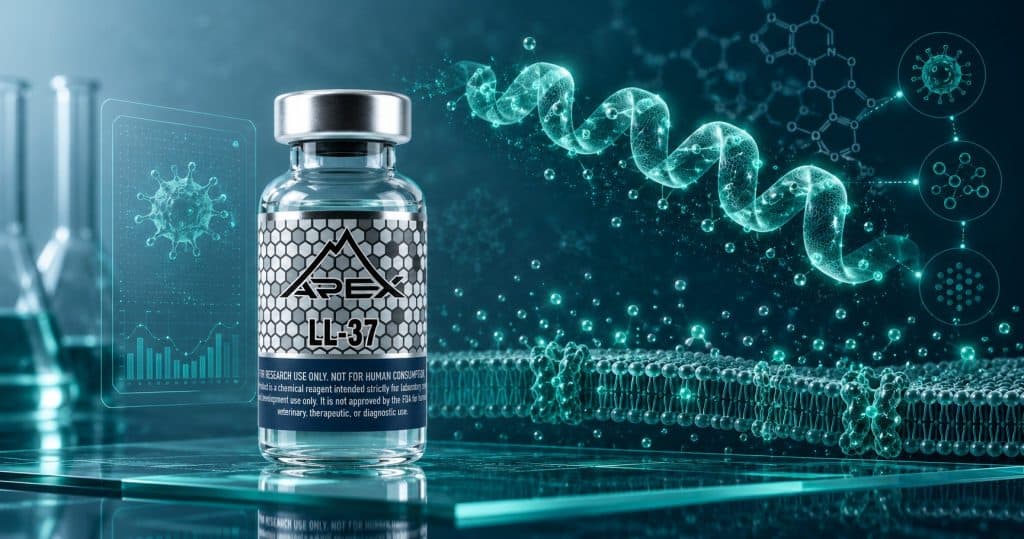
LL-37 is the only human cathelicidin antimicrobial peptide, a 37-residue cationic amphipathic alpha-helix cleaved by proteinase 3 from the hCAP-18 precursor encoded by the single CAMP gene, and preclinical research studies it for direct membrane-permeabilizing antimicrobial action together with immunomodulatory roles spanning FPR2/FPRL1-mediated chemotaxis, endotoxin neutralization, and wound-repair signaling. Apex Laboratory supplies LL-37 as a research-grade chemical reagent for in-vitro and preclinical laboratory research only, not for human or veterinary use.
Among the antimicrobial peptides of the innate immune system, one human molecule occupies a singular position: it is the only cathelicidin the human genome encodes. LL-37 — a 37-residue cationic peptide named for the two leucine residues at its N-terminus and its length of thirty-seven amino acids — is the mature, active fragment liberated from the hCAP-18 precursor protein, itself the product of a single human cathelicidin gene.[1] What makes LL-37 a focus of so much research is not antimicrobial killing alone but the breadth of activities packed into one short, amphipathic helix: direct membrane disruption of microbes on one side, and a wide repertoire of receptor-mediated immune-signaling and tissue-repair effects on the other.[2]
This guide summarizes the LL-37 research literature for laboratory context — its origin in the CAMP gene and hCAP-18 processing, its amphipathic-helix structure and membrane mechanism, its broad-spectrum antimicrobial and antibiofilm action, its many immunomodulatory roles, its wound-healing and angiogenic functions, and the vitamin-D axis that controls its expression. LL-37 sits within the broader Apex tissue-repair research peptides cluster, and it is supplied strictly as a research-grade chemical reagent for in-vitro and preclinical investigation — not as a drug, dietary product, or therapy for human or veterinary use.
LL-37 at a Glance
- LL-37 is the sole human cathelicidin — a 37-residue, cysteine-free, cationic amphipathic α-helix derived from the hCAP-18 protein and the single human cathelicidin gene CAMP (historically FALL39).
- It is liberated when neutrophil-granule proteinase 3 cleaves the hCAP-18 pro-form extracellularly, producing the active 37-residue peptide (Sorensen 2001).
- In vitro it acts as a broad-spectrum, salt-tolerant antimicrobial that permeabilizes microbial membranes: solid-state NMR shows the helix lies parallel to the bilayer surface, ruling out a transmembrane barrel-stave pore, and the authors concluded a toroidal-pore mechanism.
- Beyond direct killing, research describes receptor-mediated immunomodulation: FPR2/FPRL1 chemotaxis, LPS/endotoxin neutralization, TLR-response modulation, P2X7-driven IL-1β release, and dendritic-cell effects.
- Preclinical wound-healing and angiogenesis studies and the vitamin-D-driven transcriptional induction of CAMP make LL-37 a focal point in tissue-repair research.
- LL-37 has no FDA-, EMA-, or other approved formulation anywhere; Apex supplies it strictly as a research-grade chemical reagent at ≥99% HPLC purity for in-vitro and preclinical use only.
LL-37 (Human Cathelicidin)
What Is LL-37? The Only Human Cathelicidin
LL-37 is a 37-residue cationic peptide and the sole representative of the cathelicidin family of antimicrobial peptides in humans. Where many mammals carry several cathelicidin genes, the human genome encodes just one, and LL-37 is its mature antimicrobial product — a point that the canonical structure-function literature emphasizes when it describes LL-37 as the only human member of the cathelicidin family.[1] That uniqueness concentrates a remarkable amount of innate-immune function into a single molecule.
A 37-residue cationic amphipathic peptide
The peptide carries the sequence LLGDFFRKSKEKIGKEFKRIVQRIKDFLRNLVPRTES, a chain rich in basic (cationic) lysine and arginine residues and notably free of cysteine, so it forms no disulfide bonds. Its molecular weight is 4493.33 g/mol against the molecular formula C205H340N60O53, values consistent with PubChem CID 16198951 and CAS number 154947-66-7. The two N-terminal leucines and the length of 37 residues are the literal source of the name “LL-37.”
A “factotum” peptide of many functions
Comprehensive reviews characterize LL-37 as a multifunctional — even “factotum” — peptide, cataloguing antibacterial, antifungal, antiviral, chemotactic, immunomodulatory, wound-healing, and angiogenic activities, alongside a capacity to balance pro- and anti-inflammatory responses.[2] The original parent peptide was first identified from a human bone-marrow cDNA library as a 39-residue, cysteine-free putative antibiotic designated FALL-39, the precursor from which the 37-residue mature form derives.[3] Every activity summarized in this guide is drawn from in-vitro, ex-vivo, or animal-model research and is presented for laboratory context only, not as a clinical claim. LL-37 is one of several reagents in the Apex tissue-repair research peptides cluster studied for host-defense and immune-signaling mechanisms.
From Gene to Peptide: CAMP, hCAP-18, and Proteinase-3 Cleavage
To understand LL-37 it helps to trace its lineage from gene to active peptide. The molecule is the end product of a defined biosynthetic route: a single gene, a stored pro-protein, and a specific proteolytic cleavage step that liberates the mature antimicrobial fragment.
The single human cathelicidin gene
The human cathelicidin gene — historically named FALL39 and now designated CAMP — is the only cathelin-family gene in the human genome, and its mature granulocyte product is the 37-residue LL-37, a single-gene status confirmed in the canonical structure-function review.[1] This is why LL-37 is so often called “the only human cathelicidin”: there is no paralog to share the workload. The original FALL-39 identification placed the precursor’s expression in bone marrow and testis, consistent with a myeloid origin.[3]
hCAP-18: the stored pro-protein
The CAMP gene encodes an 18-kDa cationic antimicrobial protein, hCAP-18, comprising an N-terminal cathelin-like domain and the C-terminal LL-37 sequence. hCAP-18 is stored in the specific granules of neutrophils and is also expressed in epithelial cells, where it is held in an inactive pro-form until it is needed. The mature, antimicrobially active peptide is only the C-terminal 37 residues; the cathelin domain must be removed for full activity.
Proteinase-3 liberates the active peptide
The decisive maturation step is extracellular cleavage. Work on neutrophil processing established that proteinase 3, an enzyme of the azurophil granules, is responsible for cleaving secreted hCAP-18 to release the active LL-37 peptide after exocytosis.[4] This means the active molecule is generated at the right place and time — outside the cell, at sites of degranulation — rather than being stored in its active form. For researchers, the practical corollary is that the synthetic research-grade reagent corresponds to that mature 37-residue cleavage product, not to the full hCAP-18 pro-protein.
Structure and Membrane Interaction: The Amphipathic Helix
The physical chemistry of LL-37 is the key to its direct antimicrobial action. Its sequence is arranged so that, upon contact with a membrane, the peptide folds into a helix with one face crowded with positively charged residues and the other with hydrophobic residues — the defining amphipathic architecture of this peptide class.
A curved helix-bend-helix in micelles
High-resolution NMR work on LL-37 in lipid micelles resolved the structure as a curved amphipathic helix-bend-helix spanning roughly residues 2 through 31, with a flexible, disordered C-terminal tail; the same study identified the short internal fragment KR-12 as the minimal antibacterial core.[5] The cationic face mediates the initial electrostatic attraction to the anionic lipids that are abundant in bacterial membranes, while the hydrophobic face drives insertion into the lipid environment.
Amphipathic α-helix → direct membrane permeabilization PLUS receptor-mediated immunomodulation
LL-37 has two mechanistic faces. Its cationic amphipathic α-helix binds anionic microbial membranes and permeabilizes them: solid-state NMR shows the helix lies parallel to the bilayer surface, ruling out a transmembrane barrel-stave pore, and the authors concluded a toroidal-pore mechanism.[6] — behavior that underlies its broad-spectrum, salt-tolerant antimicrobial action. In parallel, the same peptide acts through defined receptors to immunomodulate: it chemoattracts neutrophils, monocytes and T cells via the formyl peptide receptor FPR2/FPRL1, binds and neutralizes LPS/endotoxin, modulates TLR-driven cytokine output, and induces FPRL1-dependent angiogenesis.[15] The first face is receptor-independent membrane physics; the second is receptor-mediated signaling. All steps are characterized in cell and animal systems. Dürr et al. (2006), Biochim Biophys Acta.
Surface-parallel orientation and a toroidal-pore mechanism
How LL-37 actually disrupts the membrane has been studied directly by solid-state NMR. The peptide’s amphipathic helix was shown to lie parallel to the bilayer surface in both anionic and zwitterionic membranes, ruling out a transmembrane barrel-stave pore; the authors concluded a toroidal-pore mechanism in which the peptide bends the bilayer and the membrane lipids line the resulting pore.[6] This surface-parallel orientation is mechanistically distinct from the fixed barrel-stave models of some other antimicrobial peptides, and it is one reason LL-37’s activity is described as broad and somewhat non-specific at the membrane level.
Why the structure matters for the reagent
The canonical structure-function review ties these features together, summarizing LL-37’s amphipathic α-helical conformation, its membrane interactions, and the pleiotropic functions that flow from a single, conformationally flexible scaffold.[1] Because the active conformation is induced on contact with lipids and is sensitive to the local environment, identity and integrity of the synthetic peptide matter for reproducible membrane-interaction experiments — a theme returned to in the sourcing section.
Broad-Spectrum Direct Antimicrobial Action In Vitro
The first-described and most extensively documented activity of LL-37 is direct, broad-spectrum antimicrobial action. In the test tube, the peptide kills a wide range of organisms, and several of its in-vitro properties make it a useful research model for cationic host-defense peptides.
Gram-positive, Gram-negative, and salt-tolerant activity
Characterization of LL-37 from human neutrophils reported broad-spectrum in-vitro antibacterial activity, with minimum inhibitory concentrations below 10 µg/ml against both Gram-negative and Gram-positive organisms — including Pseudomonas aeruginosa, Escherichia coli, Staphylococcus aureus, and vancomycin-resistant enterococci — and notably retained activity in the presence of 100 mM sodium chloride.[7] Salt tolerance is a meaningful experimental detail: many antimicrobial peptides lose potency at physiological ionic strength, so retained activity at 100 mM NaCl marks LL-37 as relatively robust in that respect.
Expression at epithelial surfaces
Beyond neutrophils, reviews describe LL-37/hCAP-18 expression at epithelial surfaces and roles in antimicrobial defense — evidence that the peptide functions as part of a first-line epithelial innate-immune barrier and not solely as a granulocyte product.[2] The structure-function literature situates this direct killing within the peptide’s amphipathic membrane mechanism described in the preceding section.[1] All of these are in-vitro and ex-vivo characterizations; none constitutes a clinical antimicrobial claim, and none should be read as evidence of efficacy in any infection setting.
Antibiofilm, Antiviral, and Antifungal Research Findings
The antimicrobial repertoire of LL-37 extends well beyond planktonic bacteria. Three further lines of in-vitro and animal-model research — antibiofilm, antiviral, and antifungal — broaden the picture and illustrate why the peptide is studied as a versatile host-defense molecule.
Antibiofilm activity at sub-MIC concentrations
One of the more striking findings is that LL-37 affects biofilms at concentrations well below those needed to kill planktonic bacteria. At sub-MIC concentrations as low as 0.5 µg/ml, LL-37 inhibited Pseudomonas aeruginosa biofilm formation and acted on pre-formed biofilms by reducing bacterial attachment, stimulating twitching motility, and downregulating the Las and Rhl quorum-sensing systems.[8] This quorum-sensing interference is mechanistically distinct from membrane killing and is a frequent reason LL-37 is used as a research tool in biofilm models.
Antiviral activity against influenza A
LL-37 has also been studied as an antiviral agent. In influenza-A models, the peptide showed in-vitro and in-vivo antiviral activity, reducing viral replication and disease severity in mice and lowering pro-inflammatory cytokine output, with evidence pointing to a direct effect on the virion.[9] These are model-system observations; the dual reduction of both viral burden and inflammation is part of why LL-37 is framed in reviews as balancing host defense with immune regulation.
Antifungal activity against Candida albicans
The spectrum reaches fungi as well. Comprehensive reviews catalog LL-37’s antifungal activity — including killing of Candida albicans in vitro through membrane permeabilization — alongside its antibacterial and antiviral actions.[2] The same membrane-disruptive mechanism that underlies antibacterial killing thus appears to extend to fungal membranes. Across all three categories, the findings are in-vitro and animal-model results gathered for research context and are not a basis for any application claim.
Immunomodulation I: Chemotaxis via FPR2/FPRL1
If direct killing were the whole story, LL-37 would be merely a natural antibiotic. What elevates it to a central position in immunology is a second, receptor-mediated dimension: the peptide actively shapes the immune response, beginning with the recruitment of immune cells to sites of infection or injury.
A formyl-peptide-receptor agonist
The neutrophil-granule- and epithelial-cell-derived LL-37 was shown to chemoattract human peripheral-blood neutrophils, monocytes, and T cells, and to do so through the formyl peptide receptor-like 1 (FPRL1, also known as FPR2).[10] This is a genuinely receptor-dependent activity — distinct from the receptor-independent membrane disruption that drives antimicrobial killing — and it positions LL-37 as a chemotactic signal rather than only a microbicide.
Bridging innate and adaptive immunity
Because FPR2/FPRL1 engagement recruits both innate effectors (neutrophils, monocytes) and adaptive cells (T cells), LL-37 functions in the literature as a bridge between the two arms of immunity, amplifying cellular recruitment well beyond what a simple antibiotic would accomplish.[2] This chemotactic role is one of the clearest illustrations of the “two faces” framing developed in the mechanism callout above — the same molecule that lyses a microbial membrane can, through a defined receptor, orchestrate the cellular immune response. These are characterizations from cell-based human research and are reported here as mechanism, not as therapeutic effect.
Immunomodulation II: LPS/Endotoxin Neutralization and TLR Modulation
A second strand of immunomodulation concerns not the recruitment of cells but the dampening of excessive inflammation. LL-37 and its parent protein engage directly with bacterial endotoxin and with the receptor pathways that endotoxin activates, and the net effect in several models is anti-inflammatory.
The Two Faces of LL-37: Direct Antimicrobial vs Immunomodulatory Roles
| Attribute | Direct Antimicrobial Face | Immunomodulatory Face |
|---|---|---|
| Primary action | Membrane permeabilization of microbes | Receptor-mediated immune signaling |
| Receptor involvement | Receptor-independent (membrane physics) | FPR2/FPRL1, TLR pathways, P2X7 |
| Representative effect | Broad-spectrum, salt-tolerant killing; antibiofilm; antifungal; antiviral | Chemotaxis; LPS/endotoxin neutralization; TNF-α dampening; IL-1β release |
| Concentration regime | MIC range (and sub-MIC antibiofilm) | Often active at low physiological concentrations |
| Tissue-repair link | Clears microbes from wound bed | FPRL1-driven angiogenesis; re-epithelialization signaling |
| Double-edged note | Generally protective host defense | Self-DNA/pDC type-I-interferon circuit implicated in inflammatory disease |
Direct LPS binding and endotoxin neutralization
The endotoxin-neutralizing capacity traces back to the parent protein. Cloning of human CAP18 demonstrated that its C-terminal fragment binds lipopolysaccharide (LPS), inhibits LPS-induced nitric oxide and tissue-factor responses, and protects mice from LPS lethality.[11] By binding LPS directly, LL-37 can sequester endotoxin before it triggers a full inflammatory cascade — a mechanism of considerable interest in endotoxemia and sepsis research models.
Tuning the TLR-driven inflammatory response
LL-37 also modulates signaling downstream of Toll-like receptors. At low physiological concentrations, the peptide was shown to dampen LPS/TLR-driven inflammation by inhibiting pro-inflammatory TNF-α release in monocytic cells and to protect animal models against endotoxemia.[12] The comprehensive reviews frame this as one pole of LL-37’s capacity to balance pro- and anti-inflammatory outcomes depending on concentration and context.[2] The concentration-dependence is an important experimental caveat: the same peptide reported to dampen inflammation at low concentrations participates in pro-inflammatory circuits in other settings, as the disease section below details. These are model-system mechanisms, not demonstrated clinical anti-inflammatory effects.
Immunomodulation III: P2X7, IL-1beta, and Dendritic Cells
LL-37’s influence on the immune system is not uniformly anti-inflammatory. In other contexts it acts as an immunostimulant, engaging specific receptors to amplify cytokine output and to shape the differentiation of antigen-presenting cells. This dual capacity is central to understanding the peptide as a context-dependent regulator.
P2X7-dependent IL-1beta processing and release
In LPS-primed monocytes, LL-37 was identified as an activator of the P2X7 receptor, driving the maturation and release of interleukin-1β (IL-1β).[13] Because P2X7-dependent IL-1β processing is a pro-inflammatory event, this finding shows LL-37 amplifying an inflammatory signal — the opposite valence to its TNF-α-dampening activity — and underscores that the peptide’s net immunological effect is highly dependent on cell type, priming state, and concentration.
Shaping dendritic cells and T-cell polarization
LL-37 also acts at the interface of innate and adaptive immunity by influencing antigen-presenting cells. Reviews of its immunomodulatory repertoire describe how it modifies the differentiation of monocyte-derived dendritic cells and, through those altered dendritic cells, influences the resulting T-cell polarization.[2] By tuning how dendritic cells mature and instruct T cells, LL-37 can shape the character of the downstream adaptive response, reinforcing its description as an immunomodulatory peptide rather than a simple effector. Researchers comparing immunomodulatory reagents may also consult the Apex Thymosin alpha-1 research guide, which covers a structurally unrelated peptide studied for immune-modulating activity. All findings here derive from cell-based human and animal research.
Wound Healing, Re-Epithelialization, and Angiogenesis Research
LL-37’s relevance to the tissue-repair cluster rests on a body of work showing that, beyond fighting microbes, it participates in the cellular events of wound closure. Three intertwined functions — re-epithelialization, angiogenesis, and in-vivo wound healing — have been documented in skin and vascular models.
Re-epithelialization of skin wounds
In human skin, hCAP-18/LL-37 is upregulated in healing epithelium, and blocking it with anti-LL-37 antibodies inhibited re-epithelialization in an ex-vivo wound model; notably, the epithelium of chronic, non-healing ulcers was found to lack LL-37.[14] The combination — presence in healing tissue, requirement for closure when antibody-blocked, and absence in chronic ulcers — implicates the peptide directly in the wound-repair process in these models.
An angiogenic function via FPRL1
The wound-repair role has a vascular component. LL-37/hCAP-18 was shown to induce angiogenesis both in vitro and in vivo, acting through FPRL1 on endothelial cells — the same receptor family that mediates its leukocyte chemotaxis.[15] Promoting new blood-vessel formation is integral to granulation-tissue development, and this FPRL1-mediated angiogenic activity links LL-37’s immunological and tissue-repair faces through a shared receptor.
A pro-wound-healing role beyond cell culture
Animal-model work reinforces these mechanisms functionally. The comprehensive review literature describes roles for LL-37 in antimicrobial defense and wound healing, situating its re-epithelialization and angiogenic activities within a broader tissue-repair function beyond cell culture.[2] These are preclinical findings in cell and animal systems; none establishes a wound-healing effect in humans, and none should be read as a therapeutic claim. Researchers building a tissue-repair reagent panel may compare adjacent guides such as the Apex GHK-Cu research guide and BPC-157 research guide, which cover other peptides studied in wound-repair contexts through distinct mechanisms.
The Vitamin D Axis: Transcriptional Induction of CAMP
One of the most important regulatory discoveries about LL-37 concerns how its expression is controlled. The CAMP gene is not constitutively maximal; it is induced, and a central inducer is the active form of vitamin D — a link that has reframed how researchers think about vitamin D status and innate immunity.
A vitamin D response element in the CAMP gene
The molecular basis is a direct transcriptional one. The human CAMP gene was shown to contain a consensus vitamin D response element bound by the vitamin D receptor (VDR), such that 1,25-dihydroxyvitamin D3 strongly up-regulates cathelicidin/LL-37 expression in myeloid and epithelial cells.[16] This makes LL-37 a direct downstream target of vitamin D signaling, and it explains why cathelicidin expression is sensitive to vitamin D availability.
TLR triggering of the vitamin-D antimicrobial response
The pathway integrates with pattern-recognition signaling. Toll-like-receptor activation of human macrophages was shown to upregulate the vitamin D receptor and the vitamin-D-activating enzyme 1-hydroxylase, thereby inducing cathelicidin and enabling killing of intracellular Mycobacterium tuberculosis — a result that mechanistically links serum vitamin D status to cathelicidin induction and innate antimicrobial capacity.[17] This TLR-to-vitamin-D-to-cathelicidin circuit is one of the most-cited findings in the LL-37 literature and a frequent experimental model for studying nutritional control of innate immunity. The induction findings are mechanistic research results and carry no implication about vitamin D supplementation in any clinical context.
The Double-Edged Sword: LL-37 in Inflammatory Disease Research
The same properties that make LL-37 a versatile host-defense molecule can, in the wrong context, contribute to pathology. This “double-edged sword” character is essential to an accurate, research-only understanding of the peptide and is a recurring theme in the inflammatory-disease literature.
Self-DNA complexes and plasmacytoid dendritic cells
The pivotal mechanism involves nucleic-acid sensing. LL-37 was shown to complex self-DNA into condensed structures that trigger TLR9 in plasmacytoid dendritic cells and drive type I interferon production — a pathway implicated in the autoimmune skin disease psoriasis.[18] Normally, self-DNA released from dying cells is poorly immunogenic; by packaging it into a form that engages TLR9, LL-37 can convert a self-molecule into a potent immune trigger. The same cationic, nucleic-acid-binding chemistry that supports host defense thus underlies an autoinflammatory mechanism.
Why this matters for research interpretation
Reviews emphasize that LL-37’s net effect — protective host-defense peptide versus driver of sterile inflammation — depends heavily on concentration, location, and the molecular partners it encounters, which is precisely why the literature describes it as balancing pro- and anti-inflammatory roles rather than being uniformly beneficial.[2] For laboratory work this is a cautionary, interpretive note, not a clinical statement: the disease associations summarized here describe research mechanisms in cell and animal systems and are not claims about treating, causing, or preventing any human condition. LL-37 remains a research-grade reagent for in-vitro and preclinical use only.
Sourcing Research-Grade LL-37
For any LL-37 experiment, reproducibility depends on knowing exactly what is in the vial. Because LL-37 is a 37-residue peptide whose active amphipathic conformation is induced on contact with membranes and whose sequence is rich in basic residues, both purity and sequence identity directly affect experimental outcomes, so research-grade material should be accompanied by analytical documentation rather than label claims alone. Apex provides handling context for laboratory work only; nothing here is a dosing recommendation, and no human dosing protocol for LL-37 exists, since all of the activity summarized in this guide derives from in-vitro, ex-vivo, and animal-model research.
Format, reconstitution, and storage for laboratory use
Apex supplies LL-37 as a lyophilized powder in a 5 mg single-SKU format. As a lyophilized peptide it is generally stored desiccated and protected from light, with long-term storage typically at −20°C and reconstituted aliquots kept cold and freeze-thaw cycles minimized to preserve integrity. These are general peptide-handling conventions rather than compound-specific stability data. For protocol detail, consult the Apex guides on how to reconstitute peptides and the peptide storage guide; researchers should follow institutional protocols for all reagent preparation.
HPLC purity and identity verification
Apex supplies LL-37 at ≥99% purity, verified by reversed-phase HPLC, confirming the intended 37-residue sequence (LLGDFFRKSKEKIGKEFKRIVQRIKDFLRNLVPRTES) against the expected mass near 4493.33 g/mol for the C205H340N60O53 formula. Each lot is documented with a per-batch certificate of analysis available through the lab-verified COA archive; researchers should review the lot-specific COA rather than relying on a generic specification. Background on interpreting these documents is available in the Apex primers on how to read a peptide COA and HPLC testing of peptide purity.
Research-use-only designation and adjacent reagents
LL-37 is sold strictly for in-vitro and preclinical laboratory research and is not for human or veterinary use; it has no approved pharmaceutical formulation, a status discussed further in the Apex overview of research-grade vs pharmaceutical-grade peptides. The Apex editorial standards and research library document how each guide is sourced and reviewed. Researchers assembling a host-defense and tissue-repair reagent panel often pair LL-37 with related compounds; the items below are available as research reagents.
LL-37 and Adjacent Research Reagents
LL-37 5mg
Research-grade human cathelicidin, lyophilized powder, 5 mg, ≥99% HPLC-verified. For in-vitro and preclinical laboratory research only.
View ProductKPV
C-terminal alpha-MSH tripeptide (Lys-Pro-Val); anti-inflammatory melanocortin-derived research reagent. Laboratory use only.
View ProductThymosin Alpha-1
Thymosin alpha-1; immunomodulatory peptide research reagent studied in immune-signaling models. Research use only.
View ProductFrequently Asked Questions
What is LL-37?
LL-37 is the only known human cathelicidin antimicrobial peptide. It is a 37-residue, cysteine-free, cationic amphipathic alpha-helix derived from the hCAP-18 protein encoded by the single human CAMP gene, and is studied as a research-grade reagent in in-vitro and preclinical settings only. Apex Laboratory supplies LL-37 as a research-grade chemical reagent for laboratory use only, not for human or veterinary use.
Where does the name LL-37 come from?
The name reflects the peptide’s two N-terminal leucine residues (‘LL’) and its length of 37 amino acids. It is the mature antimicrobial fragment released from the hCAP-18 precursor, which was originally described as the 39-residue cysteine-free peptide FALL-39 from a human bone-marrow cDNA library (Agerberth 1995).
How is LL-37 produced from hCAP-18?
In research models, the pro-form hCAP-18 stored in neutrophil specific granules is cleaved extracellularly after the cell degranulates. Proteinase 3 from azurophil granules has been identified as the protease solely responsible for liberating the active 37-residue LL-37 peptide from secreted hCAP-18 (Sorensen 2001). The single human CAMP gene (historically FALL39) encodes that precursor (Agerberth 1995).
What antimicrobial activity has been reported for LL-37 in the lab?
In-vitro studies report broad-spectrum, salt-tolerant activity against Gram-positive and Gram-negative bacteria, with minimum inhibitory concentrations below 10 micrograms per milliliter retained at 100 mM sodium chloride (Turner 1998). Additional research describes antibiofilm effects against Pseudomonas aeruginosa at sub-MIC concentrations (Overhage 2008), antiviral activity against influenza A in models (Barlow 2011), and antifungal activity against Candida albicans (Vandamme 2012), generally attributed to membrane permeabilization. These are laboratory findings only.
How does LL-37 interact with the immune system in research?
Beyond direct killing, research describes LL-37 as immunomodulatory. It chemoattracts neutrophils, monocytes and T cells through the formyl peptide receptor FPR2/FPRL1 (De Yang 2000), binds and neutralizes LPS/endotoxin (Larrick 1995), dampens TLR-driven TNF-alpha release at low concentrations (Mookherjee 2006), drives P2X7-dependent IL-1beta release (Elssner 2004), and influences dendritic-cell differentiation and T-cell polarization (Vandamme 2012). These are cell-culture and animal-model mechanisms.
What is the connection between LL-37 and vitamin D?
The human CAMP gene carries a vitamin D response element bound by the vitamin D receptor, and active 1,25-dihydroxyvitamin D3 transcriptionally up-regulates cathelicidin/LL-37 expression in myeloid and epithelial cells (Gombart 2005). Toll-like-receptor activation of macrophages also induces the vitamin-D pathway to drive cathelicidin and intracellular killing of Mycobacterium tuberculosis (Liu 2006). This is a widely studied innate-immunity research pathway and is not a statement about vitamin D supplementation.
Why is LL-37 described as a ‘double-edged sword’?
While LL-37 supports host defense, research shows it can complex self-DNA into structures that trigger TLR9 in plasmacytoid dendritic cells and drive type I interferon production (Lande 2007). This mechanism is implicated in inflammatory-disease research such as psoriasis. Reviews note that its net effect depends on concentration, location, and molecular partners, which is why context matters in preclinical interpretation (Vandamme 2012).
Is LL-37 approved for therapeutic use, and how should it be handled?
No. LL-37 has no approved pharmaceutical formulation anywhere. Apex Laboratory supplies it strictly as a research-grade chemical reagent: a lyophilized powder, 5 mg, at greater-than-or-equal-to 99% HPLC purity, for in-vitro and preclinical laboratory research only, not for human or veterinary use. As a lyophilized peptide it is generally stored desiccated and protected from light, typically at minus 20 degrees Celsius, with reconstituted aliquots kept cold and freeze-thaw minimized. None of this constitutes human dosing or administration guidance.
Continue Your Research
Researchers building broader context across the Apex Research Library may find the following references useful:
- Tissue Repair Research Peptides — the cluster hub situating LL-37 among host-defense and tissue-repair reagents
- KPV Peptide Research Guide — the alpha-MSH C-terminal tripeptide studied for anti-inflammatory signaling, compared with LL-37 in this guide
- Thymosin Alpha-1 Research Guide — a structurally distinct immunomodulatory peptide studied in immune-signaling research
- GHK-Cu Research Guide — the copper tripeptide studied for ECM remodeling and wound-repair signaling
- BPC-157 Research Guide — the gastric pentadecapeptide studied as a cytoprotection and tissue-repair comparator
- How to Reconstitute Peptides — general protocol for preparing lyophilized peptides such as LL-37 for in-vitro work
- Peptide Storage Guide — storage and freeze-thaw handling that preserve a lyophilized peptide reagent
- How to Read a Peptide Certificate of Analysis — interpreting HPLC purity and identity data on a lot-specific COA
Research Use Disclaimer
All LL-37 products and the information in this guide are intended strictly for in-vitro and preclinical laboratory research. LL-37 is a research-grade chemical reagent and is not a drug, dietary supplement, or therapeutic product. It is not approved by the FDA, EMA, or any other regulatory authority, and it has no approved indication or pharmaceutical formulation anywhere. It is not for human or veterinary consumption, diagnosis, treatment, or any clinical use. The antimicrobial, immunomodulatory, wound-healing, angiogenic, vitamin-D-axis, and inflammatory-disease findings summarized here derive from cell-culture, ex-vivo, and animal-model studies and are presented for research context only; they do not constitute therapeutic, efficacy, or safety claims. Researchers are responsible for compliance with all applicable institutional, local, and national regulations governing the acquisition, handling, and use of research chemicals.