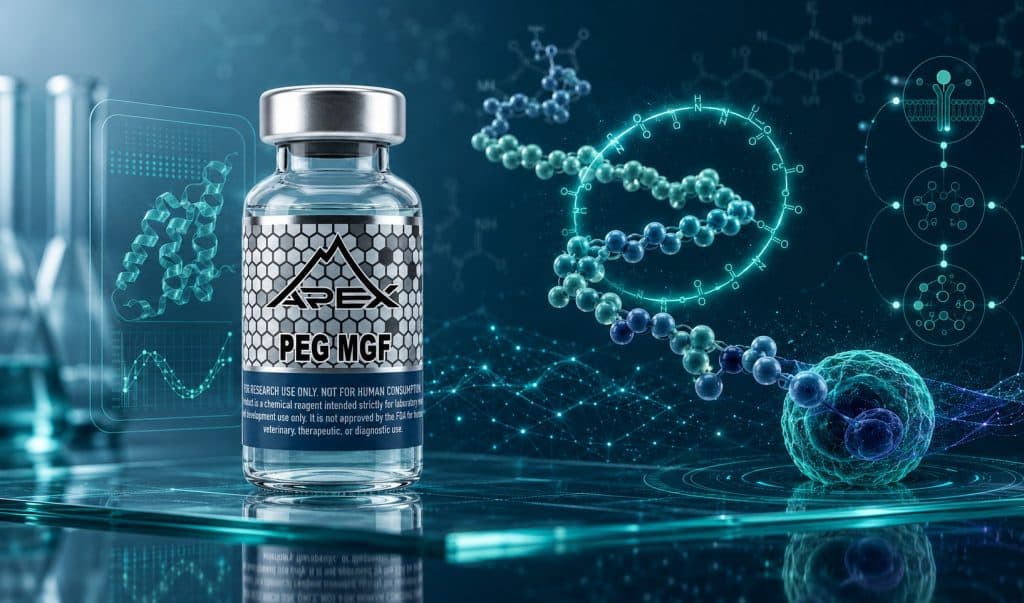
PEG-MGF is a research-grade peptide pairing the C-terminal E-domain of Mechano Growth Factor (MGF), the IGF-1Ec splice variant of the IGF1 gene, with a polyethylene glycol chain intended to lengthen the persistence of a native fragment reported to be rapidly degraded and short-lived. In the Goldspink-program literature, mechanical overload and muscle damage induce MGF and the synthetic E-peptide is studied for satellite-cell activation in preclinical and in-vitro models, but those findings remain contested by independent replication, and PEG-MGF is supplied strictly for laboratory research only.
Among the peptides marketed within the growth-hormone and IGF-1 axis, PEG-MGF occupies an unusual position: the name on the vial and the molecule in the published literature are not quite the same thing. PEG-MGF is sold as the C-terminal E-domain peptide of Mechano Growth Factor (MGF) — the IGF-1Ec splice variant of the IGF1 gene first identified in stretched skeletal muscle[1] — covalently linked to a polyethylene glycol (PEG) chain. The peer-reviewed record, by contrast, overwhelmingly characterizes native MGF and the unmodified synthetic MGF E-peptide, not the specific PEGylated commercial construct. That gap between reagent and literature is the first thing a researcher needs to hold in mind, and this guide keeps it in view throughout.[2]
This guide summarizes the MGF research literature for laboratory context — the IGF1 gene-splicing biology that produces it, the unique E-domain that defines it, its proposed satellite-cell mechanism, the preclinical models in which it has been studied, and the genuine replication controversy that keeps its muscle activity from being treated as settled. PEG-MGF sits within the broader Apex growth hormone axis research peptides cluster, and it is supplied strictly as a research-grade chemical reagent for in-vitro and preclinical investigation — not as a drug, dietary product, or therapy for human or veterinary use.
PEG-MGF at a Glance
- PEG-MGF is the synthetic C-terminal E-domain peptide of Mechano Growth Factor — the IGF-1Ec splice variant of the IGF1 gene — covalently joined to polyethylene glycol; PEGylation is a stability strategy for a very short-lived native fragment.
- MGF arises from alternative splicing of the IGF1 gene into IGF-1Ea, IGF-1Eb, and IGF-1Ec (human MGF), isoforms that share the mature IGF-1 core but carry distinct C-terminal E-domains.
- The Goldspink program (Yang, McKoy, Hill, Philippou) reported that mechanical overload and muscle damage induce a rapid, transient MGF pulse that coincides with satellite-cell activation in preclinical models.
- In-vitro work has suggested the MGF E-peptide favors myoblast and progenitor proliferation while inhibiting terminal differentiation, with some reports proposing its action does not require the IGF-1 receptor.
- The MGF literature is genuinely contested: an independent pharmaceutical-industry replication found no apparent effect of MGF peptide on muscle cells, and other work found E-peptide activity to be IGF-1R-dependent.
- PEG-MGF as a sold reagent is largely a research-supplier construct; the peer-reviewed literature characterizes native MGF and the synthetic MGF E-peptide, not the specific PEGylated commercial product, and Apex supplies it strictly as a research-grade reagent at ≥99% purity for in-vitro and preclinical use only.
PEG-MGF (PEGylated MGF E-Domain Peptide)
What PEG-MGF Is: A PEGylated MGF E-Domain Peptide
PEG-MGF is best defined in two layers: the underlying biological molecule and the chemical modification applied to it. The biological molecule is Mechano Growth Factor, a name given to a particular alternatively spliced product of the IGF1 (insulin-like growth factor 1) gene. Within MGF, the fragment of interest is a unique C-terminal E-domain (Ec) peptide of roughly 24 amino acids. PEG-MGF is that peptide covalently conjugated to a polyethylene glycol moiety.[3]
The reagent versus the literature
A point of intellectual honesty belongs up front. The original identification of MGF traces to Yang and colleagues, who in 1996 cloned a stretch-induced IGF-1 isoform from rabbit skeletal muscle — the founding paper of what became the Goldspink MGF program.[1] Almost everything in the peer-reviewed record concerns native MGF or the unmodified synthetic MGF E-peptide. “PEG-MGF” as a catalog item is largely a research-supplier construct: the precise synthetic sequence and PEGylation chemistry vary by supplier and are not a standardized pharmacopeial entity. A critical minireview by Matheny and colleagues synthesized the MGF tissue-repair literature while explicitly flagging interpretive caveats around the splice-variant and E-peptide claims — a useful reminder that even the underlying biology carries open questions.[2]
Why a fragment, and why PEGylated
Researchers study the MGF E-peptide rather than full-length IGF-1Ec because the E-domain is the structurally distinctive part — Philippou and colleagues characterized the last 24 amino acids of the E domain as the unique antigenic region that distinguishes human MGF.[3] The PEG is a separate, purely chemical intervention: native MGF E-peptide is extremely short-lived, and PEGylation is intended to slow its degradation. That rationale, and the limits of what can honestly be claimed about it, are detailed in a dedicated section below.
IGF1 Gene Splicing: IGF-1Ea, IGF-1Eb, and IGF-1Ec (MGF)
To understand MGF, start with the gene that produces it. A single IGF1 gene gives rise to multiple messenger-RNA isoforms through alternative splicing, and those isoforms differ not in their mature IGF-1 core but in their C-terminal extension peptides — the E-domains. Philippou and colleagues reviewed this isoform biology, describing IGF-1Ea, IGF-1Eb, and IGF-1Ec (the human MGF isoform) and their autocrine and paracrine roles in skeletal muscle.[4]
One gene, multiple E-domains
The shared element across these isoforms is the mature IGF-1 peptide; what changes is the trailing E-peptide produced by which exons are retained or skipped during splicing. Goldspink, in a widely cited review, framed this as a system in which mechanical signals shift IGF-I gene splicing toward the MGF isoform versus the IGF-IEa isoform, and proposed a two-phase model of muscle adaptation built on that splicing switch.[5] In that model, the IGF-1Ec (MGF) pulse and the later IGF-1Ea rise play sequential, distinct roles.
The interpretive caveat
It is worth pairing the Goldspink framing with the Matheny minireview, which frames MGF as a putative product of IGF-I gene expression and is candid that the splice-variant and E-peptide claims carry interpretive uncertainty.[2] The splicing biology itself is well-established; the downstream functional claims for the isolated E-peptide are where the literature becomes contested, as later sections make explicit.
The Unique MGF C-Terminal E-Domain Peptide
The fragment that gives PEG-MGF its name is the C-terminal E-domain of human IGF-1Ec. Because IGF-1Ec shares its mature IGF-1 core with the other isoforms, the E-domain is what makes MGF molecularly distinctive — and it is the part synthesized and studied as the “MGF E-peptide.”
The last 24 amino acids
Philippou and colleagues defined this region precisely when they raised and characterized a rabbit anti-human MGF polyclonal antibody against the last 24 amino acids of the E domain, establishing that C-terminal stretch as the distinguishing antigenic identity of human MGF.[3] This is the structural anchor for the synthetic E-peptide reagents that appear throughout the research record, and by extension for the peptide that PEG-MGF conjugates to PEG.
The active core and species-specific action
Papageorgiou and colleagues characterized the human Ec peptide as the active core of a progression growth factor in PC-3 prostate-cancer cells, reporting a species-specific mode of action; notably the human Ec peptide did not stimulate mouse C2C12 myoblasts in that study, and its activity was blocked by anti-IGF-1Ec rather than by an anti-IGF-1R antibody.[6] Species-specificity is an important handling caveat for researchers: findings generated with one species’ E-peptide sequence cannot be assumed to transfer cleanly to another, which is one reason the literature is harder to consolidate than a single-target small molecule would be. The original cloning work by Yang and colleagues remains the lineage anchor for all of this E-domain characterization.[1]
Mechano-Transduction: Induction by Mechanical Overload and Damage
The “mechano” in Mechano Growth Factor is not decorative — it names the central observation of the entire program: that mechanical signaling controls which IGF-1 isoform a muscle produces. This is the most robust part of the MGF literature, because it concerns gene-expression measurements rather than the more contested functional claims about the isolated peptide.
Mechanical overload → IGF1 splicing to IGF-1Ec (MGF) → autocrine MGF E-peptide → satellite/progenitor-cell proliferation
In the Goldspink-program model, mechanical overload, stretch, and local muscle damage act as the upstream signal that shifts alternative splicing of the IGF1 gene toward the IGF-1Ec isoform — human Mechano Growth Factor — producing a rapid, transient MGF pulse that precedes the sustained IGF-1Ea rise. The unique C-terminal E-domain (Ec) peptide is then proposed to act in an autocrine fashion to favor satellite/progenitor-cell proliferation while inhibiting terminal differentiation, expanding the precursor pool available for repair. The proposed receptor is contested: some work argues for a non-IGF-1R mechanism, while independent replication reports IGF-1R-dependence or no effect at all. Every step is characterized in animal-model and in-vitro systems. Goldspink (2005), Physiology (Bethesda).
Stretch and stimulation induce the MGF splice variant
The founding observation came from Yang and colleagues, who identified a stretch-induced IGF-1 isoform in rabbit skeletal muscle.[1] McKoy and colleagues then showed that mechanical stretch combined with electrical stimulation preferentially induces the MGF/IGF-1Ec splice variant in rabbit muscle, establishing mechano-transduction as the control point for IGF-1 gene splicing.[7] The Goldspink review consolidated these observations into the proposal that mechanical load shifts splicing toward MGF.[5]
The rapid, transient pulse after damage
The temporal pattern is a defining feature. Hill and colleagues reported that after local muscle damage in rodents, MGF is expressed rapidly and transiently and coincides with satellite (stem) cell activation, preceding the more sustained IGF-IEa rise.[8] This rapid-pulse-then-sustained-rise sequence is the empirical backbone of the two-phase adaptation model, and it is consistently observed at the messenger-RNA level across the program’s studies. These are gene-expression findings in animal muscle and isolated cells, reported here as research context.
Satellite-Cell Activation and Myoblast Proliferation vs Differentiation
If the splicing biology is the most established part of the MGF story, the proposed cellular function of the isolated E-peptide is where the most-cited claims live — and where the contest begins. The recurring proposal is that the MGF E-peptide pushes muscle precursor cells toward proliferation and away from terminal differentiation.
Proliferation up, differentiation held back
The cornerstone functional study came from Yang and colleagues, who reported that the MGF E-domain peptide increased myoblast proliferation and inhibited terminal differentiation, and that antibody-blocking experiments indicated its action was mediated through a receptor distinct from the IGF-1 receptor — in contrast to mature IGF-I.[9] This proliferation-favoring, differentiation-inhibiting pattern is the signature ascribed to MGF across much of the program.
Expanding the progenitor pool
Two later studies extended this into human muscle cultures. Ates and colleagues reported that the synthetic MGF E-peptide increased the desmin-positive progenitor (satellite) cell pool in normal, dystrophic, and ALS human muscle cultures, apparently by blocking myogenic differentiation.[10] Kandalla and colleagues reported that the MGF E-peptide activated human muscle progenitor cells and increased their fusion potential across donor ages in vitro.[11] The coincidence of the endogenous MGF pulse with satellite-cell activation after damage, documented by Hill and colleagues, is the in-vivo correlate cited alongside these culture findings.[8] Every one of these is a cell-culture or animal-model result; none establishes an effect in humans, and the next sections show why even the cell-culture picture is disputed.
Evidence the E-Peptide Action May Differ From IGF-1R Signaling
A central and consequential claim in the MGF literature is that the E-peptide does not simply act as another IGF-1-receptor agonist — that it has a distinct molecular entry point. This claim is what would distinguish MGF mechanistically from mature IGF-1 and from analogs like IGF-1 LR3. It is also one of the most directly contested claims, as the controversy section makes clear.
The distinct-receptor proposal
The proposal originates with Yang and colleagues, whose antibody-blocking data led them to argue that MGF E-peptide proliferative activity is mediated through a receptor distinct from the IGF-1 receptor.[9] Papageorgiou and colleagues’ characterization of the human Ec peptide as an active core with a species-specific mode of action came from PC-3 prostate-cancer cells, not muscle — the human Ec peptide did not stimulate mouse C2C12 myoblasts in that study — so it speaks to species- and cell-context-dependent activity rather than offering direct evidence about the E-peptide’s receptor in muscle.[6]
A non-canonical binding partner
The most concrete non-IGF-1R mechanistic clue comes from outside muscle. Podratz and colleagues reported that MGF protected dorsal-root-ganglion neurons from cisplatin-induced neurotoxicity in vitro and in vivo, and identified nucleolin as a key binding partner — a finding that supports a non-canonical mechanism distinct from classical IGF-1R signaling.[12] A nucleolin interaction is mechanistically interesting precisely because nucleolin is not the IGF-1 receptor. That said, this evidence sits in tension with replication work reporting IGF-1R-dependence, and the honest summary is that the receptor question is unresolved — a point developed fully below.
Neuroprotection and CNS Research Context
Although MGF began as a muscle story, a substantial strand of the literature has examined it in the central and peripheral nervous system. These CNS findings are preclinical — animal models and isolated cultures — and they are notable partly because several report activity described as independent of the IGF-1 receptor.
Brain ischemia and neurogenesis
Dluzniewska and colleagues reported a strong neuroprotective effect of the synthetic autonomous MGF C-terminal (E-domain) peptide in a gerbil transient-brain-ischemia model and in organotypic hippocampal cultures, with action described as independent of the IGF-1 receptor.[13] Extending the picture to aging, Tang and colleagues reported that transgenic MGF overexpression promoted neurogenesis in the aging mouse brain, taking MGF research beyond muscle into CNS models.[14]
Motoneuron rescue and neurotoxicity protection
In a neuromuscular disease model, Riddoch-Contreras and colleagues reported that MGF delivery rescued motoneurons and improved muscle function in SOD1(G93A) ALS mice.[15] The Podratz nucleolin study, already discussed for its mechanistic implication, also belongs here as a neuroprotection finding in dorsal-root-ganglion neurons.[12] These are encouraging-looking preclinical signals, but they are model-specific results and carry no implication for human use; they are included to map the breadth of the research, not to assert efficacy.
Cardiac and Other Tissue-Repair Models
Beyond muscle and nerve, the MGF E-domain has been studied in cardiac injury and in non-muscle cell types, where a recurring theme is anti-apoptotic, function-preserving activity. As with every section here, these are preclinical findings.
Myocardial infarction models
Carpenter and colleagues reported that the MGF E-domain peptide reduced loss of cardiac function and limited remodeling in a sheep myocardial-infarction model.[16] Mavrommatis and colleagues provided a mechanistic complement, reporting that the MGF E-domain region inhibited cardiomyocyte apoptosis and preserved cardiac function during myocardial infarction — supporting an anti-apoptotic action for the E-peptide.[17]
Localized delivery and a non-muscle cell type
The short-lived nature of the E-peptide shaped how it was delivered. Peña and colleagues used localized polymeric microstructures to deliver the MGF E-domain peptide and reported improved cardiac function after myocardial infarction — an explicit example of delivery and stability engineering applied to the short-lived fragment.[18] Outside contractile tissue, Xin and colleagues reported that the synthetic MGF E-peptide inhibited osteoblast differentiation and mineralization in vitro, extending the proliferation-favoring, differentiation-inhibiting pattern to a non-muscle cell type.[19] The osteoblast result is a useful caution: “inhibits differentiation” is not uniformly a beneficial outcome, and reading it as such would misstate the data.
Aging and Blunted MGF Response to Loading
One of the more internally consistent threads in the MGF literature concerns aging: the capacity to upregulate MGF in response to mechanical loading appears to decline with age, in both rodents and humans. Because these are again gene-expression and physiological measurements rather than isolated-peptide functional claims, they are relatively robust.
Blunted induction in aged rodent muscle
Owino and colleagues reported that mechanical-overload induction of the autocrine MGF splice variant is blunted with age in rodent muscle, linking the loss of MGF responsiveness to age-related muscle decline.[20] Goldspink and colleagues separately associated defective IGF-I gene splicing and reduced MGF expression with muscle-wasting states.[21]
The human exercise data
The human counterpart came from Hameed and colleagues, who reported that high-resistance exercise significantly increased MGF messenger RNA in young but not elderly men — a direct demonstration of an age-related difference in the MGF splicing response to mechanical loading in humans.[22] Philippou and colleagues characterized the time-course of IGF-1Ea, IGF-1Eb, and MGF isoform expression after exercise-induced muscle damage in humans and characterized synthetic MGF E-peptide signaling in C2C12 myoblasts in vitro.[23] Importantly, these are observations of the endogenous gene-splicing response to exercise; they are not evidence that administering an exogenous MGF or PEG-MGF reagent reproduces or restores that response.
Why Native MGF Is Short-Lived: The PEGylation Rationale
The chemical logic behind PEG-MGF rests on a single problem: the native MGF E-peptide does not last long. Understanding that problem, and being precise about what the PEG modification can and cannot be claimed to fix, is essential to handling this reagent honestly.
A rapidly degraded fragment
The native MGF E-peptide is reported to be rapidly degraded and short-lived, owing to rapid proteolysis and clearance; its lability implies a persistence on the order of minutes, though that figure is an inference from the peptide’s instability rather than a measured half-life in the cited literature. The clearest evidence of how seriously researchers took this lability is that they engineered around it: Peña and colleagues turned to localized polymeric delivery precisely to keep the short-lived E-domain peptide present long enough to act in a cardiac model.[18] The neuroprotection work with the autonomous C-terminal peptide likewise depended on the synthetic fragment being deliverable in an active form.[13]
What PEGylation is — and what the half-life numbers are not
PEGylation is a general protein-chemistry strategy: attaching a polyethylene glycol chain increases a molecule’s hydrodynamic radius and can slow proteolysis and renal clearance, extending its functional window. For PEG-MGF, that is the stated rationale — a plausible chemical intervention against a genuinely short-lived peptide. It is critical, however, to separate the rationale from specific marketed numbers. Supplier half-life figures such as “48–72 hours” are marketing claims, not peer-reviewed measurements: no citation in this guide’s verified literature reports a PEG-MGF half-life, because the published work characterizes native MGF and the unmodified E-peptide, not the PEGylated commercial construct. The Matheny minireview’s caution about over-reading MGF claims applies with particular force here.[2] Researchers should treat any quantified PEG-MGF persistence figure as an unverified supplier specification.
The Replication Controversy: Conflicting Evidence on MGF Activity
No honest research guide to MGF can present its muscle activity as settled. Two influential studies directly contest the early Goldspink-program claims, and a balanced reading must give them equal weight. This is not a minor caveat — it is the central reason MGF remains scientifically contested rather than established.
MGF E-Peptide vs Mature IGF-1 vs IGF-1 LR3: Fragment vs Full Agonists
| Attribute | MGF E-Peptide (PEG-MGF) | Mature IGF-1 | IGF-1 LR3 |
|---|---|---|---|
| Molecular identity | C-terminal E-domain fragment (~24 aa) of the IGF-1Ec splice variant | Full-length mature IGF-1 (70 aa) | Modified full-length IGF-1 analog (Long R3 substitution) |
| Origin | Autocrine splice-variant fragment (IGF1 alternative splicing) | Endogenous IGF-1 hormone | Engineered long-acting IGF-1 analog |
| Receptor target | Contested: proposed non-IGF-1R vs reported IGF-1R-dependent | IGF-1 receptor (full agonist) | IGF-1 receptor (full agonist) |
| IGF-binding-protein affinity | Not the relevant axis (isolated E-domain) | High (regulated by IGFBPs) | Reduced (prolongs action) |
| Reported cellular effect | Proposed proliferation up, differentiation inhibited (contested) | Proliferation and differentiation / fusion | Potent IGF-1R agonism; prolonged |
| Evidence status | Contested — null replication and IGF-1R-dependence reported | Well-established IGF-1 biology | Established analog pharmacology |
| Regulatory status | Research-only; no approved formulation | Research reagent; no MGF-type approval | Research-only; no approved formulation |
An independent replication finding no apparent effect
The most direct challenge came from Fornaro and colleagues, working in a pharmaceutical-industry setting. They reported that synthetic MGF peptide, tested at concentrations up to 500 ng/ml, had no apparent proliferative or differentiation effect on myoblasts or primary muscle stem cells — in pointed contrast to mature IGF-1, which was active in the same systems.[24] Because this was an independent attempt to reproduce the foundational proliferation claims and it failed to do so, it stands as a serious counterpoint to the satellite-cell narrative.
Evidence the E-peptide needs the IGF-1 receptor after all
The second challenge targets the distinct-receptor hypothesis directly. Brisson and colleagues reported that IGF-I E-peptide mitogenic and motogenic effects were dependent on the IGF-I receptor — blocked by IGF-1R inhibition or MAPK inhibition — which challenges the proposed IGF-1R-independent MGF mechanism.[25] Taken together with the Fornaro null result, this means two of the most-cited MGF claims — that the E-peptide drives muscle-cell proliferation, and that it does so through a non-IGF-1R mechanism — are both contested by independent work.
How to hold the contradiction
The responsible synthesis, echoing Matheny’s minireview, is that the MGF E-peptide literature contains genuinely conflicting results that have not been fully reconciled.[2] Differences in peptide source, sequence, species, concentration, and assay design are plausible contributors to the disagreement, and the species-specific mode of action reported by Papageorgiou and colleagues may be part of the explanation.[6] For a researcher, the practical implication is clear: MGF / PEG-MGF is an open experimental question, not a validated tool, and any study design should anticipate the possibility of a null result.
PEG-MGF vs IGF-1 and IGF-1 LR3: How They Differ
Researchers most often encounter PEG-MGF alongside mature IGF-1 and the long-acting analog IGF-1 LR3, and conflating them is a common error. The three are related — all trace to the IGF1 gene — but they are pharmacologically distinct, and the distinction matters for any comparative study design.
Fragment versus full agonists
Mature IGF-1 and IGF-1 LR3 are full IGF-1-receptor agonists: IGF-1 LR3 is a modified full-length IGF-1 analog that potently activates the IGF-1 receptor while having reduced affinity for IGF-binding proteins, which prolongs its action. The MGF E-peptide is not a full IGF-1 molecule at all — it is the isolated C-terminal extension whose proposed activity centers on proliferation and a possibly distinct (and contested) receptor mechanism rather than classical full IGF-1R agonism.[9] Philippou and colleagues’ isoform review frames precisely this division of labor among IGF-1 isoforms within muscle.[4]
The receptor caveat the comparison depends on
The cleanest way to state the comparison is also the most honest: IGF-1 and IGF-1 LR3 have a well-defined receptor (IGF-1R); the MGF E-peptide’s receptor is disputed. Brisson and colleagues’ finding that E-peptide activity is IGF-1R-dependent means the supposedly sharp mechanistic line between MGF and the full agonists may be blurrier than the early literature implied.[25] Researchers building a comparative panel can review the Apex IGF-1 LR3 research guide for the full-agonist comparator, and the CJC-1295 research guide and Ipamorelin research guide for upstream GH-axis secretagogues. The comparison below is a summary of research pharmacology, not of approved therapies.
Research-Grade Sourcing, Reconstitution, and Storage
For any PEG-MGF experiment, the interpretability of the result depends on knowing what is actually in the vial — and that is harder for PEG-MGF than for a defined small peptide, because the PEGylated construct is not a single standardized structure. Apex provides handling context for laboratory work only; nothing in this section is a dosing recommendation, and no human dosing protocol for PEG-MGF exists in the cited literature.
Identity, purity, and the limits of a single spec
PEG-MGF is supplied as a lyophilized powder at ≥99% purity per catalog, but two honest caveats apply. First, no single CAS number, molecular formula, or PubChem CID can be assigned to the PEGylated form, because PEG polymer dispersity means the product is a distribution of closely related species rather than one exact structure — the specifications table records these as “Not specified” deliberately, not as an oversight. Second, the underlying E-peptide is the species the literature characterizes, so a purity number alone does not confirm that the conjugated, intact peptide is present. Reversed-phase HPLC and a lot-specific certificate of analysis are the appropriate verification tools; background is available in the Apex guides on how to read a peptide COA and HPLC testing for peptide purity, and each lot is documented through the lab-verified COA archive.
Reconstitution, storage, and research-use-only designation
As a lyophilized peptide, PEG-MGF is generally stored dry, cold, and desiccated, with reconstituted material refrigerated for short-term use or frozen for longer-term storage and freeze-thaw cycling minimized to preserve integrity. These are general peptide-handling conventions rather than compound-specific stability data. For protocol detail, consult the Apex guides on how to reconstitute peptides and the peptide storage guide. PEG-MGF is sold strictly for in-vitro and preclinical laboratory research and is not for human or veterinary use; it has no approved pharmaceutical formulation and no approved indication anywhere, a status reinforced in the Apex treatment of research-grade vs pharmaceutical-grade peptides. The Apex editorial standards and research library document how each guide is sourced and reviewed, and the items below are available as research reagents.
PEG-MGF and Adjacent GH-Axis Research Reagents
PEG-MGF 2mg
Research-grade PEGylated MGF E-domain peptide, lyophilized powder, ≥99% purity, for in-vitro and preclinical laboratory research only.
View ProductIGF-1 LR3
Long-acting IGF-1 analog research reagent; the closest GH-axis comparator for IGF-1 receptor agonism studies.
View ProductFollistatin-344 1mg
Research-grade follistatin reagent studied in myostatin-pathway and muscle-research contexts.
View ProductFrequently Asked Questions
What is PEG-MGF?
PEG-MGF is a research-grade peptide consisting of the synthetic C-terminal E-domain of Mechano Growth Factor (MGF) – the IGF-1Ec splice variant of the IGF1 gene – covalently attached to a polyethylene glycol chain. It is supplied as a lyophilized powder for in-vitro and preclinical laboratory research only. An important caveat: the peer-reviewed literature characterizes native MGF and the unmodified synthetic MGF E-peptide, not the specific PEGylated commercial construct sold as PEG-MGF.
How does MGF relate to IGF-1?
MGF (IGF-1Ec in humans) is one of several isoforms produced by alternative splicing of the IGF1 gene, alongside IGF-1Ea and IGF-1Eb. All share the mature IGF-1 core but differ in their C-terminal E-domain (Philippou 2007). MGF’s distinctive last-24-amino-acid E-domain peptide is the fragment that research models study separately from mature IGF-1 (Philippou 2008), and it is the peptide that PEG-MGF conjugates to PEG.
Why is MGF called a ‘mechano’ growth factor?
In the Goldspink program’s animal and in-vitro work, mechanical overload, stretch, and muscle damage shift IGF1 gene splicing toward the MGF isoform, producing a rapid, transient MGF pulse (Yang 1996; McKoy 1999; Hill 2003). The ‘mechano’ name reflects this induction by mechanical signaling. The gene-splicing response to loading is the most robust part of the MGF literature, distinct from the more contested claims about the isolated E-peptide.
Why is PEG attached to MGF, and what is its half-life?
The native MGF E-peptide is reported to be rapidly degraded and short-lived due to rapid proteolysis and clearance; its persistence is sometimes described as on the order of minutes, but that is an inference from the peptide’s instability rather than a measured half-life in the cited literature. PEGylation increases the molecule’s hydrodynamic size and is intended to slow degradation, extending the functional window for laboratory study; localized polymeric delivery has been used in cardiac models for a similar stabilization purpose (Pena 2015). Specific marketed half-life figures such as ’48 to 72 hours’ are supplier marketing claims, not peer-reviewed measurements – no published study cited here reports a PEG-MGF half-life.
Does the MGF E-peptide act through the IGF-1 receptor?
This is an open and contested research question. Some Goldspink-group studies reported that the MGF E-peptide’s proliferative effects are mediated by a receptor distinct from the IGF-1 receptor (Yang 2002), and nucleolin has been identified as a binding partner in neuronal work (Podratz 2020). However, Brisson and colleagues (2012) found E-peptide activity to be IGF-1R-dependent, blocked by IGF-1R or MAPK inhibition, so the proposed receptor-independent mechanism remains disputed.
Is the muscle and recovery research on MGF settled?
No. Early Goldspink-program studies described MGF E-peptide effects on satellite-cell and myoblast proliferation (Yang 2002; Ates 2007; Kandalla 2011), but an independent pharmaceutical-industry replication by Fornaro and colleagues (2014) found no apparent effect of MGF peptide on myoblasts or primary muscle stem cells at concentrations up to 500 ng/ml. A critical minireview (Matheny 2010) also flagged interpretive caveats. Any research summary of MGF should present both the positive findings and these counterpoints; the muscle activity is contested, not established.
How does PEG-MGF differ from IGF-1 LR3?
IGF-1 LR3 is a modified full-length IGF-1 analog that potently agonizes the IGF-1 receptor with reduced binding-protein affinity, prolonging its action. PEG-MGF is instead a fragment – the isolated MGF E-domain peptide – whose proposed activity centers on satellite-cell proliferation and a possibly distinct, contested receptor mechanism rather than classical full IGF-1R agonism (Yang 2002; Brisson 2012). They are related through the IGF1 gene but pharmacologically distinct.
Is PEG-MGF approved for any therapeutic use?
No. PEG-MGF has no approved pharmaceutical formulation and no approved human or veterinary indication anywhere. It is a research-use-only chemical reagent intended strictly for in-vitro and preclinical laboratory investigation; it is not for human consumption. All of the biological findings summarized in research on MGF derive from cell-culture and animal-model studies and do not constitute therapeutic, efficacy, or safety claims.
Continue Your Research
Researchers building broader context across the Apex Research Library may find the following references useful:
- Growth Hormone Axis Research Peptides — the cluster hub situating PEG-MGF within the broader GH and IGF-1 axis
- IGF-1 LR3 Research Guide — the long-acting full IGF-1-receptor agonist analog and closest MGF comparator
- CJC-1295 Research Guide — an upstream GHRH-analog secretagogue in the same GH-axis cluster
- Ipamorelin Research Guide — a selective growth-hormone secretagogue studied alongside GH-axis peptides
- Research-Grade vs Pharmaceutical-Grade Peptides — the regulatory-framing anchor reinforcing PEG-MGF’s research-only status
- How to Reconstitute Peptides — general protocol for preparing labile lyophilized peptides for in-vitro work
- Peptide Storage Guide — storage and freeze-thaw handling for the lyophilized 2mg PEG-MGF reagent
- How to Read a Peptide Certificate of Analysis — interpreting HPLC purity and identity data on a lot-specific COA
Research Use Disclaimer
All PEG-MGF products and the information in this guide are intended strictly for in-vitro and preclinical laboratory research. PEG-MGF is a research-grade chemical reagent and is not a drug, dietary supplement, or therapeutic product. It is not approved by the FDA, EMA, or any other regulatory authority, and it has no approved indication anywhere. It is not for human or veterinary consumption, diagnosis, treatment, or any clinical use. The splicing, mechanistic, satellite-cell, neuroprotection, cardiac, and aging findings summarized here derive from cell-culture and animal-model studies of native MGF and the synthetic MGF E-peptide — not the specific PEGylated commercial construct — and several of the most-cited muscle-cell claims are directly contested by independent replication; all are presented for research context only and do not constitute therapeutic, efficacy, or safety claims. Any specific half-life or persistence figure marketed for PEG-MGF is an unverified supplier specification, not a peer-reviewed measurement. Researchers are responsible for compliance with all applicable institutional, local, and national regulations governing the acquisition, handling, and use of research chemicals.