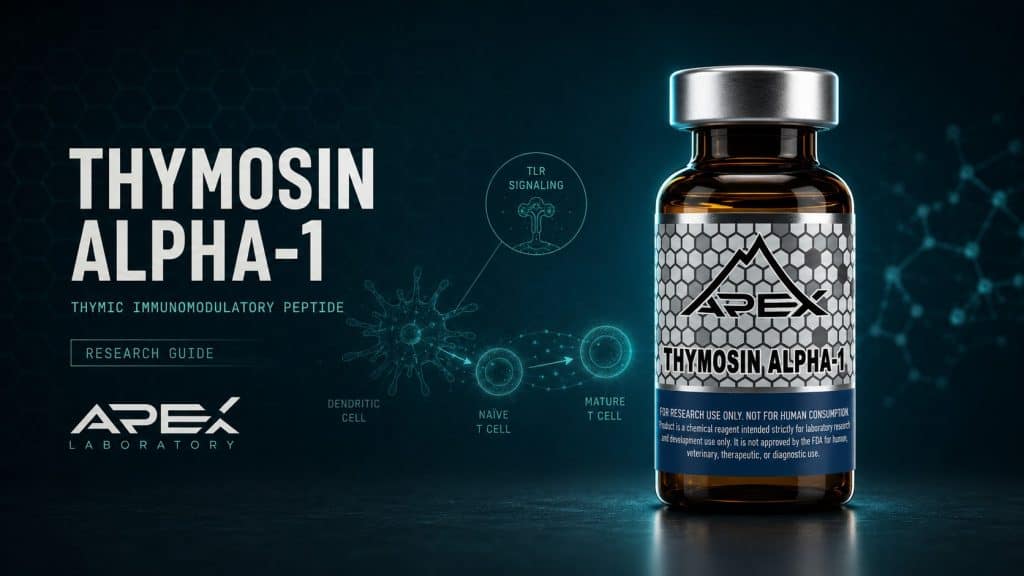
Thymosin alpha-1 is a 28-amino-acid, N-terminally acetylated thymic peptide (CAS 62304-98-7; molecular weight 3108.28 g/mol) originally isolated from thymosin fraction-5 and characterized in the Allan Goldstein laboratory. Preclinical research describes it as an immunomodulator acting through Toll-like receptors, notably TLR9, to influence dendritic-cell and T-cell maturation, cytokine signaling, and natural-killer-cell activity. Apex Laboratory supplies thymosin alpha-1 as a research-grade chemical reagent for in-vitro and preclinical research, distinct from the Zadaxin (thymalfasin) pharmaceutical formulation, which is approved abroad but not FDA-approved.
The story of thymosin alpha-1 begins not with a single molecule but with a crude glandular extract. In the late 1960s and 1970s, work that traced from the Abraham White laboratory through the University of Texas Medical Branch at Galveston and on to George Washington University produced thymosin fraction-5 (TF5), a partially purified preparation from calf thymus that retained the immune-restoring activity attributed to the thymus gland.[1] From that fraction, the laboratory of Allan L. Goldstein isolated and characterized the most active species, a small acidic peptide that was sequenced and reported in 1977 and named thymosin alpha-1.[2]
This guide surveys what the peer-reviewed literature documents about thymosin alpha-1 (Tα1, thymalfasin) as a research subject: its molecular identity as a 28-amino-acid, N-terminally acetylated peptide, its proposed Toll-like-receptor mechanism, the breadth of antiviral and immune-reconstitution research it has appeared in, and the regulatory distinction between the research-grade reagent and the pharmaceutical formulation marketed abroad. Every claim here describes laboratory and animal-model findings; nothing on this page is a therapeutic or efficacy claim.
Key Research Takeaways
- Thymosin alpha-1 (Tα1, thymalfasin) is a 28-amino-acid, N-terminally acetylated peptide corresponding to residues 1–28 of prothymosin alpha; CAS 62304-98-7, molecular weight ≈3108.28 g/mol.
- It was isolated from thymosin fraction-5, a calf-thymus preparation, and characterized in the Allan Goldstein laboratory, with the defining work reported in 1977.
- Published research describes immunomodulation through Toll-like receptors — most prominently TLR9 — engaging MyD88, IRF7, IRF3 and NF-κB signaling in dendritic cells.
- Preclinical and clinical-research work spans hepatitis B and C models, sepsis immune dysfunction, and post-viral immune reconstitution; the clinical evidence is mixed and remains under investigation.
- The molecule is marketed abroad as Zadaxin (thymalfasin) in roughly 35-plus countries, yet holds only FDA Orphan Drug designation in the United States — it is not FDA-approved for marketing.
- Apex supplies thymosin alpha-1 as a research-grade chemical reagent at ≥99% purity verified by HPLC and ESI-MS, for in-vitro and preclinical use only — not for human consumption.
Molecular Specifications
What Is Thymosin Alpha-1? Molecular Identity and Catalog Specifications
Thymosin alpha-1 is a single-chain peptide of 28 amino acids, a length confirmed directly in the experimental literature where it is described as a “28 amino acid peptide initially isolated from the thymus.”[3] Its sequence corresponds to residues 1–28 of the larger precursor protein prothymosin alpha, and its N-terminal serine carries an acetyl modification. The peptide is highly acidic and charged, with the catalog and PubChem records in agreement: CAS number 62304-98-7, molecular formula C129H215N33O55, molecular weight approximately 3108.28 g/mol, and PubChem CID 16130571.
One structural feature distinguishes thymosin alpha-1 from many globular peptides and proteins: structural-biology work classifies it among the thymosin proteins that are short, highly charged, and intrinsically unstructured in solution, with ordered conformation inducible only under particular conditions such as low pH or interaction with binding partners.[4] For laboratory purposes this matters in two ways. First, the defined single mass makes the molecule a clean analytical target, which is central to the verification standards discussed in the HPLC purity-testing guide. Second, a disordered peptide demands attention to reconstitution and storage, topics covered in the peptide reconstitution guide and peptide storage guide. Thymosin alpha-1 sits within the broader specialty research peptides category at Apex Laboratory.
Thymic Origin: Thymosin Fraction-5 and the Goldstein Lineage
The thymus had long been suspected of secreting humoral factors that govern immune cell development, but isolating those factors required a tractable starting material. Thymosin fraction-5, prepared from calf thymus, became that material. Goldstein’s own historical account documents the preparation of TF5 and the program built around it, including the filing of the first investigational new drug application for a thymosin preparation in 1974.[1] The lineage of the research program is itself part of the record: it traces from the Abraham White laboratory at Albert Einstein, to the University of Texas Medical Branch at Galveston, and then to George Washington University.
Within TF5, investigators recognized not one factor but a family. A contemporaneous account co-authored from the Goldstein group described thymosin fraction-5 as containing a family of thymic factors that control T-cell maturation, and reported that thymosin alpha-1 induces the formation of functional helper cells.[5] A historical overview later credited the characterization of thymosin alpha-1 to Allan Goldstein in 1977 and summarized its immunoregulatory role, including the upregulation of MHC class-I and Toll-like-receptor expression and the modulation of cytokine production.[2] This Goldstein attribution is preserved throughout the literature and is named here at first mention as a matter of historical accuracy.
Immunomodulatory Mechanism: TLR-Mediated Dendritic-Cell and T-Cell Maturation
Toll-like receptor / MyD88 / IRF7 / NF-κB signaling in dendritic cells
The central mechanistic model for thymosin alpha-1 is innate-immune receptor engagement. Published research reports that the peptide signals through Toll-like receptors — most prominently TLR9, with additional roles described at TLR2, TLR3, TLR4 and TLR7 — recruiting the adaptor MyD88 and activating the transcription factors IRF7, IRF3 and NF-κB.[6] In plasmacytoid dendritic cells this TLR9/MyD88/IRF7 axis drives type-I and type-II interferon output, while dendritic-cell maturation and MHC-I/HLA upregulation link the innate signal to T-cell maturation. The reported effects span dendritic cells, T cells, B cells, macrophages and natural-killer cells, consistent with action at an early integrative node of immune signaling.
The most developed mechanistic account of thymosin alpha-1 centers on innate-immune pattern-recognition receptors, the Toll-like receptors (TLRs). Work describing the peptide as an endogenous regulator of inflammation, immunity, and tolerance reported that thymosin alpha-1 primes dendritic cells through TLR/MyD88-dependent signaling and activates plasmacytoid dendritic cells via a TLR9/MyD88/IRF7 axis, with downstream induction of indoleamine 2,3-dioxygenase (IDO) and a tolerogenic program.[6] A comprehensive 2023 review broadened this picture, reporting that thymosin alpha-1 engages TLR3, TLR4 and TLR9 (and is also implicated at TLR2 and TLR7), activating both IRF3 and NF-κB and thereby modulating T cells, B cells, macrophages and natural-killer cells.[7]
The functional consequence emphasized across these reports is dendritic-cell maturation feeding into adaptive immunity. By upregulating MHC class-I and HLA molecules and shaping the cytokine environment, thymosin alpha-1 is described as supporting T-cell maturation, a theme that connects the modern receptor-level data back to the original observation that the peptide drives functional helper-cell formation.[2] These are mechanistic observations from laboratory and animal systems and remain an active area of investigation rather than settled human pharmacology.
Cytokine Modulation and Natural-Killer-Cell Activity
A recurring and important nuance in the thymosin alpha-1 literature is that its effect on cytokine output is context-dependent rather than uniformly stimulatory. An in-vitro study of human monocyte-derived dendritic cells reported a dual effect: under viral-type Toll-like-receptor stimulation (TLR3 and TLR7/8 agonists), thymosin alpha-1 enhanced surface expression of HLA class-I and class-II molecules and increased secretion of IL-6, TNF-α and IL-8, whereas the response differed under bacterial-type TLR2/4 stimulation.[8] This finding underlies the frequent description of the peptide as an immune “modulator” rather than a simple stimulant, and as a candidate vaccine-adjuvant tool in research settings.
Beyond the dendritic-cell and T-cell axis, mechanism reviews report that thymosin alpha-1 influences natural-killer-cell activity as part of its broader action across innate and adaptive compartments.[7] The breadth of cell types engaged — dendritic cells, T cells, B cells, macrophages and NK cells — is consistent with a molecule that acts at an early, integrative node of immune signaling rather than on a single effector lineage.
Structural Pharmacology: An Intrinsically Disordered Peptide and Its Membrane Interaction
How a small, charged, intrinsically disordered peptide produces such broad signaling effects is itself a research question. Structural studies place thymosin alpha-1 among proteins that lack a fixed fold in aqueous solution.[4] Nuclear magnetic resonance work then asked whether the peptide acquires structure at biological surfaces, and reported that thymosin alpha-1 is unstructured in water but adopts two helical tracts when it interacts with negatively charged membrane surfaces, including vesicles bearing phosphatidylserine and cells displaying exposed phosphatidylserine.[9]
This membrane-recognition hypothesis is mechanistically attractive because exposed phosphatidylserine is a hallmark of stressed, apoptotic or virally altered cells, offering a structural rationale for context-dependent activity. It remains a structural hypothesis under study rather than an established receptor-binding model, and it sits alongside the Toll-like-receptor account rather than replacing it. For researchers, the practical upshot is that conformational behavior is environment-sensitive, reinforcing the importance of consistent buffer and handling conditions when designing in-vitro experiments.
Antiviral Research: Hepatitis B and Hepatitis C Models
The single largest body of applied thymosin alpha-1 research concerns viral hepatitis, where the peptide has been studied as an immune adjunct to conventional antiviral regimens. The mechanistic basis was established in part by an in-vivo study showing that thymosin alpha-1 activates TLR9/MyD88/IRF7-dependent plasmacytoid-dendritic-cell viral sensing, driving an IFN-α/IFN-γ effector response and conferring protection in a murine cytomegalovirus model.[10] That innate antiviral wiring motivated combination-therapy research in chronic viral hepatitis.
In hepatitis B, a systematic review and meta-analysis examined entecavir plus thymosin alpha-1 versus entecavir monotherapy in HBV-related cirrhosis, documenting the immunological-enhancement research context for that combination while noting that the included trials derived from a single national population.[11] In hepatitis C, a randomized study of 552 prior non-responders added thymosin alpha-1 at 1.6 mg subcutaneously twice weekly to peginterferon alfa-2a and ribavirin; the per-protocol sustained virological response was higher with thymosin alpha-1 (41.0% versus 26.3%, P = 0.048), but the difference was not significant on intention-to-treat analysis (12.7% versus 10.5%, P = 0.407).[12] The honest reading of this record is a mixed signal under investigation. A 2023 mechanism review situates thymosin alpha-1 as an immune enhancer studied across hepatitis B, hepatitis C and other viral contexts, without resolving the efficacy question.[7] None of this establishes efficacy for any human use.
Sepsis and Immune-Reconstitution Research
Because severe sepsis frequently involves a state of immune suppression rather than only hyperinflammation, thymosin alpha-1 has been investigated as a candidate immune-reconstitution agent in critical illness. The most rigorous test to date is the TESTS trial, a multicentre, double-blinded, placebo-controlled phase 3 study of thymosin alpha-1 in sepsis.[13] A 2025 systematic review and meta-analysis with trial-sequential analysis then pooled the randomized evidence for 28-day sepsis mortality and concluded that the overall impact on sepsis outcomes remains unclear, with the available sample size judged inadequate for a definitive answer.[14] The appropriate framing is therefore explicitly unsettled evidence, not demonstrated benefit.
A related immune-reconstitution thread comes from post-viral immunology: an ex-vivo study reported that thymosin alpha-1 helped restore immune homeostasis in lymphocytes from individuals with post-acute sequelae of SARS-CoV-2 infection whose immune responses were chronically altered.[15] A historical review across infectious diseases adds breadth, summarizing research in hepatitis, sepsis, invasive aspergillosis in bone-marrow-transplant patients, and vaccine enhancement, and noting a dose-effect relationship and a favorable reported safety profile in those studies.[16] These remain research findings reported in the literature, not clinical guidance.
Research Dosing Context (Preclinical and Investigational)
Doses appearing in the thymosin alpha-1 research literature vary by study design and indication, and they describe investigational and clinical-research contexts only. The most frequently cited concrete figure comes from the chronic hepatitis C study, which used 1.6 mg administered subcutaneously twice weekly alongside standard antiviral therapy.[12] Historical reviews note that across the infectious-disease literature a dose-effect relationship has been described, with later investigations exploring different regimens.[16]
Apex Laboratory provides no human dosing guidance and makes no recommendation regarding administration. The figures above are reproduced solely to characterize the published research record. The research-grade reagent is intended exclusively for in-vitro and preclinical laboratory use; experimental design, concentration ranges and handling are the responsibility of the qualified researcher. For reconstitution mechanics relevant to a lyophilized peptide, see the reconstitution guide.
How Thymosin Alpha-1 Compares With Other Thymosin-Family Research Peptides
Thymosin Alpha-1 vs Related Thymosin-Family Research Peptides
| Attribute | Thymosin Alpha-1 (Tα1) | TB-500 (Thymosin Beta-4 fragment) | Thymalin |
|---|---|---|---|
| Family | Alpha-thymosin (prothymosin alpha fragment) | Beta-thymosin (thymosin beta-4 active fragment) | Thymic polypeptide bioregulator |
| Size | 28-residue, N-acetylated peptide | Short actin-binding-derived fragment | Mixture of low-molecular-weight thymic polypeptides |
| Primary research focus | Immunomodulation via Toll-like receptors; dendritic-cell and T-cell maturation | Actin sequestration; tissue repair and angiogenesis research | Immunosenescence and immune-regulation research |
| Reported mechanism node | TLR9/MyD88/IRF7 and NF-κʙ signaling | G-actin sequestration / cytoskeletal dynamics | Polypeptide bioregulator (less molecularly defined) |
| Apex research cluster | Specialty research peptides | Tissue-repair research peptides | Specialty research peptides |
The word “thymosin” labels a heterogeneous set of molecules that are not structurally or functionally interchangeable, and conflating them is a common source of confusion. Thymosin alpha-1 is an alpha-thymosin: a small, acidic, intrinsically disordered 28-residue peptide derived from prothymosin alpha and studied predominantly for immunomodulation through Toll-like receptors.[7] The beta-thymosins are a chemically distinct family; the most-studied member, thymosin beta-4, is an actin-sequestering peptide whose widely researched active fragment is the subject of the TB-500 research guide, and which is studied mainly in tissue-repair and angiogenesis contexts within the tissue-repair research peptides cluster.
Notably, the families are not entirely siloed in their reported activities. A study from the Goldstein group documented that thymosin alpha-1 itself stimulates endothelial-cell migration, angiogenesis and wound healing, a secondary mechanism that overlaps thematically with the tissue-repair literature usually associated with the beta-thymosins.[3] This is why thymosin alpha-1 appears both in the specialty immunomodulatory grouping and in the immunomodulatory-family discussion within the tissue-repair pillar. The comparison table below summarizes the practical distinctions a researcher should keep straight.
Foreign Regulatory Framing: Thymalfasin Abroad Versus Non-Approval in the United States
Thymosin alpha-1 is an instructive case of a single molecule occupying two categorically different regulatory worlds. Under the international nonproprietary name thymalfasin, a pharmaceutical formulation of thymosin alpha-1 is marketed abroad as a prescription medicine in roughly 35-plus countries — including China, India, the Philippines and Russia — with approved indications such as chronic hepatitis B (hepatitis C in some markets) and use as an immune adjunct or vaccine adjuvant during cancer treatment.
In the United States the situation is different. Thymalfasin is not FDA-approved for marketing; it has held only FDA Orphan Drug designation, which is a designation that supports development incentives, not a marketing approval. The distinction is the same one drawn in the research-grade versus pharmaceutical-grade peptides guide: same molecule (thymosin alpha-1 / thymalfasin); categorically distinct regulatory frameworks. Apex Laboratory’s product is the research-grade chemical reagent — not the pharmaceutical formulation marketed abroad, not a substitute for it, and not for human consumption. It is supplied for in-vitro and preclinical research only.
Research-Grade Quality and Verification: COA, HPLC, and ESI-MS
Because thymosin alpha-1 is a defined single-mass peptide, it is an unusually clean analytical target, and Apex’s verification standard takes advantage of that. Each research-grade lot is supplied as a lyophilized powder accompanied by a Certificate of Analysis reporting purity of ≥99% determined by high-performance liquid chromatography (HPLC), with identity confirmed by electrospray-ionization mass spectrometry (ESI-MS) against the expected mass near 3108.3.[4] Reading a Certificate of Analysis critically is itself a skill; the how to read a peptide COA guide explains what each section should show, and the HPLC purity-testing guide explains how the purity figure is generated.
This verification discipline is the practical expression of Apex’s editorial standards and lab-verified documentation. For an intrinsically disordered peptide whose conformation shifts with its environment, identity and purity confirmation by orthogonal methods is not a formality — it is what allows an experimental result to be attributed to the intended molecule rather than to a contaminant or a degradation product.
Limitations of the Current Evidence Base
Thymosin alpha-1 is not a thin-literature compound; it has been studied since the 1970s across mechanism, structure and applied infectious-disease research. The honest qualification is about the quality and consistency of the applied evidence rather than its quantity. Several of the most consequential studies are equivocal: the hepatitis C randomized trial showed a per-protocol response signal that disappeared on intention-to-treat analysis,[12] and the 2025 sepsis meta-analysis with trial-sequential analysis concluded that the impact on sepsis outcomes remains unclear.[14] A substantial share of the hepatitis B and sepsis combination-therapy evidence also derives from trials in a single national population, which constrains generalization.[11]
For the researcher, the practical implication is to treat published outcomes as hypotheses to be tested under controlled conditions, not as established facts about human benefit. Mechanistic findings — TLR engagement, dendritic-cell maturation, context-dependent cytokine modulation — are better supported than any specific clinical outcome. The broader research library places thymosin alpha-1 alongside related compounds so that claims can be cross-checked against the primary literature.
Safety, Tolerability & Adverse-Event Observations (Research Context)
In published clinical research, thymosin alpha-1 has been characterized as generally well tolerated, and these observations are reported here strictly as findings from named studies rather than as guidance on what any individual should expect. A peer-reviewed pharmacy review of thymosin alpha-1 summarized its pharmacology, pharmacokinetics, and adverse-effect profile across the hepatitis trials of the 1990s and concluded that the peptide is well tolerated, with most studies observing only local irritation at the injection site.[17] A historical review across the broader infectious-disease literature reached a similar reading, describing a dose-effect relationship together with a favorable reported safety profile in the studies it surveyed.[16]
More recent and more rigorous trials have documented adverse-event data directly. The multicentre, double-blinded, placebo-controlled TESTS phase 3 sepsis trial was designed to report both efficacy and safety outcomes for thymosin alpha-1 in critically ill patients,[13] and the hepatitis B systematic review of entecavir plus thymosin alpha-1 versus entecavir alone explicitly examined adverse effects alongside antiviral endpoints in HBV-related cirrhosis.[11] The consistent theme across these reports is tolerability rather than a distinctive toxicity signal, though the underlying trials differ in population, design, and quality, and several derive from a single national population.
For laboratory purposes none of this constitutes a clinical safety conclusion or any statement about human use. These are adverse-event and tolerability observations recorded in the published research record, framed as study findings. The research-grade reagent supplied by Apex Laboratory is for in-vitro and preclinical use only and is not for human consumption; experimental safety controls, containment, and handling are the responsibility of the qualified researcher, consistent with the practices outlined in the peptide storage guide.
Sourcing Research-Grade Thymosin Alpha-1
When sourcing thymosin alpha-1 for laboratory work, the decisive variables are verified identity and purity, transparent documentation, and unambiguous research-only framing. Apex Laboratory supplies thymosin alpha-1 as a lyophilized, research-grade chemical reagent verified to ≥99% purity by HPLC with identity confirmed by electrospray-ionization mass spectrometry, with per-lot documentation accessible through the lab-verified program and the methodology described under editorial standards. The reagent is intended exclusively for in-vitro and preclinical research and is not for human consumption; it is the research-grade molecule, not the thymalfasin pharmaceutical formulation marketed abroad.
Thymosin alpha-1 sits within the specialty research peptides cluster and is also discussed among the immunomodulatory members referenced in the tissue-repair research peptides family. Researchers comparing thymosin-family reagents may also review the TB-500 research guide and the wider research library. Questions about documentation or sourcing can be directed to the editorial team.
thymosin alpha 1 and Adjacent Research Reagents
Thymosin Alpha 1
28-amino-acid thymic immunomodulatory peptide research reagent; supplied at ≥99% purity verified by HPLC and mass spectrometry.
View ProductTB-500
Thymosin Beta-4 active fragment; related thymosin-family tissue-repair research reagent.
View ProductFrequently Asked Questions
What is thymosin alpha-1?
Thymosin alpha-1 (Talpha1, thymalfasin) is a 28-amino-acid, N-terminally acetylated peptide originally isolated from thymosin fraction-5, a calf-thymus preparation characterized in the Allan Goldstein laboratory and reported in 1977. It corresponds to residues 1-28 of the larger prothymosin alpha protein, carries CAS number 62304-98-7, and has a molecular weight of about 3108.28 g/mol. In research settings it is studied as an immunomodulatory peptide. Apex Laboratory supplies it strictly as a research-grade chemical reagent for in-vitro and preclinical work.
How does thymosin alpha-1 modulate the immune system?
Published research describes thymosin alpha-1 acting through Toll-like receptors — most prominently TLR9, along with reported interactions at TLR2/3/4/7 — engaging MyD88, IRF7, IRF3 and NF-κB signaling. In preclinical and in-vitro models this is associated with dendritic-cell priming and maturation, upregulation of MHC class-I/HLA molecules, modulation of cytokines such as IL-6, TNF-α and interferons, support for T-cell maturation, and altered natural-killer-cell activity. These mechanisms are documented in laboratory and animal systems and remain an active area of investigation.
What is the molecular structure of thymosin alpha-1?
Thymosin alpha-1 is a single-chain, 28-residue peptide with an acetylated N-terminal serine and a highly acidic, charged composition (molecular formula C129H215N33O55; PubChem CID 16130571). In aqueous solution it is intrinsically disordered, but structural studies show it can adopt partial helical conformation when it interacts with negatively charged membrane surfaces such as exposed phosphatidylserine. Its single, well-defined molecular mass (about 3108.3) makes it a clean target for HPLC purity assessment and ESI-MS identity confirmation.
What is the half-life of thymosin alpha-1?
In published pharmacokinetic research, native thymosin alpha-1 has a short serum half-life of approximately two hours: it is rapidly absorbed after subcutaneous dosing, reaches peak serum concentrations within about two hours, and returns to baseline within roughly 24 hours. This short circulating half-life is one reason investigators have engineered longer-acting variants, such as PASylated and albumin- or Fc-fusion constructs, to extend plasma residence in research models. These are pharmacokinetic findings from the literature, reported as research context only and not as dosing guidance.
What dosing has been used in thymosin alpha-1 research?
Doses reported in the published research literature vary by study and indication; for example, a chronic hepatitis C investigation and an earlier pharmacy review both describe 1.6 mg (about 900 micrograms per square meter) administered subcutaneously twice weekly alongside standard antiviral therapy, and some later trials explored higher doses. These figures describe investigational and clinical-research contexts only. Apex Laboratory provides no human dosing guidance; the research-grade reagent is intended exclusively for in-vitro and preclinical laboratory use.
What side effects or tolerability has thymosin alpha-1 shown in research?
In published clinical research, thymosin alpha-1 has generally been reported as well tolerated, with reviews of the hepatitis trials noting mainly local injection-site irritation and describing an overall favorable safety profile. More recent controlled studies, including the placebo-controlled TESTS phase 3 sepsis trial and hepatitis B combination-therapy meta-analyses, documented adverse-event data directly and did not surface a distinctive toxicity signal. These are tolerability observations recorded in named studies, reported as research findings only — not patient guidance, and not a safety claim for any human use.
Is thymosin alpha-1 (Zadaxin / thymalfasin) FDA-approved?
No. The pharmaceutical formulation marketed abroad as Zadaxin (active ingredient thymalfasin) is approved as a prescription medicine in roughly 35-plus countries — including China, India, the Philippines and Russia — for indications such as chronic hepatitis B and as an immune adjunct. In the United States it is not FDA-approved for marketing; it has held only FDA Orphan Drug designation. Apex Laboratory’s research-grade thymosin alpha-1 is the same molecule but a categorically distinct, research-only reagent — not the pharmaceutical formulation and not for human consumption.
How does thymosin alpha-1 compare with TB-500 (thymosin beta-4)?
They share the word “thymosin” but are chemically and functionally distinct families and are not interchangeable. Thymosin alpha-1 is an alpha-thymosin: a small, acidic, intrinsically disordered 28-residue peptide derived from prothymosin alpha and studied mainly for immunomodulation through Toll-like receptors. TB-500 is the widely researched active fragment of thymosin beta-4, a beta-thymosin actin-sequestering peptide studied chiefly in tissue-repair and angiogenesis contexts. Both are supplied only as research-grade reagents for in-vitro and preclinical use; neither is a drug or for human consumption.
Continue Your Research
Researchers building broader context across the Apex Research Library may find the following references useful:
- Specialty Research Peptides — The cluster hub where thymosin alpha-1 sits alongside other specialty immunomodulatory and metabolic research reagents.
- Tissue-Repair Research Peptides — Covers the thymosin immunomodulatory family and beta-thymosin tissue-repair compounds that thematically overlap with Tα1.
- TB-500 Research Guide — Companion thymosin-family guide on the thymosin beta-4 active fragment for direct family comparison.
- Research-Grade vs Pharmaceutical-Grade Peptides — Explains the same-molecule, distinct-regulatory-framework distinction relevant to thymalfasin abroad versus the research reagent.
- How to Read a Peptide COA — Walks through interpreting the Certificate of Analysis that accompanies each research-grade lot.
- HPLC Testing for Peptide Purity — Details how the ≥99% HPLC purity figure for peptides like thymosin alpha-1 is generated and verified.
- Peptide Storage Guide — Storage and stability practice relevant to a lyophilized, intrinsically disordered peptide.
- Apex Research Library — The full corpus for cross-checking thymosin alpha-1 claims against the primary literature and related compounds.
Research Use Disclaimer
This content is provided for educational and research-reference purposes only and describes published in-vitro and preclinical findings. Thymosin alpha-1 supplied by Apex Laboratory is a research-grade chemical reagent intended exclusively for in-vitro and preclinical laboratory research. It is NOT a drug, NOT a dietary supplement, NOT for human or veterinary consumption, and NOT for diagnostic or therapeutic use. Nothing here is a medical claim or a statement of efficacy or safety for any human application. Thymosin alpha-1 is the same molecule marketed abroad as the thymalfasin pharmaceutical formulation, but the research-grade reagent and the foreign-approved pharmaceutical product occupy categorically distinct regulatory frameworks; the reagent is not FDA-approved and is not a pharmaceutical product. See the research-grade versus pharmaceutical-grade peptides guide for that distinction. Handling, experimental design, and compliance with all applicable laws and institutional policies are the sole responsibility of the qualified researcher.