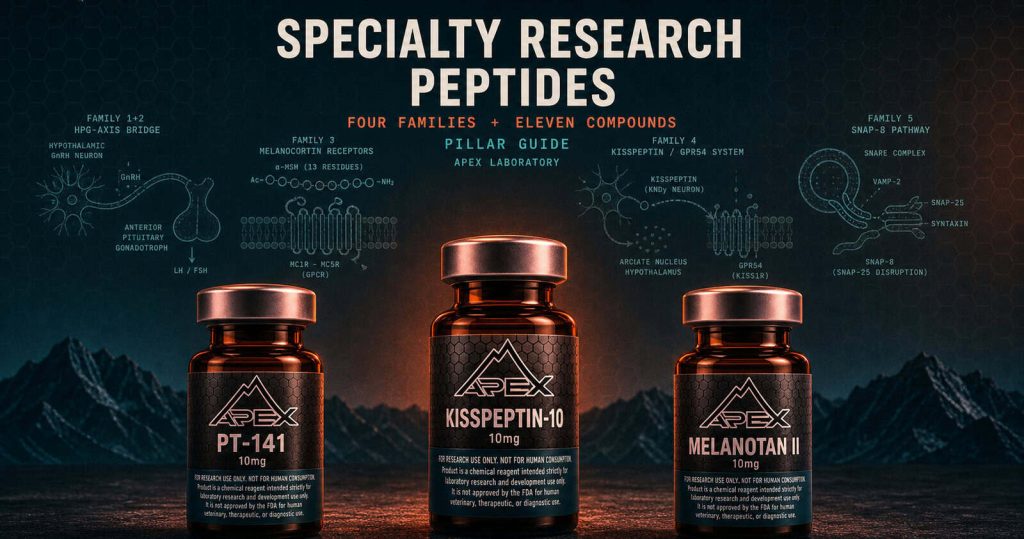
Specialty research peptides are a category covering hypothalamic-pituitary signaling and melanocortin-receptor compounds that don’t fit cleanly into other research-peptide categories. They include hypothalamic releasing peptides (Gonadorelin, Triptorelin), HPG-axis gonadotropins (HCG, HMG), melanocortin agonists (Melanotan I, Melanotan II, PT-141), and neuropeptide signaling compounds (Kisspeptin-10, Oxytocin), with research evidence ranging from established clinical literature to investigational mechanisms.
The eleven specialty research peptides in the Apex Laboratory catalog span four research traditions with research-volume gradients that differ by orders of magnitude. HPG-axis peptides — Gonadorelin, Triptorelin Acetate 2mg, HCG, HMG 75iu — sit on five decades of clinical-trial literature anchored by Schally’s 1971 GnRH-decapeptide characterization (Nobel 1977). Melanocortin agonists — Melanotan I (afamelanotide), Melanotan II, PT-141 (Bremelanotide) — carry moderate clinical depth bracketed by two recent FDA approvals (Scenesse FDA October 2019; Vyleesi FDA June 21, 2019). Neuropeptides — Kisspeptin-10, Oxytocin Acetate — combine deep historical chemistry (Du Vigneaud Nobel 1955) with the modern Imperial College London Comninos / Dhillo kisspeptin program. Investigational compounds — Snap-8, Adamax — are frontier-stage with sparse PubMed-indexed research. This guide treats each family on its own evidence terms.
This pillar indexes the eleven catalog compounds against twenty-three PubMed-verified primary citations distributed across the four mechanism families. Each FDA-approved compound formulation receives Cerebrolysin-precedent per-jurisdiction regulatory framing, with Apex’s research-grade chemical reagent material distinguished explicitly from the approved pharmaceutical formulation in every reference. The guide closes with the eleven-compound regulatory landscape and the Specialty research-grade catalog presentation.
What the specialty research peptide category covers
The Apex specialty research peptide category, as we define it for catalog purposes, comprises research-grade chemical reagents that engage four distinct mechanism-family traditions: hypothalamic-pituitary-gonadal (HPG) axis biology, melanocortin receptor pharmacology, classical neuropeptide signaling, and investigational frontier compounds. The category is bounded by mechanism-family lineage rather than by structural class. This is why eleven catalog members occupy the same pillar despite spanning small linear decapeptides (Gonadorelin), large heterogeneous glycoprotein hormones (HCG, HMG), cyclic synthetic α-MSH analogs (Melanotan I, Melanotan II, PT-141), short cyclic disulfide neuropeptides (Oxytocin), and short linear cosmetic peptides (Snap-8).
Family 1 covers the HPG-axis hypothalamic releasing peptides: Gonadorelin Acetate (the native gonadotropin-releasing-hormone decapeptide) and Triptorelin Acetate 2mg (the D-Trp6-substituted synthetic GnRH agonist analog). Family 2 covers the HPG-axis gonadotropins: HCG (human chorionic gonadotropin) and HMG 75iu (human menopausal gonadotropin / menotropins). Family 3 covers the melanocortin receptor agonists: Melanotan I 10mg (afamelanotide; MC1R-selective), Melanotan II 10mg (pan-MC1-5R agonist), and PT-141 10mg (Bremelanotide; MC4R/MC3R-selective). Family 4 covers the neuropeptides: Kisspeptin-10 (KISS1R/GPR54 upstream HPG-axis regulator) and Oxytocin Acetate (the classical posterior-pituitary nonapeptide), with VIP maintained as an adjacent vasoactive-intestinal-peptide catalog reference rather than one of the eleven compounds profiled in this pillar. A fifth functional category — investigational compounds — collects Snap-8 10mg (acetyl octapeptide-3) and Adamax 10mg (frontier-stage research compound).
The category is bounded against general consumer-marketed peptide content. None of the eleven compounds is positioned in this guide as a therapeutic, supplement, or consumer wellness product. All eleven are research-grade chemical reagents intended exclusively for in-vitro laboratory research. Where an FDA-approved pharmaceutical formulation of the same molecule exists (Triptorelin / Trelstar / Triptodur, HCG / Pregnyl / Novarel, Gonadorelin / Factrel, Melanotan I / Scenesse, PT-141 / Vyleesi, Oxytocin / Pitocin, HMG / Menopur / Repronex), Apex’s research-grade material is held distinct from the approved formulation throughout.
Specialty Research Peptides at a Glance
- The Specialty research peptide category covers eleven Apex catalog compounds organized into four mechanism families with dramatically asymmetric research-evidence bases — the asymmetry IS the article’s organizing logic
- Family 1 — HPG-axis hypothalamic releasing peptides (Gonadorelin, Triptorelin Acetate 2mg) — rests on Schally’s 1971 GnRH decapeptide characterization and the Nobel 1977 Schally / Guillemin recognition
- Family 2 — HPG-axis gonadotropins (HCG, HMG 75iu) — comprises glycoprotein hormones with shared α-subunit and distinct β-subunits; HMG carries combined FSH and LH activity
- Family 3 — melanocortin receptor agonists (Melanotan I afamelanotide, Melanotan II, PT-141 Bremelanotide) — bracketed by two recent FDA approvals: Scenesse October 2019 and Vyleesi June 21, 2019
- Family 4 — neuropeptides (Kisspeptin-10, Oxytocin Acetate) — combines deep historical chemistry (Du Vigneaud Nobel 1955) with modern Comninos / Dhillo Imperial College London kisspeptin program
- Family 5 — investigational compounds (Snap-8, Adamax) — sparse PubMed-indexed evidence base; Apex catalog stewardship of frontier compounds is research-context value, not implied pharmacology
Why the research-evidence base is so asymmetric across this category
The eleven catalog compounds span research-volume gradients that differ by orders of magnitude, and this asymmetry is the article’s organizing logic. Four-family evidence-depth calibration is the load-bearing service this pillar provides for laboratory researchers approaching the Specialty cluster: the same word “peptide” applied across Gonadorelin and Adamax masks a five-decade-versus-zero PubMed-indexed-paper gap that researchers must hold in view when designing experimental work and weighting prior-literature evidence.
HPG-axis (Family 1 + Family 2) sits at the deep end of the gradient. Gonadorelin and Triptorelin rest on Schally, Arimura, Matsuo, and Baba’s 1971 Science paper establishing GnRH as the single decapeptide regulating both luteinizing and follicle-stimulating hormone secretion1 — the foundational work recognized by the 1977 Nobel Prize in Physiology or Medicine awarded to Schally and Roger Guillemin. HCG and HMG sit on decades of glycoprotein-hormone biochemistry and clinical-trial literature in reproductive medicine and assisted reproduction.
Melanocortin agonists (Family 3) carry moderate clinical depth bracketed by two recent FDA approvals. Hadley, Hruby, and colleagues at the University of Arizona established the structure-activity-relationship template for the entire class with the cyclic [half-Cys⁴, half-Cys¹⁰]-α-MSH superagonist published in PNAS in 1982. The 2019 FDA approvals of Scenesse (afamelanotide) for erythropoietic protoporphyria and Vyleesi (Bremelanotide / PT-141) for premenopausal hypoactive sexual desire disorder anchor the class’s modern clinical literature.
Neuropeptides (Family 4) combine historically deep chemistry with newer-field modern research. Du Vigneaud’s 1953/1954 oxytocin chemistry program at Cornell University Medical College achieved the first total synthesis of any peptide hormone (Nobel Prize in Chemistry 1955). At the newer-field end, the Imperial College London Dhillo / Comninos kisspeptin sexual-brain-processing research published in JCI Insight in 2018 and 2020 establishes a contemporary depth for kisspeptin biology.11
Investigational compounds (Family 5 — Snap-8 and Adamax) sit at the sparse-evidence end of the gradient. Snap-8 (acetyl octapeptide-3) is a SNAP-25 SNARE-disruption peptide developed as the eight-amino-acid extension of the Argireline (acetyl hexapeptide-3/-8) cosmetic peptide class; the closest published research anchor is Blanes-Mira and colleagues’ 2002 Int J Cosmet Sci paper on the Argireline parent compound.23 Adamax has no PubMed-indexed peer-reviewed literature at the time of this publication. The Strategy E discipline this pillar applies is asymmetry-honest framing: researchers calibrating to Snap-8 or Adamax are calibrating to a different evidence base than researchers calibrating to Triptorelin or Kisspeptin-10, and that calibration must be explicit.
Foundational Research Programs
The specialty research peptide field rests on a multi-decade, multi-tradition genealogy. Six named-investigator research programs supply the scientific spine of the four mechanism families, and the timeline that follows situates each program against the eight milestones connecting Du Vigneaud’s 1953 oxytocin chemistry to the 2019 FDA Vyleesi approval.
Du Vigneaud at Cornell University Medical College: the oxytocin chemistry foundation (1953-1954)
Vincent du Vigneaud, with John M. Mueller, John G. Pierce, Charlotte Ressler, John M. Trippett, and colleagues at Cornell University Medical College, achieved the structure determination and total synthesis of oxytocin — the first peptide hormone whose structure was determined and synthesized. The 1953 Mueller, Pierce, du Vigneaud paper in the Journal of Biological Chemistry on performic-acid-oxidized oxytocin chemistry anchors the lineage that culminated in the 1954 Journal of the American Chemical Society total synthesis paper.20 Du Vigneaud was awarded the 1955 Nobel Prize in Chemistry for the work, and the program established the experimental foundation for every subsequent peptide-hormone synthesis effort.
Schally, Arimura, Matsuo, Baba at Tulane University and Veterans Administration Hospital New Orleans: the GnRH foundation (1971)
Andrew V. Schally, Akira Arimura, Hisayuki Matsuo, Yieko Baba, and Abba J. Kastin at Tulane University and the Veterans Administration Hospital New Orleans reported in Science in 1971 that gonadotropin-releasing hormone is a single decapeptide regulating both luteinizing and follicle-stimulating hormone secretion.1 The companion Biochem Biophys Res Commun paper by Matsuo, Baba, Nair, Arimura, and Schally established the porcine GnRH amino-acid sequence — pyroGlu-His-Trp-Ser-Tyr-Gly-Leu-Arg-Pro-Gly-NH₂.2 The work was recognized by the 1977 Nobel Prize in Physiology or Medicine awarded jointly to Schally and Roger Guillemin (with Rosalyn Yalow) and is the foundational literature for Gonadorelin (the GnRH decapeptide itself) and Triptorelin (the synthetic D-Trp6-substituted GnRH agonist analog) in this catalog.
Hadley, Hruby, Sawyer at the University of Arizona: the melanocortin pharmacology foundation (1982)
Tomi K. Sawyer, Victor J. Hruby, P. S. Darman, and Mac E. Hadley at the University of Arizona reported in PNAS in 1982 the cyclic [half-Cys⁴, half-Cys¹⁰]-α-MSH analog as a melanotropin superagonist with biological activity exceeding that of native α-MSH.12 The cyclic-superagonist work established the structure-activity-relationship template for the entire melanocortin agonist class — Melanotan I (afamelanotide; the [Nle⁴, D-Phe⁷]-α-MSH 13-residue analog), Melanotan II (the cyclic α-MSH analog), and PT-141 (Bremelanotide; the cyclic 7-amino-acid α-MSH-derived peptide) all trace their structural and pharmacological lineage back to the Hadley / Hruby Arizona program. The 1996 Hadley, Hruby, Jiang, Sharma, Fink review in Pigment Cell Research synthesized the program’s melanocortin-receptor characterization across MC1R-MC5R subtypes.13
de Roux at Hôpital Robert Debré and Seminara at Massachusetts General Hospital: the kisspeptin / GPR54 foundation (2003)
Two laboratories independently established kisspeptin as the upstream HPG-axis regulator in 2003. Nicolas de Roux, Emmanuelle Genin, Jean-Claude Carel, Fumihiko Matsuda, Jean-Louis Chaussain, and Edwin Milgrom at Hôpital Robert Debré in Paris reported in PNAS that loss-of-function mutations in GPR54 — the kisspeptin receptor (KISS1R) — cause hypogonadotropic hypogonadism.7 Stephanie B. Seminara, Sophie Messager, Emmanouella E. Chatzidaki, Rosemary R. Thresher, James S. Acierno, and William F. Crowley Jr. at the Massachusetts General Hospital and Harvard Medical School Reproductive Endocrine Unit reported the same conclusion independently in the New England Journal of Medicine the following month.8 Together the two papers founded the field of kisspeptin / GPR54 HPG-axis upstream regulation that is the modern context for the Kisspeptin-10 catalog entry.
Comninos and Dhillo at Imperial College London: the modern kisspeptin sexual-brain-processing program (2018-2020)
Alexander N. Comninos, Lysia Demetriou, Matthew B. Wall, Edouard G. Mills, Ali Abbara, Sophie A. Clarke, Layla Thurston, Bryn M. Owen, and Waljit S. Dhillo at Imperial College London have established the modern kisspeptin sexual-brain-processing research program. Comninos and colleagues’ 2018 JCI Insight paper demonstrated that intravenous kisspeptin modulates human resting-state brain connectivity in regions associated with sexual and emotional processing.10 Yang, Demetriou, Wall, Mills, Zargaran, Thurston, Sarang, Owen, Abbara, Comninos, and Dhillo extended the program in JCI Insight in 2020, demonstrating that kisspeptin enhances brain responses to olfactory and visual cues of attraction in men.11 The Imperial College London program is the contemporary depth-anchor for Kisspeptin-10’s central-brain pharmacology beyond the HPG-axis upstream-regulator framing.
Pfaus, Diamond, Kingsberg: the PT-141 / Bremelanotide development lineage (2006-2019)
The PT-141 / Bremelanotide clinical-development arc traces from preclinical pharmacology through phase 2 and phase 3 clinical trials to FDA approval in 2019. James G. Pfaus, François Giuliano, and Hélène Gelez at Concordia University Montréal published the foundational preclinical CNS-effects review of bremelanotide in the Journal of Sexual Medicine in 2007.16 Leonard E. Diamond, Daniel C. Earle, Julia R. Heiman, Raymond C. Rosen, and Michael A. Perelman reported the early-phase clinical effect of PT-141 on subjective sexual response in premenopausal women in the Journal of Sexual Medicine in 2006.17 Sheryl A. Kingsberg, Anita H. Clayton, David Portman, Lisa A. Williams, Julie Krop, Robert Jordan, Johna Lucas, and James A. Simon reported the pivotal RECONNECT phase 3 trials of bremelanotide for premenopausal HSDD in Obstetrics & Gynecology in November 2019.18 The trials anchored the FDA approval of Vyleesi (June 21, 2019; Palatin Technologies / AMAG Pharmaceuticals) for premenopausal hypoactive sexual desire disorder.
-
1953
Mueller, Pierce, du Vigneaud anchor the oxytocin synthesis program
Vincent du Vigneaud’s Cornell University Medical College program publishes the performic-acid-oxidized oxytocin chemistry that underwrites the 1954 total synthesis — the first peptide hormone synthesized — recognized by the 1955 Nobel Prize in Chemistry. Mueller, Pierce, du Vigneaud, J Biol Chem (1953).
-
1971
Schally, Arimura, Matsuo, Baba characterize GnRH
Andrew Schally and colleagues at Tulane University and the Veterans Administration Hospital New Orleans establish gonadotropin-releasing hormone as the single decapeptide regulating both LH and FSH secretion — recognized by the 1977 Nobel Prize in Physiology or Medicine awarded jointly to Schally and Roger Guillemin. Schally et al., Science (1971).
-
1982
Sawyer, Hruby, Hadley publish cyclic α-MSH superagonist
Hadley / Hruby program at the University of Arizona reports the cyclic [half-Cys⁴, half-Cys¹⁰]-α-MSH analog with superagonist activity — the structure-activity-relationship foundation for Melanotan I, Melanotan II, and PT-141. Sawyer, Hruby, Darman, Hadley, PNAS (1982).
-
1994
Conn & Crowley publish definitive GnRH-and-analogs review
P. Michael Conn (Oregon Health Sciences University) and William F. Crowley Jr. (Massachusetts General Hospital) publish the canonical Annual Review of Medicine synthesis of GnRH biology and synthetic GnRH analog pharmacology — bridging Schally’s discovery to the GnRH-analog therapeutic era. Conn & Crowley, Annu Rev Med (1994).
-
2000
Trelstar (triptorelin pamoate) FDA-approved for advanced prostate cancer
FDA approves Trelstar (Debiopharm / Watson Pharmaceuticals) under NDA 20-715 for advanced prostate cancer — the first FDA approval for the GnRH agonist triptorelin in the United States.
-
2003
de Roux and Seminara independently identify GPR54 as the upstream HPG-axis regulator
Nicolas de Roux at Hôpital Robert Debré (in PNAS) and Stephanie Seminara at Massachusetts General Hospital and Harvard Medical School (in NEJM) independently identify GPR54 (KISS1R) loss-of-function as the cause of hypogonadotropic hypogonadism — founding the kisspeptin / GPR54 HPG-axis-upstream-regulator field. de Roux et al., PNAS (2003) and Seminara et al., NEJM (2003).
-
2014 / 2019
Scenesse (afamelanotide / Melanotan I) approved by EMA (2014) and FDA (October 2019)
Clinuvel Pharmaceuticals’ Scenesse (afamelanotide) is approved by the European Medicines Agency in 2014 for adult erythropoietic protoporphyria; the U.S. Food and Drug Administration approves the same product in October 2019 — the first MC1R agonist approved by either authority. Langendonk et al., NEJM (2015).
-
2019
Vyleesi (Bremelanotide / PT-141) FDA-approved June 21, 2019 for premenopausal HSDD
FDA approves Vyleesi (Palatin Technologies / AMAG Pharmaceuticals) on June 21, 2019 for premenopausal hypoactive sexual desire disorder — the first MC4R agonist approved for HSDD. The pivotal RECONNECT phase 3 trials anchor the approval. Kingsberg et al., Obstet Gynecol (2019).
Family 1 — HPG-axis hypothalamic releasing peptides: Gonadorelin and Triptorelin
Family 1 contains the two HPG-axis hypothalamic releasing peptides in the Apex catalog: Gonadorelin Acetate (the native GnRH decapeptide) and Triptorelin Acetate 2mg (the D-Trp6-substituted synthetic GnRH agonist analog). Both compounds engage the GnRH receptor (GnRHR) on anterior pituitary gonadotrophs to influence luteinizing and follicle-stimulating hormone release. The pharmacological distinction between them — pulsatile release physiology versus continuous-administration suppression via receptor desensitization — is the organizing principle for the family’s research literature.
Gonadorelin — the GnRH decapeptide
Gonadorelin is the native gonadotropin-releasing hormone decapeptide pyroGlu-His-Trp-Ser-Tyr-Gly-Leu-Arg-Pro-Gly-NH₂ (CAS 33515-09-2; molecular weight 1182.29) characterized by Schally, Arimura, Matsuo, and Baba in 1971 and recognized by the Nobel 1977 award. P. Michael Conn and William F. Crowley Jr.’s 1994 Annual Review of Medicine article remains the canonical definitive review of GnRH biology and the synthetic GnRH analog class — covering pulsatile versus continuous administration, agonist versus antagonist pharmacology, and the bridge from Schally’s discovery to the modern GnRH-analog research and clinical literature.3
Gonadorelin’s regulatory history in the United States includes two distinct FDA-approved formulations. Factrel (Wyeth-Ayerst) was approved in 1982 under NDA 19-595 for diagnostic hypothalamic-pituitary axis evaluation; Lutrepulse (Ferring Pharmaceuticals) was approved in 1989 for primary hypothalamic amenorrhea via pulsatile administration and was subsequently withdrawn from the U.S. market. Apex’s Gonadorelin Acetate (2mg / 5mg presentations) is supplied as a research-grade GnRH decapeptide chemical reagent intended exclusively for in-vitro laboratory research and is distinct from the historical Factrel diagnostic formulation and the historical Lutrepulse pulsatile formulation. The forthcoming Gonadorelin and Triptorelin GnRH guide at /gonadorelin-triptorelin-gnrh-guide/ will cover the per-compound pharmacology, the pulsatile-release physiology, and the published-literature evidence base in greater depth.
Triptorelin — D-Trp6 GnRH agonist analog
Triptorelin is the synthetic GnRH agonist analog with a D-tryptophan substitution at position 6 (CAS 57773-63-4; molecular weight 1311.45). The D-Trp6 substitution confers resistance to endopeptidase cleavage and substantially extends the compound’s half-life relative to native Gonadorelin. The pharmacological consequence is that continuous Triptorelin administration produces an initial gonadotropin flare followed by sustained HPG-axis suppression through GnRH receptor desensitization — the principle exploited in the compound’s clinical applications. Bertelloni, Mucaria, Baroncelli, and Peroni’s 2018 Expert Review of Clinical Pharmacology covers Triptorelin depot pharmacology in the pediatric central precocious puberty indication.4
Triptorelin’s FDA-approved formulation history includes Trelstar (Debiopharm / Watson Pharmaceuticals) — approved in 2000 under NDA 20-715 for advanced prostate cancer — and Triptodur (Arbor Pharmaceuticals) — approved in 2017 for central precocious puberty in pediatric patients. Apex’s Triptorelin Acetate 2mg is supplied as a research-grade chemical reagent intended exclusively for in-vitro laboratory research and is distinct from the Trelstar and Triptodur pharmaceutical formulations. The Cerebrolysin-precedent dual-NDA framing for Triptorelin parallels the Sermorelin / Geref dual-NDA precedent (Geref diagnostic NDA 19-863 1990; Geref therapeutic NDA 20-443 1997 — a separate compound under separate sponsor). The Apex Triptorelin Acetate 2mg catalog entry is positioned for in-vitro research applications only.
Family 2 — HPG-axis gonadotropins: HCG and HMG
Family 2 contains the two HPG-axis gonadotropin glycoprotein hormones in the Apex catalog: HCG (human chorionic gonadotropin) and HMG 75iu (human menopausal gonadotropin / menotropins). Both are large heterogeneous glycoproteins distinct in structure and mechanism from the small synthetic peptides that dominate the rest of the Specialty cluster, and both engage the LH-receptor / FSH-receptor axes downstream of the GnRH-driven gonadotropin release that Family 1 modulates.
HCG — human chorionic gonadotropin biochemistry
HCG (CAS 9002-61-3; approximately 36,700 g/mol) is a placentally-secreted glycoprotein hormone with an α-subunit shared with luteinizing hormone, follicle-stimulating hormone, and thyroid-stimulating hormone, and a β-subunit unique to HCG. The compound binds the LH/CG receptor (LHCGR) with high affinity and acts pharmacologically as a long-acting LH-receptor agonist downstream of the hypothalamic-pituitary axis. Laurence A. Cole’s 2010 single-author review in Placenta is the canonical reference for HCG biochemistry — covering regular HCG, hyperglycosylated HCG, free β-subunit, sulfated HCG, and the substantial structural heterogeneity that distinguishes HCG from monomeric small peptides.5
HCG’s regulatory history includes numerous FDA-approved pharmaceutical formulations historically and currently — Pregnyl (Organon), Novarel (Ferring Pharmaceuticals), and other branded HCG products under various NDAs. Apex’s HCG (5000 IU / 10,000 IU presentations) is supplied as a research-grade glycoprotein reagent intended exclusively for in-vitro laboratory research and is distinct from the approved pharmaceutical formulations of HCG.
HMG — human menopausal gonadotropin / menotropin urinary preparation
HMG (CAS 9002-68-0; approximately 34,000 g/mol glycoprotein mixture) is a purified urinary preparation containing both FSH and LH activity — typically approximately 75 IU each per ampoule — derived from the urine of postmenopausal women. The preparation’s combined FSH-plus-LH activity distinguishes it pharmacologically from pure recombinant FSH preparations. Smitz, Andersen, Devroey, Arce, and the MERIT Group reported the distinct endocrine profile of highly purified HP-hMG versus recombinant FSH in IVF ovarian stimulation in Human Reproduction in 2007.6 The MERIT-trial endocrine-profile finding is the modern mechanism-distinguishing reference for HMG as a research-context reagent: the LH activity component yields measurably different downstream steroidogenesis patterns than FSH-only preparations.
HMG’s regulatory history includes Menopur (Ferring Pharmaceuticals) and Repronex (Ferring Pharmaceuticals) and other FDA-approved menotropin formulations for ovulation induction and assisted reproductive technology applications. Apex’s HMG 75iu is supplied as a research-grade urinary gonadotropin preparation intended exclusively for in-vitro laboratory research and is distinct from the Menopur and Repronex pharmaceutical formulations. The forthcoming HCG and HMG gonadotropins guide at /hcg-hmg-gonadotropins-guide/ will cover the per-compound glycoprotein-hormone biochemistry and the published-literature evidence base in greater depth.
Family 3 — Melanocortin receptor agonists: Melanotan I, Melanotan II, PT-141
Family 3 contains the three melanocortin receptor agonists in the Apex catalog: Melanotan I 10mg (afamelanotide), Melanotan II 10mg, and PT-141 10mg (Bremelanotide). All three trace their structural and pharmacological lineage to the Hadley / Hruby α-melanotropin program at the University of Arizona. Hans B. Schiöth, Tatjana Haitina, Maria K. Ling, Aneta Ringholm, and Robert Fredriksson’s 2005 Peptides review of melanocortin-receptor structural, pharmacological, and genomic conservation across vertebrate evolution provides the modern receptor-subtype reference framework.14 The defining receptor-selectivity distinctions across the three Family 3 compounds — MC1R-selective, pan-MC1-5R, and MC4R/MC3R-selective respectively — organize the family’s catalog rationale.
Melanotan I (afamelanotide) — MC1R-selective melanocortin agonist
Melanotan I is afamelanotide — the [Nle⁴, D-Phe⁷]-α-MSH 13-residue analog (CAS 75921-69-6; molecular weight 1646.85) — an MC1R-selective melanocortin agonist developed from the Hadley / Hruby Arizona program. The compound stimulates eumelanin synthesis in epidermal melanocytes and was developed pharmacologically for photoprotection in erythropoietic protoporphyria. Janneke G. Langendonk, Manisha Balwani, Karl E. Anderson, Herbert L. Bonkovsky, Alexander V. Anstey, D. Montgomery Bissell, Joseph Bloomer, Christel Edwards, Norbert J. Neumann, Charles Parker, and colleagues reported the pivotal multinational phase 3 trial of afamelanotide for erythropoietic protoporphyria in the New England Journal of Medicine in 2015.15
Melanotan I afamelanotide’s regulatory history includes Scenesse (Clinuvel Pharmaceuticals) — approved by the European Medicines Agency in 2014 and by the U.S. Food and Drug Administration in October 2019 for adult erythropoietic protoporphyria — the first MC1R agonist approved by either regulatory authority. Apex’s Melanotan I 10mg is supplied as a research-grade chemical reagent intended exclusively for in-vitro laboratory research and is distinct from the Scenesse subcutaneous implant formulation supplied by Clinuvel. The Cerebrolysin-precedent per-jurisdiction precision (EMA 2014; FDA October 2019) is held throughout this guide to distinguish the two distinct regulatory events.
Melanotan II — pan-MC1-5R agonist (research-only globally)
Melanotan II is the cyclic synthetic α-MSH analog (CAS 121062-08-6; molecular weight 1024.18) acting at MC1R, MC3R, MC4R, and MC5R as a pan-melanocortin-receptor agonist. The compound has been studied in pigmentation biology, appetite regulation pathways, and central sexual-behavior research. Melanotan II is NOT FDA-approved anywhere globally and is research-only. No EMA, NMPA, or other regulatory authority has approved Melanotan II for any human indication. Apex’s Melanotan II 10mg is supplied as a research-grade chemical reagent intended exclusively for in-vitro laboratory research, and the existing Melanotan II research guide covers the per-compound pharmacology, the cyclic-α-MSH-analog chemistry, and the published-literature evidence base in greater depth.
PT-141 (Bremelanotide) — MC4R / MC3R-selective melanocortin agonist
PT-141 is Bremelanotide — the cyclic 7-amino-acid α-MSH-derived peptide (CAS 189691-06-3; molecular weight 1025.18) — derived structurally from Melanotan II by oxidative removal of the C-terminal residue and re-cyclization. Pharmacologically PT-141 acts at central MC4R and MC3R-expressing neurons in the medial preoptic area to influence sexual-arousal pathways, with selectivity for MC4R / MC3R distinct from the pan-receptor agonism of Melanotan II. Pfaus, Giuliano, and Gelez’s 2007 Journal of Sexual Medicine preclinical CNS-effects overview anchors the mechanism literature.16 Diamond, Earle, Heiman, Rosen, and Perelman reported the early-phase 2 effect on subjective sexual response in premenopausal women in 2006.17 Kingsberg, Clayton, Portman, Williams, Krop and colleagues reported the pivotal RECONNECT phase 3 trials in Obstetrics & Gynecology in November 2019.18 Simon, Kingsberg, Portman, Williams, and Krop reported the long-term safety and efficacy extension in the same November 2019 Obstet Gynecol issue.19
PT-141 Bremelanotide’s regulatory history includes Vyleesi (Palatin Technologies / AMAG Pharmaceuticals) — approved by the FDA on June 21, 2019 for premenopausal hypoactive sexual desire disorder — the first MC4R agonist approved for HSDD. Apex’s PT-141 10mg is supplied as a research-grade chemical reagent intended exclusively for in-vitro laboratory research and is distinct from the Vyleesi auto-injector formulation supplied by Palatin. The forthcoming PT-141 / Bremelanotide research guide at /pt-141-bremelanotide-research-guide/ publishes simultaneously with this pillar and covers the per-compound mechanism, the RECONNECT trial program, and the regulatory-history detail in greater depth.
Family 4 — Neuropeptides: Kisspeptin-10 and Oxytocin
Family 4 contains the two classical neuropeptides in the Apex catalog: Kisspeptin-10 (the 10-amino-acid C-terminal fragment of kisspeptin / metastin) and Oxytocin Acetate (the cyclic disulfide nonapeptide). Both compounds engage central nervous system pharmacology with documented HPG-axis and behavioral implications, and both rest on foundational chemistry / discovery work from named research lineages: the Du Vigneaud Cornell oxytocin program (Nobel 1955) and the de Roux / Seminara 2003 kisspeptin / GPR54 discovery program plus the Comninos / Dhillo Imperial College London modern brain-connectivity research.
Kisspeptin-10 — KISS1R / GPR54 upstream HPG-axis regulator
Kisspeptin-10 (KP-10; CAS 374675-21-5; molecular weight 1302.47) is the 10-amino-acid C-terminal fragment of kisspeptin / metastin that retains full agonist activity at GPR54 (KISS1R), the kisspeptin receptor. The compound is the upstream HPG-axis regulator that stimulates GnRH neuron activity in the hypothalamic arcuate nucleus and rostral periventricular zone — positioning kisspeptin biology one level upstream of the Schally GnRH-decapeptide work that anchors Family 1. The 2003 independent identification of GPR54 loss-of-function as the cause of hypogonadotropic hypogonadism by de Roux and colleagues at Hôpital Robert Debré (in PNAS) and by Seminara and colleagues at Massachusetts General Hospital and Harvard Medical School (in NEJM) established kisspeptin as the upstream HPG-axis regulator.78
Erik Hrabovszky’s 2014 Neuroendocrinology single-author review of human hypothalamic kisspeptin neuroanatomy provides the modern neuroanatomical framework for kisspeptin biology — covering the KNDy (kisspeptin / neurokinin B / dynorphin) neurons in the arcuate nucleus and the rostral periventricular kisspeptin neuron population.9 The Imperial College London Comninos / Dhillo research program has extended kisspeptin biology into central-brain sexual and emotional processing. Comninos, Demetriou, Wall, Shah, Clarke, and colleagues’ 2018 JCI Insight paper demonstrated that intravenous kisspeptin administration modulates human resting-state brain connectivity in regions associated with sexual and emotional functions.10 Yang, Demetriou, Wall, Mills, Zargaran, Comninos, and Dhillo’s 2020 JCI Insight paper extended the program by demonstrating that kisspeptin enhances brain responses to olfactory and visual cues of attraction in men.11
Kisspeptin-10 has no FDA, EMA, NMPA, or other regulatory approval anywhere globally — the compound is research-only globally. Apex’s Kisspeptin-10 (5mg / 10mg presentations) is supplied as a research-grade chemical reagent intended exclusively for in-vitro laboratory research. The forthcoming Kisspeptin-10 research guide at /kisspeptin-10-research-guide/ will cover the per-compound pharmacology, the de Roux / Seminara discovery literature, and the Imperial College London Dhillo-program brain-connectivity research in greater depth.
Oxytocin Acetate — Du Vigneaud nonapeptide
Oxytocin is the cyclic disulfide nonapeptide Cys-Tyr-Ile-Gln-Asn-Cys-Pro-Leu-Gly-NH₂ (CAS 50-56-6; molecular weight 1007.19) — the first peptide hormone whose structure was determined and whose total synthesis was achieved. Mueller, Pierce, and du Vigneaud’s 1953 J Biol Chem performic-acid-oxidized oxytocin chemistry paper is the lineage anchor for the Cornell University Medical College oxytocin synthesis program that produced Vincent du Vigneaud’s 1955 Nobel Prize in Chemistry.20 Oxytocin acts on the oxytocin receptor (OXTR) — a Class A GPCR — characterized comprehensively in Gerald Gimpl and Falk Fahrenholz’s 2001 Physiological Reviews article on the oxytocin receptor system structure, function, and regulation.21 The Gimpl / Fahrenholz review is the single most-cited oxytocin-receptor reference in the field.
C. Sue Carter’s 2014 Annual Review of Psychology paper on oxytocin pathways and the evolution of human behavior provides the canonical modern social-bonding-oxytocin synthesis from the Indiana University Kinsey Institute Carter laboratory.22 The Carter program situates oxytocin within the broader pair-bonding, vasopressin-comparative, and social-neurobiology research literature that defines the contemporary oxytocin field.
Oxytocin’s regulatory history includes Pitocin (synthetic oxytocin) — approved historically by the FDA for labor induction — and Syntocinon (international oxytocin nasal preparation) historically. Apex’s Oxytocin Acetate (2mg / 5mg / 10mg presentations) is supplied as a research-grade chemical reagent intended exclusively for in-vitro laboratory research and is distinct from the Pitocin and historical Syntocinon clinical formulations. The forthcoming Oxytocin research guide at /oxytocin-research-guide/ will cover the Du Vigneaud lineage chemistry, the OXTR receptor pharmacology, and the social-bonding research literature in greater depth.
Family 5 — Investigational compounds: Snap-8 and Adamax
Family 5 contains the two investigational frontier compounds in the Apex catalog: Snap-8 10mg (acetyl octapeptide-3) and Adamax 10mg. The Strategy E sparse-evidence honesty discipline applies in full here. Neither compound carries the depth of PubMed-indexed peer-reviewed literature that anchors Families 1 through 4, and the article frames each accordingly — without inflation, without extrapolation, without defamation. Apex catalog stewardship of frontier compounds is a research-context value for laboratories investigating these molecules, and the value is preserved by honest framing of the underlying evidence base.
Snap-8 (acetyl octapeptide-3) — SNAP-25 SNARE-disruption cosmetic peptide design lineage
Snap-8 is acetyl octapeptide-3 (CAS 868844-74-0; molecular weight 1075.16) — the eight-amino-acid SNAP-25-derived SNARE-disruption peptide developed by Lipotec as the next-generation extension of the Argireline cosmetic-peptide class (acetyl hexapeptide-3 / -8). The mechanism of action is competitive disruption of the SNARE complex assembly required for vesicle fusion at presynaptic terminals: Snap-8 competes with native SNAP-25 for assembly into the SNARE complex, thereby reducing acetylcholine release at neuromuscular junctions. The compound is studied in research contexts for facial-expression-peptide pharmacology and for SNARE-pathway research applications.
The closest published research-paper anchor for the Snap-8 / Argireline cosmetic peptide design lineage is Concepción Blanes-Mira, Jaime Clemente, Gregorio Jodas, Antonio Gil, Gregorio Fernández-Ballester, Hortensia Ponsati, Antonio Gutiérrez, Enrique Pérez-Payá, and Antonio Ferrer-Montiel’s 2002 International Journal of Cosmetic Science paper on the synthetic hexapeptide Argireline with antiwrinkle activity.23 Argireline is the parent compound from the same Lipotec SNAP-25 / SNARE-targeting cosmetic peptide design tradition that produced Snap-8. No Snap-8-specific PubMed-indexed clinical-research paper exists at the time of this publication. Apex frames Snap-8 honestly as a SNAP-25 SNARE-disruption-derived cosmetic peptide for research into acetylcholine-release / facial-expression peptide pharmacology, with the Blanes-Mira Argireline parent-compound paper as the closest published lineage anchor; the article does NOT extrapolate clinical-grade efficacy claims that the Snap-8-specific literature does not support.
Snap-8 has no FDA, EMA, NMPA, or other regulatory drug approval anywhere globally; the compound is research-only globally and exists in cosmetic-ingredient regulatory contexts only. Apex’s Snap-8 10mg is supplied as a research-grade chemical reagent intended exclusively for in-vitro laboratory research.
Adamax — frontier-stage research compound
Adamax 10mg is supplied as a research-grade chemical reagent for researcher-led CNS-pathway exploration. Catalog-described as a Semax / BDNF-family dipeptide with an approximate molecular weight of 382.5 g/mol, the compound sits adjacent to the broader Apex CNS catalog covered in the CNS research peptides pillar and the Selank and Semax comparison guide. The Strategy E sparse-evidence honesty discipline holds in full here: PubMed-indexed peer-reviewed literature on Adamax specifically is absent at the time of this publication. No PubMed-indexed clinical research paper exists for Adamax under that compound name.
The honest framing applied throughout this pillar is that researchers investigating Adamax are approaching a frontier-stage exploration without an established peer-reviewed evidence base. Apex catalog stewardship of frontier compounds is a research-context value for laboratories pursuing such investigation — the catalog provides material and quality control that would otherwise be unavailable for early-stage research-context work — but the catalog framing does NOT imply established pharmacology, established mechanism characterization, or clinical-research literature that the published evidence base does not support. Adamax has no FDA, EMA, NMPA, or other regulatory approval anywhere globally; the compound is research-only globally. Apex’s Adamax 10mg is supplied as a research-grade chemical reagent intended exclusively for in-vitro laboratory research.
Mechanism Family Map — Specialty Research Peptides
| Family | Receptor / pathway target | Representative compound | Research evidence depth | Catalog availability |
|---|---|---|---|---|
| 1 — HPG-axis hypothalamic releasing peptides | GnRH receptor (GnRHR); pituitary gonadotroph LH/FSH release | Gonadorelin / Triptorelin | Decades-deep clinical-trial literature; Schally 1971 lineage (Nobel 1977); Trelstar FDA 2000 + Triptodur FDA 2017 approvals | Gonadorelin Acetate / Triptorelin Acetate 2mg |
| 2 — HPG-axis gonadotropins | LH/CG receptor (HCG); FSH receptor + LH activity (HMG) | HCG / HMG | Decades-deep clinical literature; Cole 2010 hCG biochemistry; Smitz 2007 HP-hMG MERIT trial | HCG / HMG 75iu |
| 3 — Melanocortin receptor agonists | MC1R (Melanotan I); MC1-5R pan-agonist (Melanotan II); MC4R / MC3R (PT-141) | Melanotan I afamelanotide / Melanotan II / PT-141 Bremelanotide | Moderate clinical depth; Hadley α-MSH 1982 lineage; two recent FDA approvals (Scenesse October 2019; Vyleesi June 21, 2019) | Melanotan I 10mg / Melanotan II 10mg / PT-141 10mg |
| 4 — Neuropeptides | KISS1R / GPR54 (Kisspeptin-10); OXTR (Oxytocin) | Kisspeptin-10 / Oxytocin Acetate | Du Vigneaud Nobel 1955 oxytocin chemistry; de Roux + Seminara 2003 KISS1R; Comninos / Dhillo Imperial College London 2018-2020 | Kisspeptin-10 / Oxytocin Acetate |
| 5 — Investigational compounds | SNARE / SNAP-25 disruption (Snap-8); CNS-pathway investigational (Adamax) | Snap-8 / Adamax | Sparse PubMed-indexed evidence; Blanes-Mira 2002 Argireline parent-compound lineage anchor for Snap-8; Adamax has no PubMed-indexed peer-reviewed literature | Snap-8 10mg / Adamax 10mg |
The mechanism family map indexes the four primary mechanism families plus the investigational compound functional category. The asymmetric-evidence-base column is the Strategy E thesis made tabular: Family 1 and Family 2 sit on decades of clinical-trial literature; Family 3 carries moderate clinical depth bracketed by two recent FDA approvals; Family 4 combines historically deep chemistry with modern Imperial College London brain-connectivity research; Family 5 investigational compounds are sparse-evidence frontier-stage. The next H2 reads the regulatory landscape across the seven FDA-approved compound families covered in this catalog under Cerebrolysin-precedent per-jurisdiction precision.
Reading the regulatory landscape across this category
Seven of the eleven Apex Specialty catalog compounds have FDA-approved pharmaceutical formulations of the same molecule, and four are research-only globally. The Cerebrolysin-precedent regulatory framing — per-jurisdiction precision, explicit Apex research-grade distinction from the approved formulation — applies in full to each of the seven FDA-approved compound families. The four research-only globally compounds (Melanotan II, Kisspeptin-10, Snap-8, Adamax) are framed under standard research-only globally framing.
Triptorelin has two distinct FDA approvals across two indications: Trelstar (Debiopharm / Watson Pharmaceuticals) — approved in 2000 under NDA 20-715 for advanced prostate cancer — and Triptodur (Arbor Pharmaceuticals) — approved in 2017 for central precocious puberty in pediatric patients. Apex’s Triptorelin Acetate 2mg is supplied as a research-grade chemical reagent intended exclusively for in-vitro laboratory research and is distinct from both Trelstar and Triptodur formulations.
HCG has numerous FDA-approved pharmaceutical formulations historically and currently — Pregnyl (Organon), Novarel (Ferring), and other branded HCG products under various NDAs. Apex’s HCG (5000 IU / 10,000 IU) is a research-grade glycoprotein reagent distinct from these approved pharmaceutical formulations.
Gonadorelin has two distinct FDA-approved formulations: Factrel (Wyeth-Ayerst) — approved in 1982 under NDA 19-595 for diagnostic hypothalamic-pituitary axis evaluation — and Lutrepulse (Ferring Pharmaceuticals) — approved in 1989 for primary hypothalamic amenorrhea via pulsatile administration, subsequently withdrawn from the U.S. market. Apex’s Gonadorelin Acetate is a research-grade GnRH decapeptide distinct from Factrel and Lutrepulse formulations.
Melanotan I (afamelanotide) has one approved formulation, Scenesse (Clinuvel Pharmaceuticals), approved by the European Medicines Agency in 2014 and by the FDA in October 2019 for adult erythropoietic protoporphyria — the first MC1R agonist approved by either regulatory authority. Apex’s Melanotan I 10mg is a research-grade chemical reagent distinct from the Scenesse subcutaneous implant formulation.
PT-141 (Bremelanotide) has one approved formulation, Vyleesi (Palatin Technologies / AMAG Pharmaceuticals), approved by the FDA on June 21, 2019 for premenopausal hypoactive sexual desire disorder — the first MC4R agonist approved for HSDD. Apex’s PT-141 10mg is a research-grade chemical reagent distinct from the Vyleesi auto-injector formulation. The forthcoming PT-141 / Bremelanotide research guide at /pt-141-bremelanotide-research-guide/ publishes in the same batch as this pillar and covers the Vyleesi regulatory history and the RECONNECT trial program in greater depth.
Oxytocin has Pitocin (synthetic oxytocin) approved historically by the FDA for labor induction, with multiple post-1962 NDA records reflecting modern reapprovals. Apex’s Oxytocin Acetate is a research-grade chemical reagent distinct from the Pitocin clinical formulation.
HMG (menotropins) has Menopur (Ferring) and Repronex (Ferring) and other FDA-approved menotropin formulations for ovulation induction and assisted reproductive technology. Apex’s HMG 75iu is a research-grade urinary gonadotropin preparation distinct from these clinical formulations.
The four research-only globally compounds — Melanotan II, Kisspeptin-10, Snap-8, and Adamax — have no FDA, EMA, NMPA, or other regulatory drug approval anywhere globally. Apex supplies all four as research-grade chemical reagents intended exclusively for in-vitro laboratory research.
The regulatory landscape across the eleven catalog compounds reflects the Cerebrolysin-precedent template — per-compound clarity, per-jurisdiction precision where multiple approval events apply (Triptorelin Trelstar 2000 + Triptodur 2017; Gonadorelin Factrel 1982 + Lutrepulse 1989; Melanotan I Scenesse EMA 2014 + FDA October 2019), and explicit distinction between Apex’s research-grade chemical reagent material and any approved pharmaceutical formulation. None of the eleven catalog compounds is intended for human use, veterinary use, diagnostic application, or therapeutic administration.
Sourcing Research-Grade Specialty Peptides
Researchers sourcing specialty research peptides for laboratory work navigate a market with substantial quality variance across the four mechanism families. Apex Laboratory’s research-grade Specialty catalog spans the four mechanism families documented above plus the Family 5 investigational frontier compounds. The flagship trio — PT-141, Kisspeptin-10, and Melanotan II — represents three of the four primary mechanism families (melanocortin receptor agonists in two distinct receptor-selectivity classes plus the kisspeptin upstream HPG-axis regulator), and the broader catalog includes the remaining HPG-axis and neuropeptide family members (Gonadorelin Acetate, Triptorelin Acetate 2mg, HCG, HMG 75iu, Melanotan I 10mg, Oxytocin Acetate) plus the Family 5 investigational compounds (Snap-8 10mg, Adamax 10mg).
The full Apex Research Library indexes this pillar alongside lateral pillars on tissue repair, GLP-1 / metabolic, growth hormone axis, CNS, and Cerebrolysin research peptides. The editorial standards and lab-verified hubs document the COA, HPLC, and mass-spectrometry verification framework that Apex’s research-grade discipline rests on. Procedural references for laboratory use include the reconstitution guide, the peptide storage guide, the how to read a COA guide, the HPLC purity testing guide, and the peptide dosing calculator guide. The Apex Lab Methods cluster — including the vendor evaluation guide, research grade vs pharmaceutical grade peptides, the 99% purity research guide, and the mass spectrometry peptide identification guide — provides the analytical-quality documentation that research-grade specialty peptide work calls on.
Flagship trio — research-context catalog presentation
Catalog Specialty Research Peptides
PT-141 10mg
Bremelanotide MC4R / MC3R-selective melanocortin receptor agonist; the molecule behind Vyleesi (FDA June 21, 2019; Palatin / AMAG); supplied as a research-grade chemical reagent for in-vitro laboratory research, distinct from the Vyleesi formulation.
View research-grade PT-141Kisspeptin-10
KISS1R / GPR54 upstream HPG-axis regulator; the de Roux / Seminara 2003 discovery lineage with modern Imperial College London Comninos / Dhillo brain-connectivity research; supplied as a research-grade chemical reagent for in-vitro laboratory research.
View research-grade Kisspeptin-10Melanotan II 10mg
Cyclic α-MSH analog acting as a pan-MC1-5R agonist; Hadley / Hruby Arizona α-melanotropin program lineage; research-only globally with no regulatory approval; supplied as a research-grade chemical reagent for in-vitro laboratory research.
View research-grade Melanotan IIFrequently Asked Questions
What are specialty research peptides?
Specialty research peptides are research-grade chemical reagents engaging four mechanism-family traditions: hypothalamic-pituitary-gonadal axis biology (Gonadorelin, Triptorelin, HCG, HMG), melanocortin receptor pharmacology (Melanotan I, Melanotan II, PT-141), classical neuropeptide signaling (Kisspeptin-10, Oxytocin), and investigational frontier compounds (Snap-8, Adamax). The Apex catalog covers eleven such compounds across these four families.
What is the difference between Gonadorelin and Triptorelin?
Gonadorelin is the native gonadotropin-releasing hormone decapeptide characterized by Schally in 1971 (Nobel 1977). Triptorelin is the synthetic D-Trp6-substituted GnRH agonist analog with extended half-life and continuous-administration HPG-axis suppression via receptor desensitization. Trelstar (Triptorelin pamoate) was FDA-approved in 2000 for advanced prostate cancer; Triptodur in 2017 for central precocious puberty.
Are PT-141 and Vyleesi the same compound?
PT-141 and Bremelanotide are alternative names for the same MC4R / MC3R-selective melanocortin receptor agonist molecule. Vyleesi is the FDA-approved auto-injector pharmaceutical formulation of bremelanotide approved by the FDA on June 21, 2019 (Palatin Technologies / AMAG) for premenopausal HSDD. Apex’s PT-141 10mg is a research-grade chemical reagent distinct from the Vyleesi formulation.
What does Melanotan I do that Melanotan II does not?
Melanotan I (afamelanotide) is MC1R-selective and stimulates eumelanin synthesis in epidermal melanocytes; it is the active ingredient in Scenesse (Clinuvel) approved by EMA in 2014 and by FDA in October 2019 for erythropoietic protoporphyria. Melanotan II is a pan-MC1-5R agonist studied in pigmentation, appetite, and sexual-behavior pathways and is research-only globally with no regulatory approval anywhere.
Is Kisspeptin-10 FDA-approved?
No. Kisspeptin-10 has no FDA, EMA, NMPA, or other regulatory approval anywhere globally and is research-only globally. The compound was established as the upstream HPG-axis regulator by the 2003 independent papers from de Roux at Hôpital Robert Debré (PNAS) and Seminara at Massachusetts General Hospital (NEJM), with modern brain-connectivity research from the Imperial College London Comninos / Dhillo program in 2018-2020.
Why is Snap-8 included in a research-peptide catalog?
Snap-8 (acetyl octapeptide-3) is an eight-amino-acid SNAP-25-derived SNARE-disruption peptide developed by Lipotec as the next-generation extension of the Argireline cosmetic-peptide class. The closest published research anchor is Blanes-Mira et al. 2002 on the Argireline parent compound. Snap-8 is supplied for in-vitro SNARE-pathway and acetylcholine-release research; it is research-only globally with no regulatory drug approval.
What is the FDA approval status of HCG and HMG?
HCG has numerous FDA-approved pharmaceutical formulations historically and currently including Pregnyl (Organon) and Novarel (Ferring) under various NDAs. HMG (human menopausal gonadotropin / menotropins) has Menopur (Ferring) and Repronex (Ferring) FDA-approved for ovulation induction and IVF. Apex’s HCG and HMG 75iu are research-grade chemical reagents distinct from these clinical pharmaceutical formulations.
Continue Your Research
Researchers continuing into per-compound depth will find dedicated guides for the foundational down-cluster catalog members, alongside lateral pillar references that situate the Specialty cluster within the broader Apex research-content architecture. Several down-cluster guides covering the remaining catalog compounds are forthcoming and are referenced below as plain-text URLs until those guides publish.
- Melanotan II Research Guide — the foundational Family 3 catalog member with pan-MC1-5R agonism and the cyclic α-MSH analog chemistry deep dive
- Selank and Semax Comparison Guide — the adjacent CNS context covering the Russian neuropeptide research program; cross-references the Adamax frontier-compound framing in Family 5
- Tissue Repair Research Peptides Pillar — the lateral cluster covering BPC-157, TB-500, GHK-Cu, and the broader tissue-recovery catalog
- GLP-1 / Metabolic Research Peptides Pillar — the lateral cluster covering incretin pharmacology and metabolic research peptides
- Growth Hormone Axis Research Peptides Pillar — the lateral cluster covering somatotrophic axis research peptides, including GHRH analogs and ghrelin mimetics
- CNS Research Peptides Pillar — the lateral cluster covering the broader CNS research-peptide catalog; cross-references Adamax
- Cerebrolysin Research Guide — the related neurotrophic-peptide research compound covered as a standalone Tier 1 lateral entry
- Peptide Vendor Evaluation Guide — the analytical-quality framework for sourcing research-grade peptides
- Research-Grade vs Pharmaceutical-Grade Peptides — the regulatory and analytical distinction relevant to all eleven catalog compounds
- ≥99% Purity Standard Guide — the Apex analytical purity standard documentation
- Mass Spectrometry Peptide Identification Guide — the MS-based identity verification methodology
- How to Reconstitute Peptides — the procedural reconstitution protocol
- Peptide Storage Guide — the storage-condition reference for research-grade peptides
- HPLC Testing Peptide Purity Guide — the HPLC-based purity verification methodology
- How to Read a COA Guide — the certificate-of-analysis interpretation reference
- Peptide Dosing Calculator Guide — the research-context reconstitution-dosing calculation reference
- Apex Research Library — the indexed catalog of all Apex research guides, organized by research focus and tier
- PT-141 (Bremelanotide) Research Guide
- Semax Research Guide
- NAD+ Research Guide
- BPC-157 Research Guide
- GHK-Cu Research Guide
- TB-500 (Thymosin Beta-4) Research Guide
The forthcoming longevity and bioregulator research peptides pillar at /longevity-bioregulator-research-peptides/ publishes simultaneously with this guide in the same batch and covers the Khavinson short-peptide bioregulator program, the mitochondrial-derived peptides (Humanin, MOTS-c), the NAD+/sirtuin pathway, senolytic peptides (FOXO4-DRI), and the Szeto-Schiller mitochondrial-targeted antioxidant SS-31. The forthcoming PT-141 / Bremelanotide research guide at /pt-141-bremelanotide-research-guide/ also publishes simultaneously and covers the per-compound deep-dive treatment of the Vyleesi-precedent Family 3 melanocortin agonist. Additional forthcoming guides cover Gonadorelin and Triptorelin GnRH at /gonadorelin-triptorelin-gnrh-guide/, Kisspeptin-10 at /kisspeptin-10-research-guide/, HCG and HMG at /hcg-hmg-gonadotropins-guide/, Oxytocin at /oxytocin-research-guide/, and the cross-cluster Tier 3 Melanotan I vs Melanotan II comparison at /melanotan-i-vs-melanotan-ii/.
Research Use Disclaimer
This article is provided for educational and research reference purposes only. The eleven specialty research peptides covered in this guide — Gonadorelin Acetate, Triptorelin Acetate 2mg, HCG, HMG 75iu, Kisspeptin-10, Melanotan I 10mg, Melanotan II 10mg, PT-141 10mg, Oxytocin Acetate, Snap-8 10mg, and Adamax 10mg — are supplied by Apex Laboratory as research-grade chemical reagents intended exclusively for in-vitro laboratory research. Seven of the eleven compound families have FDA-approved pharmaceutical formulations of the same molecule, and Apex’s research-grade material is held distinct from the approved formulation in every reference: Triptorelin (Trelstar FDA 2000 NDA 20-715; Triptodur FDA 2017), HCG (multiple FDA-approved formulations historically and currently, including Pregnyl and Novarel), Gonadorelin (Factrel FDA 1982 NDA 19-595; Lutrepulse FDA 1989 withdrawn), Melanotan I afamelanotide (Scenesse EMA 2014; FDA October 2019, Clinuvel), PT-141 Bremelanotide (Vyleesi FDA June 21, 2019, Palatin / AMAG), Oxytocin (Pitocin FDA-approved historically), and HMG (Menopur and Repronex FDA-approved). The remaining four catalog compounds — Melanotan II, Kisspeptin-10, Snap-8, and Adamax — have no FDA, EMA, NMPA, or other regulatory drug approval anywhere globally and are research-only globally. None of the eleven catalog products is intended for human use, veterinary use, diagnostic application, or therapeutic administration.