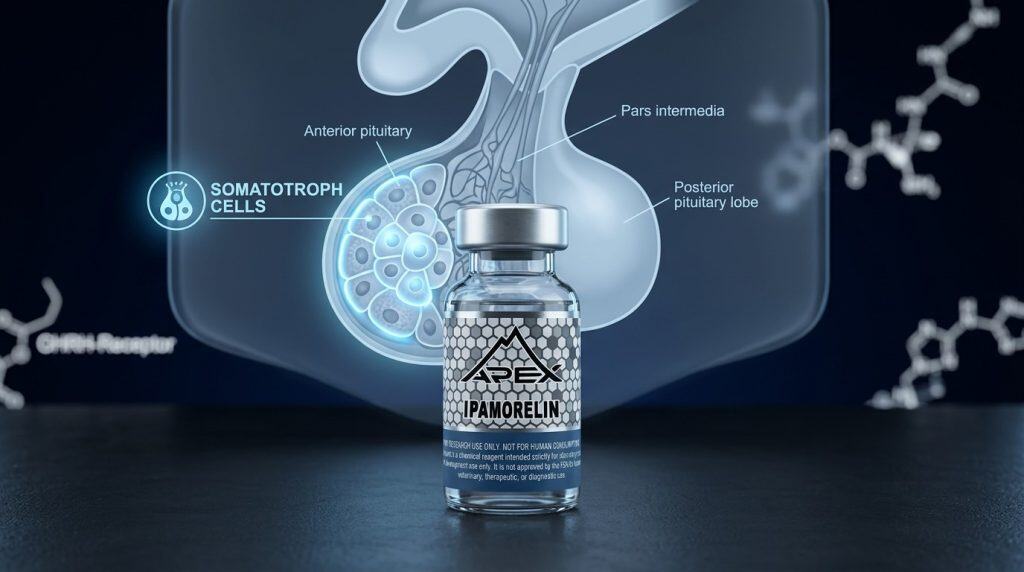
Ipamorelin is a synthetic pentapeptide (Aib-His-D-2-Nal-D-Phe-Lys-NH2) and a selective growth-hormone secretagogue that acts as an agonist of the ghrelin receptor — the growth-hormone-secretagogue receptor, GHS-R1a. In animal and human research it is studied for stimulating pulsatile growth-hormone release with little effect on cortisol, ACTH, or prolactin, a selectivity that distinguishes it from earlier growth-hormone-releasing peptides such as GHRP-2 and GHRP-6.
Ipamorelin is a selective growth-hormone secretagogue and a ghrelin-receptor agonist — a small synthetic pentapeptide that stimulates the pituitary to release growth hormone by acting on the same receptor that the hunger hormone ghrelin uses, the growth-hormone-secretagogue receptor GHS-R1a.[1][2] What made it notable when it was first described is its selectivity: among the growth-hormone-releasing peptides, ipamorelin was characterized as releasing growth hormone with potency comparable to GHRP-6 but without the parallel rise in cortisol, ACTH, and prolactin seen with that class.[1]
This guide covers Ipamorelin‘s molecular identity, its action at the ghrelin receptor, the selective growth-hormone-release mechanism that defines it, the published bone, body-composition, and gastric-motility research, and how it compares with other growth-hormone secretagogues in the growth-hormone-axis research cluster of the Apex Research Library. Every factual claim is referenced to the primary literature, and Ipamorelin is supplied strictly as a research-grade chemical reagent for in-vitro and preclinical investigation — not a drug, supplement, or therapy for human or veterinary use.
Ipamorelin at a Glance
- Ipamorelin is the synthetic pentapeptide Aib-His-D-2-Nal-D-Phe-Lys-NH2, CAS 170851-70-4, with a molecular weight of approximately 711.9 g/mol (molecular formula C38H49N9O5, PubChem CID 9831659).
- It is a selective growth-hormone secretagogue and an agonist of the ghrelin receptor (growth-hormone-secretagogue receptor, GHS-R1a) — the receptor whose endogenous ligand is ghrelin.
- It belongs to the growth-hormone-releasing peptide (GHRP) lineage but, unlike GHRP-2 and GHRP-6, releases growth hormone with little effect on cortisol, ACTH, or prolactin.
- It was first described by Raun and colleagues in 1998 as “the first selective growth-hormone secretagogue.”
- Published animal research spans bone growth and bone-mineral content, anti-catabolic body-composition effects, and gastric-motility/postoperative-ileus models, where it acts as a ghrelin-receptor agonist.
- Ipamorelin has no FDA-approved formulation and is monitored in anti-doping control; Apex supplies it strictly as a ≥99% (HPLC + MS verified) research reagent for in-vitro and preclinical use only.
Ipamorelin
What Is Ipamorelin? Molecular Identity
Ipamorelin is a synthetic pentapeptide with the sequence Aib-His-D-2-Nal-D-Phe-Lys-NH2 — 2-methylalanyl-L-histidyl-3-(2-naphthyl)-D-alanyl-D-phenylalanyl-L-lysinamide. The presence of the non-natural residue 2-aminoisobutyric acid (Aib), two D-amino acids, and a C-terminal amide are deliberate features that confer metabolic stability and receptor selectivity on a very small molecule. It carries a molecular weight of approximately 711.9 g/mol, the molecular formula C38H49N9O5, and CAS number 170851-70-4 (PubChem CID 9831659); it is typically supplied as the acetate salt.

Ipamorelin structure. The pentapeptide Aib-His-D-2-Nal-D-Phe-Lys-NH2, incorporating 2-aminoisobutyric acid and two D-amino acids. Structure image: PubChem CID 9831659, U.S. National Library of Medicine (public domain).
A Pentapeptide Growth-Hormone Secretagogue
A growth-hormone secretagogue is a compound that stimulates the pituitary gland to secrete growth hormone. Ipamorelin belongs to the growth-hormone-releasing peptide (GHRP) family, a lineage of small synthetic peptides derived ultimately from GHRP-1.[3] Within that family it occupies a distinctive position because of its selectivity, discussed in detail below.
The GHRP Lineage and Medicinal Chemistry
Ipamorelin has also served as a template in medicinal chemistry. Structure-activity studies derived potent growth-hormone secretagogues from the ipamorelin scaffold — including the orally active analog NN703 — confirming ipamorelin’s in-vivo growth-hormone-releasing potency and mapping the features responsible for it.[4][5][6] This medicinal-chemistry record is part of why ipamorelin is a well-characterized reference compound in secretagogue research.
Ipamorelin and the Ghrelin Receptor (GHS-R1a)
The receptor that ipamorelin targets is the growth-hormone-secretagogue receptor, GHS-R1a — better known today as the ghrelin receptor. Understanding that receptor is the key to understanding how ipamorelin works.
The Growth-Hormone-Secretagogue Receptor
The growth-hormone-secretagogue receptor was cloned by Howard and colleagues in 1996 as a G-protein-coupled receptor expressed in the pituitary and hypothalamus that mediates the growth-hormone-releasing action of the synthetic secretagogues.[2] Three years later, Kojima and colleagues identified its endogenous ligand: ghrelin, an octanoylated 28-amino-acid stomach peptide — which is why GHS-R1a is now generally called the ghrelin receptor.[7] The synthetic secretagogues, including ipamorelin, were in effect ligands in search of the natural hormone that ghrelin turned out to be.
Ipamorelin as a Selective Ghrelin-Receptor Agonist
Ipamorelin acts as an agonist at this ghrelin receptor. Comparative receptor-binding and structure-activity work places ipamorelin alongside GHRP-1, GHRP-2, GHRP-6, and hexarelin as a GHS-R1a-active secretagogue, with in-vivo confirmation of its activity,[8] and more recent pharmacology characterizes ipamorelin as a peripherally restricted, selective ghrelin-receptor agonist in functional models.[9] It is this ghrelin-receptor agonism — coupled with the selectivity described in the next section — that defines ipamorelin’s research profile.
Discovery and Research History
Ipamorelin was introduced to the literature in 1998 by Raun and colleagues at Novo Nordisk, in a paper whose title states the central claim plainly: ipamorelin is “the first selective growth-hormone secretagogue.” They reported that ipamorelin released growth hormone with a potency and efficacy comparable to GHRP-6 but, unlike GHRP-6 and the other peptidyl secretagogues, did not stimulate the release of ACTH or cortisol — the defining selectivity result.[1] Pharmacokinetic work in healthy human volunteers subsequently described dose-proportional kinetics with a terminal half-life on the order of two hours and episodic growth-hormone release,[10] and cellular studies localized the action to anterior-pituitary somatotrophs, where ipamorelin increased secretory-granule volume and dynamic growth-hormone content.[11]
Mechanism of Action: Selective Growth-Hormone Release
Ipamorelin’s mechanism has two linked parts: it triggers growth-hormone release by agonizing the ghrelin receptor on pituitary somatotrophs, and it does so with a selectivity that spares the other pituitary hormone axes.
Ghrelin-receptor agonism → pulsatile GH release, without cortisol/ACTH/prolactin
Ipamorelin binds the ghrelin receptor (GHS-R1a) on anterior-pituitary somatotrophs and stimulates pulsatile growth-hormone secretion, increasing secretory-granule content and dynamic GH release. Its defining feature is selectivity: at GH-releasing doses in animal and human studies it produces little or no rise in cortisol, ACTH, or prolactin, in contrast to GHRP-2, GHRP-6, and hexarelin. Downstream, GH release can raise IGF-1, and the peptide has been studied for bone, body-composition, and gastric-motility effects. All findings are from cell, animal, and clinical-research settings.
Growth-Hormone Release From Pituitary Somatotrophs
The direct action is on the pituitary. Jiménez-Reina and colleagues showed that ipamorelin acts on anterior-pituitary somatotrophs, increasing secretory-granule volume density and dynamic growth-hormone content,[11] consistent with the human pharmacokinetic-pharmacodynamic finding that ipamorelin induces episodic growth-hormone release.[10] Downstream of repeated growth-hormone release, animal studies report rises in IGF-I.[12]
Selectivity: Minimal Cortisol, ACTH, and Prolactin Response
The property that named ipamorelin — “selective” — is the dissociation of growth-hormone release from the other pituitary outputs that the GHRP class typically co-stimulates. Raun and colleagues established this directly: ipamorelin matched GHRP-6 for growth-hormone release but did not raise ACTH or cortisol.[1] The contrast is sharpened by human studies of the other secretagogues: Arvat and colleagues showed that GHRP-2 and the hexarelin-class peptides release growth hormone but also significantly raise prolactin, ACTH, and cortisol.[13][14] Ipamorelin’s comparatively clean profile is the central reason it became a reference selective secretagogue.
Published Research: Key Application Areas
The ipamorelin research record spans bone, body composition, and gastrointestinal motility. All findings below are research results in cells, animals, or clinical-research settings, not demonstrated therapeutic effects.
Bone and Bone-Mineral Research
Several rat studies examined skeletal endpoints. Johansen and colleagues reported that ipamorelin dose-dependently increased longitudinal (tibial) bone-growth rate and body-weight gain in adult rats,[15] and Svensson and colleagues found that ipamorelin (and GHRP-6) increased bone-mineral content and cortical bone dimensions in adult female rats.[16] In a glucocorticoid-challenge model, ipamorelin counteracted steroid-induced losses in periosteal bone formation and muscle strength.[17]
Body Composition and Anti-Catabolic Research
A second cluster concerns nitrogen balance and body composition under catabolic stress. Ipamorelin exerted growth-hormone-like anti-catabolic effects, counteracting steroid-induced nitrogen wasting and improving nitrogen balance,[18] and reversed glucocorticoid-induced body-weight loss while raising IGF-I.[12] A separate study reported that ipamorelin increased body fat, food intake, and serum leptin through mechanisms that appeared partly growth-hormone-independent — a reminder that the peptide’s effects are not reducible to growth-hormone release alone.[19]
Gastric Motility and Postoperative-Ileus Research
Because the ghrelin receptor regulates gastrointestinal motility, ipamorelin has been studied as a ghrelin-receptor agonist in gut models. It accelerated gastrointestinal transit and ameliorated experimental ileus,[20] and restored gastric emptying and smooth-muscle contractility after surgery via a ghrelin-receptor-dependent mechanism.[21] This line extended to a human Phase 2 randomized controlled trial of ipamorelin for postoperative ileus, in which the ghrelin-receptor agonist was well tolerated; it is cited here as investigational-research context, not as evidence for any approved use.[22]
Ipamorelin vs Other Growth-Hormone Secretagogues
Ipamorelin is one of several research peptides that increase growth-hormone signaling, and they divide cleanly by mechanism. For broader context see the growth-hormone-axis research peptides hub and the Ipamorelin vs CJC-1295 comparison.
Ipamorelin vs GHRP-2/6, CJC-1295, and Sermorelin
| Attribute | Ipamorelin | GHRP-2 / GHRP-6 | CJC-1295 | Sermorelin |
|---|---|---|---|---|
| Receptor target | Ghrelin receptor (GHS-R1a) | Ghrelin receptor (GHS-R1a) | GHRH receptor | GHRH receptor |
| Class | Selective GHRP pentapeptide | Earlier GHRPs | Long-acting GHRH analog | GHRH(1–29) analog |
| Cortisol / ACTH / prolactin | Little to no rise (selective) | Significant rise reported | Minimal (GHRH arm) | Minimal (GHRH arm) |
| Research pairing | Often studied with a GHRH analog | Standalone GHRP research | Paired with a ghrelin-receptor agonist | Paired with a ghrelin-receptor agonist |
| Regulatory status | Research-only; no approved drug | Research-only; no approved drug | Research-only; no approved drug | Research-only as reagent |
Ipamorelin vs GHRP-2 and GHRP-6
Ipamorelin, GHRP-2, and GHRP-6 are all ghrelin-receptor agonists, but the selectivity distinction is the crux: ipamorelin matches GHRP-6 for growth-hormone release while avoiding the prolactin, ACTH, and cortisol elevations that characterize GHRP-2 and the hexarelin class in human studies.[1][14] That is the practical reason ipamorelin is often chosen as the reference selective secretagogue.
Ipamorelin vs CJC-1295 and Sermorelin
CJC-1295 and Sermorelin act on a different receptor entirely — the growth-hormone-releasing-hormone (GHRH) receptor — rather than the ghrelin receptor. CJC-1295 is a long-acting GHRH analog producing sustained growth-hormone and IGF-I increases in humans.[23] Because the GHRH and ghrelin-receptor pathways are complementary, ipamorelin is frequently studied alongside a GHRH analog; see the CJC-1295 and Sermorelin research guides.
Stability, Handling, and Reconstitution (Research Use)
The guidance below concerns laboratory handling of Ipamorelin as a research reagent. Nothing here is a human dosing, administration, or usage instruction; Ipamorelin is for in-vitro and preclinical research only.
Lyophilized Storage
Store lyophilized Ipamorelin at −20°C, protected from light and moisture. Its non-natural residues (Aib, D-amino acids) and C-terminal amide give the pentapeptide good metabolic stability — one study recovered 60–80% of the dose intact, with markedly lower clearance than comparator peptides[24] — and well-stored lyophilized material is expected to remain stable over extended periods. See the Apex peptide storage guide.
Reconstitution
Ipamorelin dissolves readily in bacteriostatic water for laboratory preparation. Researchers planning in-vitro concentrations can use the Apex reconstitution calculator and the how to reconstitute peptides protocol; reconstituted solution is held at 2–8°C with freeze-thaw cycling minimized. These tools support laboratory work and contain no human-use directions.
Identity and Purity Verification (COA, HPLC, MS)
Reproducible research depends on confirmed identity. For ipamorelin, mass spectrometry confirms the expected mass near 711.9 g/mol and the presence of the non-natural Aib and D-residues that define the sequence. Apex supplies Ipamorelin at ≥99% purity, verified by reversed-phase HPLC and mass spectrometry, with a per-lot certificate of analysis through the lab-verified COA archive; see the primers on how to read a certificate of analysis and HPLC testing for peptide purity.
Regulatory Status
Ipamorelin is not an FDA-approved drug and has no approved therapeutic indication; an investigational program in postoperative ileus did not lead to approval.[22] Growth-hormone secretagogues are monitored in anti-doping control. These are factual regulatory points. Apex supplies Ipamorelin strictly as a research-grade chemical reagent for in-vitro and preclinical work, not for human or veterinary use.
Sourcing Research-Grade Ipamorelin
For growth-hormone-secretagogue and ghrelin-receptor research, Ipamorelin should be sourced as documented research-grade material with its identity confirmed by mass spectrometry. Apex supplies Ipamorelin as a ≥99%-pure lyophilized peptide, HPLC- and MS-verified, for in-vitro and preclinical use only.
Ipamorelin
Research-grade Aib-His-D-2-Nal-D-Phe-Lys-NH2 — a selective growth-hormone secretagogue and ghrelin-receptor agonist — verified to ≥99% purity by HPLC and mass spectrometry, with a per-lot certificate of analysis. Supplied strictly for in-vitro and preclinical research.
View Ipamorelin →Frequently Asked Questions
What is ipamorelin?
Ipamorelin is a synthetic pentapeptide (Aib-His-D-2-Nal-D-Phe-Lys-NH2) and a selective growth-hormone secretagogue. It acts as an agonist of the ghrelin receptor, the growth-hormone-secretagogue receptor GHS-R1a, to stimulate the pituitary to release growth hormone. It has a molecular weight of about 711.9 g/mol and CAS number 170851-70-4. Apex Laboratory supplies ipamorelin as a research-grade chemical reagent for in-vitro and preclinical research only.
Is ipamorelin a ghrelin receptor agonist?
Yes. Ipamorelin acts as an agonist at the ghrelin receptor, which is the growth-hormone-secretagogue receptor GHS-R1a. This receptor was cloned in 1996 (Howard 1996) and its endogenous ligand, ghrelin, was identified in 1999 (Kojima 1999). Receptor-binding and pharmacology studies place ipamorelin among the GHS-R1a-active secretagogues and characterize it as a selective, peripherally restricted ghrelin-receptor agonist (Ferro 2017; Mohammadi 2020).
How does ipamorelin work?
Ipamorelin binds the ghrelin receptor (GHS-R1a) on anterior-pituitary somatotrophs and stimulates pulsatile growth-hormone release, increasing secretory-granule content and dynamic growth-hormone output (Jimenez-Reina 2002). Its defining feature is selectivity: at growth-hormone-releasing doses it produces little or no rise in cortisol, ACTH, or prolactin, unlike GHRP-2 and GHRP-6 (Raun 1998). Downstream growth-hormone release can raise IGF-1. These are cell, animal, and clinical-research findings.
What makes ipamorelin selective compared with GHRP-2 and GHRP-6?
Ipamorelin was described as the first selective growth-hormone secretagogue because it releases growth hormone with potency comparable to GHRP-6 but, unlike GHRP-6 and GHRP-2, does not significantly raise ACTH or cortisol (Raun 1998). Human studies of the other secretagogues confirm that GHRP-2 and hexarelin-class peptides release growth hormone but also raise prolactin, ACTH, and cortisol (Arvat 1999). That dissociation is the basis of ipamorelin's selectivity.
What is the molecular weight and sequence of ipamorelin?
Ipamorelin has the sequence Aib-His-D-2-Nal-D-Phe-Lys-NH2 (2-methylalanyl-L-histidyl-3-(2-naphthyl)-D-alanyl-D-phenylalanyl-L-lysinamide), a molecular formula of C38H49N9O5, a molecular weight of approximately 711.9 g/mol, and CAS number 170851-70-4 (PubChem CID 9831659). The non-natural residue Aib, the two D-amino acids, and the C-terminal amide contribute to its stability and receptor selectivity.
Who discovered ipamorelin?
Ipamorelin was first described by Raun and colleagues at Novo Nordisk in 1998, in a paper titled 'Ipamorelin, the first selective growth hormone secretagogue' (Raun 1998). They reported that it released growth hormone with efficacy comparable to GHRP-6 while, unlike GHRP-6, not stimulating ACTH or cortisol release, establishing the selectivity that defines the compound.
What research has been done on ipamorelin and bone?
Rat studies report skeletal effects. Ipamorelin dose-dependently increased longitudinal tibial bone-growth rate and body-weight gain in adult rats (Johansen 1999), increased bone-mineral content and cortical bone dimensions (Svensson 2000), and counteracted glucocorticoid-induced losses in bone formation and muscle strength (Andersen 2001). These are animal-model research findings, not demonstrated effects in humans.
Has ipamorelin been studied for gut motility or ileus?
Yes, as a ghrelin-receptor agonist. Ipamorelin accelerated gastrointestinal transit and ameliorated experimental ileus (Venkova 2009) and restored gastric emptying and smooth-muscle contractility after surgery through a ghrelin-receptor-dependent mechanism (Greenwood-Van Meerveld 2012). A human Phase 2 trial studied ipamorelin for postoperative ileus, where it was well tolerated (Beck 2014); this is investigational-research context, not an approved use.
How is ipamorelin stored and reconstituted for research?
Lyophilized ipamorelin is stored at minus 20 degrees Celsius, protected from light and moisture, where its non-natural residues give it good stability. For laboratory use it dissolves readily in bacteriostatic water; reconstituted material is held at 2 to 8 degrees Celsius with freeze-thaw cycling minimized, and longer-term aliquots are frozen at minus 20 degrees Celsius. These are laboratory-handling conventions only and are not a human dosing or administration instruction.
Is ipamorelin approved or legal?
Ipamorelin is not approved by the FDA, EMA, or any other regulatory authority as a drug and has no approved therapeutic indication; an investigational program in postoperative ileus did not lead to approval. Growth-hormone secretagogues are monitored in anti-doping control. The research-grade ipamorelin supplied by Apex Laboratory is intended strictly for in-vitro and preclinical laboratory research and is not for human or veterinary consumption or any clinical use.
How is research-grade ipamorelin purity verified?
Research-grade ipamorelin is characterized by reversed-phase HPLC, which quantifies purity by separating the intended peptide from synthesis byproducts, and by mass spectrometry, which confirms identity against the expected mass near 711.9 g/mol including the non-natural Aib and D-residues. Apex supplies ipamorelin at greater-than-or-equal-to 99 percent purity with a per-lot certificate of analysis available through its lab-verified archive.
Continue Your Research
Related Growth-Hormone-Axis Research Guides
Growth-Hormone-Axis Research Peptides
The cluster hub situating ipamorelin among growth-hormone-axis secretagogues and analogs.
Open HubCJC-1295 Research Guide
The long-acting GHRH-receptor analog studied as the complementary GHRH arm of secretagogue research.
Read GuideIpamorelin vs CJC-1295
A direct comparison of the ghrelin-receptor and GHRH-receptor approaches to GH-secretagogue research.
CompareSermorelin Research Guide
The GHRH(1–29) analog studied within the same growth-hormone-axis research cluster.
Read GuideReferences
All citations were verified against the published record via the NCBI E-utilities API for existence, correct attribution, and support of the associated claim. Each links to its PubMed record.
- Raun K, Hansen BS, Johansen NL, Thøgersen H, Madsen K, Ankersen M, et al. Ipamorelin, the first selective growth hormone secretagogue. Eur J Endocrinol. 1998;139(5):552-61. PMID: 9849822
- Howard AD, Feighner SD, Cully DF, Arena JP, Liberator PA, Rosenblum CI, et al. A receptor in pituitary and hypothalamus that functions in growth hormone release. Science. 1996;273(5277):974-7. PMID: 8688086
- Ahnfelt-Rønne I, Nowak J, Olsen UB Do growth hormone-releasing peptides act as ghrelin secretagogues?. Endocrine. 2001;14(1):133-5. PMID: 11322495
- Ankersen M, Johansen NL, Madsen K, Hansen BS, Raun K, Nielsen KK, et al. A new series of highly potent growth hormone-releasing peptides derived from ipamorelin. J Med Chem. 1998;41(19):3699-704. PMID: 9733495
- Hansen BS, Raun K, Nielsen KK, Johansen PB, Hansen TK, Peschke B, et al. Pharmacological characterisation of a new oral GH secretagogue, NN703. Eur J Endocrinol. 1999;141(2):180-9. PMID: 10427162
- Hansen TK, Ankersen M, Raun K, Hansen BS Highly potent growth hormone secretagogues: hybrids of NN703 and ipamorelin. Bioorg Med Chem Lett. 2001;11(14):1915-8. PMID: 11459660
- Kojima M, Hosoda H, Date Y, Nakazato M, Matsuo H, Kangawa K Ghrelin is a growth-hormone-releasing acylated peptide from stomach. Nature. 1999;402(6762):656-60. PMID: 10604470
- Ferro P, Krotov G, Zvereva I, Rodchenkov G, Segura J Structure-activity relationship for peptídic growth hormone secretagogues. Drug Test Anal. 2017;9(1):87-95. PMID: 26811125
- N Mohammadi E, Louwies T, Pietra C, Northrup SR, Greenwood-Van Meerveld B Attenuation of Visceral and Somatic Nociception by Ghrelin Mimetics. J Exp Pharmacol. 2020;12:267-274. PMID: 32801950
- Gobburu JV, Agersø H, Jusko WJ, Ynddal L Pharmacokinetic-pharmacodynamic modeling of ipamorelin, a growth hormone releasing peptide, in human volunteers. Pharm Res. 1999;16(9):1412-6. PMID: 10496658
- Jiménez-Reina L, Cañete R, de la Torre MJ, Bernal G Influence of chronic treatment with the growth hormone secretagogue Ipamorelin, in young female rats: somatotroph response in vitro. Histol Histopathol. 2002;17(3):707-14. PMID: 12168778
- Malmlöf K, Johansen PB, Haahr PM, Wilken M, Oxlund H Methylprednisolone does not inhibit the release of growth hormone after intravenous injection of a novel growth hormone secretagogue in rats. Growth Horm IGF Res. 1999;9(6):445-50. PMID: 10629165
- Arvat E, Ramunni J, Bellone J, Di Vito L, Baffoni C, Broglio F, et al. The GH, prolactin, ACTH and cortisol responses to Hexarelin, a synthetic hexapeptide, undergo different age-related variations. Eur J Endocrinol. 1997;137(6):635-42. PMID: 9437229
- Arvat E, Di Vito L, Lanfranco F, Broglio F, Giordano R, Benso A, et al. Tyr-Ala-Hexarelin, a synthetic octapeptide, possesses the same endocrine activities of Hexarelin and GHRP-2 in humans. J Endocrinol Invest. 1999;22(2):91-7. PMID: 10195374
- Johansen PB, Nowak J, Skjaerbaek C, Flyvbjerg A, Andreassen TT, Wilken M, et al. Ipamorelin, a new growth-hormone-releasing peptide, induces longitudinal bone growth in rats. Growth Horm IGF Res. 1999;9(2):106-13. PMID: 10373343
- Svensson J, Lall S, Dickson SL, Bengtsson BA, Rømer J, Ahnfelt-Rønne I, et al. The GH secretagogues ipamorelin and GH-releasing peptide-6 increase bone mineral content in adult female rats. J Endocrinol. 2000;165(3):569-77. PMID: 10828840
- Andersen NB, Malmlöf K, Johansen PB, Andreassen TT, Ørtoft G, Oxlund H The growth hormone secretagogue ipamorelin counteracts glucocorticoid-induced decrease in bone formation of adult rats. Growth Horm IGF Res. 2001;11(5):266-72. PMID: 11735244
- Aagaard NK, Grøfte T, Greisen J, Malmlöf K, Johansen PB, Grønbaek H, et al. Growth hormone and growth hormone secretagogue effects on nitrogen balance and urea synthesis in steroid treated rats. Growth Horm IGF Res. 2009;19(5):426-31. PMID: 19231263
- Lall S, Tung LY, Ohlsson C, Jansson JO, Dickson SL Growth hormone (GH)-independent stimulation of adiposity by GH secretagogues. Biochem Biophys Res Commun. 2001;280(1):132-8. PMID: 11162489
- Venkova K, Mann W, Nelson R, Greenwood-Van Meerveld B Efficacy of ipamorelin, a novel ghrelin mimetic, in a rodent model of postoperative ileus. J Pharmacol Exp Ther. 2009;329(3):1110-6. PMID: 19289567
- Greenwood-Van Meerveld B, Tyler K, Mohammadi E, Pietra C Efficacy of ipamorelin, a ghrelin mimetic, on gastric dysmotility in a rodent model of postoperative ileus. J Exp Pharmacol. 2012;4:149-55. PMID: 27186127
- Beck DE, Sweeney WB, McCarter MD, Ipamorelin 201 Study Group Prospective, randomized, controlled, proof-of-concept study of the Ghrelin mimetic ipamorelin for the management of postoperative ileus in bowel resection patients. Int J Colorectal Dis. 2014;29(12):1527-34. PMID: 25331030
- Teichman SL, Neale A, Lawrence B, Gagnon C, Castaigne JP, Frohman LA Prolonged stimulation of growth hormone (GH) and insulin-like growth factor I secretion by CJC-1295, a long-acting analog of GH-releasing hormone, in healthy adults. J Clin Endocrinol Metab. 2006;91(3):799-805. PMID: 16352683
- Johansen PB, Hansen KT, Andersen JV, Johansen NL Pharmacokinetic evaluation of ipamorelin and other peptidyl growth hormone secretagogues with emphasis on nasal absorption. Xenobiotica. 1998;28(11):1083-92. PMID: 9879640
Research Use Disclaimer
All Ipamorelin products and the information in this guide are intended strictly for in-vitro and preclinical laboratory research. Ipamorelin is a research-grade chemical reagent and is not a drug, dietary supplement, or therapeutic product. It is not approved by the FDA, EMA, or any other regulatory authority for therapeutic use, has no approved drug indication, and growth-hormone secretagogues are monitored in anti-doping control. It is not for human or veterinary consumption, diagnosis, treatment, or any clinical use. The mechanistic, bone, body-composition, and gastric-motility findings summarized here derive from cell-culture, animal-model, and clinical-research studies; they are presented for research context only and do not constitute therapeutic, efficacy, or safety claims. Researchers are responsible for compliance with all applicable institutional, local, and national regulations governing the acquisition, handling, and use of research chemicals.