
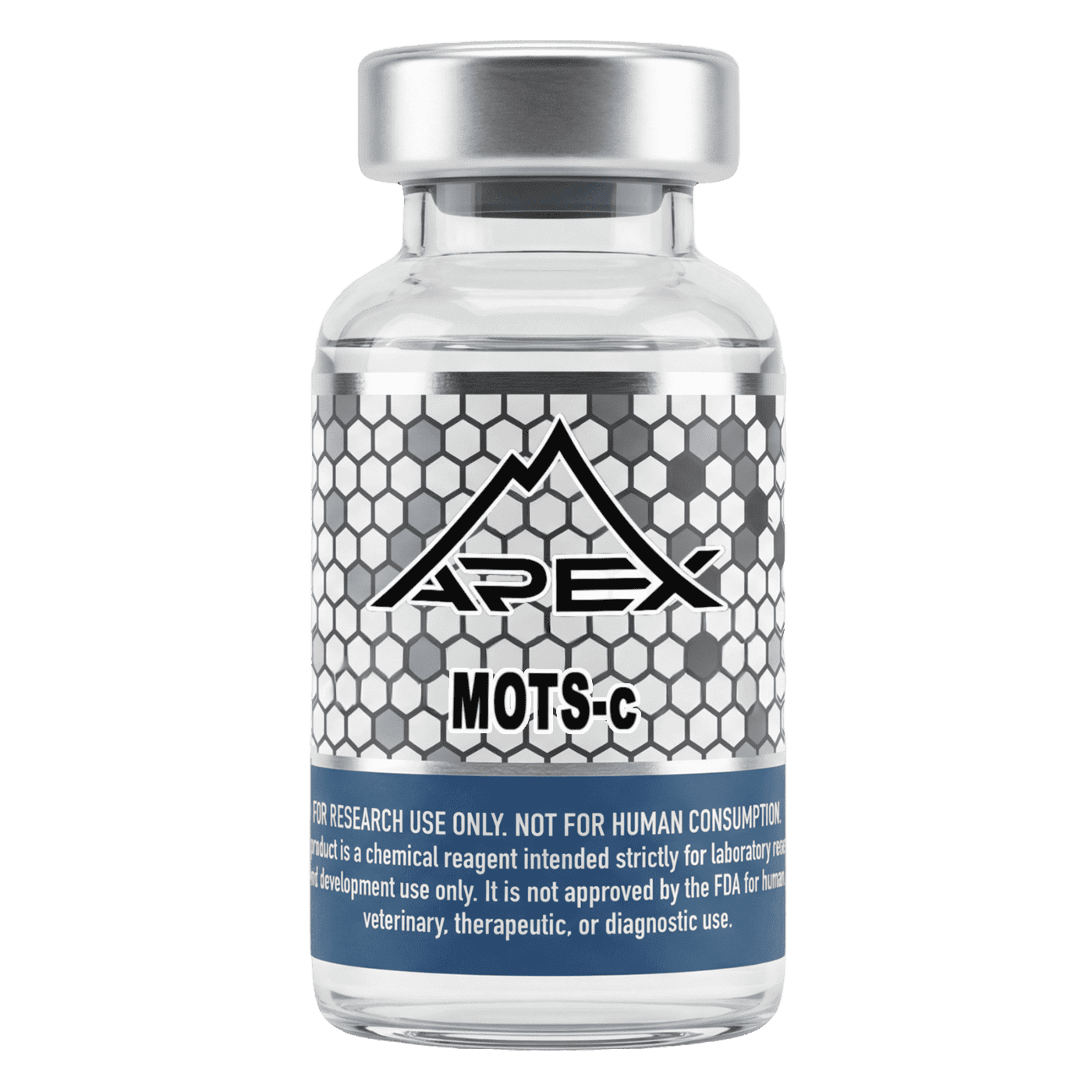
Certificate of Analysis — MOTS-c 40mg
Mitochondrial-derived 16-AA peptide
Verified by Apex Laboratory in-house HPLC (purity by 220 nm peak area) and ESI mass spectrometry (mass identity confirmation). Data on this page describes the current shipping lot.
- Purity (HPLC, area %): 99.84%
- Mass found (ESI-MS): 2174.52 Da
- Mass expected: 2174.50 Da
- HPLC retention time: 15.0 min
- Batch ID: APX-2026-0314-M
- Test date: March 14, 2026
- Analyst: K. Norwood
View MOTS-c 40mg on the Lab Verified COA archive · Read the MOTS-c Research Guide
MOTS-c (Human) is a 16-residue mitochondrial-derived peptide (MDP) encoded within the mitochondrial 12S ribosomal RNA gene, supplied by Apex Laboratory as a high-purity synthetic reagent for in-vitro laboratory research and development. The HPLC chromatogram and mass spectrometry data displayed above belong to the current shipping lot (batch APX-2026-0314-M) — there is no email gate, no separate document request, and no third-party summary standing between you and the release data. The analytical record you see is the material that leaves our facility. This product is intended exclusively for research use only and is not approved for human consumption, veterinary application, or any therapeutic purpose.
Compound Overview
MOTS-c (mitochondrial open reading frame of the twelve-S rRNA type-c) is an unusual peptide because its coding sequence does not reside in nuclear DNA. Instead, a short open reading frame embedded inside the 12S rRNA region of the mitochondrial genome is translated to yield this 16-amino-acid product. That mitochondrial origin places it in a small and distinctive family of mitochondrial-derived peptides (MDPs) alongside humanin and the SHLP series, separating it cleanly from the nuclear-encoded growth-factor and incretin peptides that dominate most catalogs.
Mechanistically, the most studied feature of MOTS-c in laboratory models is its activation of the AMP-activated protein kinase (AMPK) energy-sensing pathway. Through the AMPK axis it has been reported in cell systems to influence the folate–methionine one-carbon cycle and de novo purine biosynthesis, linking it to cellular metabolic flux rather than to a single membrane receptor. A second defining property distinguishes MOTS-c from classical secreted hormones: under conditions of metabolic or oxidative stress, the peptide translocates to the nucleus, where it has been described as a mitochondrial-to-nuclear retrograde signal capable of modulating stress-adaptive and antioxidant gene programs. This nuclear-translocation behavior, combined with its mitochondrial genomic source, is what makes MOTS-c a frequent subject of metabolism, mitokine, and cellular-stress signaling research.
Research Background & Published Literature
MOTS-c was first described by the laboratory of Dr. Pinchas Cohen at the University of Southern California, with the foundational report published in Cell Metabolism in 2015. Subsequent investigation has framed it as a putative mitochondrial-encoded signaling peptide, or “mitokine,” characterized in cell culture and animal-model systems at the level of AMPK pathway activation, cellular one-carbon (folate–methionine) flux, and stress-induced nuclear translocation. Because it sits at the intersection of mitochondrial genomics and AMPK signal transduction, the published record spans cellular biochemistry, mitochondrial bioenergetics, and aging-biology research, all conducted in controlled in-vitro and preclinical settings rather than in human application.
Researchers exploring the published record for this compound can review the following peer-reviewed and database sources for additional context on its mechanism, signaling pathways, and experimental applications:
- Lee et al. (2015) — foundational characterization of the mitochondrial-derived peptide MOTS-c and its AMPK-linked metabolic signaling in cell and animal models (Cell Metabolism)
- PubMed — current MOTS-c mitochondrial-derived peptide literature
- PubChem — MOTS-c compound and structural records
For a deeper research-focused overview, see the MOTS-c research guide, which covers mechanism, mitochondrial-genome context, and lab-handling considerations in more detail.
Technical Specifications
| Product Name | MOTS-c (Human) |
| Other Names | Mitochondrial ORF of the 12S rRNA type-c; mitochondrial-derived peptide |
| Classification | Mitochondrial-Derived Peptide (MDP) |
| Molecular Formula | C₁₀₁H₁₅₂N₂₈O₂₂S₂ |
| Molecular Weight | 2174.7 g/mol (expected 2174.50; found 2174.52 — see MS above) |
| Sequence / Structure | 16-amino-acid peptide encoded in the mitochondrial 12S rRNA gene |
| Purity Specification | ≥99% (HPLC + MS verified; this lot 99.84%) |
| Physical Form | Lyophilized (freeze-dried) powder · sealed glass vial |
| Recommended Diluent | Bacteriostatic water or sterile laboratory-grade water |
| Available Sizes | 10mg · 20mg · 40mg |
| Intended Use | In-vitro research only — not for human consumption |
Storage, Handling & Stability
As a lyophilized 16-residue peptide, MOTS-c is best held at -20°C in its sealed vial for long-term storage, where the dry powder is stable for extended periods. Once reconstituted with a sterile diluent, refrigerate the solution at 2–8°C and keep freeze-thaw cycles to a minimum by aliquoting working volumes in advance, consistent with your laboratory’s standard operating procedures. Because the peptide is small and lacks the lipophilic fatty-acid modifications found on long-acting metabolic peptides, it dissolves readily in aqueous diluent and elutes at a moderate reversed-phase retention time (~15.0 min in this batch).
- Allow the sealed vial to equilibrate to room temperature before opening to avoid condensation on the cold powder.
- Reconstitute with bacteriostatic water or sterile laboratory-grade water directed gently down the vial wall rather than agitating the peptide.
- Aliquot reconstituted material into single-use working volumes to avoid repeated freeze-thaw stress on the dissolved peptide.
- Protect from prolonged ambient-temperature exposure, moisture, and light, and reseal promptly after each withdrawal.
- Label every aliquot with compound name, concentration, reconstitution date, and operator initials for full lot traceability.
Quality Assurance & Analytical Verification
Every MOTS-c lot passes a dual-verification protocol before it is released into inventory: High-Performance Liquid Chromatography confirms chromatographic purity, and Mass Spectrometry confirms molecular identity and intact mass. The data for the lot you would receive is published directly at the top of this page — it is not a stock graphic but the genuine release record for batch APX-2026-0314-M, tested 2026-03-14, reporting 99.84% purity.
For a peptide of this size (~2175 Da), electrospray ionization typically presents the analyte across low charge states, with the doubly-protonated [M+2H]²⁺ species near m/z 1088 and the singly-protonated [M+H]⁺ species near m/z 2175. The measured monoisotopic mass of 2174.52 against the expected 2174.50 places the identity confirmation well within tolerance, demonstrating that the synthesized sequence matches the target molecular weight. To understand how to interpret these figures for any Apex lot, see our guides on mass spectrometry for peptide verification and how to read a Certificate of Analysis. Prior-lot analytical records are archived in our Lab Verified collection.
Frequently Asked Questions
Why is MOTS-c described as “mitochondrial-derived” rather than a normal peptide?
Most research peptides are encoded by nuclear DNA. MOTS-c is different: its 16-residue sequence is read from a short open reading frame embedded inside the mitochondrial 12S rRNA gene. That genomic origin is what classifies it as a mitochondrial-derived peptide (MDP) and is central to why it is studied as a mitochondrial-to-nuclear signaling molecule rather than a conventional secreted hormone.
What signaling pathway is MOTS-c most associated with in laboratory studies?
In published cell and animal-model work, MOTS-c is most closely tied to activation of the AMP-activated protein kinase (AMPK) energy-sensing pathway, with downstream effects reported on the folate–methionine one-carbon cycle and de novo purine biosynthesis. It is also studied for its stress-induced translocation to the nucleus, where it has been characterized as a retrograde mitochondrial signal.
How does MOTS-c differ from humanin or SS-31 in research use?
MOTS-c and humanin are both mitochondrial-derived peptides, but they are studied along different axes — MOTS-c primarily through AMPK and metabolic signaling, humanin through cytoprotective and apoptosis-related pathways. SS-31 is not an MDP at all; it is a synthetic cardiolipin-targeting tetrapeptide investigated for inner-membrane and bioenergetic research. They are frequently compared in mitochondrial-biology experiments but are mechanistically distinct.
What molecular weight should the mass spectrometry confirm for this peptide?
The target molecular weight for MOTS-c is 2174.7 g/mol (molecular formula C₁₀₁H₁₅₂N₂₈O₂₂S₂). For the current lot the MS reported a found mass of 2174.52 against an expected 2174.50, confirming that the synthesized sequence matches the intended structure within analytical tolerance.
Is this product approved for human use?
No. All compounds sold by Apex Laboratory are classified as chemical research reagents intended strictly for in-vitro laboratory research. They are not approved for human consumption, veterinary use, or any therapeutic application. MOTS-c is supplied solely as a synthetic research peptide for controlled experimental work. Purchasers who imply intended bodily use will have their orders cancelled and their accounts permanently suspended.
Is bulk ordering available for MOTS-c?
Yes. For bulk quantities, custom packaging, or recurring supply agreements, contact our team through the contact page with the compound name, desired quantity, preferred size (10mg, 20mg, or 40mg), and your target delivery timeline. Volume pricing is available for qualifying institutional and recurring orders.
Related Research Compounds
Researchers studying mitochondrial-derived peptides and AMPK-linked metabolic signaling may also be interested in related reagents from Apex Laboratory: Humanin 10mg (a sibling mitochondrial-derived peptide), SS-31 (a cardiolipin-targeting mitochondrial tetrapeptide), AICAR (an AMPK-activating research compound), and 5-Amino-1MQ (an NNMT-inhibitor studied in metabolic models). Browse the full Apex Laboratory research catalog to see all available peptides, reagents, and laboratory supplies.
Shipping, Packaging & Delivery
Orders confirmed before 2:00 PM Eastern Time on a business day are dispatched the same day through tracked US domestic carriers. Each MOTS-c vial travels in insulated, temperature-appropriate packaging built to protect the lyophilized peptide in transit. As soon as your shipment arrives, move the vial into -20°C storage. If your protocol is time-sensitive or you need a specific delivery window, reach out to our support team beforehand and we will help coordinate the dispatch around your laboratory schedule.
Research Use Disclaimer
For in-vitro research use only. Not for human consumption. All products sold by Apex Laboratory — including MOTS-c (Human) — are intended exclusively for qualified researchers, accredited laboratories, and educational institutions. MOTS-c is supplied as a chemical research reagent and is not approved by the FDA or any other regulatory authority for human or veterinary use. Purchasers assume full responsibility for safe handling, proper storage, and compliance with all applicable federal, state, and local laws, regulations, and institutional policies governing the purchase and use of chemical research reagents.

Reviews
There are no reviews yet.