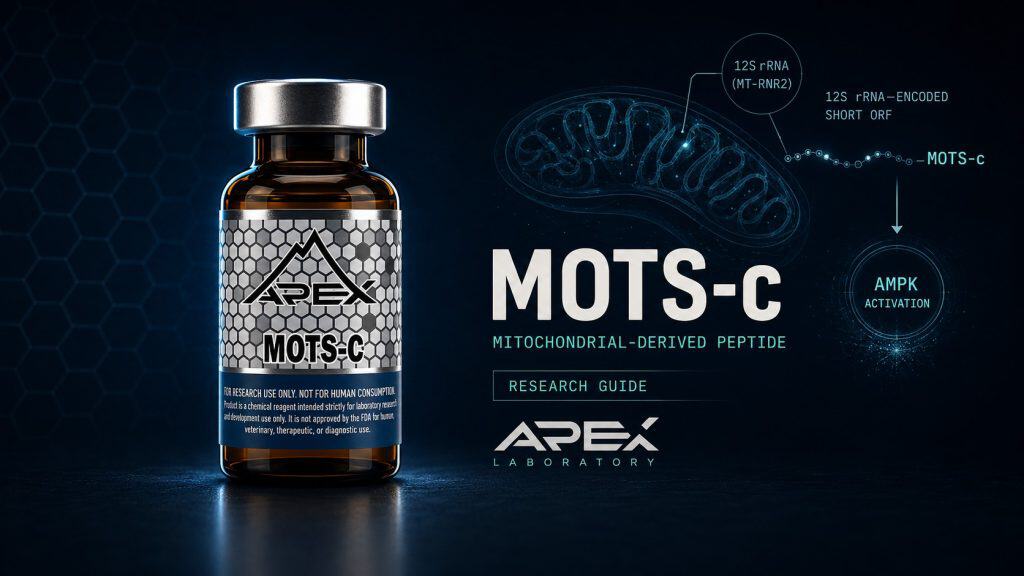
MOTS-c (Mitochondrial ORF of the 12S rRNA type-c) is a 16-amino-acid mitochondrial-derived peptide encoded within a short open reading frame of the mitochondrial 12S rRNA gene, first reported in 2015 by Changhan Lee and Pinchas Cohen at the USC Leonard Davis School of Gerontology. In preclinical research it is studied as an exercise-mimetic regulator of metabolic homeostasis that intercepts the folate and one-carbon cycle to activate AMPK and can translocate to the nucleus to modulate adaptive gene expression.
In 2015, a research team led by Changhan Lee and senior author Pinchas Cohen at the University of Southern California Leonard Davis School of Gerontology reported a peptide that did not fit the conventional picture of where peptides come from. Rather than being transcribed from the nuclear genome, this 16-amino-acid molecule was encoded within a short open reading frame embedded in the mitochondrial 12S ribosomal RNA gene. They named it MOTS-c — Mitochondrial ORF of the Twelve-S rRNA type-c — and described it in Cell Metabolism as a regulator of metabolic homeostasis that intercepts the folate and one-carbon cycle and activates AMP-activated protein kinase (AMPK).[1]
MOTS-c belongs to a small but growing family of mitochondrial-derived peptides (MDPs), and the years since its discovery have produced a focused body of preclinical literature spanning cell culture, mouse metabolic and exercise models, and human observational genetics.[2] This guide summarizes that research for laboratory context. MOTS-c sits within the broader Apex longevity and bioregulator research cluster, and it is supplied strictly as a research-grade chemical reagent for in-vitro and preclinical investigation — not as a drug, dietary product, or therapy for human or veterinary use.
MOTS-c at a Glance
- MOTS-c is a 16-residue mitochondrial-derived peptide (MDP) encoded within a short open reading frame of the mitochondrial 12S rRNA gene (MT-RNR1), not the nuclear genome.
- It was first reported in 2015 by Changhan Lee and Pinchas Cohen at the USC Leonard Davis School of Gerontology, following the earlier mitochondrial peptide Humanin.
- In preclinical models MOTS-c intercepts the folate and one-carbon (methionine) cycle and its tethered de novo purine biosynthesis, driving AMPK activation with skeletal muscle as a primary target.
- Mouse studies describe MOTS-c as an exercise mimetic that is exercise-induced and is associated with improved insulin sensitivity and attenuated age-dependent physical decline — healthspan, not lifespan, language.
- Human data are limited to observational genetics: the K14Q (m.1382A>C) polymorphism associates with type 2 diabetes risk and with muscle-fiber composition and performance.
- MOTS-c has no FDA, EMA, or NMPA-approved formulation anywhere; Apex supplies it strictly as a research-grade chemical reagent at ≥99% purity for in-vitro and preclinical use only.
MOTS-c (Human)
What Is MOTS-c? A Mitochondrial-Derived Peptide
MOTS-c is a 16-amino-acid peptide with the primary sequence Met-Arg-Trp-Gln-Glu-Met-Gly-Tyr-Ile-Phe-Tyr-Pro-Arg-Lys-Leu-Arg (single-letter MRWQEMGYIFYPRKLR). What sets it apart from the thousands of peptides catalogued in research is its origin: it is not encoded by a nuclear gene but by a short open reading frame (sORF) nested inside the mitochondrial 12S ribosomal RNA gene, designated MT-RNR1. Peptides arising this way are collectively termed mitochondrial-derived peptides, or MDPs.[1]
The 16-amino-acid 12S rRNA-encoded peptide
Because mitochondrial DNA is small, compact, and historically thought to encode only a handful of well-characterized proteins, the recognition that functional bioactive peptides could be hidden within ribosomal RNA reading frames reframed how researchers think about mitochondrial output. In the original report, MOTS-c was shown to be detectable in tissues and circulation and to act on cellular metabolism rather than remaining confined to the organelle.[2] For a fuller treatment of the wider class, see the Apex Humanin and MOTS-c research guide.
Naming: Mitochondrial ORF of the 12S rRNA type-c
The acronym encodes its own provenance. “MOTS” stands for Mitochondrial ORF of the Twelve-S rRNA, and the “-c” designates the specific reading frame identified by the discovery group. This naming convention deliberately distinguishes MOTS-c from Humanin, the founding MDP encoded in a different region of the mitochondrial genome, and signals that further mitochondrial sORF-derived peptides may share the family nomenclature.[3]
Discovery and Research Lineage: The Cohen Lab at USC
MOTS-c was first reported in the March 2015 issue of Cell Metabolism by a group at the University of Southern California Leonard Davis School of Gerontology, with Changhan Lee as first author and Pinchas Cohen as senior author.[1] Preserving that attribution matters: a large share of the foundational mechanistic work on MOTS-c traces back to this single laboratory and its collaborators, which is an important consideration when weighing the breadth of independent replication in the literature.
Changhan Lee, Pinchas Cohen, and the Leonard Davis School of Gerontology
The Cohen group approached mitochondrial DNA not merely as the blueprint for the electron transport chain but as a potential source of signaling peptides. Their gerontology-focused program framed MOTS-c within the study of aging biology and metabolic decline from the outset, an emphasis that has continued to shape how the peptide is investigated.[2] Subsequent collaborations — notably with groups at the University of Auckland on exercise physiology — broadened the experimental scope while keeping the originating lab central.[6]
The Humanin precedent and the search for additional mitochondrial sORFs
MOTS-c did not emerge in isolation. Humanin, the first recognized mitochondrial-derived peptide, had earlier established that mitochondrial DNA could encode bioactive short peptides, and it provided both a conceptual template and a methodological precedent for the search that uncovered MOTS-c.[3] The relationship between these peptides is explored further in the Apex Humanin and MOTS-c research guide.
Molecular Structure and Sequence
The MOTS-c sequence Met-Arg-Trp-Gln-Glu-Met-Gly-Tyr-Ile-Phe-Tyr-Pro-Arg-Lys-Leu-Arg comprises sixteen residues. PubChem (CID 146675088) lists a molecular formula of C101H152N28O22S2 and a molecular weight of approximately 2174.6 g/mol, consistent within rounding with the catalog value of 2174.7 g/mol. The two sulfur atoms in that formula correspond to the peptide’s two methionine residues at positions 1 and 6.[1]
Primary sequence MRWQEMGYIFYPRKLR
The sequence is notably basic, carrying multiple arginine and lysine residues, which is relevant to handling and reconstitution behavior. A defined CAS number is not catalog-specified for this peptide, and Apex records it as “Not specified” rather than assigning a placeholder value — an honesty point worth noting when cross-referencing vendor documentation. Researchers verifying identity should rely on the sequence, the PubChem formula, and mass-spectrometric confirmation rather than a CAS lookup.
Molecular weight, formula, and encoding within MT-RNR1
Because MOTS-c is read from the mitochondrial 12S rRNA gene, its sequence is dictated by mitochondrial rather than nuclear genetics, a detail that becomes important when discussing naturally occurring sequence variants later in this guide.[9] For practical confirmation-of-identity workflows, see the Apex primers on how to read a peptide certificate of analysis and HPLC testing for peptide purity.
How MOTS-c Works: Mechanism of Action in Research Models
The mechanism reported in the discovery paper is distinctive among signaling peptides. Rather than acting principally through a dedicated cell-surface receptor, MOTS-c was described as intercepting the folate and one-carbon (methionine) cycle, with downstream effects on the de novo purine biosynthesis pathway tethered to it. The reported consequence is activation of AMP-activated protein kinase (AMPK), a central cellular energy sensor, with skeletal muscle identified as a primary target tissue in mice.[1]
Folate / one-carbon cycle interception → AMPK activation
In the discovery model, MOTS-c does not act primarily through a classical cell-surface receptor. Instead it intercepts the folate and one-carbon (methionine) cycle and the de novo purine biosynthesis pathway tethered to it, leading to accumulation of an AICAR-related intermediate that activates AMP-activated protein kinase (AMPK). AMPK engagement shifts cells toward catabolic, energy-generating metabolism, with skeletal muscle described as the primary target tissue in mice. Under metabolic stress, MOTS-c has also been reported to translocate to the nucleus to help regulate adaptive gene-expression programs. All steps are characterized in cell and animal models. Lee et al. (2015), Cell Metabolism.
Folate / one-carbon (methionine) cycle interception and de novo purine biosynthesis
In the originating model, MOTS-c interferes with the folate cycle in a way that alters the pool of metabolic intermediates feeding purine synthesis. The accumulation of certain intermediates is proposed as the upstream trigger that engages AMPK, rather than direct allosteric binding of the peptide to the kinase itself. A 2023 review consolidating the preclinical evidence frames this folate-cycle-to-AMPK axis as the recurring through-line across MOTS-c metabolic studies.[13]
AMPK activation and the AICAR / folate intermediate link
AMPK activation is the mechanistic hinge that connects MOTS-c to its reported metabolic effects, since AMPK governs the cellular shift toward catabolic, energy-generating pathways. The proposed route — accumulation of an AICAR-related purine-biosynthesis intermediate — is conceptually adjacent to how the small-molecule AMPK activator AICAR works, and researchers comparing the two may find the Apex AICAR research guide a useful reference point. The comparison is mechanistic and should not be read as functional equivalence.[1]
Skeletal muscle as the primary target organ in preclinical models
Across the foundational studies, skeletal muscle recurs as the tissue where MOTS-c effects are most prominently characterized, consistent with the high metabolic and mitochondrial demand of muscle.[2] All of these mechanistic descriptions derive from cell-culture and animal experiments and should be read as research-model findings, not as established human pharmacology.
Stress-Induced Nuclear Translocation and Adaptive Gene Expression
One of the more conceptually striking observations in the MOTS-c literature is that a mitochondrially encoded peptide can move into the nucleus. Under metabolic stress, MOTS-c has been reported to translocate from the cytosol to the nucleus, where it is described as participating in the regulation of adaptive nuclear gene-expression programs — a form of mitochondrial-to-nuclear retrograde signaling.[4]
Mitochondrial-to-nuclear retrograde signaling
A mechanistic synthesis published in BioEssays framed MOTS-c explicitly as a mitochondrial-encoded regulator of the nucleus, positioning it as a messenger that allows the mitochondrion to influence the broader transcriptional state of the cell in response to energetic and oxidative stress.[5] It is worth noting that the nuclear-translocation account rests substantially on originating-group commentary and review-level synthesis rather than a large body of independent primary studies, so it is best described in the literature’s own hedged terms.
Regulation of antioxidant and metabolic stress-response gene programs
The adaptive programs described include genes linked to antioxidant defense and metabolic homeostasis, consistent with a peptide whose proposed role is helping cells respond to nutrient and energy stress. Exercise-physiology work later reinforced the idea that MOTS-c expression and localization respond to physiological stressors such as exercise.[6]
MOTS-c as an Exercise Mimetic in Preclinical Research
A substantial strand of MOTS-c research positions it as an “exercise mimetic” in animal models — a term used in the literature to describe agents that reproduce some metabolic signatures of physical activity. A 2021 Nature Communications study from the USC group with University of Auckland collaborators reported that MOTS-c is exercise-induced in mouse and human skeletal muscle and circulation, and that it regulates age-dependent physical decline and muscle homeostasis.[6]
Exercise-induced expression and age-dependent physical decline
In that work, late-life intermittent MOTS-c treatment was associated with increased physical capacity in older mice, and exercise itself induced endogenous MOTS-c. The investigators framed the outcome in terms of healthspan and physical performance rather than lifespan, and that distinction should be preserved precisely: the data speak to physical capacity in aged animals, not to extension of maximum lifespan.[6]
Physical-capacity and muscle-homeostasis findings in mice
Complementary metabolomic work reported that MOTS-c improves insulin sensitivity in aged and diet-induced obese mice and shifts plasma metabolite pathways, reinforcing the exercise-mimetic characterization at the level of systemic metabolism.[7] Researchers comparing longevity-cluster bioregulators may also consider Epithalon versus MOTS-c, since the two are studied under overlapping aging-research framings despite acting through entirely different mechanisms.
Metabolic Research: Insulin Sensitivity and Metabolic Homeostasis
Metabolic homeostasis was the headline finding of the discovery paper, where MOTS-c prevented both age-dependent and high-fat-diet-induced insulin resistance and reduced diet-induced obesity in mice.[1] Subsequent work has steadily expanded this metabolic profile within the boundaries of preclinical and observational research.
MOTS-c vs Humanin: Two Mitochondrial-Derived Peptides
| Attribute | MOTS-c | Humanin |
|---|---|---|
| Length | 16 amino acids | 24 amino acids |
| Encoding region | Mitochondrial 12S rRNA (MT-RNR1) | Mitochondrial 16S rRNA region |
| Year first reported | 2015 (Lee & Cohen, USC) | Founding MDP, reported earlier |
| Primary reported pathway | Folate / one-carbon cycle → AMPK activation | Cytoprotective signaling |
| Dominant research framing | Metabolism, exercise-mimetic, muscle homeostasis | Cytoprotection, cell-survival signaling |
| Regulatory status | Research-only; no approved formulation | Research-only; no approved formulation |
Insulin sensitivity in aged and diet-induced obese mice
The 2019 metabolomic study characterized MOTS-c as enhancing insulin sensitivity specifically in aged and diet-induced obese mice, while reducing sphingolipid, monoacylglycerol, and dicarboxylate metabolism pathways in plasma.[7] These metabolite shifts provide a biochemical fingerprint that distinguishes MOTS-c effects from generic caloric restriction in the cited models.
Plasma metabolite shifts and metabolic-disorder models
A 2023 review synthesized the preclinical literature under the framing that MOTS-c functionally counters metabolic disorders through AMPK engagement and improved insulin sensitivity.[13] As with all the metabolic findings here, these are observations in cell and animal systems; they do not establish efficacy, safety, or any therapeutic role in humans. Researchers studying adjacent NAD-dependent and sirtuin-linked metabolism may find the Apex NAD+ research guide a useful companion reference.
Muscle Homeostasis and Atrophy Signaling Research
Beyond whole-body metabolism, MOTS-c has been investigated at the level of muscle-specific signaling. A 2021 study in the American Journal of Physiology — Endocrinology and Metabolism reported that MOTS-c reduces myostatin and muscle-atrophy signaling, acting through a CK2–PTEN–mTORC2–AKT–FOXO1 pathway in cultured muscle cells and lowering plasma myostatin in diet-induced obese mice.[8]
Myostatin and muscle atrophy pathways
Myostatin is a negative regulator of muscle mass, so a reported reduction in myostatin signaling is mechanistically consistent with the muscle-homeostasis and physical-capacity findings from the exercise studies. In the cited work, MOTS-c also prevented palmitic-acid-induced atrophy in C2C12 myotubes, providing an in-vitro counterpart to the in-vivo observations.[8]
Muscle fiber composition and human polymorphism associations
The muscle theme extends into human observational genetics. A 2022 study reported that a naturally occurring MOTS-c variant associates with muscle-fiber composition and muscular performance, with the variant enriched among power and sprint athletes in the studied cohorts.[10] These are association data, not interventional results, and they do not demonstrate that administering MOTS-c alters human muscle performance.
MOTS-c Genetic Variation and Human-Relevant Observations
The clearest human-relevant data on MOTS-c come not from interventional trials — of which there are none in the cited literature — but from studies of a naturally occurring sequence variant. Because MOTS-c is mitochondrially encoded, mitochondrial DNA polymorphisms can change its sequence, and one such variant has drawn particular attention.
The K14Q (m.1382A>C) polymorphism and metabolic phenotype
A 2021 study described an Asian-specific mitochondrial polymorphism, m.1382A>C, which produces a lysine-to-glutamine substitution at position 14 (K14Q) of MOTS-c. In a meta-analysis spanning three cohorts and more than 27,000 individuals, men carrying the C-allele showed a higher prevalence of type 2 diabetes, linking MOTS-c sequence variation to a metabolic phenotype at the population level.[9]
Associations with muscular performance (observational, not interventional)
The same K14Q variant has been associated with muscle-fiber composition and higher muscular performance in men, and with enrichment among sprint and power athletes.[10] A 2023 review situates these findings within the broader study of mitochondrial microproteins and mtDNA variants in athletic performance and age-related disease.[14] Throughout, it bears repeating that genetic-association studies describe correlations in populations and cannot be used to infer the effect of administering exogenous MOTS-c in any species.
MOTS-c vs Other Mitochondrial-Derived Peptides (Humanin, SHLPs)
MOTS-c is best understood as one member of a family rather than a standalone molecule. The mitochondrial-derived peptide family includes Humanin, the small humanin-like peptides (SHLPs), and MOTS-c, each encoded by a short open reading frame within mitochondrial DNA but differing in sequence, length, and reported pathway.[3]
Shared mtDNA-sORF origin, distinct sequences and pathways
Humanin, a 24-amino-acid peptide encoded within the mitochondrial 16S rRNA region, was the founding MDP and is studied largely for cytoprotective signaling. MOTS-c, encoded in the 12S rRNA region, is studied principally for AMPK-linked metabolic and exercise-related roles.[11] They share a family origin but are not interchangeable, a point covered in detail in the Apex Humanin and MOTS-c research guide.
Comparative roles in aging and healthspan research
An authoritative 2022 review in the Journal of Clinical Investigation surveyed the MDP field in the context of aging and healthspan, providing the comparative framework that places MOTS-c alongside Humanin and the SHLPs.[12] The recurring “healthspan” framing across these reviews is deliberate: the literature consistently describes function and physical capacity in aging models rather than claims about lifespan extension.
Dosing and Handling Considerations in Research Settings
Apex provides handling context for laboratory work only; nothing in this section constitutes a dosing recommendation for humans, and no human dosing protocol for MOTS-c exists in the cited literature. The published administration data are entirely murine.
Reported preclinical administration routes and ranges (animal studies)
In the foundational mouse studies, MOTS-c was administered parenterally, typically by intraperitoneal injection on a weight-normalized (mg/kg) basis in rodents.[1] The exercise-and-aging work used intermittent late-life dosing schedules in mice.[6] These murine schedules cannot be translated to human protocols; allometric scaling, species-specific pharmacokinetics, and the absence of any human safety data make such extrapolation scientifically unsupportable.
Reconstitution, storage, and freeze-thaw handling guidance
As a lyophilized peptide, MOTS-c is generally stored at −20°C in its dry form, with reconstituted aliquots held at −80°C and freeze-thaw cycles minimized to preserve integrity. These are general peptide-handling conventions rather than compound-specific stability data published for MOTS-c. For protocol detail, consult the Apex guides on how to reconstitute peptides and peptide storage.
Safety, Tolerability & Adverse-Event Observations (Research Context)
No clinical safety database exists for MOTS-c, and no regulatory authority has reviewed it for human use. What the literature provides is tolerability information reported incidentally within preclinical efficacy experiments, framed here strictly as research findings in animal models — not as patient side-effects, expected effects, or any guidance for use.
Tolerability reported in preclinical mouse studies
In published animal research, MOTS-c was administered to mice without investigators reporting overt toxicity as a limiting factor. In the 2015 discovery study, intraperitoneal MOTS-c was given to mice across age-dependent and high-fat-diet models while improving metabolic endpoints, and the report did not describe dose-limiting adverse events as a barrier to the experiments.[1] In the 2021 Nature Communications exercise-and-aging study, late-life intermittent MOTS-c was administered to older mice over an extended schedule, and the investigators reported gains in physical capacity rather than treatment-limiting toxicity over the studied window.[6] These are observations from controlled animal experiments with specific endpoints; they are not formal toxicology studies and do not establish a safety profile.
Why these observations do not constitute a human safety profile
A 2023 review consolidating the preclinical metabolic literature does not identify a characterized adverse-event or toxicology dataset for MOTS-c in humans, consistent with the absence of any interventional human trial.[13] The human-relevant data that do exist are observational genetics — a sequence polymorphism associated with type 2 diabetes prevalence at the population level — which describe correlations, not the effects or safety of administering exogenous MOTS-c.[9] Because formal toxicology, dose-finding safety, and adverse-event surveillance studies have not been published for any species, no safety, tolerability, or therapeutic conclusion for humans can be drawn from the current MOTS-c literature.
Pharmacokinetics and Half-Life: What the Research Does and Does Not Establish
Researchers planning MOTS-c experiments frequently ask about its pharmacokinetics and circulating half-life. The honest answer from the published record is that formal pharmacokinetic parameters for MOTS-c — a defined plasma half-life, clearance rate, or volume of distribution — have not been characterized in any species in the cited literature, and Apex does not assign values that the literature does not support.
Endogenous detection versus measured pharmacokinetics
What the literature does establish is that MOTS-c circulates as an endogenous peptide and that its levels are dynamic. The discovery work reported MOTS-c as detectable in tissues and circulation rather than confined to the mitochondrion,[1] and the 2021 exercise study reported that endogenous MOTS-c is exercise-induced in skeletal muscle and circulation, indicating its concentration responds to physiological stimuli.[6] Detection of a circulating peptide and characterization of its formal pharmacokinetics are separate matters; the former is documented for MOTS-c while the latter is not.
Administration schedules used in animal studies (study facts, not protocols)
In place of pharmacokinetic constants, the practical signal in the literature comes from the dosing schedules investigators chose. Mouse studies administered MOTS-c parenterally, and the exercise-and-aging work used an intermittent rather than continuous late-life schedule,[6] a design choice some authors interpret as consistent with a peptide that does not require constant exposure. These are facts about study design in mice, not pharmacokinetic measurements and not a basis for any human dosing inference. Researchers requiring kinetic data for their own model systems should generate it empirically, since the published MOTS-c record does not supply it.
Sourcing Research-Grade MOTS-c
For any MOTS-c experiment, reproducibility depends on knowing exactly what is in the vial. Because MOTS-c is a 16-mer whose sequence identity and purity directly affect experimental outcomes, research-grade material should be accompanied by analytical documentation rather than label claims alone.
HPLC purity and ESI-MS identity verification
Apex supplies MOTS-c (Human) at ≥99% purity, verified by reversed-phase high-performance liquid chromatography (HPLC) for purity and by electrospray-ionization mass spectrometry (ESI-MS) for identity, confirming the expected mass near 2174.7 g/mol against the C101H152N28O22S2 formula. Each lot is documented with a per-batch certificate of analysis available through the lab-verified COA archive; researchers should review the lot-specific COA rather than relying on a generic specification. Background on interpreting these documents is available in the guides on reading a peptide COA and HPLC purity testing.
Research-use-only designation and adjacent reagents
MOTS-c is sold strictly for in-vitro and preclinical laboratory research and is not for human or veterinary use. The Apex editorial standards and research library document how each guide is sourced and reviewed. Researchers assembling a mitochondrial- and longevity-focused reagent panel often pair MOTS-c with related compounds; the items below, and adjacent guides such as SS-31 (elamipretide) and Epithalon, situate it within the broader research context.
MOTS-c and Adjacent Research Reagents
MOTS-c (Human)
16-amino-acid mitochondrial-derived peptide encoded within the mitochondrial 12S rRNA gene; supplied at ≥99% purity verified by HPLC and mass spectrometry.
View ProductHumanin
24-amino-acid mitochondrial-derived peptide; the founding MDP characterized by the Cohen group.
View ProductNAD+
β-Nicotinamide adenine dinucleotide; sirtuin-pathway substrate bridging mitochondrial and longevity research.
View ProductFrequently Asked Questions
What is MOTS-c?
MOTS-c (Mitochondrial ORF of the 12S rRNA type-c) is a 16-amino-acid mitochondrial-derived peptide encoded within a short open reading frame of the mitochondrial 12S rRNA gene (MT-RNR1). It was first reported in 2015 by Changhan Lee and Pinchas Cohen’s group at the USC Leonard Davis School of Gerontology. In research models it is studied as a regulator of metabolic homeostasis. It is a research-use-only chemical reagent, not an approved drug.
How does MOTS-c work mechanistically?
In published preclinical work, MOTS-c is reported to intercept the folate and one-carbon (methionine) cycle and its tethered de novo purine biosynthesis, which leads to AMPK activation, with skeletal muscle as a primary target organ. Under metabolic stress it has also been described translocating to the nucleus to help regulate adaptive gene-expression programs. These mechanisms are characterized in cell and animal models and should not be read as established human pharmacology.
What is the half-life of MOTS-c?
Formal pharmacokinetic parameters for MOTS-c, including a defined plasma half-life, clearance, or volume of distribution, have not been characterized in any species in the published literature. Studies do report that MOTS-c circulates as an endogenous peptide and that its levels are exercise-induced, but detection is not the same as a measured half-life. Mouse studies used intermittent parenteral schedules. Researchers needing kinetic values for a specific model should generate them empirically.
How is research-grade MOTS-c reconstituted and stored?
As a lyophilized peptide, MOTS-c is generally reconstituted in a suitable sterile diluent such as bacteriostatic or sterile water for in-vitro work, with the basic, arginine- and lysine-rich sequence handled to minimize degradation. Dry powder is typically stored at minus 20 degrees Celsius, reconstituted aliquots at minus 80 degrees Celsius, and freeze-thaw cycles minimized. These are general peptide-handling conventions, not compound-specific stability data published for MOTS-c. See the Apex reconstitution and storage guides for protocol detail.
What does MOTS-c research show about adverse events and tolerability?
In published animal research, mouse studies administered MOTS-c parenterally while reporting metabolic and physical-capacity endpoints without describing dose-limiting toxicity as a barrier over the studied windows. These are observations from controlled efficacy experiments, not formal toxicology or safety studies, and no interventional human safety data exist. The current literature therefore supports no safety, tolerability, or therapeutic conclusion for humans; reported tolerability is a research finding in animal models only.
What doses of MOTS-c were used in published studies?
Published administration data are entirely from mouse studies, where MOTS-c was given parenterally, typically by intraperitoneal injection on a weight-normalized (mg/kg) basis, and the exercise-and-aging work used intermittent late-life schedules. These are study facts, not dosing recommendations. No human dosing protocol exists in the cited literature, and murine schedules cannot be translated to humans because of allometric scaling, species-specific kinetics, and the absence of any human safety data.
Is MOTS-c the same as other mitochondrial-derived peptides like Humanin?
No. MOTS-c and Humanin are both mitochondrial-derived peptides encoded by short open reading frames in mitochondrial DNA, but they are distinct molecules with different sequences, lengths, and reported pathways. Humanin (encoded in the 16S rRNA region) was identified first and is studied largely for cytoprotective signaling, while MOTS-c (12S rRNA) is studied for AMPK-linked metabolic and exercise-related roles. They belong to the same family but are not interchangeable.
Is MOTS-c an FDA-approved drug?
No. MOTS-c has no FDA, EMA, or other approved pharmaceutical formulation anywhere, and there is no approved therapeutic indication. The published literature consists of in-vitro, cell-culture, and preclinical animal studies plus human genetic and metabolomic association data. Apex Laboratory supplies MOTS-c strictly as a research-grade chemical reagent for in-vitro and preclinical laboratory research, not for human or veterinary use.
Continue Your Research
Researchers building broader context across the Apex Research Library may find the following references useful:
- Longevity & Bioregulator Research Peptides — the cluster hub situating MOTS-c among mitochondrial and aging-research reagents
- Humanin & MOTS-c Research Guide — how the two founding mitochondrial-derived peptides relate and differ
- Epithalon vs MOTS-c — two aging-research peptides compared across mechanism and study design
- NAD+ Research Guide — the sirtuin-pathway substrate that bridges mitochondrial and metabolic research
- AICAR Research Guide — a small-molecule AMPK activator that contextualizes the MOTS-c AMPK mechanism
- SS-31 (Elamipretide) Research Guide — a mitochondrially targeted peptide studied in adjacent bioenergetics research
- How to Reconstitute Peptides — general protocol for preparing lyophilized peptides like MOTS-c for in-vitro work
- How to Read a Peptide Certificate of Analysis — interpreting HPLC purity and ESI-MS identity data on a lot-specific COA
Research Use Disclaimer
All MOTS-c products and the information in this guide are intended strictly for in-vitro and preclinical laboratory research. MOTS-c is a research-grade chemical reagent and is not a drug, dietary supplement, or therapeutic product. It is not approved by the FDA, EMA, NMPA, or any other regulatory authority, and it has no approved indication anywhere. It is not for human or veterinary consumption, diagnosis, treatment, or any clinical use. The mechanistic, metabolic, exercise, and genetic findings summarized here derive from cell-culture, animal-model, and human observational studies and are presented for research context only; they do not constitute therapeutic, efficacy, safety, or lifespan claims. Researchers are responsible for compliance with all applicable institutional, local, and national regulations governing the acquisition, handling, and use of research chemicals.