
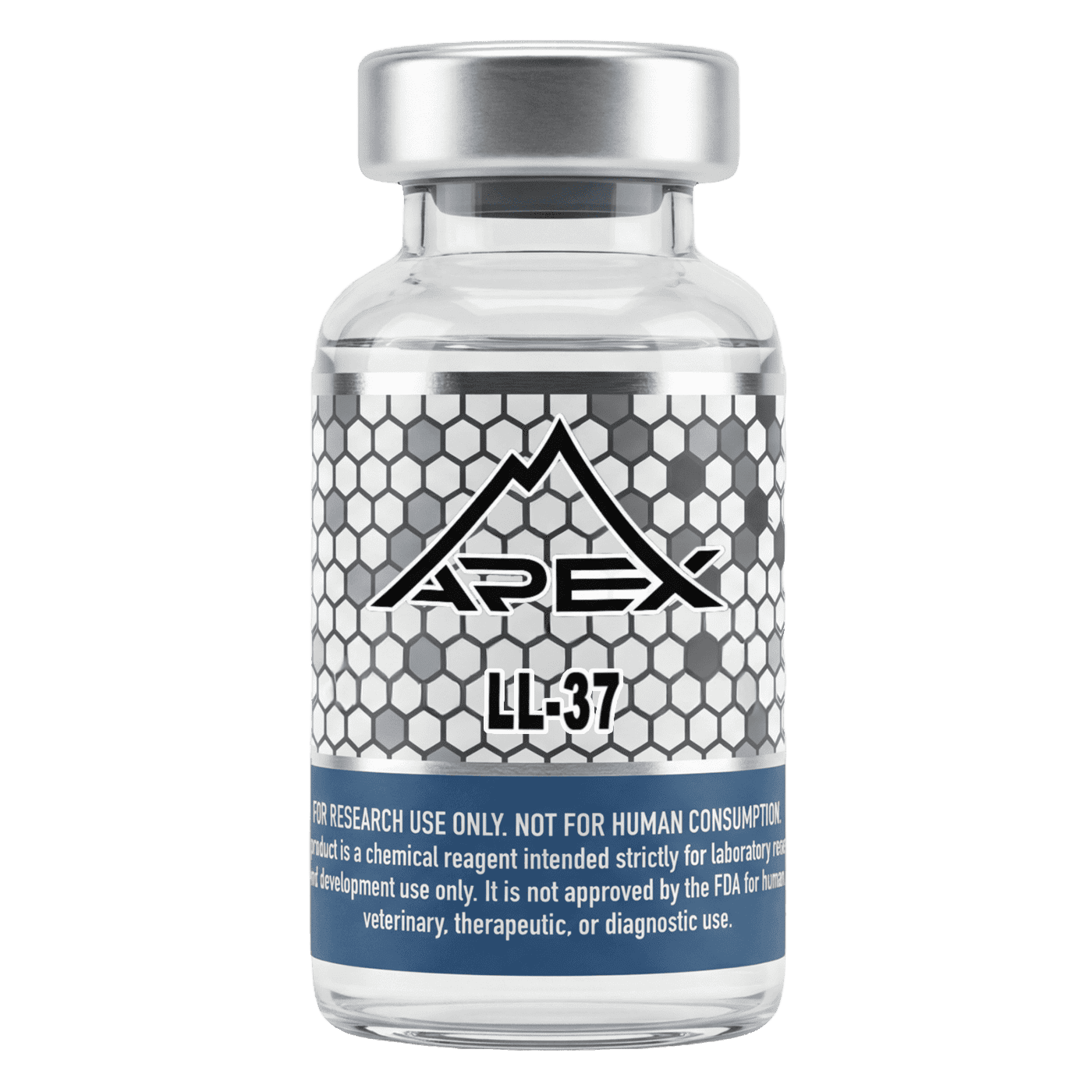
Certificate of Analysis — LL-37 5mg
Cathelicidin antimicrobial peptide (37 AA) – CAS 154947-66-7
Verified by Apex Laboratory in-house HPLC (purity by 220 nm peak area) and ESI mass spectrometry (mass identity confirmation). Data on this page describes the current shipping lot.
- Purity (HPLC, area %): 99.81%
- Mass found (ESI-MS): 4493.32 Da
- Mass expected: 4493.37 Da
- HPLC retention time: 17.5 min
- Batch ID: APX-2026-0312-L
- Test date: March 12, 2026
- Analyst: K. Norwood
View LL-37 5mg on the Lab Verified COA archive · Read the LL-37 Research Guide
LL-37 is the mature, biologically active 37-residue peptide cleaved from the C-terminus of human cathelicidin protein hCAP-18 — the only cathelicidin family member expressed in humans. The chromatogram and mass spectrometry summary shown above belong to the lot currently leaving our shelves (batch APX-2026-0312-L), not a stock graphic or a representative file: the 99.81% HPLC purity and the observed mass of 4493.32 Da are this vial’s own release data. Apex Laboratory supplies this material strictly as a high-purity reference reagent for in-vitro laboratory research and development. It is not approved for human consumption, veterinary use, or any therapeutic application.
Compound Overview
LL-37 takes its name from the two leucine residues at its N-terminus followed by a chain 37 amino acids long. In aqueous buffer the peptide is largely unstructured, but on contact with anionic surfaces — bacterial membranes, lipopolysaccharide, or detergent micelles — it folds into an amphipathic alpha-helix that segregates cationic and hydrophobic faces. That conformational switch is the structural basis for its two best-studied in-vitro behaviours: carpet-style and toroidal-pore disruption of microbial bilayers, and high-affinity binding to host receptors. Unlike the beta-sheet defensins, LL-37 is a single linear helix with a net positive charge near +6 at physiological pH, which drives its selectivity for negatively charged prokaryotic membranes over the more neutral, cholesterol-rich membranes of eukaryotic models.
Beyond membrane activity, the same peptide functions as a signalling ligand in cell-culture systems. Reported in-vitro targets include the formyl peptide receptor 2 (FPR2/FPRL1), which mediates chemotactic and migratory responses in cultured leukocytes, and purinergic P2X7 receptors implicated in inflammasome studies. Researchers also use LL-37 as a tool to probe its capacity to neutralise lipopolysaccharide, to complex with self-DNA and self-RNA in models of nucleic-acid sensing, and to modulate Toll-like receptor signalling. This combination of direct membrane-lytic chemistry and receptor-mediated immunomodulation is what distinguishes LL-37 from purely lytic synthetic antimicrobial peptides used as comparators.
Research Background & Published Literature
LL-37 is one of the most heavily cited host-defence peptides in the literature, with structural, biophysical, and cell-biology studies appearing across journals such as the Journal of Immunology, PNAS, and Antimicrobial Agents and Chemotherapy. Investigators have used it as a reference cationic peptide in innate-immunity assays, as a positive control in membrane-permeabilisation experiments, and as a probe in biofilm-disruption and lipopolysaccharide-neutralisation models. Solution-NMR and circular-dichroism work has mapped its disorder-to-helix transition, while truncation and alanine-scan studies have localised the core antimicrobial fragment within the central helix.
Researchers exploring the published literature surrounding this compound can review the following peer-reviewed sources for additional context on its structure, mechanism of action, and experimental applications in controlled laboratory settings:
- PubMed — LL-37 cathelicidin antimicrobial peptide literature
- PubChem — LL-37 / cathelicidin chemical record
Technical Specifications
| Product Name | LL-37 5mg |
| Other Names / Synonyms | Cathelicidin antimicrobial peptide (CAMP); hCAP-18(104-140); LL37 |
| Classification | Human cathelicidin host-defence / antimicrobial peptide |
| CAS Number | 154947-66-7 |
| Molecular Formula | C₂₀₅H₃₄₀N₆₀O₅₃ |
| Molecular Weight | 4493.33 g/mol (this lot: observed 4493.32 / expected 4493.37) |
| Sequence / Structure | 37 amino acids; linear, cationic, amphipathic alpha-helix; no disulfide bonds |
| Purity Specification | ≥99% (HPLC + MS verified — see chromatogram above) |
| Physical Form | Lyophilized (freeze-dried) powder · sealed glass vial |
| Recommended Diluent | Sterile water or bacteriostatic water; brief dilute acetic acid can aid initial solubilisation |
| Available Size | 5 mg per vial |
| Intended Use | In-vitro research only — not for human consumption |
Storage, Handling & Stability
Store the sealed lyophilized vial at -20°C, protected from light and moisture, for long-term stability. Because LL-37 is a highly cationic peptide, it is prone to non-specific adsorption onto glass and polypropylene surfaces; preparing working solutions in low-protein-binding tubes and, where assay-compatible, including a carrier such as 0.1% BSA can reduce loss of material during dilution. After reconstitution, keep working solutions at 2–8°C for short-term use and freeze single-use aliquots to avoid the repeated freeze-thaw that degrades helical antimicrobial peptides.
- Account for adsorptive losses: this peptide sticks to surfaces, so verify concentration in critical assays rather than assuming nominal values.
- Reseal the vial immediately after each withdrawal to limit moisture uptake by the hygroscopic powder.
- Minimise time at ambient temperature during weighing and dissolution to preserve the disorder-to-helix folding behaviour.
- Label every aliquot with compound name, concentration, reconstitution date, and operator initials for full lot traceability.
Quality Assurance & Analytical Verification
Every LL-37 lot passes a dual-verification release protocol before it enters inventory, and the resulting data is published directly to this page for the lot currently shipping. The chromatogram and analytical summary at the top of this page are this batch’s actual release record, not a marketing illustration. Reversed-phase HPLC confirms chromatographic purity — here 99.81% at a retention time of 17.5 minutes, consistent with the moderate hydrophobicity of a +6-charged 37-mer — while mass spectrometry confirms molecular identity.
For a peptide of this size (4493 Da), electrospray mass spectrometry resolves a multi-charge-state envelope rather than a single protonated ion; the dominant [M+3H]³⁺ and [M+4H]⁴⁺ species back-calculate to the observed parent mass of 4493.32 Da, matched against the expected 4493.37 Da. Cross-checking several charge states to a single deconvoluted mass is a more rigorous identity test than relying on [M+H]⁺ alone — the method is described in our mass spectrometry peptide verification guide, and the underlying purity standard is covered in our HPLC purity testing guide. Historical batch records are available on request, and current certificates are archived in the Lab Verified library.
Frequently Asked Questions
Why does LL-37 fold into a helix only in certain conditions?
In dilute aqueous buffer LL-37 is mostly disordered. When it encounters an anionic or membrane-mimetic surface — bacterial lipids, lipopolysaccharide, or detergent micelles in vitro — electrostatic and hydrophobic contacts drive it into an amphipathic alpha-helix. Researchers often run circular-dichroism titrations to capture this disorder-to-helix transition as a structural readout in membrane-interaction experiments.
How should I dissolve LL-37 for cell-free assays?
The lyophilized powder is typically reconstituted in sterile or bacteriostatic water; a brief exposure to dilute acetic acid can help solubilise stubborn material before dilution into your assay buffer. Because the peptide adsorbs to glass and plastic, prepare it in low-binding tubes and confirm concentration where the experiment is sensitive to exact amounts.
How is LL-37 different from defensins or synthetic antimicrobial peptides?
Defensins are compact, disulfide-stabilised beta-sheet peptides, whereas LL-37 is a single linear alpha-helix with no cysteines. It is also multifunctional in vitro: in addition to membrane-disrupting activity it acts as a receptor ligand (for example at FPR2) and as a lipopolysaccharide-neutralising and nucleic-acid-binding molecule, which is why it is used as a reference host-defence peptide rather than a purely lytic control.
Why is the verified mass reported as multiple values?
The certificate lists both an expected mass (4493.37 Da, calculated from the sequence) and an observed mass (4493.32 Da, measured by ESI mass spectrometry on this lot). For a 37-residue peptide the instrument records several charge states that all deconvolute to the same parent mass, which is the identity confirmation behind the ≥99% release specification.
Is this product approved for human use?
No. All compounds sold by Apex Laboratory are classified as chemical research reagents intended strictly for in-vitro laboratory research. LL-37 is not approved for human consumption, veterinary use, or any therapeutic application, and nothing on this page should be read as guidance for use in or on the body. Purchasers who imply intended bodily use will have their orders cancelled and their accounts permanently suspended.
Is bulk ordering available?
Yes. For bulk quantities, custom packaging, or recurring supply agreements, contact our team through the contact page with the compound name, desired quantity, preferred format, and your target delivery timeline. Volume pricing is available for qualifying institutional and recurring orders.
Related Research Compounds
Laboratories studying host-defence peptides, innate immunity, and tissue-repair signalling may also be interested in related reagents from Apex Laboratory: KPV (C-terminal alpha-MSH tripeptide), Thymosin Alpha 1, BPC-157, and TB-500. For broader context on this class, see the specialty research peptides pillar guide, or browse the complete Apex Laboratory research catalog.
Shipping, Packaging & Delivery
Orders confirmed before 2:00 PM Eastern Time on a business day leave the same day via tracked domestic carriers within the United States. Each LL-37 vial is sealed and packed in insulated, temperature-appropriate packaging chosen to protect the lyophilized powder in transit. On arrival, move the vial to -20°C storage without delay. If your protocol is time-sensitive or you need a specific delivery window, let our support team know in advance so we can align dispatch with your laboratory schedule.
Research Use Disclaimer
For in-vitro research use only. Not for human consumption. All products sold by Apex Laboratory — including LL-37 5mg — are intended exclusively for qualified researchers, accredited laboratories, and educational institutions. Purchasers assume full responsibility for safe handling, proper storage, and compliance with all applicable federal, state, and local laws, regulations, and institutional policies governing the purchase and use of chemical research reagents.

Reviews
There are no reviews yet.