
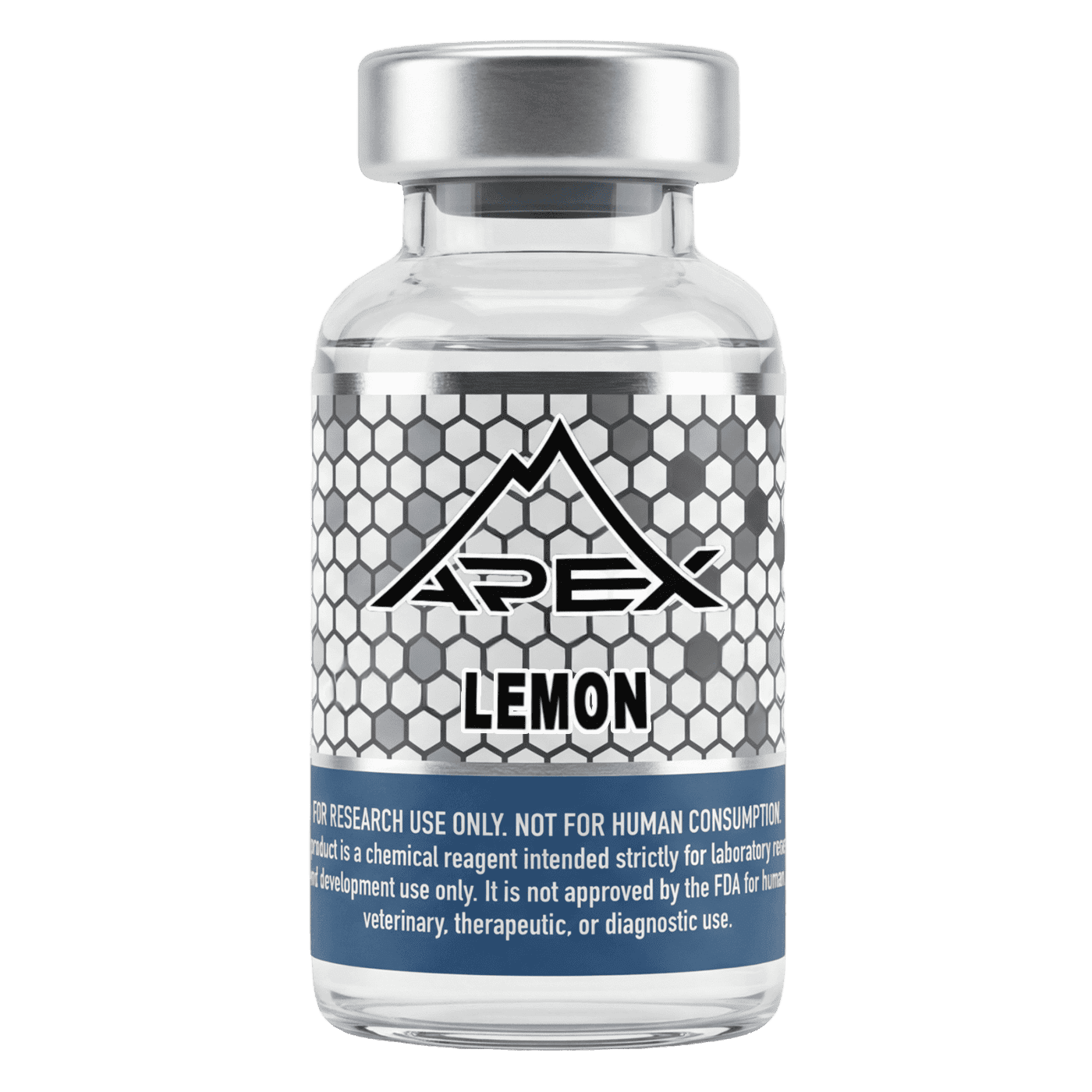
Certificate of Analysis — Lemon Bottle 10mL
Lipolytic blend · Riboflavin + Lecithin + Bromelain · No deoxycholic acid
Verified by Apex Laboratory in-house HPLC (purity by 220 nm peak area) and ESI mass spectrometry (mass identity confirmation). Data on this page describes the current shipping lot.
- Batch ID: APX-2026-0413-L
- Test date: April 13, 2026
- Analyst: K. Norwood
Lemon Bottle 10ml is a multi-component lipolysis research solution — a riboflavin-anchored aqueous blend pairing a membrane phospholipid emulsifier with a plant proteolytic enzyme, and notably formulated without deoxycholic acid. The chromatogram and identity panel above are drawn from the lot currently shipping (batch APX-2026-0413-L, tested 2026-04-13): the riboflavin marker quantification and the protein assay you see are this vial’s release record, not a stock graphic. Supplied by Apex Laboratory strictly for in-vitro laboratory research and development; it is not approved for human consumption, veterinary use, or any therapeutic or cosmetic application.
Compound Overview
Unlike a single defined molecule, Lemon Bottle is a defined-component mixture, and its research interest comes from how the three constituents behave together in adipocyte and cell-membrane model systems. Riboflavin (vitamin B2) is the flavin coenzyme precursor to FMN and FAD — the redox cofactors that fatty-acyl-CoA dehydrogenase and the mitochondrial electron-transport flavoproteins depend on for beta-oxidation of fatty acids. It also serves as the formulation’s optical fingerprint: its conjugated isoalloxazine ring absorbs strongly near 444 nm, which is why it functions as the HPLC quantification marker on the COA. Lecithin (phosphatidylcholine) is a zwitterionic glycerophospholipid that self-assembles into bilayers and micelles; in vitro it acts as an amphipathic emulsifier capable of solubilizing lipid and perturbing membrane organization. Bromelain is a cysteine-protease complex extracted from pineapple stem, its proteolytic activity expressed in Gelatin Digestion Units (GDU). What chiefly distinguishes this blend from detergent-style siblings such as Lipo-C is the deliberate absence of deoxycholic acid — the bile-salt detergent that drives membrane lysis in classic adipolytic preparations — meaning model studies here probe an enzyme-plus-phospholipid mechanism rather than a bile-acid detergent mechanism.
Research Background & Published Literature
Each constituent carries an independent body of peer-reviewed literature. Riboflavin’s role as the FAD/FMN-generating cofactor in mitochondrial fatty-acid oxidation is foundational metabolic biochemistry; phosphatidylcholine is among the most studied membrane phospholipids in emulsion and lipid-bilayer model work; and bromelain has an extensive pharmacological literature covering its proteolytic and signaling activities. The research question that motivates the combined formulation is how an emulsifying phospholipid, a proteolytic enzyme, and a redox cofactor jointly influence lipid handling, membrane integrity, and protein turnover in cultured adipocyte and tissue-model systems — always within controlled in-vitro settings, never as a treatment for living subjects. The sources below give context on mechanism and constituent biology; they are starting points for a literature review, not endorsements of any application.
- PubMed — bromelain cysteine-protease activity research
- PubMed — riboflavin, FAD and fatty-acid oxidation
- PubChem — riboflavin chemical and property record
Technical Specifications
| Product Name | Lemon Bottle 10ml |
| Other Names / Synonyms | Riboflavin + lecithin + bromelain lipolytic blend (deoxycholic-acid-free) |
| Classification | Lipolysis research solution (defined-component mixture) |
| Components & CAS | Riboflavin (CAS 83-88-5) · Lecithin / phosphatidylcholine (CAS 8002-43-5) · Bromelain (CAS 9001-00-7) |
| Riboflavin Molecular Weight | 376.36 g/mol (marker constituent) |
| Identity Method | HPLC quantification of riboflavin marker (UV ~444 nm) + protein assay for enzyme content |
| Quality Checks | Sterility: Pass · Endotoxin: < 0.5 EU/mL (LAL) |
| Physical Form | Yellow aqueous solution · sealed vial · ready to use |
| Available Size | 10 mL vial |
| Intended Use | In-vitro research only — not for human consumption |
Storage, Handling & Stability
Lemon Bottle ships as a ready-to-use aqueous solution, so the handling profile differs from a lyophilized powder — there is no reconstitution step, and the dominant stability concerns are photodegradation and enzyme denaturation rather than moisture uptake. Riboflavin is markedly light-sensitive: under illumination it photolyzes to lumiflavin and lumichrome, which both depletes the 444 nm marker and generates reactive species, so amber or foil-shielded storage matters here in a way it would not for a colorless reagent. Bromelain’s proteolytic activity is temperature- and freeze-thaw-sensitive, and the lecithin phase can oxidize on prolonged air exposure.
- Refrigerate the unopened vial at 2–8°C and protect it from light at all times — riboflavin photolysis is the primary loss pathway for this blend.
- Avoid repeated freeze-thaw cycles, which can compromise bromelain enzymatic activity; aliquot working volumes per your SOPs if subdividing.
- Withdraw with aseptic technique and reseal promptly to limit oxidation of the phospholipid phase and preserve the verified endotoxin profile.
- Record lot number (APX-2026-0413-L), open date, and operator initials on every working aliquot for full traceability.
Quality Assurance & Analytical Verification
Because Lemon Bottle is a multi-constituent mixture rather than a single pure molecule, it cannot be released on a single-ion mass spectrum the way a defined peptide is. Apex Laboratory instead applies a mixture-appropriate identity protocol: HPLC quantification of the riboflavin marker — exploiting its distinctive UV absorbance near 444 nm to confirm the flavin constituent is present at the expected level — paired with a protein assay to verify the bromelain enzyme fraction. Each lot is additionally screened for sterility (Pass on this batch) and bacterial endotoxin by LAL assay (< 0.5 EU/mL), the relevant safety checks for an aqueous solution intended for in-vitro work. The data panel at the top of this page reflects batch APX-2026-0413-L exactly as tested on 2026-04-13. For the methodology behind chromatographic marker quantification and how to interpret a release record, see our guides on HPLC purity verification and how to read a Certificate of Analysis; archived batch records are kept in the Lab Verified archive.
Frequently Asked Questions
Why is there no deoxycholic acid in this formulation?
The absence of deoxycholic acid is the defining feature of this blend and is flagged directly on the COA. Deoxycholic acid is a bile-salt detergent that drives non-selective membrane lysis in classic adipolytic preparations. By omitting it, Lemon Bottle lets researchers study an enzyme-plus-phospholipid (bromelain + lecithin) system alongside the riboflavin redox cofactor without the confounding detergent-lysis variable — a meaningfully different mechanistic model for in-vitro adipocyte studies.
Why is riboflavin used as the analytical marker instead of testing every component?
Riboflavin carries a strong, characteristic UV absorbance near 444 nm from its conjugated isoalloxazine ring, which makes it cleanly quantifiable by HPLC and an ideal optical fingerprint for batch identity. The bromelain enzyme fraction is confirmed separately by protein assay. Together the marker quantification and protein assay give a defensible identity check appropriate to a multi-component mixture, where a single molecular-ion mass spectrum would not apply.
Does this product need to be reconstituted before use in the lab?
No. Lemon Bottle is supplied as a ready-to-use 10 mL aqueous solution, so there is no lyophilized powder to dissolve. Handling focuses on keeping the vial cold and shielded from light to protect the photosensitive riboflavin marker and the temperature-sensitive bromelain enzyme.
What does the < 0.5 EU/mL endotoxin value mean on the COA?
It is the bacterial endotoxin level measured by the Limulus Amebocyte Lysate (LAL) assay, reported in endotoxin units per milliliter. A low endotoxin reading matters for in-vitro cell-culture work because endotoxin can independently activate inflammatory pathways and confound results in adipocyte and tissue-model experiments. This batch also passed sterility testing.
What is the primary research application of this solution?
It is used in controlled in-vitro settings to investigate how an emulsifying phospholipid, a proteolytic enzyme, and a flavin redox cofactor jointly affect lipid handling, membrane integrity, and protein turnover in cultured adipocyte and tissue-model systems. All such work is laboratory research; the product is not a treatment.
Is this product approved for human use?
No. All compounds sold by Apex Laboratory are classified as chemical research reagents intended strictly for in-vitro laboratory research. Lemon Bottle is not approved for human consumption, injection, veterinary use, or any therapeutic, cosmetic, or aesthetic application, and nothing on this page should be read as describing a use in people. Purchasers who imply intended bodily use will have their orders cancelled and their accounts permanently suspended.
Related Research Compounds
Researchers working with lipolysis and lipid-metabolism research solutions may also be interested in related reagents from Apex Laboratory: Lipo-C 10ml (a comparator lipotropic blend), MIC Blend (Lipo-C + B12) 10mg, and L-Carnitine 5000mg, a fatty-acid-transport research reagent. Browse the full Apex Laboratory research catalog to compare metabolic and solution-format products, or read the About page for more on our batch verification process.
Shipping, Packaging & Delivery
Orders confirmed before 2:00 PM Eastern Time on a business day leave the same day through tracked US domestic carriers. Because this is a light-sensitive aqueous solution, each Lemon Bottle vial is packed in protective, temperature-appropriate packaging built to limit heat and light exposure in transit. Move the vial into refrigerated, light-protected storage as soon as it arrives. If your protocol is time-critical or you need a specific delivery window, reach out to support ahead of ordering and we will coordinate the shipping schedule around your lab’s workflow.
Research Use Disclaimer
For in-vitro research use only. Not for human consumption. Lemon Bottle, like all products sold by Apex Laboratory, is intended exclusively for qualified researchers, accredited laboratories, and educational institutions and is supplied solely as a chemical research reagent. It is not a drug, cosmetic, or aesthetic injectable and has not been evaluated or approved by the FDA or any other regulatory authority for use in humans or animals. Purchasers assume full responsibility for safe handling, proper storage, and compliance with all applicable federal, state, and local laws, regulations, and institutional policies governing the purchase and use of chemical research reagents.

Reviews
There are no reviews yet.