
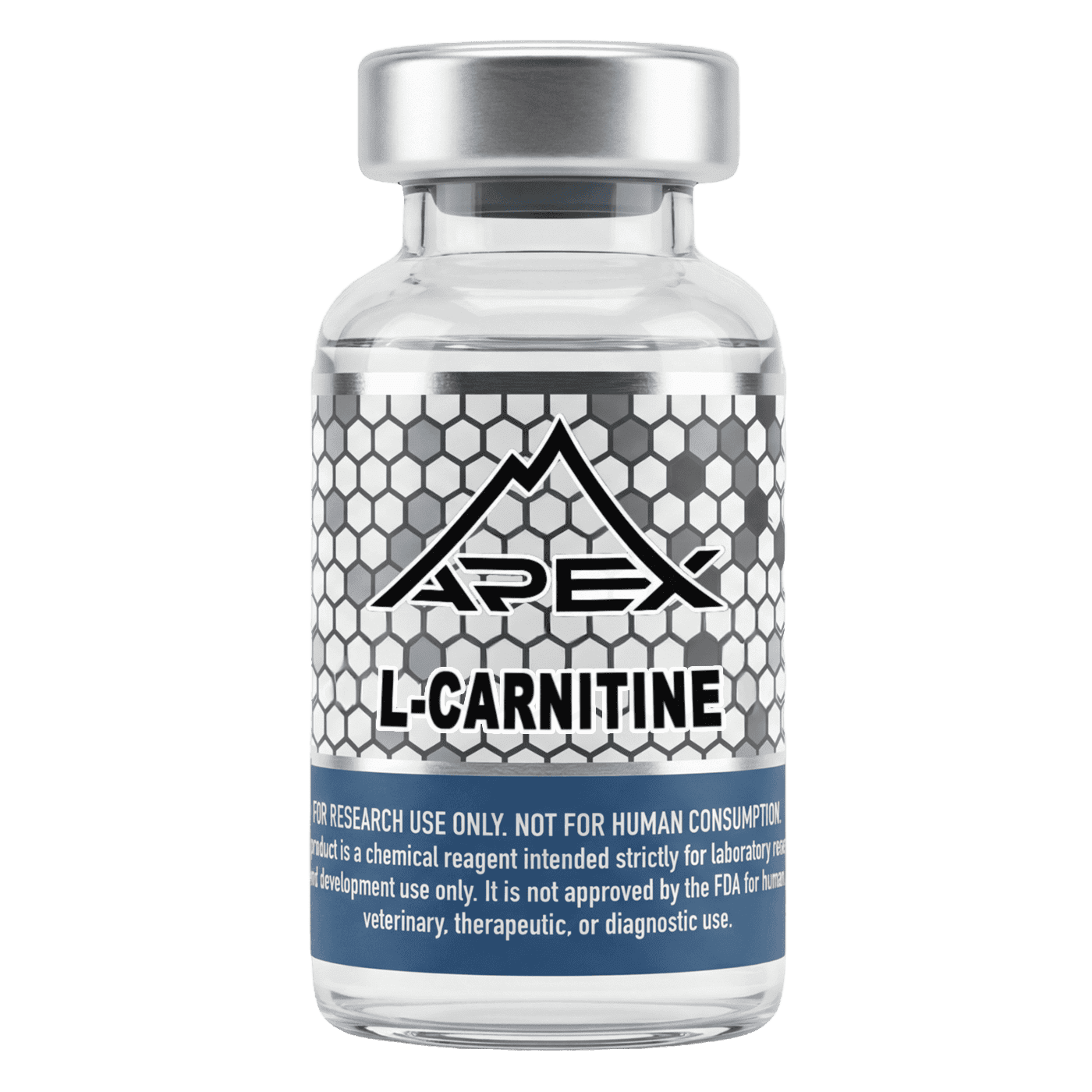
Certificate of Analysis — L-Carnitine 5000mg
Beta-hydroxy quaternary ammonium acid – CAS 541-15-1
Verified by Apex Laboratory in-house HPLC (purity by 220 nm peak area) and ESI mass spectrometry (mass identity confirmation). Data on this page describes the current shipping lot.
- Purity (HPLC, area %): 99.71%
- Mass found (ESI-MS): 161.20 Da
- Mass expected: 161.20 Da
- HPLC retention time: 3.0 min
- Batch ID: APX-2026-0325-L
- Test date: March 25, 2026
- Analyst: K. Norwood
L-Carnitine 5000mg is a research-grade preparation of the endogenous mitochondrial acyl-carrier L-carnitine (CAS 541-15-1), a small zwitterionic beta-hydroxy quaternary ammonium acid central to long-chain fatty acid import. The HPLC chromatogram and mass-spectrometry summary printed above are pulled from the lot currently leaving our shelf — batch APX-2026-0325-L, released at 99.71% purity — not a stock graphic, and no email gate or document request stands between you and the data. Supplied by Apex Laboratory strictly for in-vitro laboratory research and development; not for human consumption, veterinary use, or any therapeutic application.
Compound Overview
L-Carnitine is the biologically active L-enantiomer of 3-hydroxy-4-(trimethylazaniumyl)butanoate, a compact 161.20 g/mol metabolite carrying both a permanently charged trimethylammonium cation and a deprotonated carboxylate — the zwitterion that defines its solubility and chromatographic behaviour. Unlike the large modified peptides catalogued elsewhere in our range, it is a single-stereocentre amino-acid derivative biosynthesised in cells from lysine and methionine. Its defining function in cell-model and tissue research is as the obligatory shuttle substrate of the carnitine palmitoyltransferase system: CPT1 on the outer mitochondrial membrane transfers the long-chain acyl group from acyl-CoA onto carnitine to form acylcarnitine, the carnitine-acylcarnitine translocase (CACT) exchanges it across the inner membrane, and CPT2 regenerates acyl-CoA inside the matrix for beta-oxidation. Without carnitine, long-chain fatty acyl groups cannot cross into the matrix, so the molecule sits at the gateway of mitochondrial lipid fuel oxidation. What distinguishes the L-form from the inactive D-enantiomer and from acyl derivatives such as acetyl-L-carnitine is stereospecific recognition by the CPT enzymes — only L-carnitine is a competent acyl acceptor, which is why enantiomeric purity is a meaningful quality attribute for this reagent.
Research Background & Published Literature
L-Carnitine is among the most thoroughly characterised metabolic cofactors in the literature, with decades of work spanning fatty acid oxidation, mitochondrial bioenergetics, cardiac and skeletal-muscle energy metabolism, and oxidative-stress models. In controlled laboratory settings it is studied as a substrate probe for the CPT1/CPT2 axis, as a modulator of the cellular acyl-CoA/CoA ratio (its role in buffering free coenzyme A is a recurring experimental theme), and as a reference compound in assays of mitochondrial respiratory function and beta-oxidation flux in cultured cells and isolated mitochondria. Its small, polar structure also makes it a frequent analyte in mass-spectrometry method development for acylcarnitine profiling.
Researchers interested in the published literature surrounding this compound can explore the following peer-reviewed resources for additional context on its mechanism of action, transport pathways, and experimental applications in controlled laboratory settings:
- PubMed — L-carnitine, CPT, and fatty acid oxidation literature
- PubChem — L-carnitine chemical and property record
Technical Specifications
| Product Name | L-Carnitine 5000mg |
| Other Names | Levocarnitine; L-3-hydroxy-4-(trimethylammonio)butanoate; (R)-carnitine; vitamin BT |
| Classification | Fatty acid transport cofactor (beta-hydroxy quaternary ammonium acid) |
| CAS Number | 541-15-1 |
| Molecular Formula | C₇H₁₅NO₃ |
| Molecular Weight | 161.20 g/mol |
| Structure | Single-stereocentre zwitterionic amino-acid derivative (L-enantiomer); trimethylammonium + carboxylate |
| Purity Specification | ≥99% (HPLC + MS verified — this lot 99.71%, see chromatogram above) |
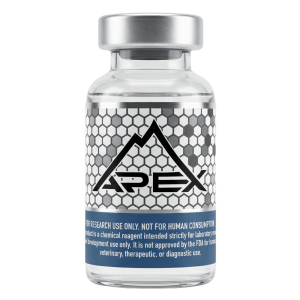
| Physical Form | Research solution (see product label) |
| Recommended Diluent | Highly water-soluble; sterile water or bacteriostatic water for working dilutions |
| Available Size | 5000mg |
| Intended Use | In-vitro research only — not for human consumption |
Storage, Handling & Stability
L-Carnitine is markedly hygroscopic — its quaternary ammonium centre readily pulls moisture from ambient air — so the single largest stability risk in routine handling is water uptake rather than thermal degradation. Keep the container tightly sealed and protected from humidity; refrigerated storage at 2–8°C is appropriate for working stock, and −20°C is suitable for longer-term holding. The compound is freely water-soluble and chemically robust in neutral aqueous buffer, but prepared dilutions should be treated as perishable: aliquot working volumes, label them, and minimise repeated warming.
- Reseal the container immediately after each withdrawal — assume hygroscopic uptake whenever the headspace is open.
- Equilibrate a chilled container to room temperature before opening to prevent condensation on the contents.
- Use freshly prepared aqueous dilutions where assay sensitivity allows; aliquot rather than freeze-thaw a single stock repeatedly.
- Label every aliquot with compound name, concentration, preparation date, and operator initials for complete lot traceability.
- Wear appropriate PPE and follow your institution’s chemical safety protocols at all times.
Quality Assurance & Analytical Verification
Every batch is cleared by a two-method release protocol before it enters inventory: reversed-phase High-Performance Liquid Chromatography to quantify chromatographic purity, and Mass Spectrometry to confirm molecular identity against the expected 161.20 Da. The chromatogram and analytical summary at the top of this page are this lot’s actual release record, not a marketing illustration. For batch APX-2026-0325-L the analyst K. Norwood recorded 99.71% purity at a 3.0-minute retention time, with the observed mass matching the expected 161.20 Da target exactly.
Because L-carnitine is a small, highly polar molecule rather than a large peptide, mass-spectrometry confirmation here rests on a clean single-charge protonated molecular ion ([M+H]⁺ at m/z 162) rather than the multi-charge ESI envelope used for high-molecular-weight peptides — the appropriate identity check for a sub-200 Da analyte. Its strong hydrophilicity is also why it elutes early (3.0 min) on a reversed-phase column. For more on how we read these traces, see our guide on HPLC and mass-spectrometry purity verification and how to read a Certificate of Analysis. Historical lot reports are available on request through our contact page, and current COAs are archived in Lab Verified.
Frequently Asked Questions
Why does L-Carnitine elute so early on the HPLC trace?
At a 3.0-minute retention time, L-carnitine is one of the earliest-eluting compounds in our catalogue. That is a direct consequence of its zwitterionic, highly water-soluble structure: a permanently charged trimethylammonium group paired with a carboxylate gives it very little affinity for the hydrophobic stationary phase, so it is carried through quickly in reversed-phase separation — the opposite behaviour of a lipidated peptide that lingers late on the column.
What is the difference between L-Carnitine and acetyl-L-carnitine?
This product is the free L-carnitine zwitterion (CAS 541-15-1, 161.20 g/mol). Acetyl-L-carnitine is the acetylated ester, a distinct compound with a higher molecular weight and different physicochemical and transport properties. The CPT enzymes that load and unload acyl groups act stereospecifically on the L-form, which is why enantiomeric and chemical identity are verified for this reagent rather than assumed.
What is the primary research application of this compound?
In controlled in-vitro systems it is used as a substrate and probe for the carnitine shuttle (CPT1/CACT/CPT2), in studies of mitochondrial beta-oxidation flux and bioenergetics in cultured cells and isolated mitochondria, in acyl-CoA/CoA buffering experiments, and as a reference analyte in mass-spectrometry method development for acylcarnitine profiling. All such work is laboratory- and model-based.
How should L-Carnitine be reconstituted or diluted for laboratory use?
The compound is freely water-soluble, so sterile water or bacteriostatic water makes a straightforward diluent for preparing working concentrations in neutral aqueous buffer. Because it is hygroscopic, weigh or measure quickly and reseal the container promptly to avoid moisture-driven mass error in your stock calculations.
Is this product approved for human use?
No. All compounds sold by Apex Laboratory are classified as chemical research reagents intended strictly for in-vitro laboratory research. They are not approved for human consumption, veterinary use, or any therapeutic application, and this material is supplied solely as a research reagent — not as a supplement, food, or drug. Purchasers who imply intended bodily use will have their orders cancelled and their accounts permanently suspended.
What documentation ships with each batch?
Each lot is backed by a Certificate of Analysis reporting HPLC purity and mass-spectrometry identity. The data for the current shipping batch is published at the top of this page; you can also view current COAs in our Lab Verified archive or request a specific lot record through our contact page.
Related Research Compounds
Researchers studying mitochondrial bioenergetics and cellular energy-metabolism pathways may also be interested in related cofactor reagents from Apex Laboratory: NAD+ as a central redox and electron-transport coenzyme for respiratory-chain and sirtuin studies, Glutathione as a thiol redox-buffer reagent for oxidative-stress models, and Vitamin B12 1mg as a one-carbon and methylmalonyl-CoA pathway cofactor. Browse the complete Apex Laboratory research catalog to see all available reagents and solutions, or read about our verification process on the About page.
Shipping, Packaging & Delivery
Orders confirmed before 2:00 PM Eastern Time on a business day go out the same day through tracked US domestic carriers. Each L-Carnitine order is packed in protective, appropriately conditioned packaging to keep the material stable in transit, and because the compound is hygroscopic we recommend moving it into sealed, humidity-controlled storage as soon as it arrives. Need a coordinated delivery window for a time-boxed protocol? Let our support team know in advance and we will line up the timing with your bench schedule.
Research Use Disclaimer
For in-vitro research use only. Not for human consumption. All products sold by Apex Laboratory — including L-Carnitine 5000mg — are intended exclusively for qualified researchers, accredited laboratories, and educational institutions. This material is supplied as a chemical research reagent only and is not a dietary supplement, food, cosmetic, or drug. Purchasers assume full responsibility for safe handling, proper storage, and compliance with all applicable federal, state, and local laws, regulations, and institutional policies governing the purchase and use of chemical research reagents.

Reviews
There are no reviews yet.