
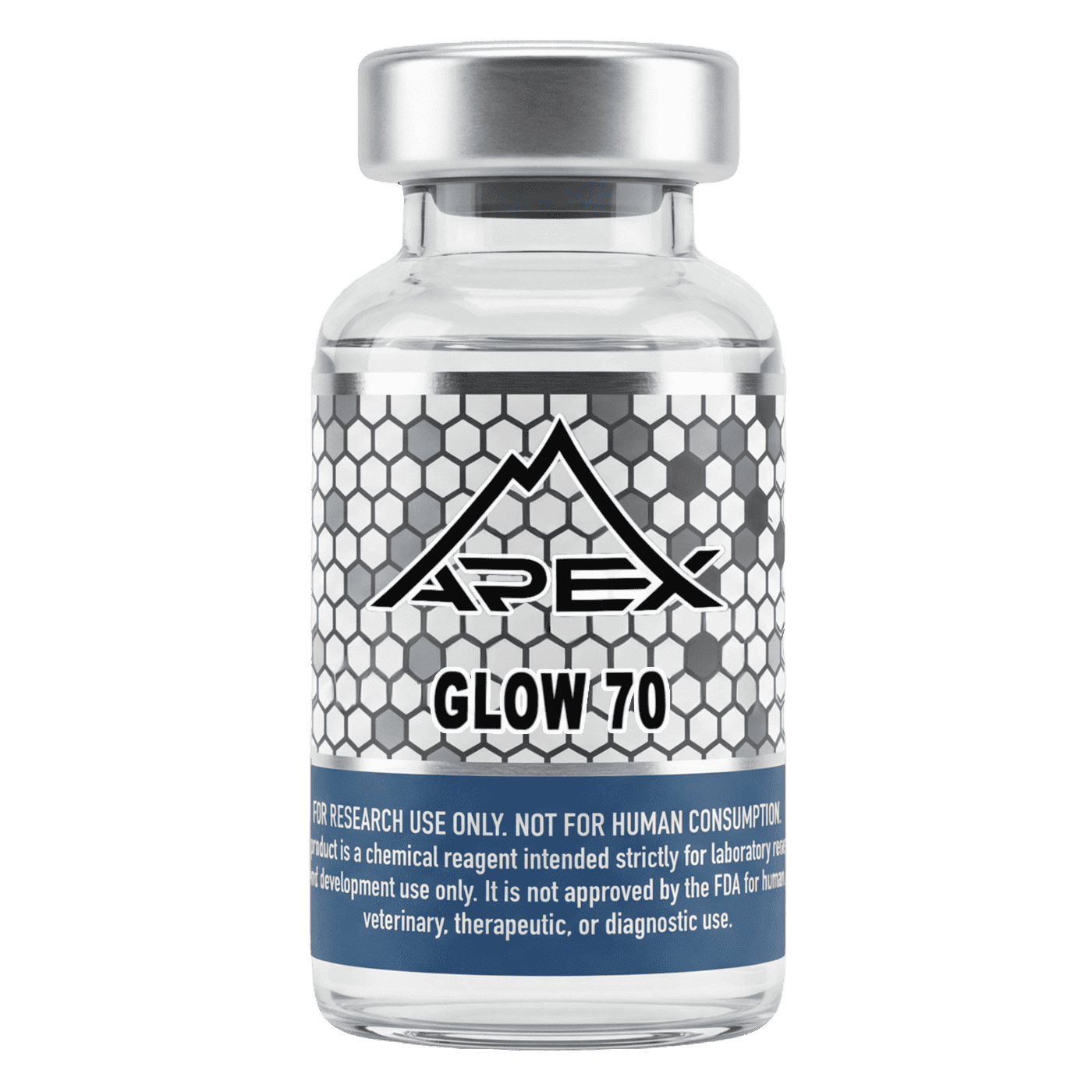
Certificate of Analysis — Glow Blend 70mg
Multi-component research blend · 3 peptides · 5:1:1 ratio
Verified by Apex Laboratory in-house HPLC (purity by 220 nm peak area) and ESI mass spectrometry (mass identity confirmation). Data on this page describes the current shipping lot.
- Purity (HPLC, area %): 99.53%
- Batch ID: APX-2026-0426-G
- Test date: April 26, 2026
- Analyst: K. Norwood
- Components: GHK-Cu (50mg), 99.56% pure; BPC-157 (10mg), 99.58% pure; TB-500 (10mg), 99.60% pure
View Glow Blend 70mg on the Lab Verified COA archive · Read the Glow Blend Research Guide
GLOW Blend 70mg — Three-Peptide Research Reagent
GLOW Blend 70mg is a single-vial research reagent that co-formulates three of the most frequently studied tissue-research peptides — GHK-Cu, BPC-157, and TB-500 — at a fixed 50 : 10 : 10 milligram ratio (a 5:1:1 mass ratio), 70 mg of total peptide material. It is supplied as a lyophilized white powder for in-vitro and preclinical laboratory research only. The reason a laboratory selects a co-formulated blend over three separate vials is procedural: when these compounds are compared in the same assay, a single reconstitution holds the component ratio constant lot to lot, removes three-way pipetting error from the preparation step, and consolidates documentation into one Certificate of Analysis. GLOW exists for research groups that want that consistency without assembling the ratio by hand each time.
Component Research Context
GHK-Cu (Copper Tripeptide, 50 mg)
GHK-Cu is a naturally occurring copper-binding tripeptide — glycyl-L-histidyl-L-lysine complexed with copper(II) — with a molecular weight of 401.91 g/mol. In the research literature it is studied as a model copper-transport ligand and as a subject in gene-expression and extracellular-matrix remodeling assays, where its small size and defined copper coordination make it a useful reference molecule. As the dominant component of GLOW by mass, GHK-Cu anchors the concentration math for the whole vial: once a researcher fixes the reconstitution volume against the 50 mg GHK-Cu fraction, the BPC-157 and TB-500 concentrations follow from the ratio. Apex supplies it verified by reverse-phase HPLC for purity and mass spectrometry for identity.
BPC-157 (Pentadecapeptide, 10 mg)
BPC-157 is a synthetic 15-amino-acid peptide (MW 1419.53 g/mol) whose sequence corresponds to a partial fragment of a human gastric protein. It is among the most frequently referenced peptides in preclinical and in-vitro angiogenesis and cytoprotection research, which is precisely why it is a common subject in laboratory method development and assay calibration. Within GLOW it is co-formulated at 10 mg alongside an equal mass of TB-500, the peptide it is most often studied next to, so the two tissue-research compounds come from one solution.
TB-500 (Thymosin β4 Fragment, 10 mg)
TB-500 is a synthetic peptide related to thymosin β4, an actin-binding protein, with a molecular weight of 4963.50 g/mol — by far the largest of the three components. In the literature it is investigated in vitro for actin sequestration and cell-migration models. Its large, distinct molecular weight is also what makes it trivial to resolve from the other two components on a chromatogram, so its purity can be reported independently on the Certificate of Analysis even though it ships co-formulated.
Why This 5:1:1 Ratio
The blend fixes GHK-Cu as the dominant component at 50 mg with BPC-157 and TB-500 each at 10 mg. Holding the ratio constant means that once a researcher establishes a reconstitution volume, every subsequent vial delivers the same relative concentrations — a precondition for reproducibility across a multi-run study. Because the three components have widely separated molecular weights (401.91, 1419.53, and 4963.50 g/mol) and distinct HPLC retention times (approximately 3.4, 12.0, and 16.2 minutes on the reference method), they remain individually resolvable even when co-formulated, which is what allows the per-component purity figures shown on the Certificate of Analysis at the top of this page.
Research Workflow Notes
Groups working with GLOW typically treat the 50 mg GHK-Cu fraction as the concentration anchor and read the two 10 mg fractions off the same dilution. Because the blend is a fixed ratio, scaling a protocol up or down is a single calculation rather than three. The reconstitution calculator on this site carries GLOW as a one-click preset, so the per-component concentrations and milligrams-per-syringe-unit are returned automatically for whatever bacteriostatic-water volume the protocol specifies.
Identity & Purity Verification
Every Apex GLOW lot is analyzed by reverse-phase HPLC for purity and by mass spectrometry for identity, with each of the three components resolved as a separate chromatographic peak at its own retention time. The interactive Certificate of Analysis above shows the batch number, test date, per-component purity, and combined purity for the exact lot shipped; you can cross-reference it against the third-party records on the Lab Verified hub. This is identity and quality documentation only and carries no use, dose, or efficacy representation.
Cost & Convenience vs. Buying Components Separately
| Approach | What you get | Price |
|---|---|---|
| GHK-Cu 50 mg (single) | 1 component | $36 |
| BPC-157 10 mg (single) | 1 component | $58 |
| TB-500 10 mg (single) | 1 component | $89 |
| Three components separately | 3 vials, manual ratio matching | $183 |
| GLOW Blend 70 mg | 1 vial, ratio pre-matched | $114 |
Sourcing the same three compounds individually costs $183 across three vials and leaves the researcher to match the ratio manually at reconstitution. The co-formulated blend is $114 — roughly a 38% reduction — in a single lot with one Certificate of Analysis and one reconstitution step.
Reconstitution, Storage & Handling
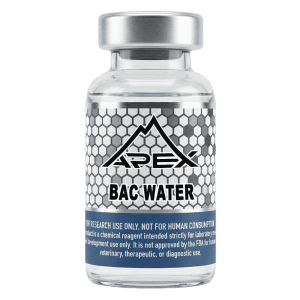
Store the lyophilized GLOW vial at -20 °C, protected from light and moisture, until reconstituted for research. Add bacteriostatic water and compute concentration with the peptide reconstitution calculator — GLOW is a built-in preset that returns per-component concentration at your chosen dilution. The reconstitution guide covers technique and the storage guide covers post-reconstitution shelf-life by handling condition. Reconstituted solution is typically held at 2-8 °C for short-term research use. All handling is the responsibility of the qualified purchaser.
Selecting GLOW for a Research Program
GLOW suits work that compares or co-studies GHK-Cu, BPC-157, and TB-500 and benefits from a fixed, reproducible ratio across runs. Because the three components span copper-transport, angiogenesis, and actin-regulation research, GLOW functions as a compact three-pathway tissue-research reagent. If a protocol additionally needs the α-MSH fragment KPV, the four-component KLOW blend is the corresponding reagent; if it does not, GLOW avoids paying for a component the work will not use. Either way the choice is about which research pathways the experiment covers, not about strength.
Documentation & Batch Records
Each lot ships with a batch identifier printed on the vial that matches the batch shown on the Certificate of Analysis, so a research record can be traced to the exact tested material. The certificate records the test date and the analyst, the per-component retention times and purity, and the combined purity for the lot. Apex retains these records and publishes them on the Lab Verified hub so a reviewer, collaborator, or auditor can confirm a batch independently rather than taking a supplier figure on trust. For research groups operating under documented quality procedures, this per-lot traceability is often the deciding factor in selecting a co-formulated reagent: one certificate covers every component in the vial.
Frequently Asked Questions
What exactly is in GLOW Blend 70mg?
One lyophilized vial containing GHK-Cu (50 mg), BPC-157 (10 mg), and TB-500 (10 mg) — 70 mg of total peptide material at a 5:1:1 mass ratio. Per-component identity and purity are documented on the Certificate of Analysis.
How is GLOW different from KLOW?
GLOW is the three-peptide blend. KLOW is the four-peptide blend — it adds KPV (10 mg), a tripeptide studied in a separate inflammatory-pathway research area. If your work does not involve the KPV component, GLOW is the corresponding reagent at a lower cost.
Can each component be verified independently?
Yes. The three peptides have widely different molecular weights and HPLC retention times, so each resolves as its own peak. The Certificate of Analysis reports purity per component plus a combined figure for the lot.
How should the blend be reconstituted for research?
Add bacteriostatic water and calculate concentration with the reconstitution calculator, which carries GLOW as a preset and returns per-component concentrations. Store lyophilized at -20 °C; hold reconstituted solution at 2-8 °C for short-term research use.
Why is GHK-Cu the largest fraction?
At 50 mg it serves as the concentration anchor for the vial, and it is the smallest molecule by weight, so it sets a convenient reference point for the reconstitution math from which the two 10 mg fractions follow.
Is this product for human use?
No. GLOW Blend 70mg is a research reagent for in-vitro and laboratory use only and is not for human or veterinary consumption.
For in-vitro research use only. Not for human or veterinary consumption. Glow Blend 70mg is intended exclusively for qualified researchers, accredited laboratories, and educational institutions. Purchasers are responsible for safe handling, storage, and compliance with applicable federal, state, local, and institutional requirements governing chemical research reagents.

Reviews
There are no reviews yet.