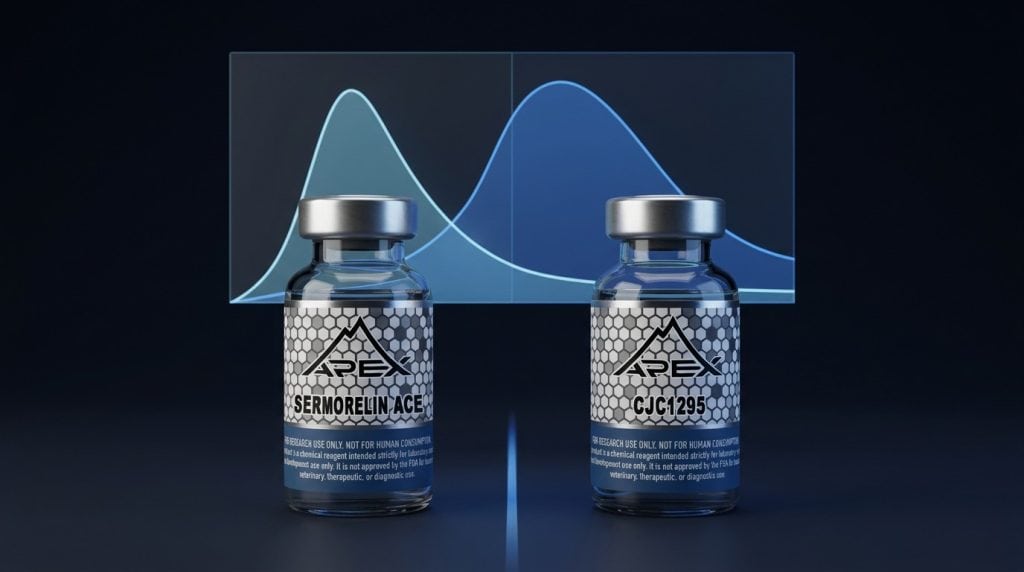
Sermorelin and CJC-1295 are both synthetic analogs of growth-hormone-releasing hormone (GHRH 1-29) that act on the pituitary GHRH receptor to stimulate growth-hormone release, and they are most usefully distinguished by their duration of action. Sermorelin is short-acting, delivering brief, pulse-like stimulation, whereas CJC-1295 — especially its albumin-binding Drug Affinity Complex (DAC) form — produces a sustained, multi-day elevation of growth hormone and IGF-1.
Sermorelin and CJC-1295 are the two most-studied synthetic GHRH analogs in growth-hormone research, and they are often discussed together because they share a receptor target but solve the same engineering problem in different ways. Native GHRH is destroyed in the bloodstream within minutes by the enzyme dipeptidyl peptidase IV (DPP-IV); Sermorelin accepts that short duration, while CJC-1295 is specifically engineered to overcome it.[1][2] This comparison guide sets the two side by side — structure, mechanism, half-life, secretion pattern, and regulatory history — so the right reagent can be matched to the right research question.
It covers both compounds’ identity and mechanism, a direct head-to-head comparison, their study in combination with ghrelin-receptor agonists, and how they sit within the Apex growth-hormone-axis research cluster of the Apex Research Library. For single-compound depth, see the Sermorelin research guide and the CJC-1295 research guide. Every factual claim is referenced to the primary literature, and both peptides are supplied strictly as research-grade chemical reagents for in-vitro and preclinical investigation — not drugs or therapies for human or veterinary use.
Sermorelin vs CJC-1295 at a Glance
- Both are GHRH-receptor agonists built on the GHRH(1-29) sequence — the shortest fully active fragment of growth-hormone-releasing hormone.
- Sermorelin is GHRH(1-29)NH2 (CAS 86168-78-7, MW ~3,357.9 g/mol); it is short-acting because DPP-IV cleaves it rapidly.
- CJC-1295 is a tetrasubstituted GHRH(1-29) that resists DPP-IV; its with-DAC form (CAS 446262-90-4) binds albumin for a ~5.8–8.1-day half-life, while its no-DAC form (Mod GRF 1-29, CAS 863288-34-0) is short-acting.
- The core contrast is pulsatile versus sustained: Sermorelin gives brief, pulse-like GH stimulation; CJC-1295 with DAC gives sustained, days-long elevation.
- Sermorelin was the FDA-approved drug Geref (NDA 19-863 in December 1990 and NDA 20-443 on September 26, 1997; discontinued in 2008 for commercial, not safety, reasons); CJC-1295 has never been an approved drug.
- Apex supplies both strictly as ≥99% (HPLC + MS verified) research reagents for in-vitro and preclinical use only.
Sermorelin & CJC-1295
Two GHRH Analogs, One Receptor
Both peptides act on the same target: the GHRH receptor, a pituitary-specific G-protein-coupled receptor on somatotroph cells that signals predominantly through cAMP to stimulate growth-hormone synthesis and release.[1][3] That growth-hormone output then drives hepatic IGF-1, within the GHRH–somatostatin–GH–IGF-1 feedback axis that governs the system.[4] Because Sermorelin and CJC-1295 engage the identical receptor, their differences are not about what they do but about how long they do it — and that single difference, duration, cascades into different secretion patterns and different research uses.
Same receptor, opposite duration strategies
Sermorelin is native GHRH(1-29) chemistry: fully active but rapidly cleaved by DPP-IV, so it gives a brief, pulse-like stimulus that mirrors the body’s own GHRH pulses. CJC-1295 is the engineering answer to that brevity: four substitutions block DPP-IV cleavage, and in the with-DAC form an albumin-binding group stretches the half-life to days, converting the pulse into a sustained signal. Whether pulsatile or sustained stimulation is preferable is itself an active research question, addressed below. All findings are from cell, animal, and human-research settings.
Sermorelin: GHRH(1-29) and the Geref History
Identity: the Minimal Active GHRH Fragment
Sermorelin is GHRH(1-29)NH2 — the first 29 amino acids of growth-hormone-releasing hormone, amidated at the C-terminus. Grossman and colleagues established that this fragment is the minimal sequence retaining full GHRH biological activity, equipotent with longer forms,[5] and Esposito and colleagues describe Sermorelin as synthetic GRF(1-29) identical to the N-terminal 29 residues of the native hormone, retaining bioactivity.[6] Its CAS number is 86168-78-7 and its molecular weight is about 3,357.9 g/mol (PubChem CID 16132413).
GH Stimulation and Diagnostic Use
Because it faithfully reproduces GHRH activity, Sermorelin has a long research and clinical-diagnostic history. GHRH(1-29)NH2 was used as an acute growth-hormone-provocation test for GH deficiency,[7] and twice-daily subcutaneous administration was shown to stimulate GH release and improve height velocity in GH-deficient children.[8] More recent description characterizes Sermorelin as a GH secretagogue that raises IGF-1, with a short half-life that necessitated frequent dosing in its clinical use.[9]
The Geref FDA History
Sermorelin’s regulatory history sets it apart from CJC-1295. It was approved by the FDA as the drug Geref, under New Drug Application 19-863 in December 1990 and a second application, NDA 20-443, on September 26, 1997, and was used both diagnostically and therapeutically for growth-hormone deficiency. Geref was discontinued from the U.S. market in 2008 — a commercial decision by the manufacturer, not a withdrawal for safety reasons. This means Sermorelin is a molecule with an established regulatory and safety record as a former approved drug, a status CJC-1295 has never held.
DPP-4 Degradation: Why Sermorelin Is Short-Acting
The limitation that defines Sermorelin is enzymatic. Dipeptidyl peptidase IV (DPP-4) inactivates native GHRH by cleaving its N-terminal dipeptide,[10] and Sermorelin (GRF 1-29) is degraded by DPP-IV to the inactive GRF(3-29) fragment.[11] The cleavage occurs at the position-2 bond, and substitution at that position dramatically slows it[12] — which is precisely the modification CJC-1295 makes.
CJC-1295: Engineered for Duration
CJC-1295 takes the GHRH(1-29) backbone and re-engineers it against degradation. It carries four amino-acid substitutions that confer protease resistance, and its long-acting form adds a Drug Affinity Complex: Jétté and colleagues described CJC-1295 as a tetrasubstituted hGRF(1-29) bearing a maleimidopropionamide-lysine group that covalently binds endogenous albumin, dramatically extending circulation time.[13] Teichman and colleagues then measured the consequence in humans — a half-life of roughly 5.8 to 8.1 days and sustained, days-long elevation of growth hormone and IGF-I.[2] The no-DAC form (Modified GRF 1-29) shares the protease resistance but, lacking the albumin anchor, remains short-acting — functionally closer to Sermorelin in duration.
Head-to-Head: Sermorelin vs CJC-1295
Sermorelin vs CJC-1295 (no-DAC and with-DAC)
| Attribute | Sermorelin | CJC-1295 (no DAC) | CJC-1295 (with DAC) |
|---|---|---|---|
| Sequence | GHRH(1-29)NH2 (native) | Tetrasubstituted GHRH(1-29) | Tetrasubstituted GHRH(1-29) + DAC |
| CAS | 86168-78-7 | 863288-34-0 | 446262-90-4 |
| DPP-IV resistance | No (rapidly cleaved) | Yes | Yes |
| Half-life | Minutes | Short | ~5.8–8.1 days |
| GH-release pattern | Brief, pulse-like | Pulse-like | Sustained, days-long |
| Regulatory status | Former FDA drug (Geref) | Research-only | Research-only |
Pulsatile vs Sustained Stimulation
The deepest difference between these reagents is not potency but pattern, and the research literature does not treat “longer” as automatically “better.” Discrete, pulsatile growth-hormone peaks — the pattern a short-acting GHRH analog like Sermorelin produces — are what physiologically drive growth and IGF-1 generation,[14] and pulsatile rather than continuous GHRH exposure is what induces pituitary GH messenger RNA and replenishes GH stores.[15] A long-acting agent like CJC-1295 with DAC produces a fundamentally different, sustained exposure. This is why the choice between them is a genuine experimental design decision: Sermorelin and no-DAC CJC-1295 model the body’s pulsatile signaling, while DAC CJC-1295 models continuous stimulation.
Combination Research and Related Analogs
Pairing With a Ghrelin-Receptor Agonist
Both GHRH analogs are studied in combination with a ghrelin-receptor agonist, because the GHRH and ghrelin pathways are complementary. The GHRH receptor signals through cAMP while the ghrelin/GH-secretagogue receptor signals through phospholipase-C/calcium, and co-activating the two potentiates the growth-hormone response roughly two-fold over either alone.[16][17] The selective ghrelin-receptor agonist ipamorelin is the most common partner,[18] which is why GHRH-analog-plus-ipamorelin pairings are a staple of growth-hormone-axis research; see the Ipamorelin research guide.
A Related Analog: Tesamorelin
A third GHRH analog rounds out the class. Tesamorelin is a stabilized GHRH(1-44) analog that, in a pivotal randomized trial, significantly reduced visceral adipose tissue and raised IGF-1,[19] and it is the first and only agent approved (as Egrifta) for reducing excess visceral fat in HIV-associated lipodystrophy.[20][21] Tesamorelin’s approval makes it a useful comparator for how a GHRH analog can reach a defined clinical endpoint; the Tesamorelin vs Sermorelin comparison covers that contrast.
Stability, Handling, and Reconstitution (Research Use)
The guidance below concerns laboratory handling of Sermorelin and CJC-1295 as research reagents. Nothing here is a human dosing, administration, or usage instruction; both are for in-vitro and preclinical research only.
Lyophilized Storage
Store both lyophilized peptides at −20°C, protected from light and moisture; well-stored lyophilized material is expected to remain stable over extended periods. See the Apex peptide storage guide.
Reconstitution
Both dissolve in bacteriostatic water for laboratory preparation. Researchers planning in-vitro concentrations can use the Apex reconstitution calculator and the how to reconstitute peptides protocol; reconstituted solution is held at 2–8°C with freeze-thaw cycling minimized. These tools support laboratory work and contain no human-use directions.
Identity and Purity Verification (COA, HPLC, MS)
Because Sermorelin and the two CJC-1295 forms are similar-sized GHRH-backbone peptides, mass spectrometry is the decisive way to tell them apart and confirm which reagent is in hand. Apex supplies all as ≥99%-purity material, verified by reversed-phase HPLC and mass spectrometry, with per-lot certificates of analysis through the lab-verified COA archive; see the primers on how to read a certificate of analysis and HPLC testing for peptide purity.
Regulatory Status
Sermorelin was formerly an FDA-approved drug (Geref, discontinued in 2008 for commercial reasons) but the research-grade reagent supplied here is for laboratory use only; CJC-1295 has never been an approved drug. Growth-hormone-axis peptides are monitored in anti-doping control. Apex supplies both strictly as research-grade chemical reagents for in-vitro and preclinical laboratory work, not for human or veterinary use.
Sourcing Research-Grade Sermorelin & CJC-1295
For GHRH-receptor and growth-hormone-axis research, both peptides should be sourced as documented research-grade material with identity — and, for CJC-1295, the specific form — confirmed by mass spectrometry. Apex supplies Sermorelin and both forms of CJC-1295 as ≥99%-pure lyophilized peptides, HPLC- and MS-verified, for in-vitro and preclinical use only.
Sermorelin (GHRH 1-29)
Research-grade GHRH(1-29)NH2 — the minimal fully active GHRH fragment — verified to ≥99% purity by HPLC and mass spectrometry, with a per-lot certificate of analysis. Supplied strictly for in-vitro and preclinical research.
View Sermorelin →
CJC-1295 (No DAC & With DAC)
Research-grade tetrasubstituted GHRH(1-29) analog, available short-acting (no DAC / Mod GRF 1-29) and long-acting (with DAC), verified to ≥99% purity by HPLC and mass spectrometry. Supplied strictly for in-vitro and preclinical research.
View CJC-1295 →Frequently Asked Questions
What is the difference between Sermorelin and CJC-1295?
Both are synthetic GHRH(1-29) analogs that stimulate the same pituitary GHRH receptor, but they differ in duration. Sermorelin is native GHRH(1-29) chemistry and is rapidly cleaved by the enzyme DPP-IV, so it is short-acting and gives brief, pulse-like growth-hormone stimulation. CJC-1295 carries four substitutions that resist that cleavage, and its with-DAC form binds albumin for a multi-day half-life and sustained elevation. Both are supplied by Apex as research-grade reagents for laboratory use only.
Is Sermorelin or CJC-1295 longer-acting?
CJC-1295 is longer-acting, especially its with-DAC form, which had a measured half-life of roughly 5.8 to 8.1 days in human study and produced days-long elevation of growth hormone and IGF-1 (Teichman 2006). Sermorelin is short-acting, with a half-life of minutes because DPP-IV rapidly degrades it (Sigalos 2017). The no-DAC form of CJC-1295 is also short-acting, closer to Sermorelin in duration.
Do Sermorelin and CJC-1295 work through the same receptor?
Yes. Both act as agonists at the GHRH receptor, a pituitary-specific G-protein-coupled receptor on somatotroph cells that signals through cAMP to stimulate growth-hormone release (Mayo 1992; Mayo 2000). Their mechanism at the receptor is the same; what differs is how long each one occupies and stimulates that receptor, which determines the growth-hormone secretion pattern.
Why is pulsatile GH release considered important?
Research indicates the pattern of growth-hormone release matters, not just the amount. Discrete, pulsatile GH peaks are what physiologically drive growth and IGF-1 generation (Veldhuis 2001), and pulsatile rather than continuous GHRH exposure is what induces pituitary GH messenger RNA and replenishes GH stores (Borski 2000). This is why a short-acting, pulse-like agent (Sermorelin or no-DAC CJC-1295) and a sustained agent (with-DAC CJC-1295) model genuinely different research scenarios.
Was Sermorelin ever an FDA-approved drug?
Yes. Sermorelin was approved by the FDA as the drug Geref, under New Drug Application 19-863 in December 1990 and a second application, NDA 20-443, on September 26, 1997, and was used for growth-hormone deficiency including as a diagnostic provocation test. Geref was discontinued from the U.S. market in 2008 for commercial reasons rather than safety concerns. CJC-1295, by contrast, has never been an FDA-approved drug. The Apex research-grade Sermorelin is for laboratory use only.
What does the DAC in CJC-1295 do, and does Sermorelin have it?
The Drug Affinity Complex (DAC) is a maleimidopropionyl group on CJC-1295 that covalently binds circulating serum albumin, which dramatically extends the peptide's half-life (Jette 2005). Sermorelin has no such modification, which is one reason it is short-acting. CJC-1295 is available both with DAC (long-acting) and without DAC (Modified GRF 1-29, short-acting); only the with-DAC form carries the albumin-binding group.
Are Sermorelin and CJC-1295 used with ipamorelin?
Both GHRH analogs are commonly studied alongside the ghrelin-receptor agonist ipamorelin, because the GHRH receptor (cAMP) and the ghrelin/GH-secretagogue receptor (calcium pathway) are complementary; co-activating them potentiates the growth-hormone response roughly two-fold over either alone (Cunha 2002; Devesa 2021). The pairing of a GHRH analog with ipamorelin is a staple of growth-hormone-axis research.
Which is better, Sermorelin or CJC-1295?
Neither is universally better; they model different research scenarios, and the right choice depends on the experimental question. Sermorelin and no-DAC CJC-1295 reproduce the body's brief, pulsatile GHRH signaling, while with-DAC CJC-1295 provides sustained, continuous stimulation. Sermorelin additionally has an established former-approved-drug record. Because both are research reagents, the comparison is about experimental design, not therapeutic preference.
What are the molecular weights of Sermorelin and CJC-1295?
Sermorelin (GHRH(1-29)NH2) has a molecular weight of about 3,357.9 g/mol (CAS 86168-78-7, PubChem CID 16132413). CJC-1295 without DAC (Modified GRF 1-29) is about 3,367.9 g/mol (CAS 863288-34-0), and CJC-1295 with DAC is about 3,647.2 g/mol (CAS 446262-90-4), the higher value reflecting the added Drug Affinity Complex. Mass spectrometry distinguishes all three.
How are Sermorelin and CJC-1295 stored and reconstituted for research?
Both lyophilized peptides are stored at minus 20 degrees Celsius, protected from light and moisture. For laboratory use they dissolve in bacteriostatic water; reconstituted material is held at 2 to 8 degrees Celsius with freeze-thaw cycling minimized, and longer-term aliquots are frozen at minus 20 degrees Celsius. These are laboratory-handling conventions only and are not a human dosing or administration instruction.
How is the purity of research-grade Sermorelin and CJC-1295 verified?
Both are characterized by reversed-phase HPLC, which quantifies purity by separating the intended peptide from synthesis byproducts, and by mass spectrometry, which confirms identity and tells apart Sermorelin and the two CJC-1295 forms by their distinct masses. Apex supplies all at greater-than-or-equal-to 99 percent purity with per-lot certificates of analysis available through its lab-verified archive.
Continue Your Research
Related Growth-Hormone-Axis Research Guides
Growth-Hormone-Axis Research Peptides
The cluster hub situating Sermorelin and CJC-1295 among GHRH analogs and secretagogues.
Open HubSermorelin Research Guide
Single-compound depth on the GHRH(1-29) analog and its former approved-drug history.
Read GuideCJC-1295 Research Guide
Single-compound depth on the DAC vs no-DAC forms and the albumin-binding mechanism.
Read GuideTesamorelin vs Sermorelin
A comparison extending the GHRH-analog class to the approved agent tesamorelin.
CompareReferences
All citations were verified against the published record via the NCBI E-utilities API for existence, correct attribution, and support of the associated claim. Each links to its PubMed record.
- Mayo KE Molecular cloning and expression of a pituitary-specific receptor for growth hormone-releasing hormone. Mol Endocrinol. 1992;6(10):1734-44. PMID: 1333056
- Teichman SL, Neale A, Lawrence B, Gagnon C, Castaigne JP, Frohman LA Prolonged stimulation of growth hormone (GH) and insulin-like growth factor I secretion by CJC-1295, a long-acting analog of GH-releasing hormone, in healthy adults. J Clin Endocrinol Metab. 2006;91(3):799-805. PMID: 16352683
- Mayo KE, Miller T, DeAlmeida V, Godfrey P, Zheng J, Cunha SR Regulation of the pituitary somatotroph cell by GHRH and its receptor. Recent Prog Horm Res. 2000;55:237-66; discussion 266-7. PMID: 11036940
- Giustina A, Veldhuis JD Pathophysiology of the neuroregulation of growth hormone secretion in experimental animals and the human. Endocr Rev. 1998;19(6):717-97. PMID: 9861545
- Grossman A, Savage MO, Lytras N, Preece MA, Sueiras-Diaz J, Coy DH, et al. Responses to analogues of growth hormone-releasing hormone in normal subjects, and in growth-hormone deficient children and young adults. Clin Endocrinol (Oxf). 1984;21(3):321-30. PMID: 6236914
- Esposito P, Barbero L, Caccia P, Caliceti P, D’Antonio M, Piquet G, et al. PEGylation of growth hormone-releasing hormone (GRF) analogues. Adv Drug Deliv Rev. 2003;55(10):1279-91. PMID: 14499707
- Grossman A, Savage MO, Blacklay A, Ross RM, Plowman PN, Preece MA, et al. The use of growth hormone-releasing hormone in the diagnosis and treatment of short stature. Horm Res. 1985;22(1-2):52-7. PMID: 2863206
- Ross RJ, Rodda C, Tsagarakis S, Davies PS, Grossman A, Rees LH, et al. Treatment of growth-hormone deficiency with growth-hormone-releasing hormone. Lancet. 1987;1(8523):5-8. PMID: 2879138
- Sigalos JT, Pastuszak AW, Allison A, Ohlander SJ, Herati A, Lindgren MC, et al. Growth Hormone Secretagogue Treatment in Hypogonadal Men Raises Serum Insulin-Like Growth Factor-1 Levels. Am J Mens Health. 2017;11(6):1752-1757. PMID: 28830317
- Mentlein R Dipeptidyl-peptidase IV (CD26)–role in the inactivation of regulatory peptides. Regul Pept. 1999;85(1):9-24. PMID: 10588446
- Bai JP, Chang LL The involvement of dipeptidyl peptidase IV in brush-border degradation of GRF(1-29)NH2 by intestinal mucosal cells. J Pharm Pharmacol. 1995;47(8):698-701. PMID: 8583376
- Martin RA, Cleary DL, Guido DM, Zurcher-Neely HA, Kubiak TM Dipeptidyl peptidase IV (DPP-IV) from pig kidney cleaves analogs of bovine growth hormone-releasing factor (bGRF) modified at position 2 with Ser, Thr or Val. Extended DPP-IV substrate specificity?. Biochim Biophys Acta. 1993;1164(3):252-60. PMID: 8102071
- Jetté L, Léger R, Thibaudeau K, Benquet C, Robitaille M, Pellerin I, et al. Human growth hormone-releasing factor (hGRF)1-29-albumin bioconjugates activate the GRF receptor on the anterior pituitary in rats: identification of CJC-1295 as a long-lasting GRF analog. Endocrinology. 2005;146(7):3052-8. PMID: 15817669
- Veldhuis JD, Anderson SM, Shah N, Bray M, Vick T, Gentili A, et al. Neurophysiological regulation and target-tissue impact of the pulsatile mode of growth hormone secretion in the human. Growth Horm IGF Res. 2001;11 Suppl A:S25-37. PMID: 11527085
- Borski RJ, Tsai W, Demott-Friberg R, Barkan AL Induction of growth hormone (GH) mRNA by pulsatile GH-releasing hormone in rats is pattern specific. Am J Physiol Endocrinol Metab. 2000;278(5):E885-91. PMID: 10780945
- Cunha SR, Mayo KE Ghrelin and growth hormone (GH) secretagogues potentiate GH-releasing hormone (GHRH)-induced cyclic adenosine 3′,5′-monophosphate production in cells expressing transfected GHRH and GH secretagogue receptors. Endocrinology. 2002;143(12):4570-82. PMID: 12446584
- Devesa J The Complex World of Regulation of Pituitary Growth Hormone Secretion: The Role of Ghrelin, Klotho, and Nesfatins in It. Front Endocrinol (Lausanne). 2021;12:636403. PMID: 33776931
- Raun K, Hansen BS, Johansen NL, Thøgersen H, Madsen K, Ankersen M, et al. Ipamorelin, the first selective growth hormone secretagogue. Eur J Endocrinol. 1998;139(5):552-61. PMID: 9849822
- Falutz J, Allas S, Blot K, Potvin D, Kotler D, Somero M, et al. Metabolic effects of a growth hormone-releasing factor in patients with HIV. N Engl J Med. 2007;357(23):2359-70. PMID: 18057338
- Dhillon S Tesamorelin: a review of its use in the management of HIV-associated lipodystrophy. Drugs. 2011;71(8):1071-91. PMID: 21668043
- Tomlinson B Drug evaluation: tesamorelin, a synthetic human growth hormone releasing factor. Curr Opin Investig Drugs. 2006;7(10):936-45. PMID: 17086939
Research Use Disclaimer
All Sermorelin and CJC-1295 products and the information in this guide are intended strictly for in-vitro and preclinical laboratory research. Both are research-grade chemical reagents and are not drugs, dietary supplements, or therapeutic products in their research-grade form. Sermorelin’s former approval as the drug Geref (discontinued in 2008) and CJC-1295’s research-only status are noted as factual regulatory points; growth-hormone-axis peptides are monitored in anti-doping control. They are not for human or veterinary consumption, diagnosis, treatment, or any clinical use. The mechanistic, pharmacokinetic, and growth-hormone/IGF-1 findings summarized here derive from cell-culture, animal-model, and human-research studies; they are presented for research context only and do not constitute therapeutic, efficacy, or safety claims. Researchers are responsible for compliance with all applicable institutional, local, and national regulations governing the acquisition, handling, and use of research chemicals.