
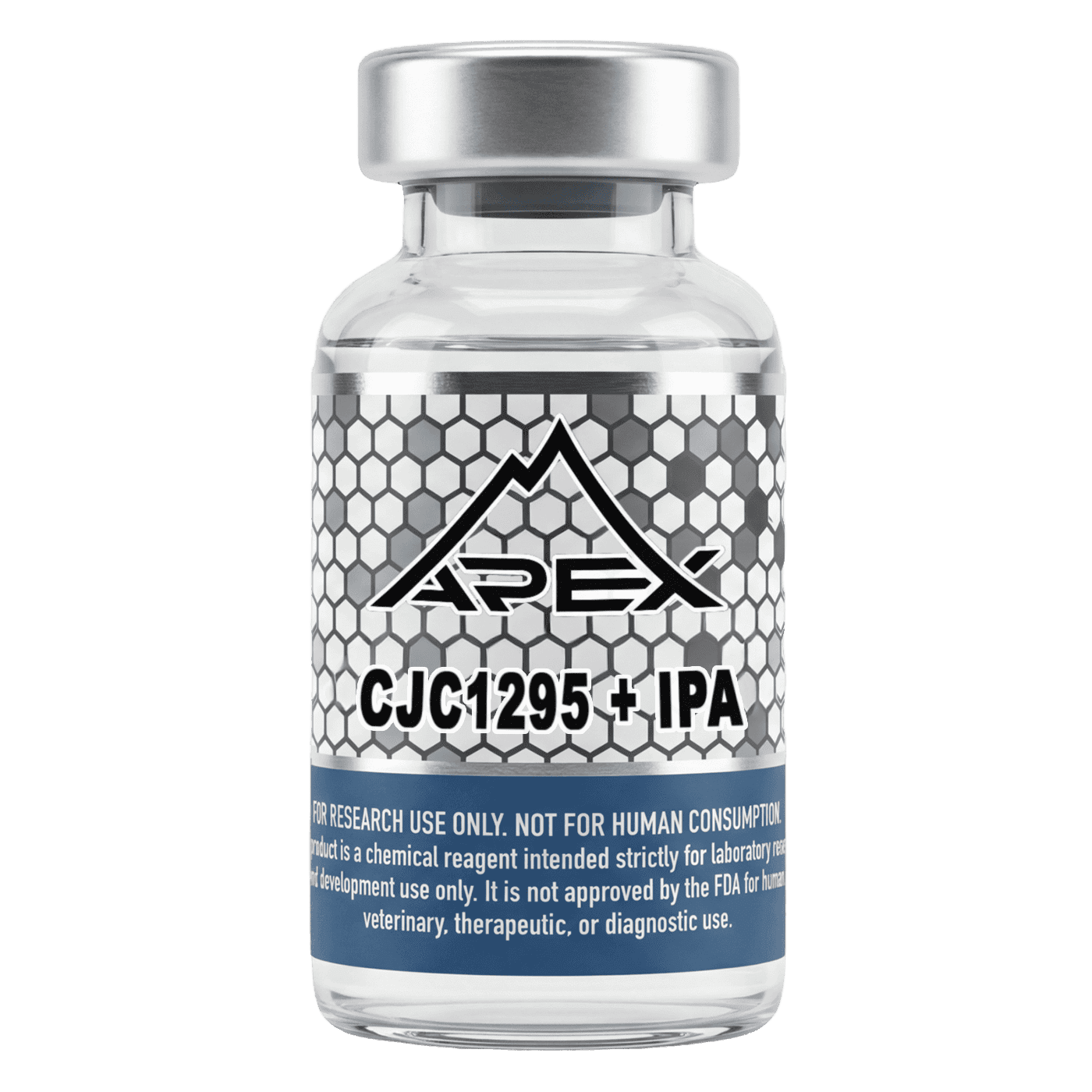
Certificate of Analysis — CJC-1295 No DAC + Ipamorelin Blend 5mg+5mg
Two-component research blend · CJC-1295 No DAC + Ipamorelin
Verified by Apex Laboratory in-house HPLC (purity by 220 nm peak area) and ESI mass spectrometry (mass identity confirmation). Data on this page describes the current shipping lot.
- Purity (HPLC, area %): 99.84%
- Batch ID: APX-2026-0319-C
- Test date: March 19, 2026
- Analyst: K. Norwood
- Components: CJC-1295 No DAC (5mg), 99.33% pure; Ipamorelin (5mg), 99.38% pure
View CJC-1295 No DAC + Ipamorelin Blend 5mg+5mg on the Lab Verified COA archive · Read the CJC-1295 No DAC + Ipamorelin Blend Research Guide
The CJC-1295 No DAC + Ipamorelin Blend is a co-lyophilized two-peptide research reagent that pairs Modified GRF (1-29) with the selective pentapeptide secretagogue Ipamorelin at a fixed 1:1 mass ratio (5 mg + 5 mg, 10 mg total) in a single sealed vial. The interactive Certificate of Analysis above — batch APX-2026-0319-C, tested 2026-03-19 — reflects the exact lot now shipping, with each component resolved as its own HPLC peak and its own purity figure. No email gate, no document request: the per-component data you see is the data in the box. This compound is supplied by Apex Laboratory strictly as an in-vitro research reagent and is not approved for human consumption, veterinary use, or any therapeutic application.
Compound Overview
This is not a single molecule but a deliberate co-formulation of two pharmacologically distinct peptides routinely studied together because they engage the growth-hormone axis at complementary, non-overlapping points. Keeping them in one vial at a controlled ratio is what makes the blend a reproducible reagent rather than two loose components.
CJC-1295 No DAC — also catalogued as Modified GRF (1-29) — is a 29-residue synthetic analog of the N-terminal active fragment of growth-hormone-releasing hormone (GHRH). At 3367.91 g/mol it is the larger component and acts on the GHRH receptor, a class B G-protein-coupled receptor, in receptor-pharmacology models. Four amino-acid substitutions relative to native GRF(1-29) confer resistance to dipeptidyl-peptidase cleavage and raise intrinsic stability. The “No DAC” designation marks the absence of the Drug Affinity Complex (an albumin-binding group); without it the molecule has a markedly shorter preclinical half-life than the DAC-bearing variant, which is why most paired-study protocols specify this short-acting form.
Ipamorelin (Aib-His-D-2-Nal-D-Phe-Lys-NH₂) is a 711.85 g/mol synthetic pentapeptide that acts as a selective agonist of the ghrelin receptor (GHS-R1a), the growth-hormone secretagogue receptor. What distinguishes it from earlier secretagogues such as GHRP-6 and GHRP-2 is its receptor selectivity: in published pharmacology it drives the GHS-R1a pathway with little of the off-target ACTH, cortisol, or prolactin cross-reactivity associated with the GHRP series, making it a cleaner reference ligand. Because a GHRH-receptor agonist and a GHS-R1a agonist sit on separate receptors and separate intracellular cascades, the two are frequently combined in studies of synergistic versus additive secretagogue signaling — the rationale for the matched 1:1 pairing here.
Research Background & Published Literature
The GHRH-analog plus selective-secretagogue combination has an established place in endocrine and receptor-pharmacology literature. GHRH(1-29) fragments such as sermorelin were among the first short GHRH analogs characterized, and the substitution chemistry behind CJC-1295 was developed to extend stability of that fragment. Ipamorelin entered the literature as a selective GHS-R1a ligand set apart from the GHRP family by its narrow secretory profile. Studies that combine the two classes in cell and animal models ask whether dual-pathway stimulation is additive or synergistic and how receptor desensitization differs between the GHRH and ghrelin arms. Researchers building context for this blend can begin with the curated literature below.
- PubMed — CJC-1295 / Modified GRF (1-29) GHRH-analog research
- PubMed — Ipamorelin and GHS-R1a secretagogue pharmacology
- PubChem — Ipamorelin chemical record
- PubChem — CJC-1295 chemical record
Technical Specifications
| Product Name | CJC-1295 No DAC + Ipamorelin Blend (5mg + 5mg) |
| Other Names / Synonyms | Modified GRF (1-29) + Ipamorelin; CJC-1295 DAC-free / Ipamorelin co-blend |
| Classification | Two-component peptide blend — GHRH-receptor analog + selective GHS-R1a secretagogue |
| Component 1 — CJC-1295 No DAC | 5 mg · MW 3367.91 g/mol · 29-residue GHRH(1-29) analog · lot purity 99.33% (HPLC) |
| Component 2 — Ipamorelin | 5 mg · MW 711.85 g/mol · 5-residue pentapeptide (Aib-His-D-2-Nal-D-Phe-Lys-NH₂) · lot purity 99.38% (HPLC) |
| Blend Ratio | 1:1 by mass · 10 mg total per vial |
| Purity Specification | ≥99% per component (HPLC + MS verified); combined lot purity 99.84% — see COA above |
| Physical Form | Co-lyophilized powder · sealed glass vial |
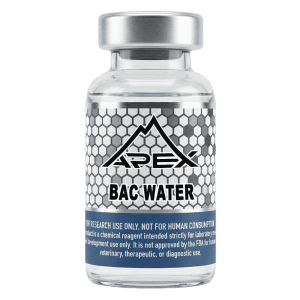
| Recommended Diluent | Bacteriostatic water or sterile laboratory-grade water |
| Available Size | One 10 mg vial (5 mg + 5 mg) — $63.00 |
| Intended Use | In-vitro research only — not for human consumption |
Storage, Handling & Stability
Because this vial holds two peptides of very different mass — a 3367.91 g/mol GHRH analog alongside a 711.85 g/mol pentapeptide — lyophilized storage protects both simultaneously and keeps the 1:1 ratio fixed until reconstitution. Hold the unopened vial at -20 °C, protected from light and moisture, for long-term stability. Reconstitute with bacteriostatic water and calculate concentration with the peptide reconstitution calculator; the reconstitution protocol covers aseptic technique and the storage guide covers reconstituted shelf-life. Once in solution, hold at 2–8 °C for short-term research use.
- Add diluent to the vial wall slowly — do not jet it directly onto the cake — so both peptides go into solution gently and uniformly.
- Aliquot promptly to minimize repeated freeze-thaw cycles, which the smaller pentapeptide tolerates better than the larger GHRH analog.
- Reseal immediately after each withdrawal to limit moisture uptake into any remaining lyophilized material.
- Label aliquots with the blend name, the lot number, concentration, reconstitution date, and operator initials for full traceability back to this COA.
Quality Assurance & Analytical Verification
Every blend lot is released only after dual verification: reverse-phase HPLC for chromatographic purity and mass spectrometry for molecular identity, performed on each component independently. A co-formulated reagent demands per-component analysis — a single combined number can hide a problem in one peptide — so the COA above separates them. The two components resolve cleanly at distinct retention times (CJC-1295 No DAC at 13.5 min, the more hydrophilic Ipamorelin earlier at 9.2 min), and each carries its own purity figure (99.33% and 99.38% for this lot) alongside the 99.84% combined value. Mass-spec identity confirmation differs by component: at 3367.91 Da, CJC-1295 No DAC is read from its ESI+ multi-charge-state envelope, while the 711.85 Da Ipamorelin is confirmed from a low charge-state ion. The reported figures belong to batch APX-2026-0319-C, analyzed by K. Norwood on 2026-03-19; full method detail is described in our guide to HPLC and mass-spectrometry purity verification, and every released COA is archived on the Lab Verified hub for independent confirmation.
Frequently Asked Questions
What exactly is in this vial, and at what ratio?
One co-lyophilized vial containing CJC-1295 No DAC (5 mg) and Ipamorelin (5 mg) — 10 mg total at a fixed 1:1 mass ratio. The COA above lists the purity and retention time for each component separately so the two can be verified independently.
What does the “No DAC” designation change?
DAC stands for Drug Affinity Complex, an albumin-binding group that greatly extends the half-life of CJC-1295. The No DAC form omits it, so it behaves as a short-acting GHRH(1-29) analog in laboratory models. This blend uses the No DAC form because it is the variant most paired-study protocols specify alongside a selective secretagogue.
Why are these two peptides studied together rather than separately?
CJC-1295 No DAC acts on the GHRH receptor while Ipamorelin acts on the separate ghrelin receptor (GHS-R1a). Because they engage different receptors and different intracellular pathways, models combine them to investigate whether dual-pathway stimulation is additive or synergistic — a question that cannot be studied with either compound alone.
Why does Ipamorelin elute before CJC-1295 on the chromatogram?
On reversed-phase HPLC the smaller, more hydrophilic Ipamorelin (711.85 g/mol) interacts less with the stationary phase and elutes earlier (9.2 min) than the larger CJC-1295 No DAC (3367.91 g/mol, 13.5 min). The clear separation is what allows each component to be quantified on its own.
Is buying the blend different from buying the two singles?
The blend is supplied as one vial with the 1:1 ratio fixed and a single COA covering both peptides, so repeat preparations stay consistent. Research that needs only one of the two compounds, or that needs the DAC variant of CJC-1295, should select the corresponding single product — CJC-1295 No DAC, Ipamorelin, or CJC-1295 with DAC — instead.
Is this product approved for human use?
No. The CJC-1295 No DAC + Ipamorelin Blend is a chemical research reagent intended strictly for in-vitro laboratory research. Neither component is approved by the FDA or any other regulatory authority for human consumption, veterinary use, or any therapeutic application. Orders that imply intended bodily use will be cancelled.
Related Research Compounds
Researchers studying growth-hormone-axis pharmacology may also want the individual components or comparator secretagogues: CJC-1295 No DAC (single), Ipamorelin (single), CJC-1295 with DAC, and Sermorelin Acetate as an alternate GHRH analog. For a component-level comparison see the Ipamorelin vs CJC-1295 research guide, and to browse the full range of secretagogue and GHRH reagents, visit the complete Apex Laboratory research catalog.
Shipping, Packaging & Delivery
Orders confirmed before 2:00 PM Eastern Time on a business day leave the same day via tracked US domestic carriers. The co-lyophilized vial travels in insulated, temperature-appropriate packaging chosen to keep both peptides stable through transit; on arrival, move it to -20 °C storage right away. If a protocol needs a particular delivery window, message support ahead of time and we will coordinate timing around your laboratory schedule.
Research Use Disclaimer
For in-vitro research use only. Not for human or veterinary consumption. The CJC-1295 No DAC + Ipamorelin Blend — including both peptide components — is sold by Apex Laboratory exclusively to qualified researchers, accredited laboratories, and educational institutions. Neither CJC-1295 No DAC nor Ipamorelin holds marketing authorization from the FDA or any other regulatory body for any indication. Purchasers assume full responsibility for safe handling, proper storage, and compliance with all applicable federal, state, local, and institutional requirements governing chemical research reagents.
Reviews
There are no reviews yet.