
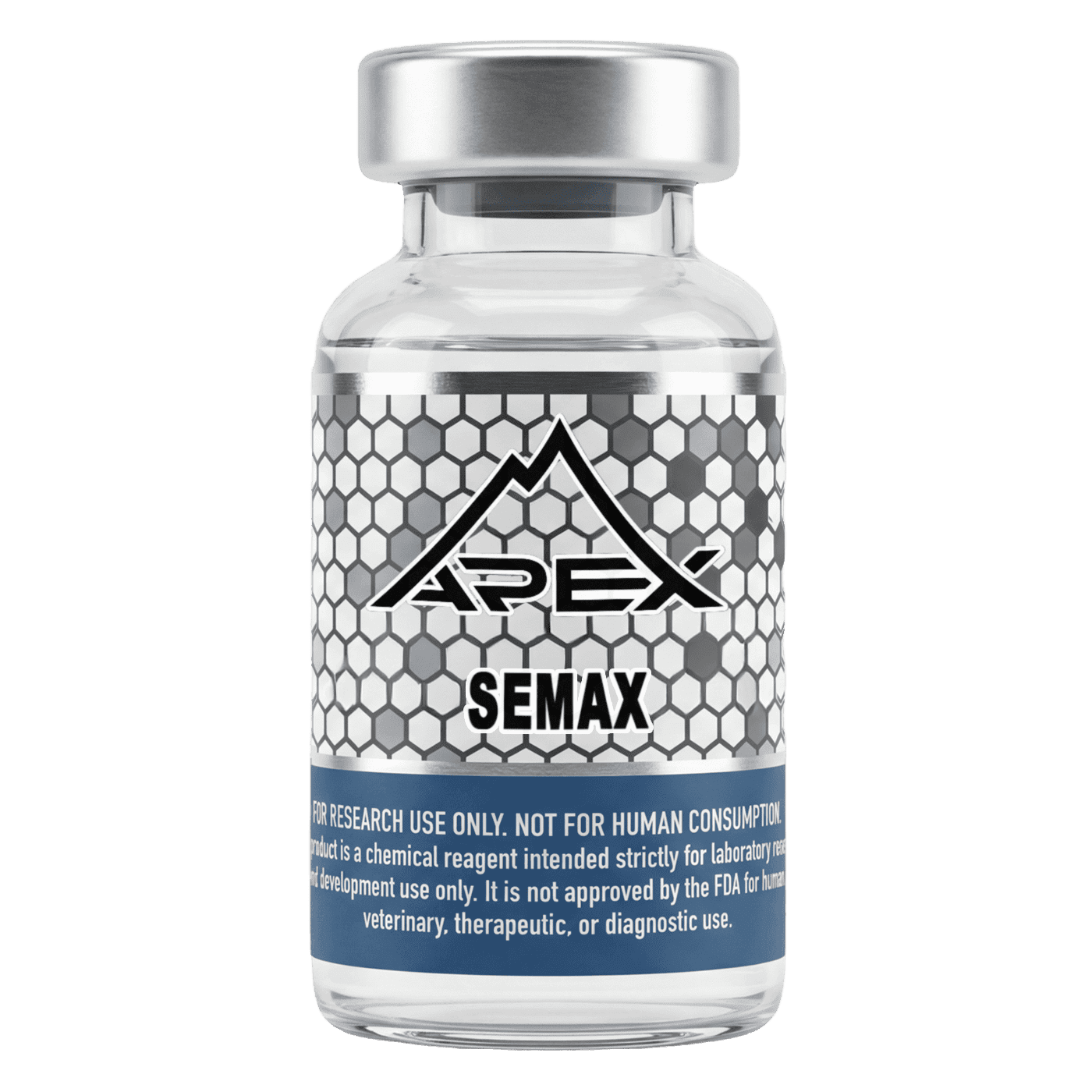
Certificate of Analysis — Semax 10mg
ACTH(4-7) analog – nootropic peptide – CAS 80714-61-0
Verified by Apex Laboratory in-house HPLC (purity by 220 nm peak area) and ESI mass spectrometry (mass identity confirmation). Data on this page describes the current shipping lot.
- Purity (HPLC, area %): 99.51%
- Mass found (ESI-MS): 813.97 Da
- Mass expected: 813.93 Da
- HPLC retention time: 7.0 min
- Batch ID: APX-2026-0320-S
- Test date: March 20, 2026
- Analyst: K. Norwood
View Semax 10mg on the Lab Verified COA archive · Read the Semax Research Guide
Semax is a synthetic heptapeptide nootropic and neuroprotective research peptide derived from an adrenocorticotropic hormone (ACTH) fragment. The HPLC chromatogram and mass spectrometry summary printed above belong to the exact lot now leaving our shelves — batch APX-2026-0320-S, released at 99.51% purity — not a stock graphic or a sanitized reference scan. The data you read is the data in the vial. Apex Laboratory supplies Semax strictly as a high-purity reagent for in-vitro laboratory research and development; it is not approved for human consumption, veterinary use, or any therapeutic application.
Compound Overview
Semax is a short, fully synthetic peptide built around the Met-Glu-His-Phe core that corresponds to the ACTH(4-7) region of adrenocorticotropic hormone, capped at the C-terminus with a Pro-Gly-Pro (PGP) extension. That PGP tail is the design feature that distinguishes Semax from the parent hormone fragment: the proline residues sharply slow enzymatic degradation by aminopeptidases and prolyl-specific proteases, extending the molecule’s effective half-life in biological media compared with the bare ACTH(4-7) tetrapeptide. Crucially, the truncation removes the residues responsible for ACTH’s classic steroidogenic activity, so in model systems Semax engages neurotrophic and neuromodulatory pathways without driving adrenal cortisol output.
Mechanistic studies in cell and rodent models describe Semax as an upregulator of brain-derived neurotrophic factor (BDNF) and its receptor TrkB, alongside modulation of nerve growth factor (NGF) signaling. It has been reported to influence dopaminergic and serotonergic tone and to attenuate markers of oxidative and inflammatory stress in neural tissue. Within the melanocortin family, the ACTH-derived core gives Semax affinity for melanocortin-type recognition relevant to neuroprotection, which separates it mechanistically from its frequent benchmate Selank — a tuftsin-derived peptide that acts predominantly through GABAergic and anxiolytic pathways rather than the neurotrophic axis Semax favors.
Research Background & Published Literature
Semax originated at the Institute of Molecular Genetics of the Russian Academy of Sciences and has one of the longer experimental track records among ACTH-analog research peptides, with published work appearing in outlets such as Brain Research and Doklady Biological Sciences. Investigations span neuroprotection in ischemia models, BDNF/NGF transcriptional response, behavioral readouts of attention and memory in rodents, and proteomic profiling of the peptide’s downstream signaling cascade. Because the compound is well characterized in the preclinical record, it is frequently used as a reference nootropic peptide in comparative in-vitro and animal-model studies of neurotrophic factor regulation.
Researchers exploring the published literature surrounding this compound can review the following sources for additional context on its mechanism of action, signaling pathways, and experimental applications in controlled laboratory settings:
- PubMed — Semax peptide BDNF / neuroprotective literature
- PubChem — Semax chemical record and structure data
Technical Specifications
| Product Name | Semax |
| Other Names / Synonyms | ACTH(4-7)-Pro-Gly-Pro; Met-Glu-His-Phe-Pro-Gly-Pro |
| Classification | Nootropic / neuroprotective peptide (ACTH analog) |
| CAS Number | 80714-61-0 |
| Molecular Formula | C₃₇H₅₁N₉O₁₀S |
| Molecular Weight | 813.93 g/mol |
| Sequence / Structure | 7-residue heptapeptide — ACTH(4-7) core with C-terminal Pro-Gly-Pro extension |
| Purity Specification | ≥99% (HPLC + MS verified — this lot 99.51%, see chromatogram above) |
| Physical Form | Lyophilized (freeze-dried) powder — sealed vial |
| Recommended Diluent | Bacteriostatic water or sterile laboratory-grade water |
| Available Sizes | 5 mg ($32.00) · 10 mg ($43.00) |
| Intended Use | In-vitro research use only — not for human consumption |
Storage, Handling & Stability
As a small, water-soluble heptapeptide, Semax is comparatively robust in lyophilized form but, like all peptides, is sensitive to repeated hydration and warming once reconstituted. Store the sealed lyophilized vial at -20°C for long-term stability. After reconstitution with a sterile diluent, hold working solution at 2–8°C and aliquot in single-use volumes so that freeze-thaw cycling is kept to a minimum, consistent with your standard operating procedures. The unprotected methionine residue at the N-terminus is a potential oxidation site, so limit exposure to air and light when the vial is open.
- Keep ambient handling time short; return the powder to cold storage promptly after weighing.
- Reseal the vial immediately after each withdrawal to limit moisture uptake by the hygroscopic powder.
- Protect dissolved peptide from light and avoid leaving working solution at room temperature between runs.
- Label every aliquot with compound name, concentration, reconstitution date, and operator initials for full lot traceability.
Quality Assurance & Analytical Verification
Every Semax lot passes a dual-verification release protocol before it is added to inventory: High-Performance Liquid Chromatography to establish chromatographic purity, and Mass Spectrometry to confirm molecular identity against the expected 813.93 g/mol parent mass. The chromatogram and analytical summary at the top of this page are this batch’s release record, not a marketing image. For batch APX-2026-0320-S, reversed-phase HPLC returned a single sharp peak with a retention time near 7.0 minutes — an early elution consistent with a hydrophilic seven-residue peptide carrying charged Glu and His side chains, in contrast to the late retention seen with lipidated metabolic peptides.
Because Semax is a small peptide just over 800 Da, electrospray mass spectrometry resolves it cleanly without relying on a deconvoluted multi-charge envelope; the measured mass of 813.97 sits within hundredths of a Dalton of the calculated value, confirming an intact sequence. To understand how these numbers are generated and read, see our guides on HPLC and mass spectrometry purity testing and how to read a Certificate of Analysis. Current and prior lot reports are also collected in the Lab Verified archive.
Frequently Asked Questions
What distinguishes Semax from the ACTH hormone it is derived from?
Semax keeps only the ACTH(4-7) Met-Glu-His-Phe core and adds a C-terminal Pro-Gly-Pro extension. The full steroidogenic portion of ACTH is removed, so in model systems Semax engages neurotrophic and neuromodulatory pathways — notably BDNF and NGF signaling — without stimulating adrenal cortisol production the way intact ACTH does.
Why does the Pro-Gly-Pro tail matter in this peptide?
The C-terminal Pro-Gly-Pro group is a stability modification. Proline residues resist cleavage by common aminopeptidases and prolyl-specific proteases, which slows enzymatic breakdown and lengthens the peptide’s functional half-life in biological media relative to the unmodified ACTH(4-7) fragment — a key reason Semax is favored as a research nootropic over the bare tetrapeptide.
How does Semax differ from Selank in research use?
Both are short Russian-developed research peptides studied for CNS effects, but they act through different routes. Semax is an ACTH-derived peptide associated with BDNF/NGF neurotrophic signaling and neuroprotection, while Selank is a tuftsin analog studied chiefly for GABAergic and anxiolytic-type activity. They are often examined side by side as complementary nootropic reference compounds.
What retention time and mass should I expect on the COA?
For batch APX-2026-0320-S the HPLC peak elutes near 7.0 minutes, reflecting Semax’s hydrophilic character, and the mass spectrometry result of 813.97 matches the calculated 813.93 g/mol parent mass. A single clean peak plus a matching measured mass together confirm both purity and identity for this lot.
Is this product approved for human use?
No. All compounds sold by Apex Laboratory are classified as chemical research reagents intended strictly for in-vitro laboratory research. Semax is not approved by the FDA for human consumption, veterinary use, or any therapeutic application. Purchasers who imply intended bodily use will have their orders cancelled and their accounts permanently suspended.
Is bulk ordering available for Semax?
Yes. For bulk quantities, custom packaging, or recurring supply agreements, contact our team with the compound name, desired quantity, preferred size (5 mg or 10 mg), and your target delivery timeline. Volume pricing is available for qualifying institutional and recurring orders.
Related Research Compounds
Researchers studying ACTH-analog and nootropic neuropeptide pathways may also be interested in related compounds from Apex Laboratory: Selank (tuftsin-analog research peptide), Adamax 10mg (adamantane-modified Semax derivative), and Cerebrolysin 60mg (neurotrophic peptide mixture). For the broader CNS category, see the Nootropic & CNS research peptides pillar guide, or browse the full Apex Laboratory research catalog.
Shipping, Packaging & Delivery
Domestic orders confirmed before 2:00 PM Eastern Time on a business day are dispatched the same day through tracked US carriers. Semax ships in a sealed vial inside insulated, temperature-appropriate packaging chosen to protect the lyophilized powder in transit. Move the vial into -20°C storage as soon as it arrives. If your protocol is time-sensitive or you need a specific delivery window, let our support team know in advance and we will coordinate the shipping schedule around your laboratory workflow.
Research Use Disclaimer
For in-vitro research use only. Not for human consumption. All products sold by Apex Laboratory — including Semax — are intended exclusively for qualified researchers, accredited laboratories, and educational institutions. Semax is supplied as a chemical research reagent and is not approved by the FDA or any other regulatory authority for human or veterinary use. Purchasers assume full responsibility for safe handling, proper storage, and compliance with all applicable federal, state, and local laws, regulations, and institutional policies governing the purchase and use of chemical research reagents.

Reviews
There are no reviews yet.