
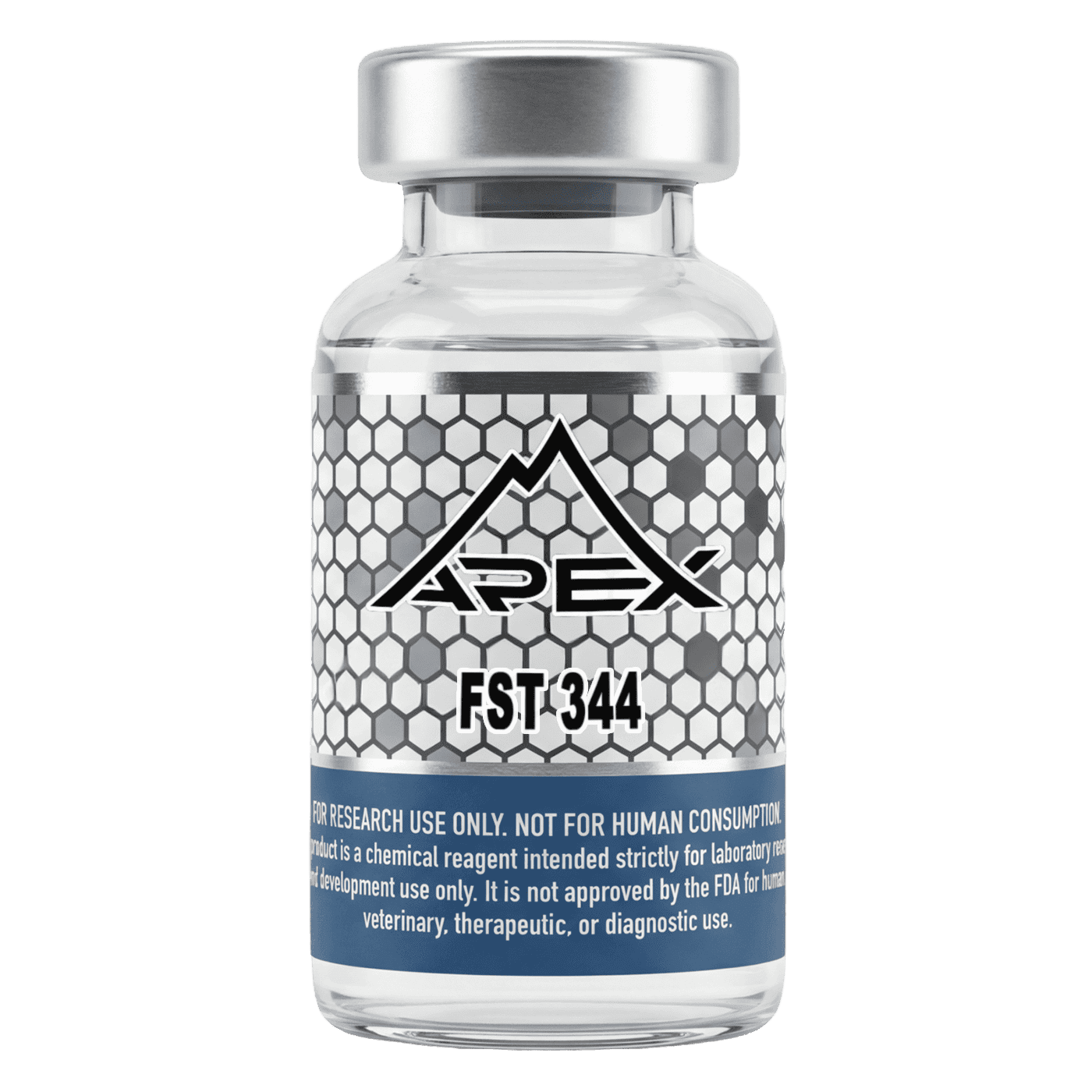
Certificate of Analysis — Follistatin 344 1mg
344-AA isoform · Glycoprotein · Activin/myostatin antagonist
Verified by Apex Laboratory in-house HPLC (purity by 220 nm peak area) and ESI mass spectrometry (mass identity confirmation). Data on this page describes the current shipping lot.
- Purity (HPLC, area %): 99.82%
- Mass expected: 38400 Da
- HPLC retention time: 13.0 min
- Batch ID: APX-2026-0410-F
- Test date: April 10, 2026
- Analyst: K. Norwood
Follistatin 344 is the 344-residue glycoprotein isoform of follistatin, a secreted antagonist of the activin and myostatin branch of the TGF-β superfamily, supplied by Apex Laboratory as a high-purity research biologic. The SDS-PAGE result, deconvoluted ESI-MS data, and analytical summary shown above are drawn from the lot currently in inventory and shipping — not a stock graphic, not a representative figure, and not held behind an email request. The numbers you see are the numbers in the vial.
This material is provided strictly for in-vitro laboratory research and development. It is not approved for human consumption, veterinary use, or any therapeutic, diagnostic, or clinical purpose.
Compound Overview
Follistatin is a monomeric, cysteine-rich glycoprotein that functions as a high-affinity scavenger of activin A and several other TGF-β superfamily ligands, most notably myostatin (GDF-8) and GDF-11. Rather than acting through its own cell-surface receptor, follistatin works by direct ligand sequestration: each molecule wraps around its target ligand and physically blocks the surfaces those ligands use to engage their type I and type II serine/threonine kinase receptors. By neutralizing activin and myostatin, follistatin removes the SMAD2/3 inhibitory tone that those ligands otherwise impose on satellite-cell proliferation, on ovarian follicular development, and on FSH output from the pituitary.
The protein is organized as an N-terminal domain followed by three tandem follistatin domains (FS1–FS3) stabilized by EGF-like and Kazal-like disulfide motifs. The 344 in the name marks the longer of the two principal splice variants: the FST344 transcript encodes a 344-amino-acid mature chain, while the shorter FST288 variant lacks the acidic C-terminal tail. That extension is what distinguishes FST344 from its sibling — it lowers affinity for cell-surface heparan sulfate proteoglycans, so FST344 behaves as a more freely circulating, less matrix-bound species in experimental systems. As a native eukaryotic glycoprotein it is N-glycosylated, and that glycoform heterogeneity is why this lot migrates as a diffuse 50–55 kDa band on SDS-PAGE despite a polypeptide backbone near 38 kDa.
Research Background & Published Literature
Follistatin has been a fixture of the reproductive-endocrinology and muscle-biology literature for nearly four decades, since its isolation as an FSH-suppressing activity in ovarian follicular fluid. Two threads dominate the record. The first is myostatin antagonism: because myostatin is a negative regulator of skeletal-muscle mass, follistatin’s ability to sequester it has made the FST344 isoform a workhorse reagent in preclinical muscle-development and atrophy-model work, where it is studied alongside the soluble myostatin-receptor decoy ACE-031. The second is activin signaling and gonadotropin regulation, where follistatin is used to dissect how activin A drives FSH transcription and follicular maturation. A smaller body of work examines follistatin in fibrosis and tissue-injury models, reflecting the broad role of TGF-β-family signaling in matrix biology.
Researchers interested in the published literature surrounding this compound can explore the following peer-reviewed resources for additional context on its mechanism of action, signaling pathways, and experimental applications in controlled laboratory settings:
- PubMed — follistatin FST344, myostatin and activin signaling literature
- PubChem — follistatin compound and protein records
Technical Specifications
| Product Name | Follistatin 344 1mg |
| Other Names / Synonyms | FST344 · FST-344 · Follistatin-344 isoform · activin-binding protein |
| Classification | Secreted glycoprotein · activin / myostatin-binding antagonist (TGF-β superfamily) |
| Structure | 344-amino-acid mature chain · N-terminal domain + three follistatin (FS) domains |
| Backbone Molecular Weight | ~38,400 g/mol (expected polypeptide mass; this lot deconvoluted to 38,738 Da) |
| Apparent SDS-PAGE Mass | 50–55 kDa diffuse band (N-glycosylated, variable glycoform distribution) |
| Purity Specification | ≥99% (this lot 99.82% by HPLC; identity by ESI-MS, SDS-PAGE + N-terminal Edman) |
| Endotoxin | < 1 EU/mg (LAL) |
| Physical Form | Lyophilized (freeze-dried) powder · sealed vial |
| Recommended Diluent | sterile laboratory-grade water or bacteriostatic water (gentle dissolution, no vortexing) |
| Available Size | 1 mg per vial |
| Intended Use | In-vitro research use only — not for human consumption |
Storage, Handling & Stability
As a multi-domain glycoprotein with an extensive disulfide network, Follistatin 344 is more sensitive to handling stress than a short synthetic peptide. Store the lyophilized vial at -20°C (or colder for archival) away from moisture and light. Reconstitute gently in sterile laboratory-grade water by directing solvent down the vial wall and letting the powder dissolve without shaking or vortexing — foaming and air-liquid interfaces are a common cause of aggregation in proteins of this size. Once in solution, hold working aliquots at 2–8°C and freeze surplus at -20°C or below; repeated freeze-thaw cycling is the single most damaging thing you can do to a glycoprotein this large.
- Aliquot the reconstituted stock on first thaw so that no single tube is frozen and thawed more than once.
- Consider a low concentration of carrier protein (for example, research-grade BSA) in dilute working solutions to limit surface adsorption to plasticware.
- Reseal the vial immediately after each withdrawal and minimize time at ambient temperature to protect the glycoform distribution.
- Label every aliquot with compound name, concentration, reconstitution date, and operator initials for full lot traceability against batch APX-2026-0410-F.
Quality Assurance & Analytical Verification
Glycoproteins demand a different release panel than small synthetic peptides, and Follistatin 344 is characterized accordingly before it enters inventory. The analytical summary at the top of this page reports the data for the current shipping lot, APX-2026-0410-F (tested 2026-04-10): 99.82% chromatographic purity by HPLC, identity confirmation by SDS-PAGE together with N-terminal Edman sequencing, and endotoxin below 1 EU/mg by LAL assay.
Because the intact molecule carries multiple charges in electrospray, mass confirmation is done by deconvoluting the full ESI-MS charge envelope rather than reading a single ion. For this lot the observed charge series spans [M+20H]20+ through [M+35H]35+, and those states back-calculate to a deconvoluted mass of 38,738 Da against an expected backbone of ~38,400 Da — the modest excess being consistent with N-linked glycosylation, which is also why the protein runs as a diffuse 50–55 kDa band on SDS-PAGE rather than a sharp line. For more on how multiply-charged envelopes are interpreted, see our guide to mass spectrometry for peptide verification and the broader HPLC and purity testing overview, or browse current certificates in the Lab Verified archive.
Frequently Asked Questions
What is the difference between Follistatin 344 and Follistatin 288?
Both arise from alternative splicing of the same FST gene. FST344 retains an acidic C-terminal tail that FST288 lacks, and that tail lowers FST344’s affinity for cell-surface heparan sulfate proteoglycans. In experimental systems the practical consequence is that FST344 behaves as a more freely diffusing, less matrix-anchored species, whereas FST288 partitions more strongly to the cell surface. The 344 isoform is the variant supplied here.
Why does this product run at 50–55 kDa on a gel when its sequence mass is around 38 kDa?
Follistatin 344 is an N-glycosylated glycoprotein, and the attached carbohydrate adds apparent mass and heterogeneity. The polypeptide backbone deconvolutes near 38.7 kDa by ESI-MS for this lot, but glycoform variability makes the molecule migrate as a diffuse band at 50–55 kDa under SDS-PAGE. This gap between sequence mass and gel mobility is expected and is itself a useful identity marker for the glycosylated species.
How does follistatin actually neutralize myostatin and activin?
It works by direct ligand sequestration rather than receptor signaling. A follistatin molecule wraps around its target ligand — activin A, myostatin (GDF-8), or GDF-11 — and occludes the surfaces those ligands use to recruit their type I and type II receptors, preventing assembly of the signaling complex and the downstream SMAD2/3 response. This makes it a clean tool for studying loss-of-function of those pathways in vitro.
How should I reconstitute and store it to preserve activity?
Dissolve the lyophilized powder gently in sterile laboratory-grade water, running solvent down the vial wall without shaking or vortexing to avoid foaming. Keep working solution at 2–8°C for short-term use, freeze surplus at -20°C or below in single-use aliquots, and avoid repeated freeze-thaw cycles, which are the main driver of aggregation in glycoproteins of this size.
Is this product approved for human use?
No. All compounds sold by Apex Laboratory are classified as chemical research reagents intended strictly for in-vitro laboratory research. Follistatin 344 is not approved for human consumption, veterinary use, or any therapeutic application, and no such use is intended or supported. Purchasers who imply intended bodily use will have their orders cancelled and their accounts permanently suspended.
What documentation ships with the vial, and is bulk supply available?
Each lot is accompanied by a Certificate of Analysis reporting HPLC purity, SDS-PAGE and Edman identity, ESI-MS mass, and LAL endotoxin; current records live in the Lab Verified archive and specific batch files can be requested through our contact page. For bulk quantities, custom fill volumes, or recurring supply agreements, contact our team with the compound name, desired quantity, and target delivery timeline.
Related Research Compounds
Researchers working on myostatin, activin, and growth-axis signaling may also be interested in related reagents from Apex Laboratory: ACE-031, a soluble activin receptor IIB decoy studied as a complementary myostatin-pathway antagonist; IGF-1 LR3, a long-acting IGF-1 analog used in muscle and growth-signaling models; PEG-MGF, the pegylated mechano growth factor IGF-1 splice variant; and TB-500 for tissue-repair research. Browse the full Apex Laboratory research catalog to see all available peptides, glycoproteins, and reagents.
Shipping, Packaging & Delivery
Orders confirmed before 2:00 PM Eastern Time on a business day leave the same day via tracked US domestic carriers. Follistatin 344 is dispatched in insulated, temperature-appropriate packaging chosen to protect a freeze-dried glycoprotein in transit; on arrival, move the vial into -20°C storage without delay. If your protocol has a fixed start date or you need a specific delivery window, reach our support team ahead of ordering and we will help align the shipping schedule to your bench timeline.
Research Use Disclaimer
For in-vitro research use only. Not for human consumption. All products sold by Apex Laboratory — including Follistatin 344 — are intended exclusively for qualified researchers, accredited laboratories, and educational institutions. Purchasers assume full responsibility for ensuring safe handling, proper storage, and compliance with all applicable federal, state, and local laws, regulations, and institutional policies governing the purchase and use of chemical research reagents.

Reviews
There are no reviews yet.