
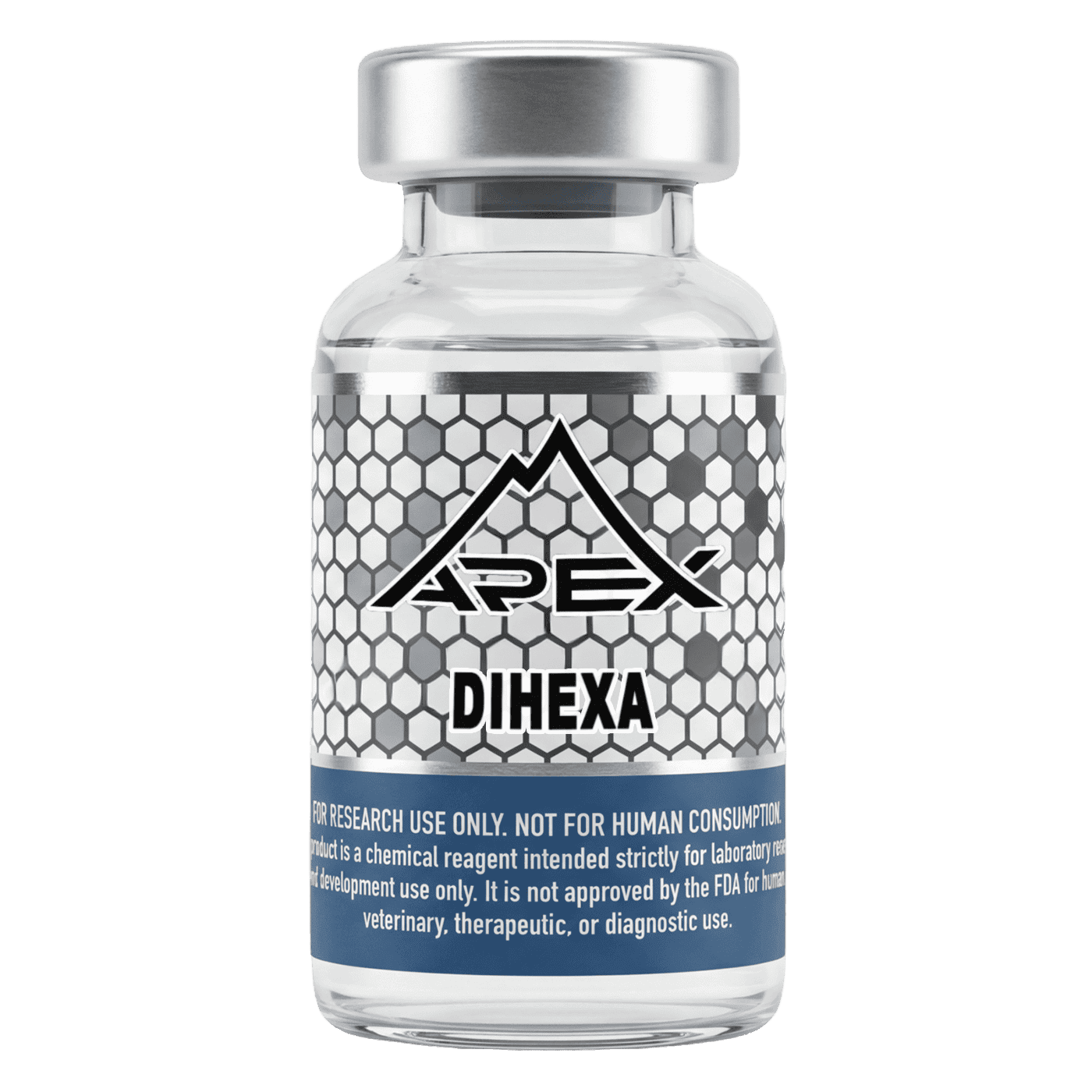
Certificate of Analysis — Dihexa 10mg
Hexanoyl-Tyr-Ile-(6) HGF/c-Met activator – CAS 1401708-83-5
Verified by Apex Laboratory in-house HPLC (purity by 220 nm peak area) and ESI mass spectrometry (mass identity confirmation). Data on this page describes the current shipping lot.
- Purity (HPLC, area %): 99.78%
- Mass found (ESI-MS): 504.84 Da
- Mass expected: 504.70 Da
- HPLC retention time: 12.0 min
- Batch ID: APX-2026-0330-D
- Test date: March 30, 2026
- Analyst: K. Norwood
Dihexa (N-hexanoic-Tyr-Ile-(6)-aminohexanoic amide) is a small-molecule angiotensin IV analog studied in vitro as a positive modulator of the hepatocyte growth factor (HGF) / c-Met receptor system. The chromatogram and mass spectrometry summary at the top of this page are pulled from the current shipping lot (batch APX-2026-0330-D) — there is no email wall, no “request the COA” form, and no third-party summary standing between you and the data. The vial you receive corresponds to the trace you can see. Dihexa is supplied for in-vitro laboratory research and development only; it is not approved for human consumption, veterinary use, or any therapeutic application.
Compound Overview
Dihexa is a synthetic derivative of Norleucine1-angiotensin IV in which the parent hexapeptide has been truncated and chemically capped to resist enzymatic degradation in laboratory preparations. Two modifications define the molecule: an N-terminal hexanoic (caproyl) acid group and a C-terminal 6-aminohexanoic amide. These hydrophobic caps shield the small Tyr-Ile dipeptide core from aminopeptidase and carboxypeptidase cleavage, giving the compound far greater stability in solution than the labile native peptide. The result is a low-molecular-weight (504.70 g/mol) amide that behaves more like a small-molecule research reagent than a conventional peptide while retaining the pharmacophore that engages the HGF/c-Met axis.
Mechanistically, Dihexa is investigated as an allosteric potentiator rather than a direct receptor ligand. In published cell models it is reported to enhance the affinity of hepatocyte growth factor for its receptor tyrosine kinase, c-Met, amplifying downstream signaling studied in connection with dendritic spine formation and synaptogenesis in cultured neurons. This places Dihexa apart from receptor-binding CNS research peptides such as Semax and Selank, which act at melanocortin/BDNF and GABAergic targets respectively; Dihexa instead probes a growth-factor-coupled receptor tyrosine kinase. Its reported picomolar activity in HGF-dependent assays is what generated the original research interest in the molecule as an in-vitro tool for studying c-Met signaling.
Research Background & Published Literature
Dihexa originated from the laboratory of Joseph Harding and colleagues at Washington State University, who designed the molecule while mapping the structure-activity relationships of angiotensin IV analogs at the AT4/IRAP and HGF/c-Met systems. The foundational characterization, published in the Journal of Pharmacology and Experimental Therapeutics by Benoist and co-workers, reported that the compound facilitated HGF/c-Met signaling and promoted spinogenesis in hippocampal neuron cultures at very low concentrations, which is why it remains a frequently cited reference compound in synaptogenesis and receptor-tyrosine-kinase modulation research. All of this work is preclinical, conducted in cell culture and animal models.
Researchers exploring the published literature surrounding this compound can review the following peer-reviewed and database resources for additional context on its mechanism of action, signaling pathways, and experimental applications in controlled laboratory settings:
- PubMed — current literature on Dihexa and HGF/c-Met modulation
- PubChem — Dihexa structural and chemical property record
Technical Specifications
| Product Name | Dihexa 10mg (60pcs) |
| Other Names | PNB-0408 · N-hexanoic-Tyr-Ile-(6)-aminohexanoic amide · Hexanoyl-Tyr-Ile activator |
| Classification | HGF/c-Met Allosteric Modulator (Angiotensin IV-Derived Research Compound) |
| CAS Number | 1401708-83-5 |
| Molecular Formula | C₂₇H₄₄N₄O₅ |
| Molecular Weight | 504.70 g/mol (average) · 504.33 monoisotopic |
| Structure | Hexanoic-acid-capped Tyr-Ile dipeptide with C-terminal 6-aminohexanoic amide |
| Purity Specification | ≥99% (HPLC + MS verified — 99.78% on this lot, see chromatogram above) |
| Physical Form | Solid research reagent · 60 units per pack |
| Recommended Diluent | DMSO or ethanol stock (lipophilic); dilute into aqueous buffer for assay |
| Available Size | 10 mg per unit · 60-piece pack |
| Intended Use | In-vitro research use only — not for human consumption |
Storage, Handling & Stability
Because Dihexa is a hydrophobic, hexanoyl-capped amide rather than a typical aqueous peptide, it dissolves poorly in water and is most stable as a solid. Store the sealed material at -20°C, protected from light and moisture, for long-term integrity. Prepare concentrated stock solutions in a compatible organic solvent (DMSO or ethanol) where the lipophilic caproyl and aminohexanoic groups remain soluble, then dilute into your assay buffer immediately before use. Keep aqueous working dilutions cold and use them promptly, since the amine-amide architecture is more prone to precipitation and slow hydrolysis once in water.
- Bring solid vials to room temperature before opening to prevent condensation onto the lipophilic powder.
- Reserve a single freeze-thaw cycle per organic stock aliquot; the caproyl cap can drive aggregation on repeated thawing.
- Verify final DMSO concentration stays within the tolerance of your cell model to avoid solvent artifacts.
- Label each aliquot with compound name, solvent, concentration, reconstitution date, and operator initials for full lot traceability.
Quality Assurance & Analytical Verification
Every Dihexa lot is released under Apex Laboratory’s dual-verification protocol before it enters inventory, and the resulting data is published directly to this page for the batch currently shipping. The chromatogram and analytical summary above are this lot’s actual release record, not a stock graphic. Reversed-phase HPLC confirmed chromatographic purity of 99.78% with a single dominant peak eluting at roughly 12.0 minutes — a retention time consistent with the molecule’s moderate lipophilicity from its dual hexanoyl/aminohexanoic caps.
Identity was confirmed by mass spectrometry. Because Dihexa is a low-molecular-weight amide rather than a large multiply-charged peptide, ESI typically yields a clean singly-protonated species, and the measured average mass of 504.84 sits within tight tolerance of the 504.70 expected for C₂₇H₄₄N₄O₅. For a primer on how that match is established, see our guide on mass spectrometry verification, and for help interpreting the report on this page review how to read a Certificate of Analysis. Historical batch records for prior Dihexa lots are available on request through our contact page or in the Lab Verified archive.
Frequently Asked Questions
What distinguishes Dihexa from the angiotensin IV peptide it is derived from?
Native angiotensin IV is a six-residue peptide that is rapidly degraded by peptidases. Dihexa retains only the Tyr-Ile pharmacophore and adds an N-terminal hexanoic (caproyl) cap plus a C-terminal 6-aminohexanoic amide. Those hydrophobic caps block the aminopeptidase and carboxypeptidase cleavage that destroys the parent peptide, which is why Dihexa shows far greater stability in laboratory models while engaging the HGF/c-Met axis.
Why is Dihexa stored and reconstituted differently from water-soluble peptides?
The two fatty-acid-style caps make Dihexa lipophilic and only sparingly water-soluble. Researchers generally prepare concentrated stocks in DMSO or ethanol where the compound dissolves cleanly, then dilute into aqueous assay buffer just before use. Storing the solid at -20°C and limiting freeze-thaw of organic stocks preserves integrity better than treating it like a standard aqueous peptide.
What receptor system does Dihexa act on in research models?
Published work characterizes Dihexa as a positive modulator of the hepatocyte growth factor (HGF) / c-Met receptor tyrosine kinase system. In hippocampal neuron cultures it has been reported to facilitate HGF-dependent signaling associated with dendritic spine formation and synaptogenesis at picomolar concentrations, making it a reference tool for studying c-Met-coupled plasticity pathways in vitro.
How is the 99.78% purity on this batch confirmed?
By two independent methods shown on this page. Reversed-phase HPLC integrates the chromatographic peak area to establish purity, and mass spectrometry confirms identity by matching the measured average mass (504.84) to the value expected for the molecular formula (504.70). Both results are recorded against batch APX-2026-0330-D, tested 2026-03-30.
Is this product approved for human use?
No. All compounds sold by Apex Laboratory are classified as chemical research reagents intended strictly for in-vitro laboratory research. They are not approved for human consumption, veterinary use, or any therapeutic application, and Dihexa has not received marketing authorization from any regulatory authority. Purchasers who imply intended bodily use will have their orders cancelled and their accounts permanently suspended.
Is bulk ordering available for Dihexa?
Yes. For larger quantities, custom packaging, or recurring supply agreements, reach our team through the contact page with the compound name, desired quantity, preferred format, and your target delivery timeline. Volume pricing is available for qualifying institutional and recurring orders.
Related Research Compounds
Researchers studying c-Met-coupled and CNS plasticity pathways may also be interested in related compounds from Apex Laboratory: Semax and Selank for melanocortin/BDNF and GABAergic CNS signaling research, and Cerebrolysin 60mg as a neurotrophic peptide mixture studied in neuronal models. For broader background see our CNS research peptides pillar guide, or browse the full Apex Laboratory research catalog.
Shipping, Packaging & Delivery
Orders confirmed before 2:00 PM Eastern Time on a business day leave the same day through tracked US domestic carriers. Each Dihexa pack is sealed and cushioned in protective, temperature-appropriate packaging to maintain compound integrity in transit. When the parcel arrives, move the material into -20°C storage without delay. If your protocol is time-sensitive or you need a specific delivery window, message our support team ahead of ordering so we can align the shipment with your laboratory schedule.
Research Use Disclaimer
For in-vitro research use only. Not for human consumption. All products sold by Apex Laboratory — including Dihexa 10mg (60pcs) — are intended exclusively for qualified researchers, accredited laboratories, and educational institutions. Dihexa is an experimental research compound that has not received approval from the FDA or any other regulatory authority for any human or veterinary indication. Purchasers assume full responsibility for safe handling, proper storage, and compliance with all applicable federal, state, and local laws, regulations, and institutional policies governing the purchase and use of chemical research reagents.

Reviews
There are no reviews yet.