
Mazdutide (LY3305677 / IBI362) is a synthetic oxyntomodulin-analog peptide acting as a dual agonist of the GLP-1 and glucagon receptors, developed by Innovent Biologics under license from Eli Lilly. It is approved by China’s National Medical Products Administration (marketed as Xinermei) for weight management and type 2 diabetes, but is not approved by the FDA or EMA. Apex Laboratory supplies it strictly as a research-grade chemical reagent, distinct from the Xinermei pharmaceutical formulation.
Mazdutide, designated LY3305677 and IBI362, is the second dual GLP-1/glucagon receptor agonist in the next-generation incretin class and the one compound in that class to have crossed from investigation into marketing approval — though so far in only one jurisdiction.[1] It is built on an oxyntomodulin backbone, a logical template because oxyntomodulin is a naturally occurring gut peptide that itself activates both the GLP-1 and glucagon receptors.[2] This guide covers its molecular identity, the oxyntomodulin-analog mechanism, the GLORY obesity and DREAMS diabetes programs, its China NMPA approval, and how it differs from the other compounds in the class.
Everything here is reported as published clinical-trial and company-disclosed research data. Apex Laboratory supplies mazdutide only as a research-grade chemical reagent for in-vitro and preclinical investigation; nothing below is a therapeutic claim or human-use guidance, and the research reagent is categorically distinct from the approved Xinermei pharmaceutical formulation, as explained in research-grade vs pharmaceutical-grade peptides.
Mazdutide at a Glance
- Mazdutide (LY3305677 / IBI362; CAS 2259884-03-0) is a unimolecular dual GLP-1/glucagon receptor agonist built on an oxyntomodulin-analog backbone, developed by Innovent Biologics under license from Eli Lilly (which holds ex-China rights).
- In the pivotal GLORY-1 Phase 3 obesity trial, mean body-weight change at 48 weeks was −11.00% (4 mg) and −14.01% (6 mg) versus +0.30% on placebo in 610 Chinese adults.
- In the DREAMS-2 Phase 3 trial in type 2 diabetes, mazdutide was superior to dulaglutide on both HbA1c and body weight.
- China’s NMPA approved mazdutide for chronic weight management (June 2025) and for type 2 diabetes glycemic control (September 2025), marketed as Xinermei — reported as the world’s first dual glucagon/GLP-1 agonist approved for weight loss.
- Mazdutide is NOT approved by the FDA or EMA; an approval in China does not confer any status elsewhere or make a research reagent a pharmaceutical product.
- Apex supplies mazdutide strictly as a ≥99% (HPLC + MS verified) research reagent for in-vitro and preclinical use, distinct from the Xinermei formulation.
Mazdutide (LY3305677 / IBI362)
What Is Mazdutide? Molecular Identity
Mazdutide is a synthetic peptide engineered as a balanced dual agonist of the GLP-1 receptor (GLP-1R) and the glucagon receptor (GCGR). It carries CAS number 2259884-03-0 and two development codes — LY3305677 (Eli Lilly, the originator) and IBI362 (Innovent Biologics, the China developer). Unlike survodutide, which is built on a glucagon-peptide backbone, mazdutide is an oxyntomodulin (OXM) analog: it derives from the gut peptide oxyntomodulin, which is itself a natural dual GLP-1/glucagon agonist, making it a logical structural template for a balanced co-agonist.
Structurally, mazdutide is a fatty-diacid-modified peptide that binds albumin to support once-weekly subcutaneous dosing. There is a documented discrepancy in its reported molecular weight: PubChem (CID 167312357) lists the formula C207H317N45O65 (about 4,476 g/mol), while several vendor and reference sheets cite C210H322N46O67 (about 4,563 g/mol) — a difference best attributed to salt or counterion form. For reproducible work the operative anchors are the CAS number and the per-lot mass-spectrometric confirmation on the certificate of analysis, not a single quoted average mass.
Oxyntomodulin-Analog Dual Mechanism
Balanced GLP-1R + GCGR agonism on an oxyntomodulin scaffold
GLP-1 receptor activation drives glucose-dependent insulin secretion, slows gastric emptying, and suppresses appetite; glucagon receptor activation adds an energy-expenditure and hepatic-lipid-mobilization arm. Because the parent peptide oxyntomodulin natively engages both receptors, the oxyntomodulin scaffold is a natural starting point for a balanced dual agonist, with the company positing that the glucagon component underlies enhanced visceral-fat and liver-fat reduction relative to GLP-1 mono-agonism. As with all dual GLP-1/glucagon designs, the GLP-1 arm is balanced against the glucagon arm so insulin secretion offsets glucagon’s counter-regulatory effect on glucose. Described as a research-context mechanism only.
The dual-agonist pharmacology was first characterized in early clinical work under the IBI362 / LY3305677 designation. Jiang and colleagues reported a Phase 1b randomized controlled trial of the GLP-1/glucagon dual agonist in Chinese patients with type 2 diabetes, establishing dose-dependent glucose and body-weight effects and the pharmacokinetic profile.[1] The second target being the glucagon receptor — not GIP — is what distinguishes mazdutide from the GIP/GLP-1 co-agonist tirzepatide.
Mazdutide Obesity Research: The GLORY Program
The weight-management evidence was built in stages. Ji and colleagues examined higher 9 mg and 10 mg doses in a placebo-controlled, multiple-ascending-dose Phase 1b trial in Chinese adults with overweight or obesity, supporting the higher-dose activity and tolerability range,[3] then reported a Phase 2 randomized controlled trial that extended the dose-dependent weight-management data with reductions in waist circumference, liver fat, and other cardiometabolic markers.[4]
The pivotal evidence is the GLORY-1 Phase 3 trial, reported by Ji and colleagues in the New England Journal of Medicine: in 610 Chinese adults with obesity or overweight, mean body-weight change at week 48 was −11.00% (95% CI −12.27 to −9.73) on 4 mg and −14.01% (95% CI −15.36 to −12.66) on 6 mg, versus +0.30% on placebo. At week 48, at least 15% weight loss was achieved by 35.7% (4 mg) and 49.5% (6 mg) of participants versus 2.0% on placebo, and the trial also reported reductions in liver fat and cardiometabolic risk factors.[5] This is the dataset that underpins the China weight-management approval.
A higher-dose Phase 3 study, GLORY-2, evaluated mazdutide 9 mg and was reported by the developer to produce up to roughly 20% mean weight loss over about 60 weeks. Those GLORY-2 figures come from a company press release and conference disclosure and had not been peer-reviewed published at the time of writing, so they are noted here as company-reported topline rather than as published trial data.
Mazdutide in Type 2 Diabetes: The DREAMS Program
Mazdutide’s diabetes evidence comes from the DREAMS Phase 3 program, two trials of which were published back-to-back in Nature. Zhu and colleagues reported mazdutide versus placebo in Chinese adults with type 2 diabetes (DREAMS-1), establishing monotherapy efficacy on glycemic control and body weight.[6] Guo and colleagues reported mazdutide versus the GLP-1 receptor agonist dulaglutide (DREAMS-2): mazdutide was superior on HbA1c, with least-squares-mean treatment differences of −0.24% (4 mg, P=0.0032) and −0.30% (6 mg, P=0.0003), and on body weight, with differences of −3.78% (4 mg) and −5.76% (6 mg), both P<0.0001 versus dulaglutide.[7] Together these two trials supported the September 2025 China approval for glycemic control.
A third trial, DREAMS-3, compares mazdutide head-to-head against semaglutide in type 2 diabetes with obesity; its rationale, design, and baseline data were published by Luo and colleagues, while its efficacy comparison has so far been disclosed only by conference and press release and is therefore noted here as not yet peer-reviewed.[8]
China NMPA Approval and Global Status
Mazdutide is the one compound in the next-generation GLP-1/glucagon and amylin class to hold a marketing approval — but only in China. China’s National Medical Products Administration (NMPA) approved mazdutide for chronic weight management in adults with overweight or obesity in June 2025, reported by its developer as the world’s first dual glucagon/GLP-1 receptor agonist approved for weight loss, and approved it separately for glycemic control in adults with type 2 diabetes in September 2025. It is marketed in China under the trade name Xinermei.
Crucially, an approval in China confers no status elsewhere. Mazdutide is not approved by the United States FDA or the European Medicines Agency, and Eli Lilly’s ex-China rights had not, as of this writing, translated into a US filing. This is precisely the situation that makes the research-grade-versus-pharmaceutical distinction concrete: the same molecule can be an approved medicine (Xinermei) under one regulator and an unapproved research material under another. Apex supplies mazdutide solely as a research-grade chemical reagent for in-vitro and preclinical study — never as the Xinermei pharmaceutical product, and never for human consumption. The same-molecule, distinct-regulatory-framework principle is the one set out in research-grade vs pharmaceutical-grade peptides.
How Mazdutide Differs from Semaglutide, Tirzepatide and Retatrutide
Mazdutide’s place in the class is defined by its receptor targets and its oxyntomodulin scaffold. The table situates it alongside the rest of the incretin landscape; for the other dual GLP-1/glucagon agonist, see the dedicated survodutide research guide, and the next-generation GLP-1 research peptides overview for a side-by-side of the whole class.
Where Mazdutide Sits
| Compound | Receptor targets | Backbone / note |
|---|---|---|
| Semaglutide | GLP-1 (single) | GLP-1 analog (Novo Nordisk) |
| Tirzepatide | GIP + GLP-1 | Incretin co-agonist (Eli Lilly) |
| Survodutide | GLP-1 + glucagon | Glucagon-peptide backbone (Boehringer) |
| Mazdutide | GLP-1 + glucagon | Oxyntomodulin analog (Innovent / Lilly) |
| Retatrutide | GIP + GLP-1 + glucagon | Triple agonist (Eli Lilly) |
Compared with semaglutide (single GLP-1) and tirzepatide (GIP + GLP-1), mazdutide’s distinguishing feature is the glucagon arm. It shares the GLP-1/glucagon target pair with survodutide but uses a different (oxyntomodulin) scaffold and a different developer and regulatory path. And it differs from retatrutide, which adds GIP on top of the GLP-1/glucagon pair to make a triple agonist. The broader landscape is mapped in the next-generation GLP-1 research peptides overview.
Safety and Tolerability (Research Context)
Across mazdutide’s published trials the dominant tolerability signal is gastrointestinal, consistent with the on-target incretin and glucagon mechanism. In the placebo-controlled multiple-ascending-dose Phase 1b study, treatment-emergent adverse events were mild or moderate, with the most frequent including diarrhea, decreased appetite, nausea, abdominal distension, and vomiting,[3] and the GLORY and DREAMS trials reported the same gastrointestinal-weighted profile, managed with stepwise dose escalation.[5] These are documented observations in the studied (predominantly Chinese) trial populations, reported for research context only; they are not patient guidance and not a safety statement about the research-grade reagent.
Sourcing Research-Grade Mazdutide
For laboratories studying oxyntomodulin-analog dual agonism, mazdutide should be sourced as documented research-grade material with identity confirmed by mass spectrometry — particularly given the form-dependent molecular-weight discrepancy noted above. Apex supplies mazdutide as a lyophilized reagent verified to ≥99% purity by reversed-phase HPLC with identity confirmation by electrospray-ionization mass spectrometry, with a per-lot certificate of analysis through the lab-verified COA archive. See the primers on reading a certificate of analysis and HPLC testing for peptide purity, and the reconstitution and storage guides for laboratory handling.
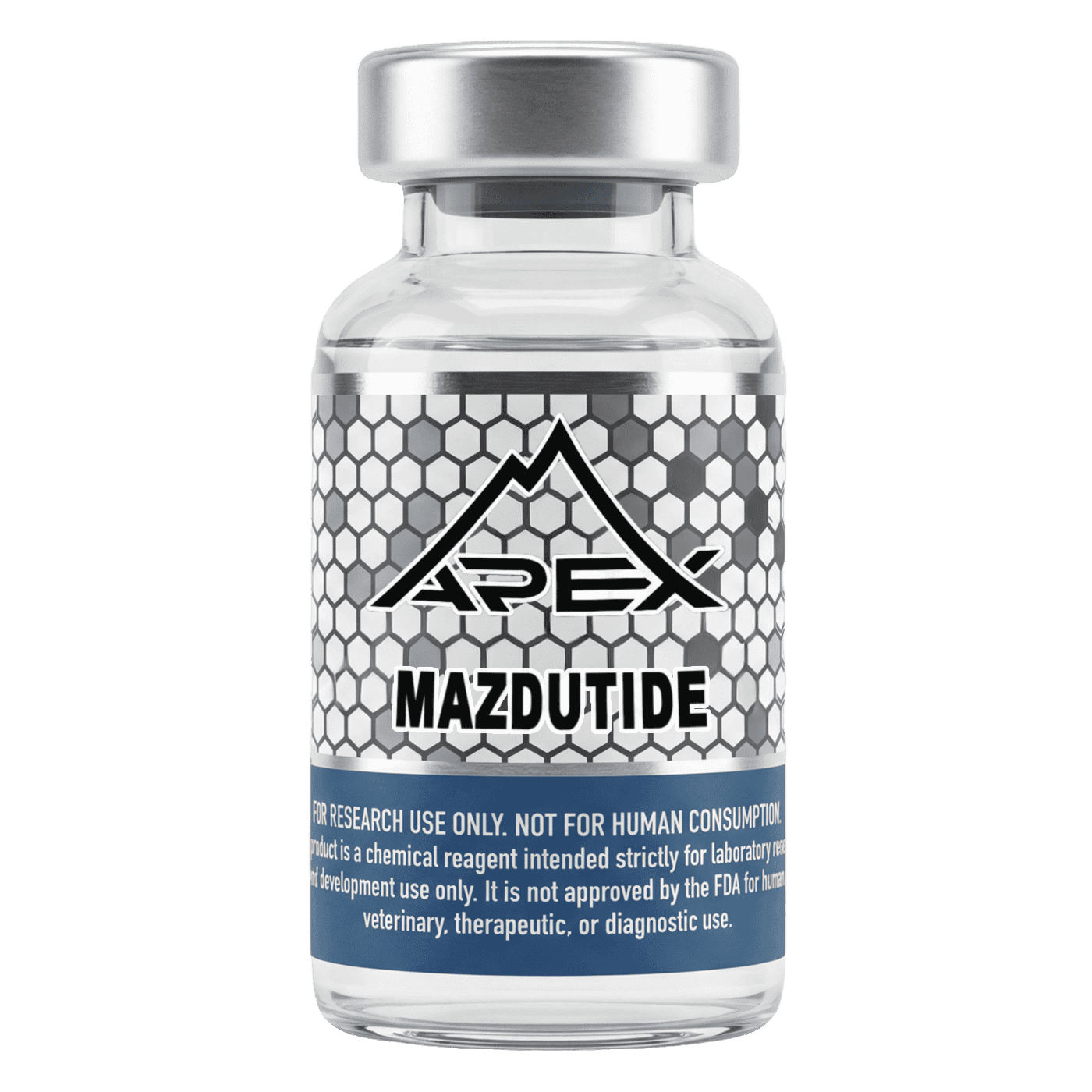
Mazdutide (LY3305677 / IBI362)
Research-grade dual GLP-1/glucagon oxyntomodulin-analog agonist — verified to ≥99% purity by HPLC and mass spectrometry, with a per-lot certificate of analysis. Supplied strictly for in-vitro and preclinical research, distinct from the Xinermei pharmaceutical formulation.
View Mazdutide →Frequently Asked Questions
What is mazdutide?
Mazdutide (development codes LY3305677 and IBI362, CAS 2259884-03-0) is a synthetic oxyntomodulin-analog peptide that acts as a unimolecular dual agonist of the GLP-1 and glucagon receptors. It is developed by Innovent Biologics under license from Eli Lilly. Apex Laboratory supplies it as a research-grade chemical reagent for in-vitro and preclinical research only, distinct from the approved Xinermei pharmaceutical formulation.
Is mazdutide FDA-approved?
No. Mazdutide is approved only by China’s National Medical Products Administration (NMPA), where it is marketed as Xinermei for chronic weight management (approved June 2025) and for type 2 diabetes glycemic control (approved September 2025). It is not approved by the FDA or the EMA. An approval in China does not confer any status elsewhere, and the research-grade reagent supplied by Apex is not the Xinermei pharmaceutical product.
What did the GLORY-1 trial show?
GLORY-1, the pivotal Phase 3 obesity trial published in the New England Journal of Medicine (Ji et al. 2025), studied 610 Chinese adults with obesity or overweight. Mean body-weight change at week 48 was -11.00% on 4 mg and -14.01% on 6 mg versus +0.30% on placebo, with at least 15% weight loss reached by 35.7% (4 mg) and 49.5% (6 mg) of participants versus 2.0% on placebo. These are documented trial observations, not efficacy claims for the research reagent.
How has mazdutide compared with dulaglutide and semaglutide in diabetes research?
In the DREAMS-2 Phase 3 trial (Guo et al. 2026, Nature), mazdutide was superior to dulaglutide on HbA1c (treatment differences -0.24% and -0.30% for 4 mg and 6 mg) and on body weight (-3.78% and -5.76%). A separate trial, DREAMS-3, compares mazdutide head-to-head with semaglutide, but its efficacy comparison has so far been disclosed only by conference and press release, not peer-reviewed publication.
How is mazdutide different from survodutide?
Both are dual GLP-1/glucagon receptor agonists, but they come from different programs and backbones. Mazdutide (LY3305677 / IBI362) is an oxyntomodulin analog developed by Innovent under license from Eli Lilly, approved in China. Survodutide (BI 456906) is built on a glucagon-peptide backbone, developed by Boehringer Ingelheim under license from Zealand Pharma, and remains investigational worldwide.
What is the molecular weight of mazdutide?
Reported values differ by source. PubChem (CID 167312357) lists molecular formula C207H317N45O65 with a molecular weight of about 4,476 g/mol, while several vendor and reference sheets cite C210H322N46O67 with a molecular weight of about 4,563 g/mol. The difference is best attributed to salt or counterion form. The reliable anchors are the CAS number 2259884-03-0 and per-lot mass-spectrometric confirmation on the certificate of analysis.
What are mazdutide’s reported side effects?
In the published trials the dominant adverse-event signal is gastrointestinal, consistent with the incretin and glucagon mechanism; the most frequently reported events include nausea, diarrhea, decreased appetite, and vomiting, mostly mild to moderate and managed with stepwise dose escalation. These are documented observations in the studied trial populations, reported for research context only, not patient guidance or a reagent safety claim.
How is research-grade mazdutide verified and stored?
Apex supplies mazdutide at greater-than-or-equal-to 99 percent purity, characterized by reversed-phase HPLC for purity and electrospray-ionization mass spectrometry for identity, with a per-lot certificate of analysis that is especially useful given the form-dependent molecular-weight discrepancy. As a lyophilized peptide it is stored at minus 20 degrees Celsius, protected from light and moisture, and reconstituted per the receiving laboratory’s standard operating procedure for in-vitro use only.
Continue Your Research
Related GLP-1 & Metabolic Research Guides
Next-Generation GLP-1 Peptides
The class overview situating mazdutide among dual GLP-1/glucagon and amylin research agonists.
Open HubSurvodutide Research Guide
The other dual GLP-1/glucagon agonist — a glucagon-backbone peptide studied in obesity and MASH.
Read GuideRetatrutide Research Guide
The triple GIP/GLP-1/glucagon agonist that adds a third receptor to the dual design.
Read GuideApex Research Library
The full catalog of mechanism-level research guides across the Apex compound library.
Browse LibraryReferences
All citations were verified against the published record via the NCBI E-utilities API for existence, correct attribution, and support of the associated claim. Each links to its PubMed record.
- Jiang H, Pang S, Zhang Y, Yu T, Liu M, Deng H, et al. A phase 1b randomised controlled trial of a glucagon-like peptide-1 and glucagon receptor dual agonist IBI362 (LY3305677) in Chinese patients with type 2 diabetes. Nat Commun. 2022;13(1):3613. PMID: 35750681
- Hope DCD, Vincent ML, Tan TMM Striking the Balance: GLP-1/Glucagon Co-Agonism as a Treatment Strategy for Obesity. Front Endocrinol (Lausanne). 2021;12:735019. PMID: 34566894
- Ji L, Gao L, Jiang H, Yang J, Yu L, Wen J, et al. Safety and efficacy of a GLP-1 and glucagon receptor dual agonist mazdutide (IBI362) 9 mg and 10 mg in Chinese adults with overweight or obesity: A randomised, placebo-controlled, multiple-ascending-dose phase 1b trial. EClinicalMedicine. 2022;54:101691. PMID: 36247927
- Ji L, Jiang H, Cheng Z, Qiu W, Liao L, Zhang Y, et al. A phase 2 randomised controlled trial of mazdutide in Chinese overweight adults or adults with obesity. Nat Commun. 2023;14(1):8289. PMID: 38092790
- Ji L, Jiang H, Bi Y, Li H, Tian J, Liu D, et al. Once-Weekly Mazdutide in Chinese Adults with Obesity or Overweight. N Engl J Med. 2025;392(22):2215-2225. PMID: 40421736
- Zhu D, Zhao J, Cai H, Chu X, Xiu S, Song C, et al. Mazdutide versus placebo in Chinese adults with type 2 diabetes. Nature. 2026;652(8108):174-180. PMID: 41407859
- Guo L, Zhang B, Xue X, Zhang X, Cai H, Jiang H, et al. Mazdutide versus dulaglutide in Chinese adults with type 2 diabetes. Nature. 2026;652(8108):181-188. PMID: 41407860
- Luo Y, Jiang H, Shi B, Cai H, Wang H, Li S, et al. Mazdutide versus Semaglutide for the treatment of type 2 diabetes and obesity: Rationale, design and baseline data of DREAMS-3 phase 3 trial. Contemp Clin Trials. 2026;160:108150. PMID: 41260459
Research Use Disclaimer
Mazdutide and the information in this guide are intended strictly for in-vitro and preclinical laboratory research. Mazdutide is a research-grade chemical reagent and is not a drug, dietary supplement, or therapeutic product in the United States or the European Union; it is not approved by the FDA or EMA, and its approval by China’s NMPA (as the pharmaceutical formulation Xinermei) is noted as a factual regulatory point about that jurisdiction only and does not make the research-grade reagent a pharmaceutical product. It is not for human or veterinary consumption, diagnosis, treatment, or any clinical use. The GLORY-2 and DREAMS-3 figures referenced are company-disclosed and not yet peer-reviewed published; the other mechanistic and clinical findings cited derive from peer-reviewed studies and are presented for research context only. They do not constitute therapeutic, efficacy, or safety claims and describe the compound as studied in those trials or as the approved foreign pharmaceutical formulation, not the research-grade reagent. Researchers are responsible for compliance with all applicable institutional, local, and national regulations governing the acquisition, handling, and use of research chemicals.