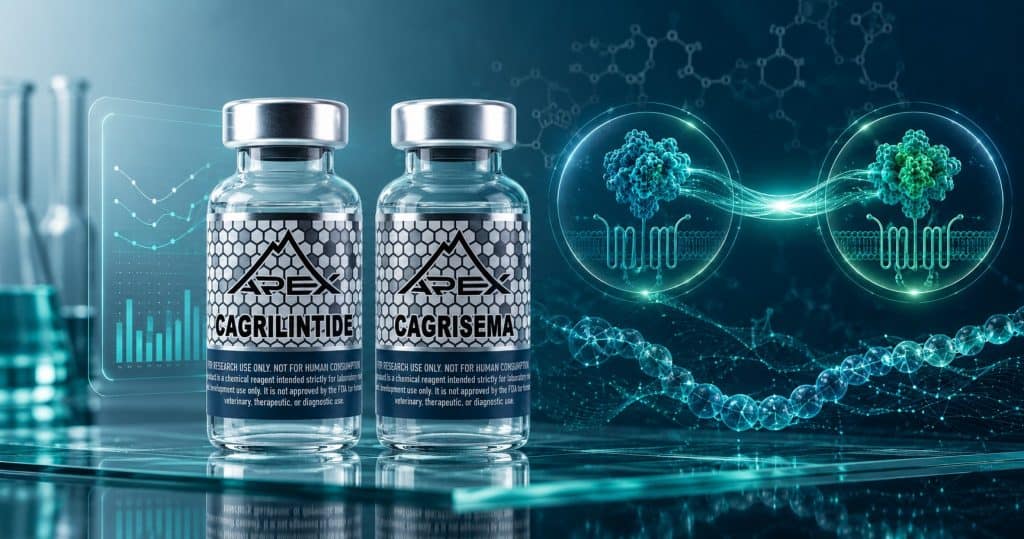
Cagrilintide (AM833) is a long-acting, lipidated, disulfide-bridged analog of the pancreatic hormone amylin that acts as a dual amylin and calcitonin receptor agonist, developed by Novo Nordisk. CagriSema is a fixed co-formulation pairing cagrilintide with the GLP-1 receptor agonist semaglutide — two distinct peptides delivered together, not a single molecule — engaging the amylin and GLP-1 satiety pathways in parallel.
Cagrilintide and CagriSema represent the amylin branch of next-generation metabolic-peptide research — a mechanistically distinct alternative to the GLP-1, GIP, and glucagon receptor strategies that define the incretin agonists.[1] Cagrilintide (AM833) is a long-acting amylin receptor agonist; CagriSema is the fixed co-formulation that combines it with the GLP-1 receptor agonist semaglutide. This guide covers amylin biology, cagrilintide’s molecular design, the monotherapy and combination research, the pivotal REDEFINE Phase 3 program, and the current regulatory picture.
A point of precision up front: CagriSema is not a single new molecule. It is two separate peptides — cagrilintide and semaglutide — delivered together, which in a research context corresponds to two distinct research-grade reagents, each with its own identity and certificate of analysis, rather than one compound with a single CAS number or molecular formula. Everything below is reported as published research data; Apex supplies cagrilintide and CagriSema only as research-grade reagents for in-vitro and preclinical use, never as pharmaceutical products or for human consumption.
Cagrilintide & CagriSema at a Glance
- Cagrilintide (AM833; CAS 1415456-99-3) is a long-acting amylin analog — a lipidated, disulfide-bridged peptide acting as a dual amylin and calcitonin receptor agonist, developed by Novo Nordisk.
- CagriSema is a fixed co-formulation of cagrilintide 2.4 mg + semaglutide 2.4 mg — two distinct peptides, not one molecule — pairing the amylin and GLP-1 satiety pathways.
- In a Phase 2 monotherapy trial, cagrilintide 4.5 mg reached about 10.8% mean weight loss at 26 weeks versus 3.0% on placebo.
- In the pivotal REDEFINE 1 Phase 3 trial (obesity, no diabetes), CagriSema produced a 22.7% mean weight reduction by the trial-product estimand (20.4% by the treatment-policy estimand) versus placebo at 68 weeks.
- In REDEFINE 2 (obesity with type 2 diabetes), the treatment-policy estimand showed 13.7% mean weight loss versus 3.4% on placebo (15.7% vs 3.1% by the trial-product estimand).
- Neither cagrilintide nor CagriSema is FDA-approved; Novo Nordisk filed a CagriSema NDA in December 2025, with FDA review expected in 2026. Apex supplies both as ≥99% (HPLC + MS verified) research reagents only.
Cagrilintide (AM833) — and CagriSema
What Are Cagrilintide and CagriSema?
Cagrilintide, designated AM833, is a synthetic long-acting analog of amylin, a pancreatic beta-cell hormone co-secreted with insulin. It carries CAS number 1415456-99-3 and is catalogued in PubChem under CID 171397054 with the molecular formula C194H312N54O59S2 and a molecular weight near 4,409 Da. It was developed by Novo Nordisk and studied both as a monotherapy candidate and, more prominently, in combination with the GLP-1 receptor agonist semaglutide.
CagriSema is that combination: a fixed co-formulation of cagrilintide 2.4 mg with semaglutide 2.4 mg. The two peptides are distinct molecules with distinct identities — semaglutide is the GLP-1 analog with its own CAS number (910463-68-2) and molecular weight (about 4,113.6 g/mol). Because CagriSema is two peptides rather than one, it has no single CAS number, molecular formula, or molecular weight; in research handling, the two components are treated as two separate reagents, each verified on its own certificate of analysis.
Amylin Biology and the Amylin Receptors
Amylin is the satiety arm of the islet hormones. Co-secreted with insulin from pancreatic beta cells, it slows gastric emptying, suppresses glucagon secretion, and promotes satiety through central pathways. Lutz, a long-standing authority on amylin physiology, traces how the amylin satiety story developed and the pharmacology that motivated amylin receptor agonists,[1] and Eržen and colleagues review amylin as a neuroendocrine hormone and the rationale for amylin receptor agonists complementing GLP-1-based approaches in obesity and diabetes research.[2]
The amylin receptors themselves are an instructive piece of pharmacology. Hay and colleagues described how the calcitonin receptor (a class B GPCR) combines with receptor-activity-modifying proteins (RAMP1, RAMP2, RAMP3) to generate the AMY1, AMY2, and AMY3 amylin-receptor phenotypes — the molecular composition that any amylin analog must engage.[3] Cagrilintide also retains intrinsic calcitonin-receptor agonism, which is why it is described as a dual amylin/calcitonin receptor agonist rather than a pure amylin agonist.
Cagrilintide: A Long-Acting Amylin Analog
Amylin/calcitonin receptor agonism, engineered for once-weekly action
Cagrilintide engages the calcitonin-receptor-plus-RAMP amylin receptors (AMY1/2/3) and the calcitonin receptor itself, acting on area-postrema and hypothalamic circuits associated with satiety and slowed gastric emptying. It was engineered from an aggregation-resistant, pramlintide-like backbone with substitutions relative to native amylin, an intramolecular disulfide bridge, a C-terminal amide, and an N-terminal acylation with a C20 fatty-diacid attached via a gamma-glutamyl linker — the lipidation that confers albumin binding and a once-weekly profile. Described as a research-context mechanism only.
The molecular design was reported by Kruse and colleagues, who described the development of cagrilintide as a long-acting amylin analog built for an extended duration of action.[4] More recently, Cao and colleagues used cryo-electron microscopy to resolve how the lipidated analog engages the calcitonin and amylin receptor complexes, clarifying the structural basis of its dual amylin/calcitonin agonism.[5] These structural and design features — the disulfide bridge, the C20 lipidation — are exactly why mass-spectrometric identity confirmation matters for the molecule.
Cagrilintide Monotherapy Research
Before it became the amylin half of CagriSema, cagrilintide was studied on its own. Lau and colleagues reported a multicentre, randomized, double-blind, placebo- and active-controlled Phase 2 dose-finding trial in 706 adults with overweight or obesity: over 26 weeks, once-weekly cagrilintide produced dose-dependent weight loss, with the 4.5 mg dose reaching about 10.8% mean reduction versus 3.0% on placebo, and a liraglutide 3.0 mg active-comparator arm reaching roughly 9.0%.[6] The dose-dependent monotherapy signal established cagrilintide as an active weight-management agent in its own right and set the stage for the combination work.
CagriSema: Amylin Plus GLP-1 Co-Administration
The combination rationale rests on amylin and GLP-1 acting through largely distinct, complementary appetite-regulatory pathways, so engaging both may recruit parallel satiety signals rather than simply intensifying one. The foundational pharmacology came from Enebo and colleagues, who reported a Phase 1b trial of concomitant cagrilintide and semaglutide 2.4 mg in adults with overweight, establishing the combination’s pharmacokinetics and tolerability and reporting additive weight loss — up to about 17.1% with cagrilintide 2.4 mg plus semaglutide 2.4 mg versus roughly 9.8% with semaglutide alone.[7]
Friás and colleagues then examined the higher fixed pairing of cagrilintide 2.4 mg with semaglutide 2.4 mg in a Phase 2 trial in type 2 diabetes: the combination produced about 15.6% mean weight loss versus 8.1% with cagrilintide alone and 5.1% with semaglutide alone, with an HbA1c reduction of about 2.2 percentage points on the combination.[8] The combination’s weight advantage over each single component was the headline; on HbA1c, the combination’s reduction was greater than cagrilintide alone but not statistically superior to semaglutide alone. These are documented trial findings, not efficacy endorsements.
The REDEFINE Phase 3 Program
The pivotal CagriSema evidence comes from the REDEFINE program. A note on how to read it: modern obesity trials report two “estimands.” The trial-product estimand estimates the effect if participants adhered to treatment; the treatment-policy estimand reflects the effect regardless of adherence. REDEFINE results differ by which estimand is quoted, so each figure below is labeled.
Garvey and colleagues reported REDEFINE 1, in 3,417 adults with obesity or overweight without type 2 diabetes: at week 68, mean body-weight change with CagriSema was −22.7% by the trial-product estimand (versus −2.3% placebo) and −20.4% by the treatment-policy estimand (versus −3.0% placebo), with 97.6% of adherent participants achieving at least 5% weight loss.[9] Notably, although the result was statistically superior to placebo, the 22.7% figure was widely characterized as “below expectation” relative to the roughly 25% the developer had previously guided; that framing dates to the December 2024 topline announcement, which triggered a sharp share-price decline, with full publication following in 2025.
Davies and colleagues reported REDEFINE 2, in 1,206 adults with obesity or overweight and type 2 diabetes: by the treatment-policy estimand, mean weight loss was 13.7% with CagriSema versus 3.4% with placebo at week 68 (15.7% versus 3.1% by the trial-product estimand), with significant glycemic improvements and at least 20% weight loss reached by 22.9% of the CagriSema group versus 0.5% on placebo (treatment-policy).[10] Both REDEFINE trials are now peer-reviewed publications.
Regulatory Status
As of this writing, neither cagrilintide (as a monotherapy) nor CagriSema is approved by the FDA, the EMA, or any other regulator. Novo Nordisk filed a United States New Drug Application for CagriSema for chronic weight management in December 2025, based on the REDEFINE program; the FDA is expected to review the application during 2026, and analyst estimates of a decision around late 2026 are speculation rather than a confirmed action date. A pending application is not an authorization. The principle that the same molecule occupies categorically distinct regulatory and supply contexts is laid out in research-grade vs pharmaceutical-grade peptides; Apex supplies cagrilintide and CagriSema only as research-grade reagents for in-vitro and preclinical use.
How CagriSema Compares to the Incretin Agonists
CagriSema’s combination strategy is fundamentally different from the incretin co-agonists: rather than engaging multiple incretin/glucagon receptors with one molecule, it pairs an amylin agonist with a GLP-1 agonist. The table places it next to the receptor-defined incretin compounds.
Where Cagrilintide and CagriSema Sit
| Compound | Pathway(s) | Strategy |
|---|---|---|
| Cagrilintide | Amylin + calcitonin receptors | Single amylin-analog molecule |
| CagriSema | Amylin + GLP-1 | Two-peptide co-formulation (cagrilintide + semaglutide) |
| Tirzepatide | GIP + GLP-1 | Single dual-incretin molecule |
| Survodutide / Mazdutide | GLP-1 + glucagon | Single dual-agonist molecule |
| Retatrutide | GIP + GLP-1 + glucagon | Single triple-agonist molecule |
The amylin branch is treated as complementary to — not redundant with — GLP-1 agonism because the two systems engage partly non-overlapping satiety circuits.[2] Whether the combined signal is strictly additive or genuinely synergistic is a question the literature is still resolving, which is exactly what the early combination pharmacology was designed to probe.[7] For the incretin alternatives, see the next-generation GLP-1 research peptides overview, the retatrutide research guide, and the semaglutide research guide for the GLP-1 component of CagriSema itself.
Safety and Tolerability (Research Context)
Across the cagrilintide and CagriSema trials the dominant tolerability signal is gastrointestinal — nausea, constipation, vomiting, and diarrhea — consistent with the amylin and GLP-1 mechanisms. In the Phase 1b combination trial, gastrointestinal disorders accounted for a substantial share of recorded adverse events, most mild to moderate in severity, with stepwise dose escalation used to manage tolerability.[7] The Phase 2 monotherapy and REDEFINE Phase 3 trials reported the same on-target gastrointestinal-weighted pattern.[6] These are documented observations in the studied trial populations, reported for research context only; they are not patient guidance and not a safety statement about the research-grade reagents.
Sourcing Research-Grade Cagrilintide & CagriSema
For amylin-pathway and combination research, both reagents should be sourced as documented research-grade material with identity confirmed by mass spectrometry — especially important for cagrilintide, a lipidated, disulfide-bridged peptide where structural integrity is consequential. Apex supplies cagrilintide and the CagriSema co-formulation verified to ≥99% purity by reversed-phase HPLC with identity confirmation by electrospray-ionization mass spectrometry, with per-lot certificates of analysis through the lab-verified COA archive. For the CagriSema co-formulation, each component — cagrilintide and semaglutide — is handled and verified as a separate reagent against its own lot-specific COA. See the primers on reading a certificate of analysis and HPLC testing for peptide purity, plus the reconstitution guide.
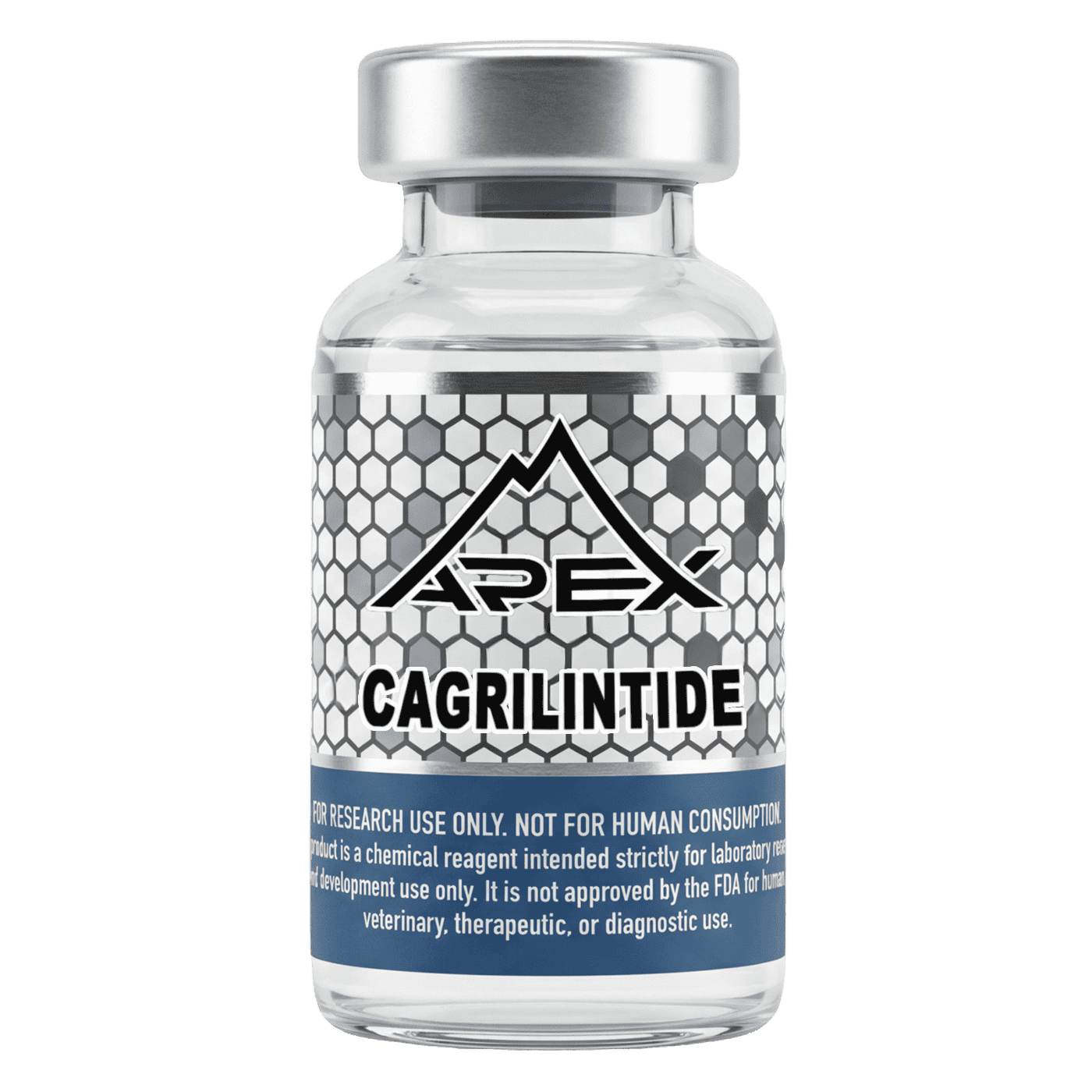
Cagrilintide (AM833)
Research-grade long-acting amylin receptor agonist — verified to ≥99% purity by HPLC and mass spectrometry, with a per-lot certificate of analysis. Supplied strictly for in-vitro and preclinical research.
View Cagrilintide →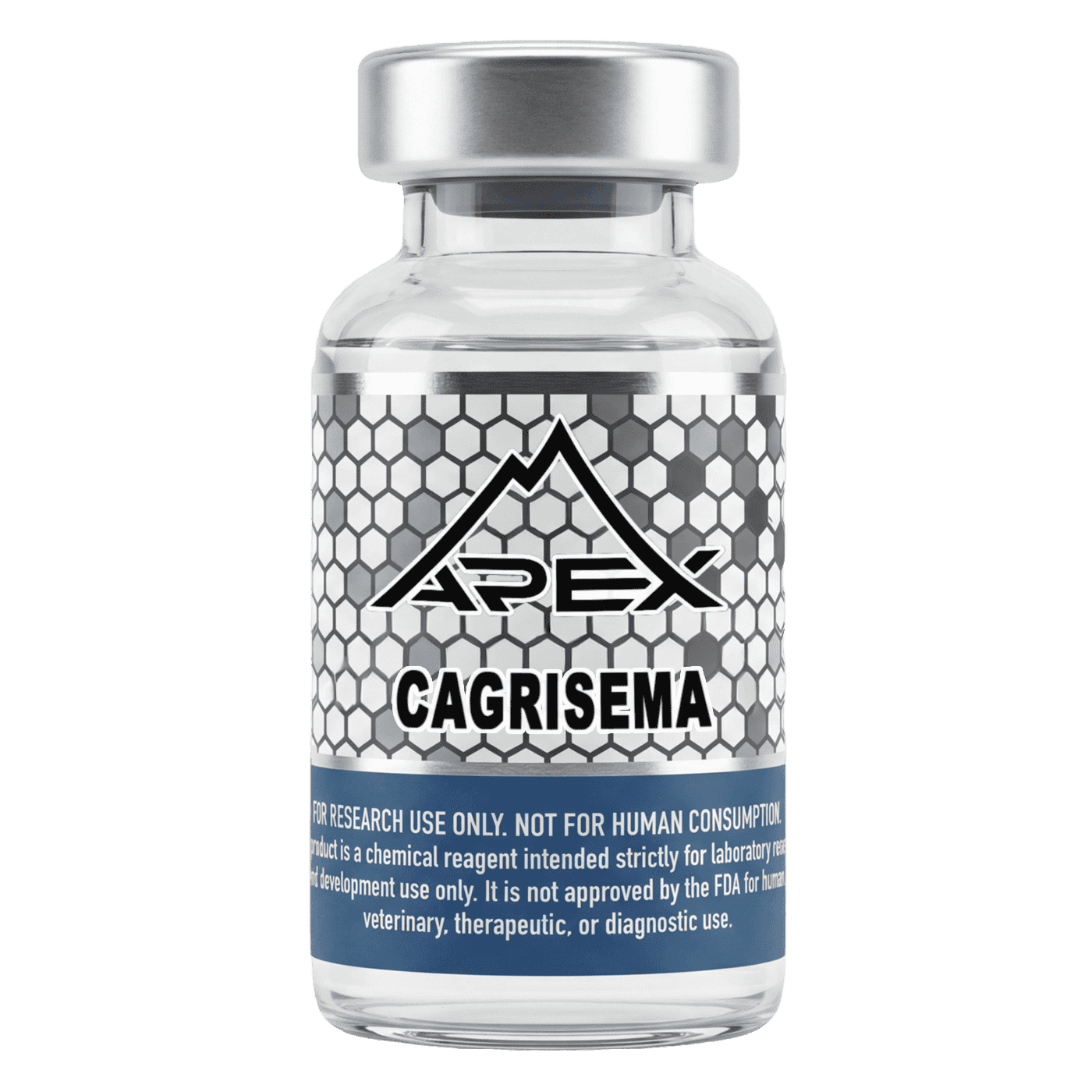
CagriSema (Cagrilintide + Semaglutide)
Research-grade amylin-plus-GLP-1 co-formulation — two peptides verified to ≥99% purity by HPLC and mass spectrometry, each against its own per-lot certificate of analysis. Supplied strictly for in-vitro and preclinical research.
View CagriSema →Frequently Asked Questions
What is cagrilintide?
Cagrilintide (development code AM833, CAS 1415456-99-3) is a synthetic long-acting analog of the pancreatic hormone amylin, engineered as a lipidated, disulfide-bridged peptide that acts as a dual amylin and calcitonin receptor agonist. It was developed by Novo Nordisk. Apex Laboratory supplies it as a research-grade chemical reagent for in-vitro and preclinical research only.
What is CagriSema, and is it one molecule?
CagriSema is a fixed co-formulation pairing cagrilintide 2.4 mg with the GLP-1 receptor agonist semaglutide 2.4 mg. It is not a single molecule: it is two distinct peptides delivered together, so it has no single CAS number, molecular formula, or molecular weight. In research handling the two components are treated as two separate reagents, each verified against its own certificate of analysis.
How does cagrilintide work?
Cagrilintide engages the amylin receptors, which form when the calcitonin receptor combines with receptor-activity-modifying proteins (RAMP1/2/3) to create the AMY1/2/3 phenotypes, and it retains calcitonin-receptor agonism (Hay 2004; Cao 2025). Amylin signaling acts on area-postrema and hypothalamic satiety circuits and slows gastric emptying (Lutz 2022). Its C20 fatty-diacid lipidation supports once-weekly dosing (Kruse 2021). These are research-context mechanisms, not effects of the research reagent.
What did the REDEFINE 1 trial show?
REDEFINE 1 (Garvey et al. 2025), in 3,417 adults with obesity or overweight without type 2 diabetes, reported a mean body-weight change of -22.7% with CagriSema by the trial-product estimand (-20.4% by the treatment-policy estimand) versus placebo at week 68, with 97.6% of adherent participants achieving at least 5% weight loss. Although superior to placebo, the 22.7% figure was widely described as below the developer’s prior ~25% expectation. These are documented trial results.
What did REDEFINE 2 show?
REDEFINE 2 (Davies et al. 2025), in 1,206 adults with obesity or overweight and type 2 diabetes, reported mean weight loss of 13.7% with CagriSema versus 3.4% with placebo at week 68 by the treatment-policy estimand (15.7% versus 3.1% by the trial-product estimand), with significant glycemic improvements and at least 20% weight loss in 22.9% of the CagriSema group versus 0.5% on placebo. These are research findings, not clinical guidance.
Is CagriSema FDA-approved?
No. Neither cagrilintide nor CagriSema is approved by the FDA, EMA, or any other regulator. Novo Nordisk filed a US New Drug Application for CagriSema for chronic weight management in December 2025, and the FDA is expected to review it during 2026; a pending application is not an approval, and no confirmed decision date has been published. The research-grade cagrilintide and CagriSema supplied by Apex are chemical reagents for laboratory research only.
How does cagrilintide differ from native amylin and pramlintide?
Native amylin is prone to aggregation, which limits its use; pramlintide was an earlier, less aggregation-prone amylin analog requiring frequent dosing. Cagrilintide was engineered from an aggregation-resistant, pramlintide-like backbone with substitutions relative to native amylin plus a C20 fatty-diacid acylation via a gamma-glutamyl linker, conferring albumin binding and a once-weekly profile (Kruse 2021). It is also a dual amylin/calcitonin receptor agonist.
How is research-grade cagrilintide verified and stored?
Apex supplies cagrilintide at greater-than-or-equal-to 99 percent purity, characterized by reversed-phase HPLC for purity and electrospray-ionization mass spectrometry for identity, with a per-lot certificate of analysis. As a lyophilized, lipidated, disulfide-bridged peptide it is stored at minus 20 degrees Celsius, protected from light and moisture, and reconstituted per the receiving laboratory’s standard operating procedure for in-vitro use only. For the CagriSema co-formulation, cagrilintide and semaglutide are each verified and handled as separate reagents.
Continue Your Research
Related GLP-1 & Metabolic Research Guides
Next-Generation GLP-1 Peptides
The class overview situating the amylin branch among dual and triple incretin agonists.
Open HubSemaglutide Research Guide
The GLP-1 receptor agonist that forms the second half of the CagriSema co-formulation.
Read GuideRetatrutide Research Guide
A single-molecule triple agonist — a contrasting strategy to CagriSema’s two-peptide approach.
Read GuideApex Research Library
The full catalog of mechanism-level research guides across the Apex compound library.
Browse LibraryReferences
All citations were verified against the published record via the NCBI E-utilities API for existence, correct attribution, and support of the associated claim. Each links to its PubMed record.
- Lutz TA Creating the amylin story. Appetite. 2022;172:105965. PMID: 35183619
- Eržen S, Tonin G, Jurišić Eržen D, Klen J Amylin, Another Important Neuroendocrine Hormone for the Treatment of Diabesity. Int J Mol Sci. 2024;25(3). PMID: 38338796
- Hay DL, Christopoulos G, Christopoulos A, Sexton PM Amylin receptors: molecular composition and pharmacology. Biochem Soc Trans. 2004;32(Pt 5):865-7. PMID: 15494035
- Kruse T, Hansen JL, Dahl K, Schäffer L, Sensfuss U, Poulsen C, et al. Development of Cagrilintide, a Long-Acting Amylin Analogue. J Med Chem. 2021;64(15):11183-11194. PMID: 34288673
- Cao J, Belousoff MJ, Johnson RM, Keov P, Mariam Z, Deganutti G, et al. Structural and dynamic features of cagrilintide binding to calcitonin and amylin receptors. Nat Commun. 2025;16(1):3389. PMID: 40204768
- Lau DCW, Erichsen L, Francisco AM, Satylganova A, le Roux CW, McGowan B, et al. Once-weekly cagrilintide for weight management in people with overweight and obesity: a multicentre, randomised, double-blind, placebo-controlled and active-controlled, dose-finding phase 2 trial. Lancet. 2021;398(10317):2160-2172. PMID: 34798060
- Enebo LB, Berthelsen KK, Kankam M, Lund MT, Rubino DM, Satylganova A, et al. Safety, tolerability, pharmacokinetics, and pharmacodynamics of concomitant administration of multiple doses of cagrilintide with semaglutide 2·4 mg for weight management: a randomised, controlled, phase 1b trial. Lancet. 2021;397(10286):1736-1748. PMID: 33894838
- Frias JP, Deenadayalan S, Erichsen L, Knop FK, Lingvay I, Macura S, et al. Efficacy and safety of co-administered once-weekly cagrilintide 2·4 mg with once-weekly semaglutide 2·4 mg in type 2 diabetes: a multicentre, randomised, double-blind, active-controlled, phase 2 trial. Lancet. 2023;402(10403):720-730. PMID: 37364590
- Garvey WT, Blüher M, Osorto Contreras CK, Davies MJ, Winning Lehmann E, Pietiläinen KH, et al. Coadministered Cagrilintide and Semaglutide in Adults with Overweight or Obesity. N Engl J Med. 2025;393(7):635-647. PMID: 40544433
- Davies MJ, Bajaj HS, Broholm C, Eliasen A, Garvey WT, le Roux CW, et al. Cagrilintide-Semaglutide in Adults with Overweight or Obesity and Type 2 Diabetes. N Engl J Med. 2025;393(7):648-659. PMID: 40544432
Research Use Disclaimer
Cagrilintide, CagriSema, and the information in this guide are intended strictly for in-vitro and preclinical laboratory research. Both are research-grade chemical reagents and are not drugs, dietary supplements, or therapeutic products; neither is approved by the FDA, EMA, or any other regulator, and the December 2025 CagriSema FDA filing is a pending application, not an authorization. They are not for human or veterinary consumption, diagnosis, treatment, or any clinical use. CagriSema is a two-peptide co-formulation, not a single molecule, and is handled as two separate reagents. The amylin, combination, and REDEFINE Phase 3 findings cited derive from clinical-research and preclinical studies and are presented for research context only; they do not constitute therapeutic, efficacy, or safety claims and describe the compounds as studied in those trials, not the research-grade reagents. Researchers are responsible for compliance with all applicable institutional, local, and national regulations governing the acquisition, handling, and use of research chemicals.