
Survodutide (BI 456906) is a synthetic acylated peptide that acts as a unimolecular dual agonist of the glucagon receptor (GCGR) and the glucagon-like peptide-1 (GLP-1) receptor, discovered by Zealand Pharma and developed by Boehringer Ingelheim. It pairs GLP-1-driven appetite and glucose effects with glucagon-receptor activation associated with energy expenditure and hepatic lipid metabolism, and is studied in obesity and metabolic dysfunction-associated steatohepatitis (MASH) research programs.
Survodutide, designated BI 456906, is one of the two dual GLP-1/glucagon receptor agonists in the next-generation incretin class.[1] It sits one mechanistic step beyond the single-agonist and GIP/GLP-1 compounds: rather than adding a second incretin receptor, it adds the glucagon receptor, a design intended to recruit hepatic and energy-expenditure pathways alongside the appetite and glucose effects of GLP-1.[2] This guide covers its molecular identity, the dual-receptor mechanism, the obesity and MASH research programs, how it differs from the other compounds in the class, and its regulatory status.
Everything here is reported as published clinical-trial and company-disclosed research data. Apex Laboratory supplies survodutide only as a research-grade chemical reagent for in-vitro and preclinical investigation; nothing below is a therapeutic claim, a description of the reagent’s effects, or human-use guidance. For the wider class context, see the next-generation GLP-1 research peptides overview and the GLP-1 and metabolic research hub.
Survodutide at a Glance
- Survodutide (BI 456906; CAS 2805997-46-8) is a unimolecular dual glucagon receptor (GCGR) and GLP-1 receptor agonist, discovered by Zealand Pharma and licensed to Boehringer Ingelheim, which leads its development.
- It is an acylated peptide carrying a fatty-acid side chain for albumin binding and a once-weekly subcutaneous half-life of roughly six to seven days.
- In a Phase 2 dose-finding obesity trial, the 4.8 mg arm reached about 14.9% mean body-weight reduction at 46 weeks versus about 2.8% on placebo.
- In a Phase 2 trial in biopsy-confirmed MASH, MASH improvement without worsening fibrosis was reported in 47%, 62%, and 43% of dose groups versus 14% on placebo.
- The pivotal SYNCHRONIZE-1 Phase 3 obesity trial reported up to 16.6% mean weight loss at 76 weeks in its April 2026 company topline; the MASH program (LIVERAGE and LIVERAGE-Cirrhosis) is ongoing.
- Survodutide is investigational and NOT approved by the FDA, EMA, or any regulator; it holds FDA Fast Track and Breakthrough Therapy designations for MASH. Apex supplies it as a ≥99% (HPLC + MS verified) research reagent only.
Survodutide (BI 456906)
What Is Survodutide? Molecular Identity
Survodutide is a synthetic, acylated peptide engineered on a glucagon-peptide backbone to activate two class B (secretin-family) G-protein-coupled receptors at once: the glucagon receptor (GCGR) and the GLP-1 receptor (GLP-1R). It carries CAS number 2805997-46-8 and the development code BI 456906, and is catalogued in PubChem under CID 171378821 with molecular formula C192H289N47O61. The molecule was discovered by Zealand Pharma and out-licensed to Boehringer Ingelheim, which leads its global development.
Like the other long-acting incretin analogs, survodutide carries a fatty-acid (lipid) modification that binds it to circulating albumin, extending its half-life to roughly six to seven days and supporting the once-weekly subcutaneous dosing used throughout its trial program. Its discovery and preclinical pharmacology were reported by Zimmermann and colleagues, who described a balanced GCGR/GLP-1R dual agonist with robust anti-obesity activity in preclinical models.[1]
Dual GLP-1/Glucagon Receptor Mechanism
GCGR + GLP-1R co-agonism on class B GPCRs
GLP-1 receptor activation couples to Gαs, raising intracellular cAMP, potentiating glucose-dependent insulin secretion, slowing gastric emptying, and reducing food intake. Glucagon receptor (GCGR) activation, also Gαs/cAMP-coupled, is associated in the co-agonism literature with increased energy expenditure and hepatic lipid mobilization. The engineering objective, reviewed by Hope and colleagues, is to balance the GLP-1-to-glucagon ratio so the GLP-1 arm offsets glucagon’s counter-regulatory effect on glucose while the glucagon arm contributes the added energy-expenditure and liver signals. Described as a research-context mechanism only.
The Glucagon Arm Is the Differentiator
The feature that separates survodutide from a GIP/GLP-1 co-agonist such as tirzepatide is the glucagon-receptor component. Zimmermann and colleagues reported that in preclinical models the combination of GLP-1R-driven reductions in food intake with GCGR-driven increases in energy expenditure produced weight reduction exceeding that of maximal GLP-1 agonism alone.[1] Thomas and colleagues subsequently characterized the molecule’s pharmacological profile and the target-engagement biomarkers — including FGF-21 and circulating amino acids — used to track glucagon-receptor activity during clinical candidate selection.[3] Because unopposed glucagon agonism can raise blood glucose, the balanced design in which GLP-1R activity offsets that effect is central to the compound’s research rationale.
Survodutide Obesity Research
The obesity program is the most mature of survodutide’s research streams. le Roux and colleagues reported a randomized, double-blind, placebo-controlled, dose-finding Phase 2 trial in adults with obesity, in which once-weekly survodutide produced dose-dependent body-weight reductions over 46 weeks; the 4.8 mg arm reached a mean reduction of about 14.9% versus roughly 2.8% on placebo.[4] Wharton and colleagues then published the rationale and design of the two pivotal Phase 3 obesity trials, SYNCHRONIZE-1 and SYNCHRONIZE-2, establishing the registrational program.[5]
SYNCHRONIZE-1, conducted in adults with obesity or overweight without type 2 diabetes, reported its topline in April 2026: up to 16.6% mean body-weight reduction at 76 weeks versus about 3.2% on placebo, with the majority of treated participants achieving at least 5% weight loss. Those figures are company-disclosed topline results that had not yet been peer-reviewed published at the time of writing, with full data expected at a scientific congress. SYNCHRONIZE-2, in people with obesity and type 2 diabetes, has reached the published-baseline-characteristics stage as reported by Wharton and colleagues, with its efficacy readout still pending.[6] A dedicated cardiovascular-outcomes trial design has also been published.[7]
Survodutide MASH and Liver Research
The glucagon arm gives survodutide a strong rationale in liver research, and metabolic dysfunction-associated steatohepatitis (MASH) is its second major program. Sanyal and colleagues reported a 48-week Phase 2 randomized trial in adults with biopsy-confirmed MASH and fibrosis: MASH improvement without worsening of fibrosis was documented in 47%, 62%, and 43% of the 2.4 mg, 4.8 mg, and 6.0 mg dose groups respectively, versus 14% on placebo, with dose groups also showing fibrosis improvement.[8] The mechanistic premise — that glucagon-receptor agonism lowers hepatic fat through increased energy expenditure and lipid handling — is the same one that motivates the dual-agonist design.
Because chronic liver disease populations include people with hepatic impairment, Lawitz and colleagues characterized the pharmacokinetics and tolerability of survodutide across cirrhosis severity strata, supporting the hepatic-impairment dosing rationale for the liver program.[9] The pivotal MASH evidence is being generated in two ongoing Phase 3 trials — LIVERAGE (in non-cirrhotic MASH with fibrosis stages 2 or 3) and LIVERAGE-Cirrhosis (in compensated MASH cirrhosis) — neither of which had reported efficacy at the time of writing.
Type 2 Diabetes Research
Survodutide has also been studied in type 2 diabetes. Blüher and colleagues reported a Phase 2 trial examining dose-response effects on HbA1c and body weight across a survodutide dose range, with an open-label semaglutide arm as an active reference; the trial documented dose-dependent glycemic and weight effects.[10] The inclusion of a semaglutide comparator is one reason survodutide is frequently discussed within a “beyond single-agonist GLP-1” framing in the research literature, though the two were not the subject of a formal head-to-head superiority design.
How Survodutide Compares to Other Incretin Agonists
Survodutide is best understood by its receptor targets relative to the rest of the class. The table places it alongside the single-agonist, GIP/GLP-1, other GLP-1/glucagon, and triple-agonist compounds; for the other dual GLP-1/glucagon agonist, see the dedicated mazdutide research guide, and the next-generation GLP-1 research peptides overview for a side-by-side of the whole class.
Where Survodutide Sits
| Compound | Receptor targets | Developer |
|---|---|---|
| Semaglutide | GLP-1 (single) | Novo Nordisk |
| Tirzepatide | GIP + GLP-1 | Eli Lilly |
| Survodutide | GLP-1 + glucagon | Zealand / Boehringer Ingelheim |
| Mazdutide | GLP-1 + glucagon (oxyntomodulin analog) | Innovent / Eli Lilly |
| Retatrutide | GIP + GLP-1 + glucagon | Eli Lilly |
Survodutide and mazdutide share the GLP-1/glucagon target pair but come from different programs and backbones; survodutide is built on a glucagon-peptide backbone, while mazdutide is an oxyntomodulin analog. Both differ from tirzepatide (which adds GIP rather than glucagon) and from retatrutide (which adds both GIP and glucagon to GLP-1). The single-agonist baseline is semaglutide.
Regulatory Status
As of this writing, survodutide is investigational and not approved by the FDA, the EMA, or any other regulator for any indication. In the United States it holds FDA Fast Track designation for MASH and, granted in 2024, Breakthrough Therapy designation for non-cirrhotic MASH with moderate-to-advanced fibrosis. It is important to be precise about what those designations mean: they are mechanisms to expedite development and review of an investigational candidate, not marketing approvals. The principle that the same molecule can occupy categorically distinct regulatory and supply contexts is laid out in research-grade vs pharmaceutical-grade peptides; Apex supplies survodutide only as a research-grade reagent for in-vitro and preclinical use.
Safety and Tolerability (Research Context)
Across survodutide’s published trials, the dominant tolerability signal is gastrointestinal — the same on-target pattern reported for the broader incretin class. In the Phase 2 obesity dose-finding trial, adverse events were predominantly gastrointestinal and occurred more frequently with survodutide than placebo, with all tested doses described by the investigators as tolerated within a stepwise dose-escalation schedule.[4] The Phase 2 MASH trial likewise documented gastrointestinal events as the most common class.[8] These are documented observations in the studied trial populations, reported here for research context only; they are not patient guidance and not a safety statement about the research-grade reagent.
Sourcing Research-Grade Survodutide
For laboratories studying dual GLP-1/glucagon pharmacology, survodutide should be sourced as documented research-grade material with identity confirmed by mass spectrometry — valuable for an acylated peptide where truncation or deletion impurities are possible. Apex supplies survodutide as a lyophilized reagent verified to ≥99% purity by reversed-phase HPLC with identity confirmation by electrospray-ionization mass spectrometry, with a per-lot certificate of analysis through the lab-verified COA archive. See the primers on reading a certificate of analysis and HPLC testing for peptide purity, and the reconstitution and storage guides for laboratory handling.
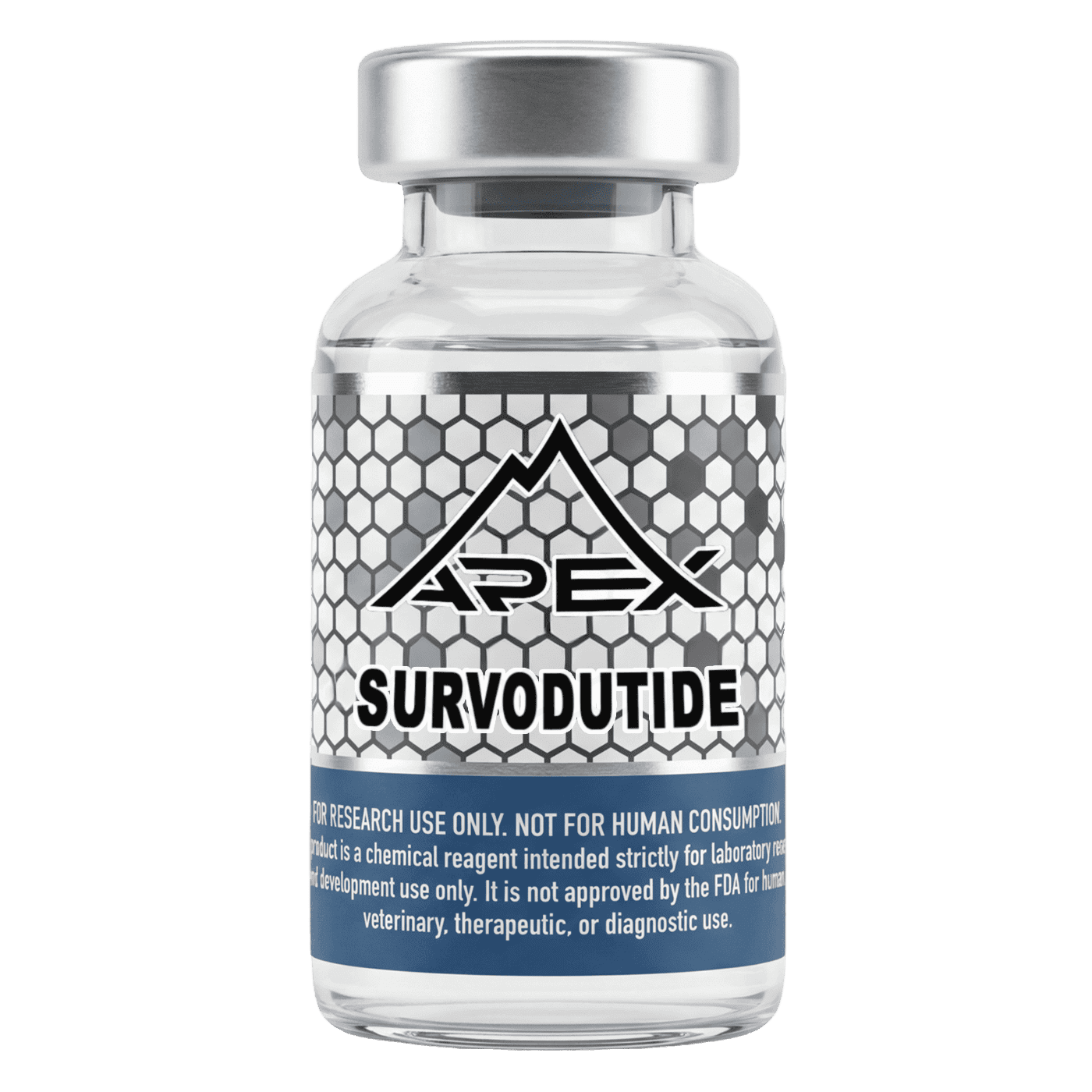
Survodutide (BI 456906)
Research-grade dual GLP-1/glucagon receptor agonist — verified to ≥99% purity by HPLC and mass spectrometry, with a per-lot certificate of analysis. Supplied strictly for in-vitro and preclinical research.
View Survodutide →Frequently Asked Questions
What is survodutide?
Survodutide (development code BI 456906, CAS 2805997-46-8) is a synthetic acylated peptide that acts as a unimolecular dual agonist of the glucagon receptor (GCGR) and the GLP-1 receptor. It was discovered by Zealand Pharma and is developed by Boehringer Ingelheim. Apex Laboratory supplies it as a research-grade chemical reagent for in-vitro and preclinical research only; it is not a pharmaceutical product.
How does survodutide’s dual GLP-1/glucagon mechanism work?
GLP-1 receptor activation promotes glucose-dependent insulin secretion, slows gastric emptying, and reduces food intake; glucagon receptor activation is associated in the literature with increased energy expenditure and hepatic lipid mobilization. Survodutide is engineered to balance the two so the GLP-1 arm offsets glucagon’s counter-regulatory effect on glucose (Zimmermann 2022; Hope 2021). This is described as a research-context mechanism, not a therapeutic effect of the reagent.
What weight loss did survodutide show in trials?
In a Phase 2 dose-finding obesity trial, the 4.8 mg arm reached about 14.9% mean body-weight reduction at 46 weeks versus roughly 2.8% on placebo (le Roux 2024). The pivotal SYNCHRONIZE-1 Phase 3 obesity trial reported up to 16.6% mean weight loss at 76 weeks in its April 2026 company topline, which had not yet been peer-reviewed published at the time of writing. These are documented trial observations, not efficacy claims for the research reagent.
What did the survodutide MASH trial show?
In a 48-week Phase 2 trial in biopsy-confirmed MASH with fibrosis, MASH improvement without worsening of fibrosis was reported in 47%, 62%, and 43% of the 2.4 mg, 4.8 mg, and 6.0 mg dose groups versus 14% on placebo, with fibrosis improvement also observed (Sanyal 2024, NEJM). The pivotal LIVERAGE and LIVERAGE-Cirrhosis Phase 3 trials are ongoing. These are research findings, not clinical guidance.
Is survodutide FDA-approved?
No. Survodutide is investigational and not approved by the FDA, EMA, or any other regulator for any indication. It holds FDA Fast Track and, since 2024, Breakthrough Therapy designation for non-cirrhotic MASH with moderate-to-advanced fibrosis, but these designations expedite review and are not approvals. The research-grade survodutide supplied by Apex is a chemical reagent for laboratory research only.
What is the difference between survodutide and mazdutide?
Both are dual GLP-1/glucagon receptor agonists, but they originate from different programs and backbones. Survodutide (BI 456906) is built on a glucagon-peptide backbone and developed by Boehringer Ingelheim under license from Zealand Pharma. Mazdutide (LY3305677 / IBI362) is an oxyntomodulin analog developed by Innovent Biologics under license from Eli Lilly, with its approval and study activity concentrated in China. Their regulatory paths also differ.
What are survodutide’s reported side effects?
In the published trials the dominant adverse-event signal is gastrointestinal, consistent with the on-target incretin and glucagon mechanism; the Phase 2 obesity and MASH trials both documented gastrointestinal events as the most common class, managed with stepwise dose escalation. These are documented trial observations for research context only, not patient guidance or a safety statement about the research-grade reagent.
How is research-grade survodutide verified and stored?
Apex supplies survodutide at greater-than-or-equal-to 99 percent purity, characterized by reversed-phase HPLC for purity and electrospray-ionization mass spectrometry for identity, with a per-lot certificate of analysis. As a lyophilized peptide it is stored at minus 20 degrees Celsius, protected from light and moisture, and reconstituted per the receiving laboratory’s standard operating procedure for in-vitro use only.
Continue Your Research
Related GLP-1 & Metabolic Research Guides
Next-Generation GLP-1 Peptides
The class overview situating survodutide among dual GLP-1/glucagon and amylin research agonists.
Open HubMazdutide Research Guide
The other dual GLP-1/glucagon agonist — an oxyntomodulin analog, approved in China.
Read GuideRetatrutide Research Guide
The triple GIP/GLP-1/glucagon agonist that extends the dual design one receptor further.
Read GuideApex Research Library
The full catalog of mechanism-level research guides across the Apex compound library.
Browse LibraryReferences
All citations were verified against the published record via the NCBI E-utilities API for existence, correct attribution, and support of the associated claim. Each links to its PubMed record.
- Zimmermann T, Thomas L, Baader-Pagler T, Haebel P, Simon E, Reindl W, et al. BI 456906: Discovery and preclinical pharmacology of a novel GCGR/GLP-1R dual agonist with robust anti-obesity efficacy. Mol Metab. 2022;66:101633. PMID: 36356832
- Hope DCD, Vincent ML, Tan TMM Striking the Balance: GLP-1/Glucagon Co-Agonism as a Treatment Strategy for Obesity. Front Endocrinol (Lausanne). 2021;12:735019. PMID: 34566894
- Thomas L, Martel E, Rist W, Uphues I, Hamprecht D, Neubauer H, et al. The dual GCGR/GLP-1R agonist survodutide: Biomarkers and pharmacological profiling for clinical candidate selection. Diabetes Obes Metab. 2024;26(6):2368-2378. PMID: 38560764
- le Roux CW, Steen O, Lucas KJ, Startseva E, Unseld A, Hennige AM Glucagon and GLP-1 receptor dual agonist survodutide for obesity: a randomised, double-blind, placebo-controlled, dose-finding phase 2 trial. Lancet Diabetes Endocrinol. 2024;12(3):162-173. PMID: 38330987
- Wharton S, le Roux CW, Kosiborod MN, Platz E, Brueckmann M, Jastreboff AM, et al. Survodutide for treatment of obesity: rationale and design of two randomized phase 3 clinical trials (SYNCHRONIZE™-1 and -2). Obesity (Silver Spring). 2025;33(1):67-77. PMID: 39495965
- Wharton S, le Roux CW, Bozkurt B, Platz E, Bleckert G, Ajaz Hussain S, et al. Baseline characteristics in the SYNCHRONIZE™-2 randomized phase 3 trial of survodutide, a glucagon receptor/GLP-1 receptor dual agonist, for obesity in people with type 2 diabetes. Diabetes Obes Metab. 2026;28(2):1490-1498. PMID: 41216778
- Kosiborod MN, Platz E, Wharton S, le Roux CW, Brueckmann M, Ajaz Hussain S, et al. Survodutide for the Treatment of Obesity: Rationale and Design of the SYNCHRONIZE Cardiovascular Outcomes Trial. JACC Heart Fail. 2024;12(12):2101-2109. PMID: 39453356
- Sanyal AJ, Bedossa P, Fraessdorf M, Neff GW, Lawitz E, Bugianesi E, et al. A Phase 2 Randomized Trial of Survodutide in MASH and Fibrosis. N Engl J Med. 2024;391(4):311-319. PMID: 38847460
- Lawitz EJ, Fraessdorf M, Neff GW, Schattenberg JM, Noureddin M, Alkhouri N, et al. Efficacy, tolerability and pharmacokinetics of survodutide, a glucagon/glucagon-like peptide-1 receptor dual agonist, in cirrhosis. J Hepatol. 2024;81(5):837-846. PMID: 38857788
- Blüher M, Rosenstock J, Hoefler J, Manuel R, Hennige AM Dose-response effects on HbA(1c) and bodyweight reduction of survodutide, a dual glucagon/GLP-1 receptor agonist, compared with placebo and open-label semaglutide in people with type 2 diabetes: a randomised clinical trial. Diabetologia. 2024;67(3):470-482. PMID: 38095657
Research Use Disclaimer
Survodutide and the information in this guide are intended strictly for in-vitro and preclinical laboratory research. Survodutide is a research-grade chemical reagent and is not a drug, dietary supplement, or therapeutic product; it is investigational and not approved by the FDA, EMA, or any other regulator for any use. It is not for human or veterinary consumption, diagnosis, treatment, or any clinical use. The SYNCHRONIZE-1 topline figures summarized here are company-disclosed clinical-trial data that had not been peer-reviewed published at the time of writing; the mechanistic, obesity, MASH, and diabetes findings cited derive from clinical-research and preclinical studies and are presented for research context only. They do not constitute therapeutic, efficacy, or safety claims and describe the investigational pharmaceutical candidate studied in those trials, not the research-grade reagent. Researchers are responsible for compliance with all applicable institutional, local, and national regulations governing the acquisition, handling, and use of research chemicals.