
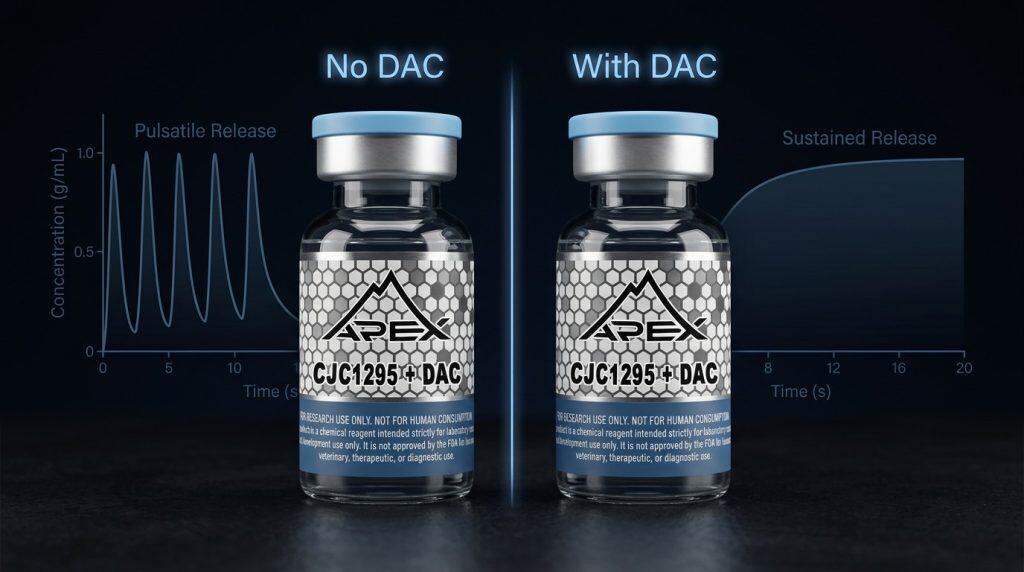
CJC-1295 is one of the most widely used GHRH (growth hormone-releasing hormone) analogs in research, but it comes in two distinct versions that produce fundamentally different GH release patterns — and confusing them is one of the most common errors in GH-axis research protocols. CJC-1295 without DAC (also called Mod GRF 1-29) produces pulsatile GH release. CJC-1295 with DAC produces sustained GH elevation. Same base peptide, profoundly different pharmacokinetics and research applications.
This guide explains both versions in detail — their molecular structures, the mechanism of the DAC modification, the pharmacological consequences for GH release kinetics, published data, and how to choose the right version for your specific research protocol.
The Base Peptide: What Is CJC-1295?
CJC-1295 is a synthetic 30-amino acid peptide analog of native GHRH. It was developed by modifying the first 29 amino acids of human GHRH (1-29) to create a compound with improved metabolic stability — specifically, resistance to DPP-4 (dipeptidyl peptidase-4) enzymatic degradation that rapidly inactivates native GHRH in circulation. The modified version is also known as Mod GRF 1-29 or Modified GRF (1-29) in research literature.
Base CJC-1295 (Mod GRF 1-29) Specifications
- CAS Registry Number: 863288-34-0
- Molecular Weight (No DAC): 3,367.97 g/mol
- Molecular Weight (With DAC): ~3,647.28 g/mol (includes the DAC conjugate)
- Peptide Length: 30 amino acids (29 modified GHRH residues + modifications)
- Target Receptor: GHRH receptor (GHRHR) on anterior pituitary somatotrophs
- Mechanism: Stimulates GH gene transcription, GH synthesis, and GH release from somatotroph cells
The key modifications that distinguish CJC-1295 from native GHRH(1-29) include amino acid substitutions at positions 2, 8, 15, and 27 that provide resistance to enzymatic degradation. These substitutions extend the effective research half-life from the ~7 minutes of native GHRH to approximately 30 minutes for the No DAC version. Published pharmacokinetic characterization by Teichman et al. (2006) in the Journal of Clinical Endocrinology & Metabolism documented these properties.
CJC-1295 Without DAC (Mod GRF 1-29): Pulsatile GH Release
CJC-1295 No DAC is the base modified GHRH analog without any further conjugation. When administered in research protocols, it activates the GHRH receptor, stimulates a pulse of GH release from pituitary somatotrophs, and is then cleared from circulation within approximately 30 minutes. The resulting GH release pattern is pulsatile — a sharp spike followed by a return to baseline.
Why Pulsatile Release Matters
The physiological pattern of endogenous GH secretion is pulsatile — the pituitary releases GH in discrete bursts (primarily during sleep), not as a continuous stream. This pulsatile pattern is biologically significant because GH receptors in target tissues undergo desensitization with continuous exposure but remain responsive to intermittent stimulation. CJC-1295 No DAC mimics this natural pulsatile pattern more closely than the DAC version, making it the preferred choice for research protocols designed to study physiological GH signaling dynamics.
Best Research Applications for No DAC Version
- Studies examining natural GH pulsatility and its downstream effects
- Combination protocols with Ipamorelin or other GH secretagogues (the pulsatile nature complements secretagogue-mediated GH amplification)
- Protocols requiring precise timing control of GH peaks
- Research examining GH receptor sensitivity and desensitization kinetics
CJC-1295 With DAC: Sustained GH Elevation
CJC-1295 with DAC is the same base peptide conjugated with a Drug Affinity Complex (DAC) — a reactive chemical group (maleimidopropionic acid) that covalently binds to serum albumin after administration. This albumin conjugation dramatically extends the compound’s circulating half-life from ~30 minutes to approximately 6-8 days, because the peptide-albumin complex is too large for renal filtration and is protected from enzymatic degradation by the albumin carrier.
The DAC Technology
The Drug Affinity Complex is a bioconjugation technology — specifically a maleimide group that reacts with the free cysteine (Cys-34) residue on human serum albumin, forming a stable thioether bond. Once this bond forms, the CJC-1295 peptide rides along with the albumin molecule, which has a natural circulating half-life of approximately 21 days. The practical result is that a single administration of CJC-1295 with DAC produces sustained, continuous GHRH receptor stimulation for days rather than minutes.
GH Release Pattern: Sustained Elevation
Unlike the sharp pulse produced by the No DAC version, CJC-1295 with DAC produces a sustained elevation of GH levels — a gentle, prolonged increase that remains above baseline for several days. This is fundamentally different from physiological pulsatile secretion and produces distinct downstream signaling consequences in GH target tissues.
Best Research Applications for DAC Version
- Studies examining the effects of sustained (non-pulsatile) GH elevation
- Protocols where infrequent administration is desirable (once-weekly research schedules)
- Pharmacokinetic studies comparing pulsatile vs sustained GHRH receptor activation
- Research on GH receptor desensitization under continuous stimulation conditions
Shop CJC-1295 Products at Apex Laboratory
CJC-1295 No DAC (Mod GRF 1-29) · CJC-1295 with DAC · CJC-1295 + Ipamorelin Blend — All ≥99% purity, HPLC & Mass Spec verified, same-day shipping.
Head-to-Head: No DAC vs With DAC
The following comparison summarizes the key practical differences between the two CJC-1295 versions to help researchers select the appropriate compound for their specific protocol:
- Molecular weight: No DAC is ~3,367 g/mol. With DAC is ~3,647 g/mol (includes the maleimide conjugation group before albumin binding).
- Effective half-life: No DAC is ~30 minutes. With DAC is ~6-8 days (after albumin binding).
- GH release pattern: No DAC produces sharp, pulsatile GH spikes. With DAC produces sustained, continuous GH elevation.
- Administration frequency in research: No DAC is typically used 1-3 times daily. With DAC is typically used once per week or less.
- Physiological relevance: No DAC more closely mimics natural pulsatile GH secretion. With DAC produces a non-physiological sustained pattern.
- Combination compatibility: No DAC pairs well with GH secretagogues like Ipamorelin (complementary pulsatile timing). With DAC is typically used as a standalone long-acting GHRH stimulator.
CJC-1295 in the GHRH Analog Landscape
CJC-1295 is one of several GHRH analogs available for research. Understanding how it compares to other GHRH-pathway compounds helps researchers select the optimal tool for their specific question:
vs Sermorelin
Sermorelin (CAS: 86168-78-7, MW: 3,357 g/mol) is the simplest GHRH analog — the unmodified first 29 amino acids of native GHRH with minimal stabilization. It has a shorter effective half-life than CJC-1295 No DAC and is more rapidly cleared. Sermorelin is FDA-approved as a diagnostic agent (Geref), giving it the most established regulatory history of any GHRH analog. It produces the most physiologically natural pulsatile pattern but requires more frequent administration.
vs Tesamorelin
Tesamorelin (CAS: 218949-48-5, MW: 5,135 g/mol) is the full-length GHRH(1-44) with a trans-3-hexenoic acid N-terminal modification for enhanced stability. It is larger than CJC-1295 and FDA-approved as Egrifta for HIV-associated lipodystrophy, making it the only GHRH analog with an FDA-approved metabolic indication. Its published dataset from clinical trials (NEJM, JAMA) is the most robust of any GHRH analog.
Storage, Handling, and Reconstitution
Both Versions — Lyophilized Storage
Store both CJC-1295 versions at -20°C in their original sealed vials. Both are medium-sized peptides (~3,300-3,600 g/mol) with good lyophilized stability for 12-18+ months. See our Peptide Storage Guide for complete protocols.
Reconstitution
Both versions dissolve readily in bacteriostatic water. For a 2 mg vial, adding 2 mL produces a concentration of 1 mg/mL (1,000 mcg/mL). Use our reconstitution calculator for custom volumes or follow our reconstitution protocol.
After Reconstitution
Store at 2-8°C. CJC-1295 No DAC: use within 14 days. CJC-1295 with DAC: use within 21 days (the DAC group provides slight additional solution stability). Aliquot for frozen storage at -20°C.
Frequently Asked Questions
What does DAC stand for in CJC-1295 with DAC?
DAC stands for Drug Affinity Complex — a reactive maleimide group attached to the CJC-1295 peptide that covalently bonds to serum albumin (specifically to the Cys-34 residue) after administration. This albumin conjugation extends the compound’s effective half-life from approximately 30 minutes to 6-8 days by creating a large peptide-albumin complex resistant to renal clearance and enzymatic degradation.
Which version should I use for combination research with Ipamorelin?
CJC-1295 No DAC (Mod GRF 1-29) is the standard choice for combination protocols with Ipamorelin. Its pulsatile GH release pattern complements Ipamorelin’s ghrelin-mediated GH amplification, and the similar short durations of both compounds allow for timed, synchronized GH pulse research. Apex Laboratory offers a pre-blended CJC-1295 + Ipamorelin Blend for this purpose.
Is CJC-1295 the same as Mod GRF 1-29?
CJC-1295 without DAC and Mod GRF 1-29 (Modified GRF 1-29) refer to the same compound — the modified GHRH(1-29) analog with DPP-4 resistant amino acid substitutions. CJC-1295 with DAC is a further-modified version that adds the Drug Affinity Complex for albumin binding. The naming can be confusing, but in practice: “CJC-1295 No DAC” = “Mod GRF 1-29” (pulsatile, short-acting). “CJC-1295 with DAC” = albumin-binding long-acting version (sustained, long-acting).
What is the CAS number for CJC-1295?
Both versions share the base peptide CAS registry number 863288-34-0. The No DAC version has a molecular weight of ~3,367.97 g/mol, while the DAC version is ~3,647.28 g/mol (reflecting the additional DAC conjugate mass).
Is either version of CJC-1295 approved for human use?
No. Neither CJC-1295 with DAC nor CJC-1295 without DAC has been approved by the FDA or any regulatory agency for human therapeutic use. Both versions sold by Apex Laboratory are classified as research chemicals intended strictly for in-vitro laboratory research.
Continue Your Research
- Ipamorelin Research Guide: The Selective Growth Hormone Secretagogue
- TB-500 (Thymosin Beta-4): Mechanism, Research & Published Studies
- Retatrutide: The Triple Agonist Peptide
- Peptide Dosing Guide: How to Calculate mcg, mg & Syringe Units
Research Use Disclaimer
This article is provided for educational and research reference purposes only. CJC-1295 and all products sold by Apex Laboratory are intended exclusively for in-vitro laboratory research use and are not for human consumption. Researchers should consult the published pharmacokinetic data cited in this article for complete methodology and results.