
Adamax is a research-chemical-market nootropic peptide marketed as an adamantane-modified, N-terminally acetylated derivative of Semax — itself a synthetic analog of the ACTH(4-10) fragment developed at the Institute of Molecular Genetics of the Russian Academy of Sciences. No peer-reviewed study characterizes Adamax specifically; its proposed neurotrophic mechanism is inferred from the established Semax literature and from adamantane medicinal chemistry.
Adamax is one of the newer entries in the research-chemical nootropic market, marketed as an “improved Semax” — a peptide built on the Semax sequence and modified with an N-terminal acetyl group and an adamantane moiety. It is important to be direct about the evidence base from the outset: there is no peer-reviewed primary literature on the compound called “Adamax.” A targeted PubMed search for the adamantane-modified Semax peptide returns no results, and the compound has no PubChem entry of its own. Everything specific to “Adamax” — its exact sequence, the position of the adamantane group, its molecular weight — comes from research-chemical vendor pages, which are not peer-reviewed, disagree with one another, and are not citable scientific sources.
This guide therefore does what the evidence actually supports: it anchors on three legitimately sourced pillars — the well-characterized Semax parent literature, adamantane as a medicinal-chemistry strategy, and the melanocortin/BDNF signaling context of the ACTH-peptide family — while clearly flagging every Adamax-specific claim as supplier-reported and unverified. Apex supplies Adamax strictly as a research-grade chemical reagent for in-vitro and preclinical investigation; nothing here is a therapeutic claim or human-use guidance, and the guide makes no claim that Adamax is equivalent to Semax or to any approved medicine.
Adamax at a Glance
- Adamax is a research-chemical-market peptide marketed as an adamantane-modified, N-acetylated derivative of Semax (the ACTH(4-10) analog Met-Glu-His-Phe-Pro-Gly-Pro).
- No peer-reviewed study characterizes Adamax itself: no PubMed-indexed paper describes the adamantane-modified Semax peptide, and it has no PubChem CID. Its structural identity (CAS, molecular weight, formula) is not authoritatively established.
- Its proposed mechanism — BDNF/NGF and TrkB modulation with melanocortin (MC4R) involvement — is inferred from the Semax parent literature and from melanocortin pharmacology, not demonstrated for Adamax.
- Semax is rigorously documented to rapidly upregulate the neurotrophins BDNF and NGF and is studied in neuroprotection and cerebral-ischemia models; it is a registered medicine in Russia (since 1994) but is not FDA- or EMA-approved.
- The adamantane group is a validated medicinal-chemistry scaffold (used in amantadine and memantine) chosen to increase lipophilicity, metabolic stability, and CNS penetration — the rationale vendors cite for Adamax, demonstrated for other peptides but not for Adamax.
- Because no standardized identity exists, per-lot HPLC and mass-spectrometry verification is especially important. Apex supplies Adamax as a ≥99% (HPLC + MS verified) research reagent for in-vitro and preclinical use only.
Adamax — and the Semax Parent
What Is Adamax?
“Adamax” is a product label used in the research-chemical market, not an academically or industrially developed drug candidate. Vendors describe it as a peptide built on the Semax backbone — the ACTH(4-10)/ACTH(4-7) analog Met-Glu-His-Phe-Pro-Gly-Pro — carrying two modifications: an N-terminal acetyl group, intended to slow aminopeptidase degradation, and an adamantane (adamantyl) moiety, intended to increase lipophilicity and central-nervous-system penetration. The sequence most often quoted is Ac-MEHFPGP or Ac-MEHFPGPAG-NH2, but vendor pages are not consistent on the sequence, on the position or linkage of the adamantane group, or even on the molecular weight (quoted only as an approximate range).
The honest summary is that the compound is uncharacterized in the scientific record. No PubMed-indexed paper describes the adamantane-modified Semax peptide sold as Adamax; a targeted search returns zero results, and the unrelated hits for the bare term “Adamax” do not concern this peptide. There is no PubChem entry for it, no registered trial, and no authoritative CAS number, molecular formula, or molecular weight. For a research vendor and a research buyer, that places the entire burden of identity on the supplier’s per-lot analytical certificate — which is why this guide treats HPLC and mass-spectrometric verification as central rather than incidental.
The Semax Parent: an ACTH(4-10) Nootropic Peptide
What is well documented is Semax, the parent peptide. Semax is a synthetic heptapeptide analog of the ACTH(4-10) region of adrenocorticotropic hormone — specifically the ACTH(4-7) fragment (Met-Glu-His-Phe) extended with a C-terminal Pro-Gly-Pro motif that resists enzymatic degradation. It was developed at the Institute of Molecular Genetics of the Russian Academy of Sciences. Crucially, as Tsai notes, Semax retains the behavioral and neurotrophic activity associated with that ACTH region while being essentially devoid of the parent hormone’s corticotropic (steroid-releasing) activity[1] — the property that makes it a nootropic-research peptide rather than a hormone. (That paper is a hypothesis review, cited here for framing rather than as primary experimental data.)
Semax is also the legitimate regulatory reference point for the family: it is a registered medicine in the Russian Federation (since 1994) for cerebrovascular and ischemic indications, but it is not approved by the FDA, the EMA, or any other Western regulator. The companion Selank & Semax research guide covers the parent peptide’s pharmacology in full; the sections below summarize the mechanism that any Semax-derived molecule would be expected to inherit.
Semax Mechanism: BDNF, NGF and Neuroprotection
Rapid BDNF / NGF upregulation and TrkB signaling
The signature action of Semax is rapid induction of the neurotrophins BDNF and NGF — the growth factors that support neuronal survival and synaptic plasticity. In research models Semax raises neurotrophin messenger RNA within minutes in glia, increases hippocampal BDNF and TrkB-receptor signaling after intranasal administration, and activates neurotrophin transcription under ischemic stress. It additionally engages dopaminergic and serotonergic systems and binds copper(II). These are documented mechanisms of the parent Semax peptide in cell and animal research, not demonstrated properties of Adamax.
The neurotrophin findings are well replicated. Shadrina and colleagues reported that Semax rapidly and strongly induces BDNF and NGF messenger RNA in rat glial cultures within hours,[2] Dolotov and colleagues showed that a single intranasal Semax administration increases hippocampal BDNF and TrkB-receptor expression and binds specific basal-forebrain sites while raising BDNF protein,[3][4] and Agapova and colleagues documented Semax-driven changes in neurotrophin gene expression in the brain.[5] Because BDNF and NGF are central to neuronal survival and plasticity, this neurotrophin upregulation is the leading candidate mechanism behind the nootropic and neuroprotective effects reported for the Semax family.
Semax is most studied in cerebral ischemia. Dmitrieva and colleagues showed that Semax (and its Pro-Gly-Pro fragment) activate the transcription of neurotrophins and their receptors after cerebral ischemia,[6] Eremin and colleagues reported that Semax activates dopaminergic and serotonergic systems with nootropic effects in rodents,[7] and Tabbì and colleagues showed Semax binds copper(II) with high affinity and protects against copper-induced toxicity — a coordination-chemistry contribution to its neuroprotection.[8] Clinically, Gusev and colleagues reported, in a moderate-sized (n=110), mostly open-label Russian study, that Semax aided recovery across stages of ischemic stroke[9] — evidence that informs the parent peptide’s Russian registration and is presented here strictly as research context.
Adamantane Modification: a Medicinal-Chemistry Strategy
The “adamantane” half of Adamax refers to a genuine and well-established medicinal-chemistry strategy, even though it has not been characterized for this particular molecule. Adamantane is a rigid, cage-like hydrocarbon scaffold prized for raising a molecule’s lipophilicity, metabolic stability, and central-nervous-system penetration. Spilovska and colleagues review adamantane as a lead structure in clinically used drugs,[10] and Lamoureux and colleagues survey its use across medicinal chemistry for exactly those ADME and CNS-tropism benefits.[11] The clearest concrete demonstration is amantadine: Kornhuber and colleagues showed that this adamantane drug reaches therapeutic concentrations in brain tissue[12] — evidence that an adamantane group can carry a molecule into the CNS.
The strategy has been applied to neurotrophic peptides specifically. Li and colleagues reported that incorporating adamantane into a neurotrophic peptide (the compound P21, a ciliary-neurotrophic-factor-derived peptide — not a Semax analog) yielded a peripherally active molecule that improved learning and memory and promoted neurogenesis and synaptic plasticity in mice.[13] Dembitsky and colleagues review adamantane-scaffold compounds as candidates for neurodegenerative disease.[14] This body of work is the strongest available precedent for the design rationale Adamax claims — but it concerns other molecules. It establishes that adamantane modification is a plausible CNS-targeting strategy; it does not establish anything about Adamax in particular, which remains uncharacterized.
Melanocortin and MC4R-BDNF Signaling Context
Because Semax derives from ACTH — a melanocortin-family hormone — the melanocortin-4 receptor (MC4R) is a plausible upstream node linking the ACTH-peptide family to BDNF. Nicholson and colleagues showed that MC4R activation stimulates hypothalamic BDNF release,[15] and Caruso and colleagues demonstrated that MC4R activation induces BDNF expression in astrocytes through the cyclic-AMP/protein-kinase-A pathway.[16] At the systems level, Giuliani and colleagues review the broad neuroprotective and neuroregenerative effects of MC4R agonists across experimental neurodegenerative models.[17]
This melanocortin-to-BDNF axis is the receptor-level context vendors invoke when they describe Adamax as acting through “MC4R activation plus BDNF/TrkB” signaling. The pathway is real and is documented for the melanocortin family; whether and how strongly Adamax engages it is unstudied. The responsible reading is that the melanocortin/BDNF context makes the proposed mechanism biologically plausible for a Semax-derived peptide, without elevating it to a demonstrated property of Adamax.
What Is and Isn’t Known About Adamax
It is worth drawing the line explicitly. Established (parent Semax): the heptapeptide identity, the BDNF/NGF/TrkB neurotrophic mechanism, neuroprotection in ischemia models, monoaminergic and copper-binding activity, and Russian clinical use and registration. Established (adamantane chemistry): that the scaffold improves lipophilicity, stability, and CNS penetration, with amantadine and memantine as clinical precedents and an adamantane neurotrophic peptide demonstrated in mice.
Not established (Adamax specifically): any peer-reviewed characterization at all — no confirmed sequence, no CAS number, no molecular weight or formula, no PubChem entry, no pharmacology study, no potency or selectivity data, no pharmacokinetics, and no controlled efficacy or safety data. Vendor claims about dosing, half-life, or potency are supplier-reported and unverifiable. For a researcher, this means Adamax should be approached as an uncharacterized research material whose identity must be established empirically for each lot, not assumed from its marketing description. It also means that any experiment using Adamax should treat its structure as a hypothesis to be confirmed by analysis, not a given.
Regulatory Status
Adamax has no regulatory status anywhere: no FDA or EMA approval, no filing, and no clinical-trial registry entry. Its parent, Semax, is a registered medicine in the Russian Federation (since 1994) for cerebrovascular and ischemic indications but is likewise not approved by the FDA, the EMA, or any other Western authority. There is no FDA-approved pharmaceutical formulation of Adamax or of Semax, so — unlike compounds such as semaglutide or tirzepatide, where a research-grade reagent and an approved drug share a molecule — there is no pharmaceutical counterpart to compare against here. Apex supplies Adamax solely as a research-grade chemical reagent for in-vitro and preclinical laboratory research, never as a drug, supplement, or therapy, and never for human or veterinary use.
Sourcing Research-Grade Adamax
For an uncharacterized peptide with no standardized identity, analytical verification is not a nicety — it is the only way to know what is in the vial. Apex supplies Adamax as a lyophilized reagent verified to ≥99% purity by reversed-phase HPLC with identity confirmation by electrospray-ionization mass spectrometry, with a per-lot certificate of analysis through the lab-verified COA archive; the measured mass on that certificate is the operative identity statement for a compound that has none in the public literature. See the primers on reading a certificate of analysis and HPLC testing for peptide purity, and the reconstitution and storage guides for laboratory handling. Researchers comparing Adamax against its parent can source Semax from the same catalog.
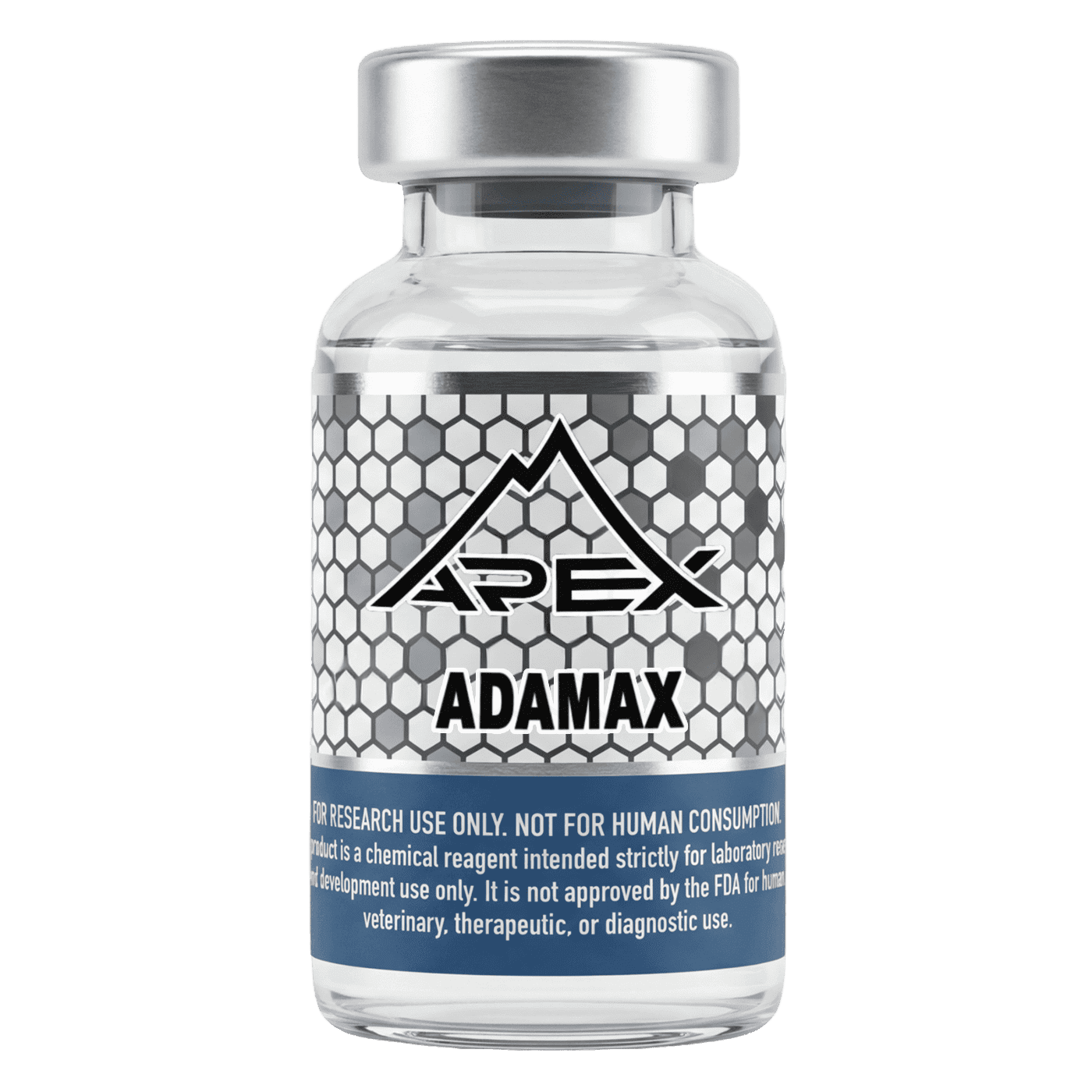
Adamax
Research-grade adamantane-modified Semax-derivative nootropic peptide — verified to ≥99% purity by HPLC and mass spectrometry, with a per-lot certificate of analysis that documents the measured mass for a compound without a standardized public identity. Supplied strictly for in-vitro and preclinical research.
View Adamax →Frequently Asked Questions
What is Adamax?
Adamax is a research-chemical-market nootropic peptide marketed as an adamantane-modified, N-terminally acetylated derivative of Semax (the ACTH(4-10) analog Met-Glu-His-Phe-Pro-Gly-Pro, developed at the Institute of Molecular Genetics of the Russian Academy of Sciences). It is a supplier-defined product rather than an academically characterized compound. Apex Laboratory supplies it as a research-grade chemical reagent for in-vitro and preclinical research only.
Is there any peer-reviewed research on Adamax?
No. No PubMed-indexed paper describes the adamantane-modified Semax peptide sold as Adamax, it has no PubChem entry, and there are no registered trials. Everything specific to Adamax comes from research-chemical vendor pages, which are not peer-reviewed and disagree on basic details. The legitimate science is the parent compound, Semax, plus the general medicinal chemistry of adamantane modification.
What is the proposed mechanism of Adamax?
Vendors describe Adamax as acting through BDNF/NGF and TrkB modulation with melanocortin (MC4R) involvement. That mechanism is inferred from the Semax parent, which rapidly upregulates BDNF and NGF and raises hippocampal TrkB signaling (Shadrina 2001; Dolotov 2006), and from melanocortin pharmacology, where MC4R activation drives BDNF expression (Nicholson 2007; Caruso 2012). It is biologically plausible for a Semax-derived peptide but has not been demonstrated for Adamax itself.
How is Adamax different from Semax?
Adamax is marketed as Semax modified with an N-terminal acetyl group (to slow degradation) and an adamantane moiety (to increase lipophilicity and CNS penetration). Semax itself is a thoroughly studied heptapeptide with a known structure (CAS 80714-61-0, MW 813.9), whereas Adamax’s exact structure, molecular weight, and CAS number are not authoritatively established. In short, Semax is characterized; Adamax, as sold, is not.
Why is adamantane used in peptide design?
Adamantane is a rigid cage-like scaffold that increases lipophilicity, metabolic stability, and central-nervous-system penetration; it appears in clinically used drugs such as amantadine and memantine (Spilovska 2016; Lamoureux 2010), and amantadine is documented to reach therapeutic brain concentrations (Kornhuber 1995). Incorporating adamantane into a neurotrophic peptide produced a CNS-active, memory-enhancing compound in mice (Li 2010, a different peptide). This validates the strategy in general, not Adamax in particular.
Does Adamax have an established molecular weight or CAS number?
No. There is no authoritative CAS number, molecular formula, or molecular weight for Adamax, and no PubChem CID. Vendors quote only an approximate, inconsistent molecular-weight range (around 984 to 1032 g/mol), which should be treated as supplier-reported and unverified. Because of this, per-lot mass-spectrometric confirmation on the certificate of analysis is the operative identity statement for the material.
Is Adamax FDA-approved or the same as an approved drug?
No. Adamax has no regulatory approval anywhere and no FDA-approved pharmaceutical counterpart. Its parent Semax is a registered medicine in Russia (since 1994) but is not approved by the FDA or EMA. The research-grade Adamax supplied by Apex is a chemical reagent for in-vitro and preclinical research only; it is not a drug, supplement, or therapy and is not for human or veterinary use.
How should research-grade Adamax be verified and stored?
Because Adamax has no standardized public identity, analytical verification is essential: Apex characterizes it by reversed-phase HPLC for purity (greater than or equal to 99 percent) and electrospray-ionization mass spectrometry for the measured mass, documented on a per-lot certificate of analysis. As a lyophilized peptide it is stored at minus 20 degrees Celsius, protected from light and moisture, and reconstituted per the receiving laboratory’s standard operating procedure for in-vitro use only.
Continue Your Research
Related Nootropic & CNS Research Guides
Nootropic & CNS Research Peptides
The cluster hub situating Adamax and Semax among nootropic and neuroprotective research reagents.
Open HubSelank & Semax Research Guide
The parent Semax peptide in full — its BDNF/NGF mechanism and Russian clinical record.
Read GuideSemax (Parent Peptide)
Source the characterized parent compound for side-by-side research against Adamax.
View SemaxApex Research Library
The full catalog of mechanism-level research guides across the Apex compound library.
Browse LibraryReferences
All citations were verified against the published record via the NCBI E-utilities API for existence, correct attribution, and support of the associated claim. Each links to its PubMed record.
- Tsai SJ Semax, an analogue of adrenocorticotropin (4-10), is a potential agent for the treatment of attention-deficit hyperactivity disorder and Rett syndrome. Med Hypotheses. 2007;68(5):1144-6. PMID: 16996699
- Shadrina MI, Dolotov OV, Grivennikov IA, Slominsky PA, Andreeva LA, Inozemtseva LS, et al. Rapid induction of neurotrophin mRNAs in rat glial cell cultures by Semax, an adrenocorticotropic hormone analog. Neurosci Lett. 2001;308(2):115-8. PMID: 11457573
- Dolotov OV, Karpenko EA, Inozemtseva LS, Seredenina TS, Levitskaya NG, Rozyczka J, et al. Semax, an analog of ACTH(4-10) with cognitive effects, regulates BDNF and trkB expression in the rat hippocampus. Brain Res. 2006;1117(1):54-60. PMID: 16996037
- Dolotov OV, Karpenko EA, Seredenina TS, Inozemtseva LS, Levitskaya NG, Zolotarev YA, et al. Semax, an analogue of adrenocorticotropin (4-10), binds specifically and increases levels of brain-derived neurotrophic factor protein in rat basal forebrain. J Neurochem. 2006;97 Suppl 1:82-6. PMID: 16635254
- Agapova TY, Agniullin YV, Shadrina MI, Shram SI, Slominsky PA, Lymborska SA, et al. Neurotrophin gene expression in rat brain under the action of Semax, an analogue of ACTH 4-10. Neurosci Lett. 2007;417(2):201-5. PMID: 17353092
- Dmitrieva VG, Povarova OV, Skvortsova VI, Limborska SA, Myasoedov NF, Dergunova LV Semax and Pro-Gly-Pro activate the transcription of neurotrophins and their receptor genes after cerebral ischemia. Cell Mol Neurobiol. 2010;30(1):71-9. PMID: 19633950
- Eremin KO, Kudrin VS, Saransaari P, Oja SS, Grivennikov IA, Myasoedov NF, et al. Semax, an ACTH(4-10) analogue with nootropic properties, activates dopaminergic and serotoninergic brain systems in rodents. Neurochem Res. 2005;30(12):1493-500. PMID: 16362768
- Tabbì G, Magrì A, Giuffrida A, Lanza V, Pappalardo G, Naletova I, et al. Semax, an ACTH4-10 peptide analog with high affinity for copper(II) ion and protective ability against metal induced cell toxicity. J Inorg Biochem. 2015;142:39-46. PMID: 25310602
- Gusev EI, Martynov MY, Kostenko EV, Petrova LV, Bobyreva SN [The efficacy of semax in the tretament of patients at different stages of ischemic stroke]. Zh Nevrol Psikhiatr Im S S Korsakova. 2018;118(3. Vyp. 2):61-68. PMID: 29798983
- Spilovska K, Zemek F, Korabecny J, Nepovimova E, Soukup O, Windisch M, et al. Adamantane – A Lead Structure for Drugs in Clinical Practice. Curr Med Chem. 2016;23(29):3245-3266. PMID: 27222266
- Lamoureux G, Artavia G Use of the adamantane structure in medicinal chemistry. Curr Med Chem. 2010;17(26):2967-78. PMID: 20858176
- Kornhuber J, Quack G, Danysz W, Jellinger K, Danielczyk W, Gsell W, et al. Therapeutic brain concentration of the NMDA receptor antagonist amantadine. Neuropharmacology. 1995;34(7):713-21. PMID: 8532138
- Li B, Wanka L, Blanchard J, Liu F, Chohan MO, Iqbal K, et al. Neurotrophic peptides incorporating adamantane improve learning and memory, promote neurogenesis and synaptic plasticity in mice. FEBS Lett. 2010;584(15):3359-65. PMID: 20600002
- Dembitsky VM, Gloriozova TA, Poroikov VV Pharmacological profile of natural and synthetic compounds with rigid adamantane-based scaffolds as potential agents for the treatment of neurodegenerative diseases. Biochem Biophys Res Commun. 2020;529(4):1225-1241. PMID: 32819589
- Nicholson JR, Peter JC, Lecourt AC, Barde YA, Hofbauer KG Melanocortin-4 receptor activation stimulates hypothalamic brain-derived neurotrophic factor release to regulate food intake, body temperature and cardiovascular function. J Neuroendocrinol. 2007;19(12):974-82. PMID: 18001327
- Caruso C, Carniglia L, Durand D, Gonzalez PV, Scimonelli TN, Lasaga M Melanocortin 4 receptor activation induces brain-derived neurotrophic factor expression in rat astrocytes through cyclic AMP-protein kinase A pathway. Mol Cell Endocrinol. 2012;348(1):47-54. PMID: 21803120
- Giuliani D, Ottani A, Neri L, Zaffe D, Grieco P, Jochem J, et al. Multiple beneficial effects of melanocortin MC(4) receptor agonists in experimental neurodegenerative disorders: Therapeutic perspectives. Prog Neurobiol. 2017;148:40-56. PMID: 27916623
Research Use Disclaimer
Adamax and the information in this guide are intended strictly for in-vitro and preclinical laboratory research. Adamax is a research-grade chemical reagent and is not a drug, dietary supplement, or therapeutic product; it has no regulatory approval in any jurisdiction and no authoritatively established structural identity. It is not for human or veterinary consumption, diagnosis, treatment, or any clinical use. There is no peer-reviewed primary literature on Adamax itself; the mechanistic discussion in this guide derives from the parent compound Semax, from the general medicinal chemistry of adamantane, and from melanocortin/BDNF signaling research, and is presented for research context only. All Adamax-specific structural and mechanistic descriptions are supplier-reported and unverified. Nothing here constitutes a therapeutic, efficacy, or safety claim, nor a claim that Adamax is equivalent to Semax or to any approved medicine. Researchers are responsible for compliance with all applicable institutional, local, and national regulations governing the acquisition, handling, and use of research chemicals.