
Retatrutide (LY3437943) is a synthetic 39-amino-acid triple hormone-receptor agonist developed by Eli Lilly that simultaneously activates the glucose-dependent insulinotropic polypeptide (GIP), glucagon-like peptide-1 (GLP-1), and glucagon receptors. In the pivotal Phase 3 TRIUMPH-1 obesity trial, whose topline results Eli Lilly reported in May 2026, the highest 12 mg dose was associated with a mean body-weight reduction of roughly 28% over 80 weeks in adults with obesity and without type 2 diabetes.
On May 21, 2026, Eli Lilly reported topline results from TRIUMPH-1, the pivotal Phase 3 obesity trial of retatrutide — the first-in-class triple agonist of the GIP, GLP-1, and glucagon receptors.[1] The readout is the most-watched late-stage obesity dataset of the year, and it is the reason retatrutide has become the single most-searched compound in the Apex research catalog. This guide explains what TRIUMPH-1 measured, what the 2026 numbers actually showed, and how they extend the Phase 2 data published three years earlier.[2]
Everything below is reported strictly as published clinical-trial and company-disclosed research data. Apex Laboratory supplies retatrutide only as a research-grade chemical reagent for in-vitro and preclinical investigation; nothing here is a therapeutic claim, a description of the research reagent’s effects, or any form of human-use guidance. For the underlying mechanism and the full Phase 2 dataset, see the companion retatrutide research guide and the retatrutide vs tirzepatide comparison; this article focuses on the Phase 3 TRIUMPH-1 result itself.
TRIUMPH-1 at a Glance
- TRIUMPH-1 (ClinicalTrials.gov NCT05929066) is an 80-week, randomized, double-blind, placebo-controlled Phase 3 trial of once-weekly retatrutide in 2,339 adults with obesity or overweight and without type 2 diabetes.
- At 80 weeks, mean body-weight reduction (efficacy estimand) was approximately 19.0% at 4 mg, 25.9% at 9 mg, and 28.3% at 12 mg, versus 2.2% on placebo — as reported in Eli Lilly’s May 21, 2026 topline announcement.
- By the treatment-regimen estimand the corresponding figures were about 17.6%, 23.7%, and 25.0%, versus 3.9% on placebo.
- At 12 mg, roughly 62.5% of participants reached at least 25% weight loss and 45.3% reached at least 30% — a magnitude historically associated with bariatric surgery.
- In a 104-week extension subgroup with baseline BMI at least 35, the 12 mg group reached about 30.3% mean reduction.
- Retatrutide remains investigational and is not approved by the FDA, EMA, or any regulator; the topline data have not yet been peer-reviewed published. Apex supplies it strictly as a ≥99% (HPLC + MS verified) research reagent.
Retatrutide (LY3437943)
What Is the TRIUMPH-1 Trial?
TRIUMPH-1 is one of four Phase 3 studies in the TRIUMPH registrational program that Eli Lilly designed to evaluate retatrutide concurrently across obesity and two obesity-related complications. Giblin and colleagues set out the program’s rationale and design: the four trials enroll more than 5,800 participants and use a novel basket structure that nests obstructive sleep apnea (OSA) and knee osteoarthritis (OA) protocols inside the weight-management studies.[3]
The Four-Trial TRIUMPH Program
Within that program, TRIUMPH-1 and TRIUMPH-2 are the two weight-management basket trials (with OSA and/or OA sub-protocols), TRIUMPH-3 studies weight management in a population with established cardiovascular disease, and TRIUMPH-4 is a stand-alone knee-osteoarthritis trial. The primary endpoint for the weight-management trials is percent change in body weight; for the OSA protocol it is change in the apnea-hypopnea index, and for knee OA it is the WOMAC pain subscale.[3] TRIUMPH-1 is the largest and most closely watched of the four because it is the general-obesity readout.
TRIUMPH-1 Design and Population
TRIUMPH-1 (registered as NCT05929066) is an 80-week, randomized, double-blind, placebo-controlled trial in 2,339 adults with obesity, or overweight with a weight-related complication, and without type 2 diabetes. Participants were randomized one-to-one-to-one-to-one to once-weekly subcutaneous retatrutide 4 mg, 9 mg, or 12 mg, or to placebo, with a subset continuing into a 104-week extension. Because the trial excluded type 2 diabetes, it isolates the compound’s weight-management profile in a general-obesity research population — the same population studied in the earlier Phase 2 obesity trial.[2]
TRIUMPH-1 2026 Results Explained
The TRIUMPH-1 numbers below come from Eli Lilly’s topline disclosure of May 21, 2026. At the time of writing they are company-reported topline results that have not yet appeared as a peer-reviewed publication, so they are summarized here as disclosed trial data rather than as findings drawn from the primary literature. Full results are expected at a scientific congress and in a peer-reviewed journal.
Weight Reduction by Dose
Modern obesity trials report two complementary “estimands.” The efficacy estimand estimates the effect if participants stayed on treatment; the treatment-regimen estimand reflects the effect regardless of adherence, including people who stopped early. TRIUMPH-1 reported both, and the table summarizes the disclosed 80-week means.
Disclosed Topline Results (Eli Lilly, May 2026)
| Arm | Efficacy estimand | Treatment-regimen estimand | ≥30% weight loss |
|---|---|---|---|
| Retatrutide 4 mg | −19.0% | −17.6% | 15.3% |
| Retatrutide 9 mg | −25.9% | −23.7% | 37.9% |
| Retatrutide 12 mg | −28.3% | −25.0% | 45.3% |
| Placebo | −2.2% | −3.9% | 0.5% |
In plain terms, the disclosed efficacy-estimand mean reduction at 12 mg was about 28.3% of baseline body weight over 80 weeks, versus 2.2% on placebo, with a clear dose-response across the 4 mg, 9 mg, and 12 mg arms. These are documented trial observations in the studied population, not efficacy endorsements and not properties of the research reagent.
Categorical Weight-Loss Thresholds
Threshold (“responder”) analyses describe how many participants crossed clinically meaningful cut-points. By Lilly’s disclosure, at 12 mg roughly 62.5% reached at least 25% weight loss, 45.3% reached at least 30%, and 27.2% reached at least 35% — against 2.2%, 0.5%, and 0.3% respectively on placebo. The 30%-plus figure is the one most commentators highlight, because reductions of that magnitude have historically been associated with bariatric surgery rather than pharmacology.
The 104-Week Extension
A 532-participant extension subgroup with baseline BMI of at least 35 continued to 104 weeks. In that subgroup the disclosed efficacy-estimand mean reductions reached about 27.9% (4 mg), 29.5% (9 mg), and 30.3% (12 mg). The continued separation from placebo at two years is the longest-duration retatrutide weight dataset disclosed so far, although it is a selected subgroup rather than the full trial population and should be read with that limitation in mind.
From Phase 2 to Phase 3: The Efficacy Trajectory
The Phase 3 readout becomes more legible alongside the Phase 2 trial it follows. Jastreboff and colleagues reported the Phase 2 obesity trial of retatrutide in the New England Journal of Medicine in 2023: a randomized, double-blind, placebo-controlled, dose-finding study in adults with obesity in which the 12 mg group reached a mean body-weight reduction of approximately 24.2% at 48 weeks, with the weight curve still declining at trial end.[2] A parallel Phase 2 program in type 2 diabetes, reported by Rosenstock and colleagues in The Lancet, established dose-responsive glycemic and weight effects in that population.[4]
Reading the two phases together, the disclosed TRIUMPH-1 efficacy-estimand mean at 12 mg (about 28.3% over 80 weeks) is numerically larger than the 48-week Phase 2 figure — consistent with the longer treatment duration and the non-plateauing trajectory the Phase 2 investigators noted. The two datasets are not directly comparable (different durations, populations, and estimand conventions), so the trajectory is best described qualitatively: greater exposure time tracked with greater mean reduction in the studied populations.
The Triple-Agonist Mechanism Behind the Data
Retatrutide’s distinguishing feature is simultaneous agonism at three receptors. Coskun and colleagues characterized LY3437943 as a single peptide that activates the GIP, GLP-1, and glucagon receptors, describing the pharmacology that underpins the clinical program.[1] A fuller treatment lives in the retatrutide research guide; the brief version follows.
GIP + GLP-1 + glucagon co-agonism
GLP-1 receptor activation promotes glucose-dependent insulin secretion and reduces food intake; GIP receptor activation potentiates the incretin response and modulates adipose metabolism; and the glucagon receptor — the third arm that distinguishes retatrutide from the dual GIP/GLP-1 agonist tirzepatide — is associated in the co-agonism literature with increased energy expenditure and hepatic lipid mobilization. The engineering objective is to balance the glucagon arm so its energy-expenditure contribution is captured while GLP-1- and GIP-driven insulin secretion offset glucagon’s counter-regulatory effect on glucose. Described as a research-context mechanism only.
That added glucagon arm is also why retatrutide draws interest in hepatic-metabolism research. Pearson and colleagues reported retatrutide-associated changes in lipid and metabolite profiles in trial participants with obesity, consistent with the glucagon component’s role in lipid handling[5] — one of several non-weight research signals discussed further below. The dual GLP-1/glucagon strategy itself, without the GIP arm, is reviewed by Hope and colleagues.[6]
How TRIUMPH-1 Compares to Tirzepatide and Semaglutide
Retatrutide is the third step in a receptor-count progression: one receptor (semaglutide, GLP-1), two receptors (tirzepatide, GIP + GLP-1), and three (retatrutide).[7] The table places the disclosed TRIUMPH-1 high-dose figure next to the headline Phase 3 results reported for the established agents, with the strong caveat that these come from separate trials of different design, duration, and population and are not head-to-head comparisons.
High-Dose Mean Weight Reduction, Pivotal Obesity Trials
| Compound | Receptors | Pivotal obesity trial | Reported high-dose mean |
|---|---|---|---|
| Semaglutide | GLP-1 | STEP 1 (68 wk) | ~14.9% |
| Tirzepatide | GIP + GLP-1 | SURMOUNT-1 (72 wk) | ~20.9–22.5% |
| Retatrutide | GIP + GLP-1 + glucagon | TRIUMPH-1 (80 wk) | ~28.3% (efficacy estimand, disclosed topline) |
The cross-trial pattern is the same one the field has watched for several years: each additional receptor arm has tracked with a larger mean reduction in its respective pivotal trial. For a mechanism-level treatment of the two-versus-three-receptor question, see retatrutide vs tirzepatide; for the single-versus-dual comparison, see semaglutide vs tirzepatide and the semaglutide research guide. Retatrutide also sits within the broader next-generation GLP-1 research peptides landscape alongside the dual GLP-1/glucagon and amylin agonists.
Beyond Weight: Retatrutide’s Wider Phase 3 Program
TRIUMPH-1 is the general-obesity readout, but the Phase 3 effort extends well beyond weight. In type 2 diabetes, Bajaj and colleagues reported TRANSCEND-T2D-1, a 40-week Phase 3 monotherapy trial assessing change in HbA1c (with weight as a key secondary endpoint) — the first peer-reviewed Phase 3 retatrutide publication.[8] A separate renal program, TRANSCEND-CKD, was designed to study kidney outcomes in type 2 diabetes with chronic kidney disease.[9]
The hepatic signal is the most striking of the non-weight findings. Sanyal and colleagues reported a Phase 2a trial in adults with metabolic dysfunction-associated steatotic liver disease (MASLD), in which the highest retatrutide dose was associated with up to roughly 86% relative reduction in liver fat at 48 weeks, with most of that group reaching normal liver-fat levels.[10] That magnitude of hepatic-fat change is the clinical signal most often attributed to the glucagon arm, and it is why retatrutide is studied in liver-metabolism models as well as obesity ones.
Mechanistic substudies add further texture. Coskun and colleagues reported a Phase 2 body-composition substudy in type 2 diabetes using DXA, quantifying the share of weight change attributable to fat mass.[11] Together these programs frame retatrutide as a multi-system metabolic research compound rather than a weight-only one — which is precisely why it is studied across so many adiposity-related disease models. None of this changes its status as an investigational, unapproved agent supplied by Apex only as a research reagent.
Safety and Tolerability Signals (Research Context)
The dominant tolerability signal disclosed for TRIUMPH-1 was gastrointestinal — the same on-target pattern reported across the incretin class. By Lilly’s topline disclosure, the most common adverse events at 12 mg versus placebo were nausea (about 42.4% vs 14.8%), diarrhea (about 32.0% vs 13.5%), and vomiting (about 25.3% vs 4.8%), most commonly during dose escalation. Discontinuation due to adverse events rose with dose, reaching about 11.3% at 12 mg versus 4.9% on placebo.
These figures are documented observations in the trial population and are reported here for research context only; they are not patient guidance, not a description of what any individual would experience, and not a safety statement about the research-grade reagent. The recurring use of stepwise dose escalation across the retatrutide program is itself a study-design feature aimed at managing that gastrointestinal profile, as the Phase 2 trials also reported.[2]
Regulatory Status and What Comes Next
TRIUMPH-1 was not the program’s first Phase 3 readout. That was TRIUMPH-4, the stand-alone knee-osteoarthritis trial, whose topline Eli Lilly reported in December 2025: in that study the 12 mg dose was associated with roughly 28.7% mean weight reduction at 68 weeks alongside a significant reduction in osteoarthritis pain — also company-reported and not yet peer-reviewed.[3] TRIUMPH-1 followed in May 2026 as the general-obesity readout.
Despite the strength of the TRIUMPH-1 topline, retatrutide is not approved by the FDA, the EMA, or any other regulator as of this writing. A pivotal Phase 3 readout is one input into a regulatory submission, not an approval. The expected sequence is peer-reviewed publication and congress presentation of the full TRIUMPH-1 dataset, completion of the remaining TRIUMPH weight-management trials (TRIUMPH-2 and the cardiovascular-disease trial TRIUMPH-3) and the TRANSCEND diabetes and kidney programs — the latter already represented by the peer-reviewed TRANSCEND-T2D-1 publication[8] — and only then potential marketing applications.
For researchers, the practical point is the one the Apex catalog makes throughout: the same molecule can be an investigational pharmaceutical candidate in a sponsor’s Phase 3 program and, separately, a research-grade chemical reagent for laboratory use. Those are categorically distinct contexts, a distinction explained in research-grade vs pharmaceutical-grade peptides. Apex supplies retatrutide only in the latter context.
Sourcing Research-Grade Retatrutide
For laboratories studying triple-agonist pharmacology, retatrutide should be sourced as documented research-grade material with identity confirmed by mass spectrometry — important for a 39-residue, fatty-acylated peptide where truncation or deletion impurities are possible. Apex supplies retatrutide as a lyophilized reagent verified to ≥99% purity by reversed-phase HPLC with identity confirmation by electrospray-ionization mass spectrometry, with a per-lot certificate of analysis through the lab-verified COA archive. See the primers on reading a certificate of analysis and HPLC testing for peptide purity, and the reconstitution and storage guides for laboratory handling.
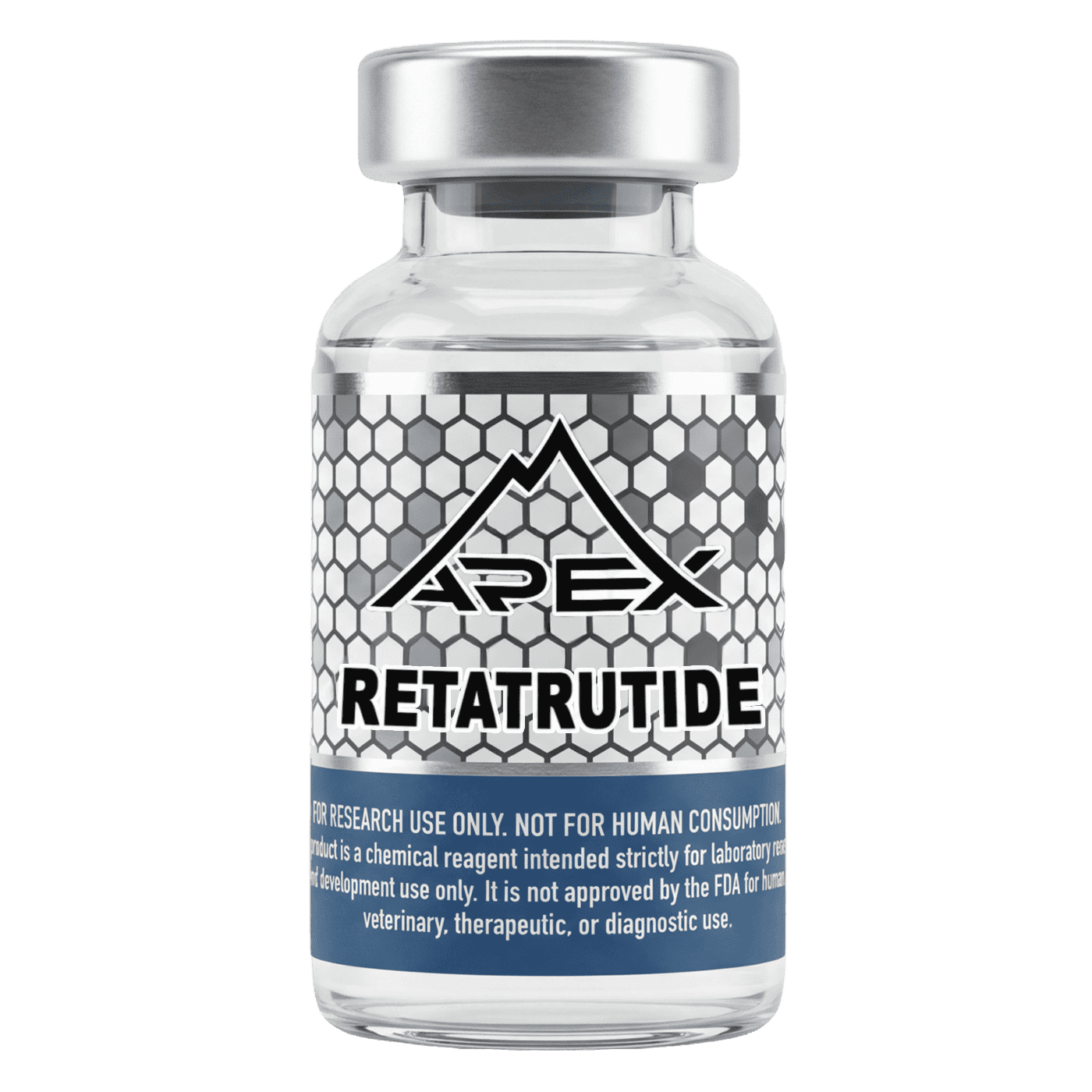
Retatrutide (LY3437943)
Research-grade triple GIP/GLP-1/glucagon receptor agonist — the compound studied in the Phase 3 TRIUMPH-1 obesity trial — verified to ≥99% purity by HPLC and mass spectrometry, with a per-lot certificate of analysis. Supplied strictly for in-vitro and preclinical research.
View Retatrutide →Frequently Asked Questions
What did the retatrutide Phase 3 TRIUMPH-1 trial show?
In Eli Lilly’s May 21, 2026 topline disclosure, TRIUMPH-1 reported mean body-weight reductions (efficacy estimand) of approximately 19.0% at 4 mg, 25.9% at 9 mg, and 28.3% at 12 mg over 80 weeks, versus 2.2% on placebo, in 2,339 adults with obesity and without type 2 diabetes. About 45.3% of the 12 mg group reached at least 30% weight loss. These are company-reported trial observations, summarized for research context; they are not yet peer-reviewed published and are not therapeutic claims.
What is the TRIUMPH program?
TRIUMPH is retatrutide’s Phase 3 registrational program of four trials in more than 5,800 participants, described by Giblin and colleagues (2026). TRIUMPH-1 and TRIUMPH-2 are weight-management basket trials with obstructive sleep apnea and knee osteoarthritis sub-protocols nested inside; TRIUMPH-3 studies weight management in a cardiovascular-disease population; and TRIUMPH-4 is a stand-alone knee-osteoarthritis trial. TRIUMPH-1 is the general-obesity readout and the largest of the four.
How does TRIUMPH-1 compare to the retatrutide Phase 2 trial?
The Phase 2 obesity trial (Jastreboff et al., NEJM 2023) reported a mean reduction of about 24.2% at 12 mg over 48 weeks, with the weight curve still declining at trial end. The disclosed TRIUMPH-1 efficacy-estimand mean at 12 mg was about 28.3% over the longer 80-week period. The two are not directly comparable because of different durations, populations, and estimand conventions, but greater exposure time tracked with greater mean reduction.
Is retatrutide better than tirzepatide or semaglutide?
Across separate pivotal trials, each additional receptor arm has tracked with a larger mean weight reduction: semaglutide (GLP-1) reported about 14.9% in STEP 1, tirzepatide (GIP + GLP-1) about 20.9 to 22.5% in SURMOUNT-1, and retatrutide (GIP + GLP-1 + glucagon) about 28.3% in TRIUMPH-1’s disclosed topline. These are not head-to-head comparisons, so cross-trial differences should be read cautiously rather than as a direct ranking.
Is retatrutide FDA-approved after TRIUMPH-1?
No. A pivotal Phase 3 readout is an input to a future regulatory submission, not an approval. As of this writing retatrutide is investigational and not approved by the FDA, EMA, or any other regulator. The research-grade retatrutide supplied by Apex Laboratory is a chemical reagent for in-vitro and preclinical research only and is not a pharmaceutical product or for human use.
What were the main side effects reported in TRIUMPH-1?
The disclosed tolerability profile was predominantly gastrointestinal, consistent with the incretin class. At 12 mg versus placebo, the most common adverse events were nausea (about 42.4% vs 14.8%), diarrhea (about 32.0% vs 13.5%), and vomiting (about 25.3% vs 4.8%), mostly during dose escalation, with discontinuation due to adverse events around 11.3% at 12 mg. These are documented trial observations for research context only, not patient guidance.
What is the molecular structure of retatrutide?
Retatrutide (development code LY3437943, CAS 2381089-83-2) is a synthetic 39-amino-acid peptide with molecular formula C221H342N46O68 and a molecular weight of 4731.33 g/mol. It carries a fatty-diacid modification that supports albumin binding and a long duration of action, and it is engineered to activate the GIP, GLP-1, and glucagon receptors with a single molecule.
Is the TRIUMPH-1 data peer-reviewed?
Not yet at the time of writing. The TRIUMPH-1 figures cited here come from Eli Lilly’s May 2026 topline announcement; full results are expected at a scientific congress and in a peer-reviewed journal. The retatrutide papers cited in this guide that are peer-reviewed include the Phase 2 obesity trial (Jastreboff 2023), the Phase 2 diabetes trial (Rosenstock 2023), the TRANSCEND-T2D-1 Phase 3 trial (Bajaj 2026), and the TRIUMPH program design paper (Giblin 2026).
Continue Your Research
Related GLP-1 & Metabolic Research Guides
Retatrutide Research Guide
The full triple-agonist mechanism and Phase 2 dataset behind the TRIUMPH-1 result.
Read GuideRetatrutide vs Tirzepatide
Two receptors versus three: how triple agonism extends the dual-incretin design.
CompareNext-Generation GLP-1 Peptides
Where retatrutide sits among dual GLP-1/glucagon and amylin research agonists.
Open HubApex Research Library
The full catalog of mechanism-level research guides across the Apex compound library.
Browse LibraryReferences
All citations were verified against the published record via the NCBI E-utilities API for existence, correct attribution, and support of the associated claim. Each links to its PubMed record.
- Coskun T, Urva S, Roell WC, Qu H, Loghin C, Moyers JS, et al. LY3437943, a novel triple glucagon, GIP, and GLP-1 receptor agonist for glycemic control and weight loss: From discovery to clinical proof of concept. Cell Metab. 2022;34(9):1234-1247.e9. PMID: 35985340
- Jastreboff AM, Kaplan LM, Frías JP, Wu Q, Du Y, Gurbuz S, et al. Triple-Hormone-Receptor Agonist Retatrutide for Obesity – A Phase 2 Trial. N Engl J Med. 2023;389(6):514-526. PMID: 37366315
- Giblin K, Kaplan LM, Somers VK, Le Roux CW, Hunter DJ, Wu Q, et al. Retatrutide for the treatment of obesity, obstructive sleep apnea and knee osteoarthritis: Rationale and design of the TRIUMPH registrational clinical trials. Diabetes Obes Metab. 2026;28(1):83-93. PMID: 41090431
- Rosenstock J, Frias J, Jastreboff AM, Du Y, Lou J, Gurbuz S, et al. Retatrutide, a GIP, GLP-1 and glucagon receptor agonist, for people with type 2 diabetes: a randomised, double-blind, placebo and active-controlled, parallel-group, phase 2 trial conducted in the USA. Lancet. 2023;402(10401):529-544. PMID: 37385280
- Pearson MJ, Willency JA, Lin Y, Abadi A, Hartman ML, Coskun T, et al. Retatrutide And Lipid And Metabolite Profiles In Participants With Obesity With Or Without Type 2 Diabetes. J Clin Endocrinol Metab. 2026. PMID: 42135195
- Hope DCD, Vincent ML, Tan TMM Striking the Balance: GLP-1/Glucagon Co-Agonism as a Treatment Strategy for Obesity. Front Endocrinol (Lausanne). 2021;12:735019. PMID: 34566894
- Nauck MA, D’Alessio DA Tirzepatide, a dual GIP/GLP-1 receptor co-agonist for the treatment of type 2 diabetes with unmatched effectiveness regrading glycaemic control and body weight reduction. Cardiovasc Diabetol. 2022;21(1):169. PMID: 36050763
- Bajaj HS, Welch M, Shah P, Luna E, Jaouimaa FZ, Liu B, et al. Efficacy and safety of retatrutide, a GIP, GLP-1, and glucagon receptor agonist, in people with type 2 diabetes and inadequate glycaemic control with diet and exercise (TRANSCEND-T2D-1): a double-blind, randomised, phase 3 trial. Lancet. 2026. PMID: 42250575
- Heerspink HJL, Lu Z, Du Y, Duffin KL, Coskun T, Haupt A, et al. The Effect of Retatrutide on Kidney Parameters in Participants With Type 2 Diabetes Mellitus and/or Obesity. Kidney Int Rep. 2025;10(6):1980-1992. PMID: 40630318
- Sanyal AJ, Kaplan LM, Frias JP, Brouwers B, Wu Q, Thomas MK, et al. Triple hormone receptor agonist retatrutide for metabolic dysfunction-associated steatotic liver disease: a randomized phase 2a trial. Nat Med. 2024;30(7):2037-2048. PMID: 38858523
- Coskun T, Wu Q, Schloot NC, Haupt A, Milicevic Z, Khouli C, et al. Effects of retatrutide on body composition in people with type 2 diabetes: a substudy of a phase 2, double-blind, parallel-group, placebo-controlled, randomised trial. Lancet Diabetes Endocrinol. 2025;13(8):674-684. PMID: 40609566
Research Use Disclaimer
Retatrutide and the information in this guide are intended strictly for in-vitro and preclinical laboratory research. Retatrutide is a research-grade chemical reagent and is not a drug, dietary supplement, or therapeutic product; it is investigational and not approved by the FDA, EMA, or any other regulator for any use. It is not for human or veterinary consumption, diagnosis, treatment, or any clinical use. The TRIUMPH-1 topline figures summarized here are company-disclosed clinical-trial data that had not been peer-reviewed published at the time of writing; the Phase 2, Phase 3, and program-design findings cited derive from clinical-research studies and are presented for research context only. They do not constitute therapeutic, efficacy, or safety claims, and they describe the investigational pharmaceutical candidate studied in those trials — not the research-grade reagent. Researchers are responsible for compliance with all applicable institutional, local, and national regulations governing the acquisition, handling, and use of research chemicals.