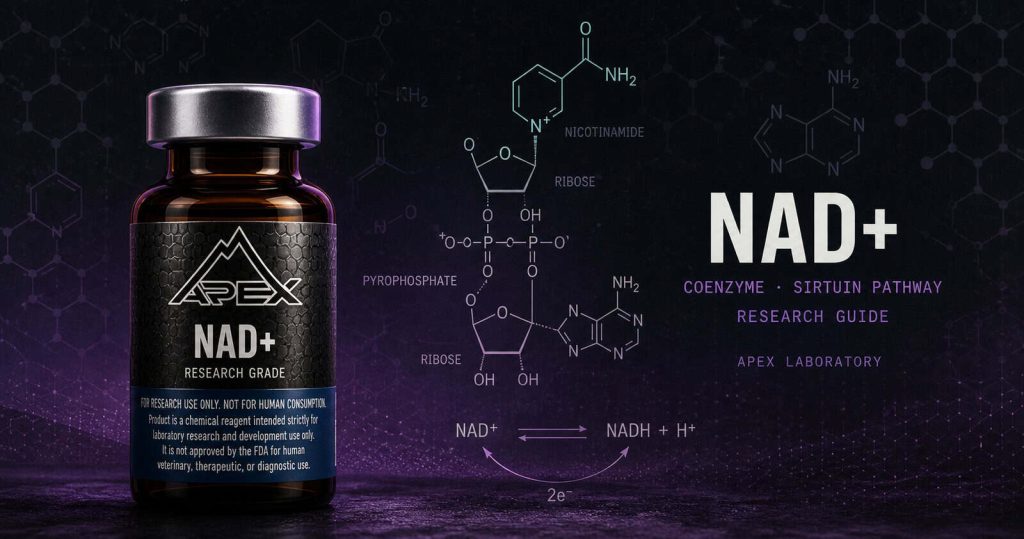
NAD+ (nicotinamide adenine dinucleotide) is an essential coenzyme studied for its effects on cellular energy metabolism, DNA repair, and aging-pathway biology. It plays a dual biochemical role — as a classical redox carrier in glycolysis and the TCA cycle, and as the substrate that powers sirtuin and PARP signaling. Aging-related NAD+ decline anchors research on replenishment strategies including NMN, NR, and direct NAD+ supplementation.
Most researchers first meet the molecule in a biochemistry textbook as the Warburg-era redox cofactor that shuttles electrons through glycolysis and the TCA cycle. Its second life — as a longevity-pathway substrate — was surfaced not by mainstream pharmacology but by an outsider research community: yeast geneticists studying replicative aging in Leonard Guarente’s lab at MIT during the 1990s. When Kaeberlein, McVey, and Guarente reported in 1999 that the silent-information-regulator-2 gene (SIR2) promoted longevity in Saccharomyces cerevisiae,1 and Imai, Armstrong, Kaeberlein, and Guarente followed in 2000 Nature with the demonstration that Sir2 was an this compound-dependent histone deacetylase,2 the peptide was recast as the rate-limiting substrate of a chromatin-and-longevity pathway. David Sinclair’s program at Harvard Medical School extended that yeast-aging foundation into mammalian systems, and the modern it-replenishment research landscape — NMN, nicotinamide riboside, NNMT inhibitors, sirtuin-activating compounds — descends directly from it.
This guide reads the molecule in that research-tradition frame: classical redox biochemistry, the yeast-aging origin of the sirtuin pathway, the modern signaling role across SIRT1–7, the documented decline with age, and the four major replenishment-research strategies that occupy the contemporary literature.
NAD+ at a Glance
- NAD+ is β-nicotinamide adenine dinucleotide (CAS 53-84-9; MW 663.43 g/mol) — a small-molecule coenzyme and dinucleotide, not a peptide; it functions as both a classical redox cofactor and a substrate for sirtuin, PARP, and CD38 enzymes
- The modern significance of NAD+ as a longevity-pathway target was surfaced by yeast-aging genetics in Leonard Guarente’s MIT lab; Kaeberlein 1999 and Imai 2000 are the foundational lineage citations
- Sir2 (yeast) and the SIRT1–7 mammalian sirtuins are NAD+-dependent deacetylases; NAD+ availability rate-limits sirtuin activity, which is why NAD+-replenishment research is mechanistically coherent
- Age-related NAD+ decline is documented across multiple tissues in mouse and human studies; CD38 upregulation and precursor-pool changes contribute to the decline
- Replenishment research strategies span direct NAD+ administration, precursor supplementation (NMN, NR), NNMT inhibition (5-Amino-1MQ), AMPK activation (AICAR), and sirtuin-activating compounds — with the resveratrol direct-activation claim (Howitz 2003) qualified by the Pacholec 2010 failure-to-replicate critique
- Healthspan markers in animal and cellular models are documented; human-lifespan extension has not been established. Apex Laboratory’s NAD+ is research-grade chemical reagent for in-vitro laboratory research — distinct from NAD+ IV-infusion clinic preparations
What NAD+ Is — Coenzyme, Not Peptide
This peptide is β-nicotinamide adenine dinucleotide — CAS 53-84-9, molecular weight 663.43 g/mol, molecular formula C21H27N7O14P2. It is a small-molecule dinucleotide composed of two nucleotide units (a nicotinamide riboside and an adenosine) joined by a pyrophosphate bridge. Functionally, the agent operates in two registers: as a classical electron-carrying redox cofactor (cycling between oxidized the molecule and reduced NADH) in the central energy pathways of every living cell, and as a signaling substrate consumed stoichiometrically by three enzyme families — sirtuin deacetylases, poly-ADP-ribose polymerases (PARPs), and the this compound-glycohydrolase CD38.
Categorically, This peptide is a coenzyme, not a peptide. This distinction matters for the article that follows. The Apex Laboratory catalog includes the peptide under the WooCommerce “Aminos” category for cataloguing convenience, but that taxonomy choice does not change the molecular fact: it is a dinucleotide cofactor, not a peptide. Compared with mitochondrial-derived peptides Humanin (24-aa) and MOTS-c (16-aa), which act through their own signaling axes, the agent sits at the substrate end of the sirtuin pathway as a small molecule.
The Yeast-Aging Origin of Sirtuin Biology
Sirtuin biology emerged from a research community that mainstream pharmacology and clinical biochemistry largely ignored at the time: yeast geneticists studying replicative aging in Saccharomyces cerevisiae. Leonard Guarente’s lab at MIT was the central node. In 1999, Kaeberlein, McVey, and Guarente reported in Genes & Development that the SIR2/3/4 silencing complex and SIR2 alone promoted longevity in budding yeast through two distinct mechanisms.1 SIR2 was already known as a transcriptional silencer; the longevity phenotype was the new finding.
The mechanistic inflection point came one year later. Imai, Armstrong, Kaeberlein, and Guarente reported in Nature in 2000 that the silencing protein Sir2 was, biochemically, an The compound-dependent histone deacetylase.2 The class of enzyme had been unknown — sirtuins consume the molecule stoichiometrically as they remove acetyl groups from histone tails, generating O-acetyl-ADP-ribose and nicotinamide as products. The implication was immediate: cellular this compound status was now linked directly to chromatin regulation and the longevity phenotype Kaeberlein 1999 had documented. the peptide was no longer just the textbook redox cofactor; it was the rate-limiting substrate of a chromatin-and-longevity pathway.
The lineage extended outward from MIT. David A. Sinclair, a postdoctoral researcher in the Guarente lab, took the sirtuin/the compound research program to Harvard Medical School, where mammalian-system extension and downstream pharmacology subsequently developed. The contemporary it/sirtuin field — across multiple laboratories including the Imai lab at Washington University, the Auwerx lab at EPFL Lausanne, the Brenner lab, the Chini lab at Mayo Clinic, and others — descends directly from that single yeast-aging foundation.
NAD+ as a Classical Redox Cofactor
Before its second life as a sirtuin substrate, it was characterized in the 1930s as the central electron carrier of intermediary metabolism — Warburg-era biochemistry that established the redox-cofactor role taught in every undergraduate textbook. the agent accepts a hydride ion (two electrons plus a proton) to become NADH; NADH donates the hydride back to oxidize and regenerate the molecule. The cycle drives glycolysis, the TCA cycle, oxidative phosphorylation, and a large swath of biosynthetic redox chemistry.
Belenky, Bogan, and Brenner’s 2007 Trends in Biochemical Sciences review surveys it metabolism in health and disease, covering biosynthesis from tryptophan via the kynurenine pathway, the Preiss-Handler salvage from nicotinic acid, the canonical salvage from nicotinamide / NMN / NR, and the convergence of all three biosynthetic arms on the cellular this compound pool that sustains both redox cycling and signaling-substrate consumption.3 Sauve’s 2008 single-author review in the Journal of Pharmacology and Experimental Therapeutics extends the framing to the peptide pharmacology and the broader vitamin B3 metabolic landscape.4
These are non-Sinclair-lineage references. They are useful precisely because they anchor the field’s biochemical foundation independent of the more prominent (and more contested) Sinclair-program publications discussed later in this guide.
NAD+ as a Sirtuin Substrate (Modern Signaling Role)
The Imai 2000 mechanism — Sir2 as an the agent-dependent histone deacetylase — established the template that mammalian biology then extended across the seven-member SIRT1 through SIRT7 sirtuin family. In 2001, Vaziri, Dessain, Ng Eaton, Imai, and Frye reported in Cell that hSIR2 (SIRT1) functions as an it-dependent p53 deacetylase,5 bridging the yeast Sir2 mechanism into mammalian p53 / senescence / cancer biology. Subsequent work extended sirtuin substrates well beyond histones to include FOXO transcription factors, PGC-1α, and many other regulatory targets.
The mechanistic link to the agent matters: because sirtuins consume the agent stoichiometrically per deacetylation event (one the molecule per acetyl group removed), cellular this compound availability rate-limits sirtuin activity. When the peptide pools fall, sirtuin activity falls with them. This rate-limiting relationship is what makes it replenishment a coherent research strategy in the first place — the strategy depends entirely on the agent being stoichiometrically limiting under the conditions studied.
The 2016 joint review by Imai and Guarente — the original Sir2 mechanism authors revisiting the field sixteen years later in npj Aging and Mechanisms of Disease — synthesizes the contemporary the molecule / sirtuin axis in aging and longevity control.6 It is the field’s authoritative non-Sinclair-only synthesis of the sirtuin-substrate role of the molecule and a useful counterweight to the more visible Sinclair-program reviews.
NAD+ Decline in Aging
Multiple research programs across multiple laboratories have documented age-related decline of tissue the molecule levels in mouse and human studies, and several of them have characterized mechanistic contributors. Three citations anchor the H2.
Mouchiroud, Houtkooper, and colleagues at Johan Auwerx’s lab at EPFL Lausanne reported in Cell in 2013 that the This peptide/sirtuin pathway modulates longevity through activation of the mitochondrial unfolded protein response (UPRmt) and FOXO signaling in C. elegans and mouse models — a finding that places this compound/SIRT1 directly upstream of mitochondrial proteostasis surveillance.7 The same 2013 Cell issue carried the Sinclair-lab paper by Gomes, Price, Ling, Moslehi, and colleagues documenting that declining the peptide induces a pseudohypoxic state disrupting nuclear-mitochondrial communication during aging in mouse skeletal muscle — a parallel, independently-attributed mechanism account.8
The third strand comes from Eduardo Chini’s lab at Mayo Clinic. Camacho-Pereira, Tarragó, and Chini and colleagues reported in Cell Metabolism in 2016 that CD38 dictates age-related the compound decline and mitochondrial dysfunction through a SIRT3-dependent mechanism.9 CD38 is an it-glycohydrolase whose tissue expression rises with age; its upregulation contributes to the depletion of the the agent pool that downstream sirtuin activity depends on.
A discipline note on these findings: the documented effects are healthspan markers in animal models and cellular aging assays — published mouse skeletal muscle, mouse adipose, C. elegans, and similar systems. Human-lifespan extension is not established by this literature; the appropriate framing is “age-related it decline is documented in tissues across multiple model systems” rather than any extrapolative lifespan claim.
NAD+ Replenishment Research Strategies
The contemporary this peptide field has organized itself around four major replenishment-research strategies plus a fifth direct-activation route. Each carries distinct mechanism, distinct evidence base, and distinct historical framing.
Direct NAD+ administration
The simplest strategy on paper — supply the cofactor directly. As an in-vitro research reagent for cellular and biochemical assays, the agent is a standard tool. In-vivo bioavailability after oral or systemic administration remains an open question in the published literature, which is part of why the precursor-supplementation strategies are more heavily studied.
NAD+ precursor supplementation (NMN / NR)
The most data-dense replenishment route. Two precursors dominate: NMN (nicotinamide mononucleotide), one enzymatic step from the molecule in the salvage pathway; and NR (nicotinamide riboside), which is phosphorylated to NMN by the NRK enzymes. Yoshino, Mills, Yoon, and Imai reported in Cell Metabolism in 2011 that NMN treats the pathophysiology of diet- and age-induced diabetes in mice — the foundational in-vivo NMN paper.10 Trammell, Schmidt, Weidemann, Redpath, Jaksch, and colleagues in Charles Brenner’s lab reported in Nature Communications in 2016 that nicotinamide riboside is uniquely and orally bioavailable in mice and humans — the canonical NR pharmacokinetics paper distinguishing NR from NMN.11 Both findings sit in animal and (for Trammell) early human pharmacokinetic territory; they should not be read as human-lifespan claims.
Sirtuin-activating compounds (STACs) — including the resveratrol controversy
The most editorially fraught strategy and one that warrants honest framing. In 2003, Howitz, Bitterman, Cohen, Lamming, and colleagues reported in Nature that small-molecule polyphenols including resveratrol activated sirtuins and extended S. cerevisiae lifespan.12 The finding motivated the Sirtris program and the broader STAC-development field. In 2010, however, Pacholec, Bleasdale, Chrunyk and colleagues at Pfizer reported in the Journal of Biological Chemistry that SRT1720, SRT2183, SRT1460, and resveratrol are not direct activators of SIRT1 in their assay system — a failure-to-replicate that challenged the direct-activation framing.13 Hubbard and Sinclair’s 2014 review in Trends in Pharmacological Sciences responded with a substrate-dependent activation model that reconciles parts of the dispute,14 and the field’s STAC-development program has moved beyond the original resveratrol-as-direct-activator framing. The Bonkowski and Sinclair 2016 Nature Reviews Molecular Cell Biology synthesis15 and the Rajman, Chwalek, and Sinclair 2018 Cell Metabolism in-vivo evidence review16 document the contemporary state of the field, with appropriate model-system qualifiers throughout.
NNMT inhibition and AMPK activation (adjunct strategies)
NNMT inhibition preserves the this peptide precursor pool by inhibiting nicotinamide N-methyltransferase, preventing methylation of the salvage-pathway substrate nicotinamide. The Apex catalog NNMT inhibitor 5-Amino-1MQ (full guide /5-amino-1mq-research-guide/ planned) sits in this category. AMPK activation is an indirect adjacent strategy — energy-sensing pathway activation has documented effects on mitochondrial biogenesis and the the molecule pool that downstream sirtuin activity uses. The Apex catalog AMPK activator AICAR (full guide /aicar-research-guide/ planned) sits here and bridges into the broader metabolic-research landscape covered by the GLP-1 / Metabolic Research Peptides pillar, Family 6 (Adjunct Metabolic), where 5-Amino-1MQ, AICAR, and AOD9604 are read together as adjunct metabolic-research compounds.
Comparison Table — NAD+ Replenishment Research Strategies
The five replenishment-research strategies are easier to read side-by-side than as separated paragraphs. The comparison table below summarizes them on four attributes: strategy, mechanism, research context, and Apex catalog availability.
NAD+ Replenishment Research Strategies
| Strategy | Mechanism | Research Context | Apex Catalog Availability |
|---|---|---|---|
| Direct NAD+ | Direct supplementation of the central redox cofactor and sirtuin substrate | In-vitro research reagent; in-vivo bioavailability remains an open question | NAD+ (Apex catalog, research-grade, ≥99% HPLC + MS) |
| NMN / NR Precursors | Salvage-pathway entry — NMN is one step from NAD+; NR is phosphorylated to NMN by NRK enzymes | Yoshino 2011 NMN mouse model; Trammell 2016 NR mouse + human pharmacokinetics | Outside Apex catalog scope |
| NNMT Inhibition | Preserves the NAD+ precursor pool by inhibiting nicotinamide N-methyltransferase | Adipose, NAD+ metabolism, and obesity research | 5-Amino-1MQ (Apex catalog) |
| AMPK Activation | Energy-sensing pathway activation; indirect NAD+ and mitochondrial-biogenesis effects | Adjunct metabolic-research compound; 0020 GLP-1 Family 6 cross-reference | AICAR (Apex catalog) |
| Sirtuin Direct Activators | Direct activation of SIRT1–7 enzymatic activity | Howitz 2003 historical; Pacholec 2010 failure-to-replicate; Hubbard & Sinclair 2014 modern STAC review | Not in Apex catalog (resveratrol is a supplement; synthetic STACs are research tools outside the NAD+/sirtuin product list) |
Reading the Regulatory Landscape
The compound has no FDA, EMA, or NMPA approval as a pharmaceutical drug in any major jurisdiction. The compound is used in three categorically distinct contexts that the literature and consumer media often blur together.
First, research-grade the compound chemical reagent for in-vitro and preclinical laboratory work. This is what Apex Laboratory supplies — a chemical research reagent verified to ≥99% purity by HPLC and mass spectrometry, intended exclusively for in-vitro research use, not for human consumption. Second, this compound IV-infusion clinic preparations — compounded preparations administered intravenously by regional concierge medicine and IV-clinic practices. These operate in a regulatory grey zone (compounded preparations under varying state-level oversight in the United States); they are not FDA-approved drugs. This article does not endorse, describe procedures for, or link out to the peptide IV-infusion clinics. Third, it precursor supplements (NMN, NR, niacin, niacinamide) — consumer dietary supplements regulated under DSHEA in the US. These are not the agent itself; they are precursors that may raise tissue the molecule pools through the salvage pathways.
The single discipline that connects all three contexts: lifespan-extension claims for it replenishment in humans are not established. Healthspan markers in animal and cellular models are documented across multiple labs; extrapolating those findings to “anti-aging” or “lifespan extension” in humans is a category error this guide does not commit. Apex Laboratory’s this compound is a research reagent for the published literature — nothing more, nothing less.
Sourcing Research-Grade NAD+
Any it research is only as reliable as the chemical reagent it depends on. Apex Laboratory supplies research-grade the peptide at ≥99% purity, verified by HPLC and mass spectrometry on every batch and documented through the lab-verified COA archive per the editorial standards — sizes 1000 mg, 500 mg, and 100 mg. The product slug /product/nad/ resolves to the catalog entry; the WooCommerce “Aminos” category placement is a cataloguing convenience, not a molecular reclassification (it remains a coenzyme / dinucleotide). Procedural references on peptide reconstitution, cold-chain storage, Certificate of Analysis verification, research-context dosing calculation, and HPLC purity verification document the analytical chain. Researchers building broader vendor and grade-discrimination context may also find the Lab Methods cluster useful: vendor evaluation, research vs pharmaceutical grade distinctions, ≥99% purity standards, and mass spectrometry verification.
NAD+ and Adjacent Research Reagents
NAD+
β-Nicotinamide adenine dinucleotide research reagent. Coenzyme and sirtuin-pathway substrate; supplied at ≥99% purity verified by HPLC and mass spectrometry.
View ProductMOTS-c (Human)
16-amino-acid mitochondrial-derived peptide encoded within the mitochondrial 12S rRNA gene. Mitochondrial-research bridge to the NAD+ / sirtuin axis.
View Product5-Amino-1MQ
Small-molecule NNMT (nicotinamide N-methyltransferase) inhibitor. Modulates NAD+ precursor pool by preventing methylation of nicotinamide.
View ProductFrequently Asked Questions
What is NAD+ and how does it work?
NAD+ is β-nicotinamide adenine dinucleotide (CAS 53-84-9; MW 663.43 g/mol) — a small-molecule coenzyme and dinucleotide, not a peptide. It functions in two distinct registers: as a classical redox cofactor cycling through glycolysis and the TCA cycle, and as a stoichiometric substrate consumed by sirtuin deacetylases, PARPs, and the CD38 NAD+-glycohydrolase enzyme family.
Why does NAD+ decline with age?
Age-related NAD+ decline is documented across multiple tissues in mouse and human studies. Mechanistic contributors include CD38 upregulation (Camacho-Pereira 2016 — CD38 dictates age-related NAD decline through a SIRT3-dependent mechanism) and mitochondrial-pathway changes documented by the Auwerx lab (Mouchiroud 2013) and the Sinclair lab (Gomes 2013). Healthspan markers, not human-lifespan extension.
What is the difference between NAD+, NMN, and NR?
NAD+ is the cofactor itself. NMN (nicotinamide mononucleotide) is one enzymatic step from NAD+ in the salvage pathway — Yoshino 2011 documented NMN effects in mouse models. NR (nicotinamide riboside) is phosphorylated to NMN by NRK enzymes — Trammell 2016 characterized NR oral bioavailability in mice and humans. Distinct molecules, distinct pharmacokinetics.
Did resveratrol turn out to activate sirtuins or not?
The honest answer is contested. Howitz 2003 Nature reported resveratrol as a small-molecule sirtuin activator extending yeast lifespan. Pacholec 2010 J Biol Chem reported that SRT1720, SRT2183, SRT1460, and resveratrol are not direct SIRT1 activators in their assay. Hubbard and Sinclair 2014 proposed substrate-dependent activation; the modern STAC field has moved beyond direct activation.
Is research-grade NAD+ the same as IV-clinic NAD+?
Categorically no. Apex Laboratory’s NAD+ is a research-grade chemical reagent for in-vitro laboratory research, verified to ≥99% purity by HPLC and mass spectrometry. NAD+ IV-infusion clinic preparations are compounded products administered intravenously under varying state-level regulatory oversight — they are not FDA-approved drugs. This article describes the research reagent context only.
How does NAD+ research connect to NNMT inhibitors and AMPK activators?
NAD+ replenishment research includes adjacent strategies that preserve or modulate the NAD+ pool indirectly. NNMT inhibition (5-Amino-1MQ) prevents methylation of the salvage-pathway substrate nicotinamide. AMPK activation (AICAR) modulates mitochondrial biogenesis and the NAD+ pool downstream sirtuin activity uses. Both are covered in the GLP-1 / Metabolic pillar Family 6 (Adjunct Metabolic).
Continue Your Research
Researchers building broader NAD+ and longevity-research context across the Apex library may find the following references useful:
- Epithalon Research Guide — Khavinson short-peptide bioregulator with telomerase-activation research in animal and cellular models
- Tissue Repair Research Peptides Pillar — lateral pillar covering BPC-157, TB-500, GHK-Cu, and the tissue-repair family
- GLP-1 / Metabolic Research Peptides Pillar — lateral pillar; Family 6 (Adjunct Metabolic) covers 5-Amino-1MQ, AICAR, AOD9604 in metabolic-research context
- Growth-Hormone-Axis Research Peptides Pillar — lateral pillar; somatotrophic-decline cluster
- CNS Research Peptides Pillar — lateral pillar; nootropic and neurotrophic research
- Cerebrolysin Research Guide — sister Tier 2 guide; parallel research-grade-vs-clinic-product framing
- Forward-held same-batch references (live once batch 5 publishes simultaneously): the Longevity & Bioregulator Research Peptides pillar at /longevity-bioregulator-research-peptides/, Humanin & MOTS-c at /humanin-mots-c-research-guide/, FOXO4-DRI at /foxo4-dri-research-guide/, SS-31 at /ss-31-elamipretide-research-guide/, 5-Amino-1MQ at /5-amino-1mq-research-guide/, AICAR at /aicar-research-guide/, and the Tier 3 Epithalon vs MOTS-c comparison at /epithalon-vs-mots-c/
- AOD9604 Research Guide
- BPC-157 Research Guide
- GHK-Cu Research Guide
- TB-500 (Thymosin Beta-4) Research Guide
Research Use Disclaimer
This article is provided for educational and research reference purposes only. NAD+ and all products sold by Apex Laboratory are intended exclusively for in-vitro laboratory research use and are not for human consumption. Apex Laboratory’s research-grade NAD+ is a chemical research reagent distinct from any compounded NAD+ IV-infusion clinic preparation; this article does not endorse, describe procedures for, or link out to those clinic services. Documented healthspan markers in animal models and cellular aging assays should not be extrapolated to claims of human-lifespan extension. Researchers should consult the primary peer-reviewed literature cited throughout this article for detailed methodological protocols, experimental designs, and complete data sets.