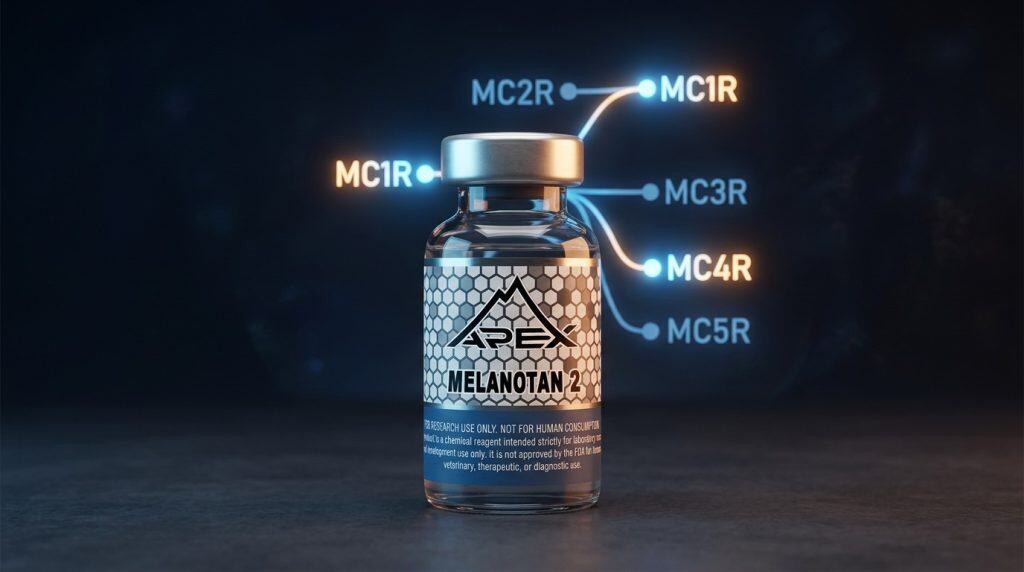
Melanotan II is a synthetic cyclic heptapeptide, Ac-Nle-cyclo(Asp-His-D-Phe-Arg-Trp-Lys)-NH2, a conformationally constrained analog of alpha-melanocyte-stimulating hormone (alpha-MSH) that acts as a non-selective agonist of the melanocortin receptors MC1R, MC3R, MC4R, and MC5R. In pharmacology research it is studied as a melanocortin-system probe, with its MC1R activity driving melanogenesis and its central MC4R activity underlying effects on sexual function and appetite that later motivated development of the derivative bremelanotide (PT-141).
Melanotan II is one of the foundational tools of melanocortin pharmacology. It descends directly from a University of Arizona research program that set out to build more potent, more stable analogs of alpha-melanocyte-stimulating hormone (alpha-MSH), the natural peptide that controls pigmentation.[1][2] By cyclizing the molecule and substituting key residues, that program produced a compound far more potent and longer-acting than native alpha-MSH — and one that, because it is non-selective across the melanocortin receptors, became a versatile experimental agonist for studying pigmentation, sexual-function, and appetite pathways.
This guide covers Melanotan II‘s molecular identity and Arizona origin, the melanocortin-receptor system it activates, its research across melanogenesis and central melanocortin pathways, its lineage to the approved drugs bremelanotide and afamelanotide, and how it sits within the Apex specialty research cluster of the Apex Research Library. Every factual claim is referenced to the primary literature, and Melanotan II is supplied strictly as a research-grade chemical reagent for in-vitro and preclinical investigation — not a drug, cosmetic, tanning product, or therapy for human or veterinary use.
Melanotan II at a Glance
- Melanotan II is the cyclic heptapeptide Ac-Nle-cyclo(Asp-His-D-Phe-Arg-Trp-Lys)-NH2; CAS 121062-08-6, MW 1024.2 g/mol, formula C50H69N15O9 (PubChem CID 92432).
- It is a conformationally constrained, non-selective agonist of the melanocortin receptors (MC1R, MC3R, MC4R, MC5R), derived from alpha-MSH.
- It originates in the University of Arizona melanotropic-peptide program of Hadley, Hruby, Dorr, and colleagues, which also produced Melanotan-I.
- Its MC1R activity drives melanogenesis; its central MC4R activity underlies the sexual-function and appetite research that defines its central pharmacology.
- The MC4R sexual-function work led to bremelanotide (PT-141), and the related Melanotan-I lineage led to afamelanotide (Scenesse) — both later approved drugs distinct from Melanotan II itself.
- Melanotan II has no approved drug formulation and case reports document adverse events from unregulated use; Apex supplies it strictly as a ≥99% (HPLC + MS verified) research reagent for in-vitro and preclinical use only.
Melanotan II (MT-II)
What Is Melanotan II? Molecular Identity and Origin

Melanotan II structure. The cyclic heptapeptide Ac-Nle-cyclo(Asp-His-D-Phe-Arg-Trp-Lys)-NH2, closed by a lactam bridge. Structure image: PubChem CID 92432, U.S. National Library of Medicine (public domain).
Melanotan II is a cyclic heptapeptide, Ac-Nle-cyclo(Asp-His-D-Phe-Arg-Trp-Lys)-NH2, in which a lactam bridge between the aspartate and lysine side chains locks the molecule into a constrained ring. It has a molecular weight of about 1024.2 g/mol, the formula C50H69N15O9, and CAS number 121062-08-6 (PubChem CID 92432). The exact cyclic structure was defined in the Arizona group’s early human pharmacology work,[3] and direct binding data established it as a high-affinity cyclic-lactam analog of the alpha-MSH(4-10) core.[4]
The Arizona Origin: Sawyer, Hruby, Hadley, and Dorr
Melanotan II is inseparable from its lineage. The line began with the discovery that substituting 4-norleucine and 7-D-phenylalanine into alpha-MSH produced a superpotent, enzymatically resistant analog (NDP-MSH),[5] followed by the design of cyclic, conformationally restricted alpha-MSH analogs — the architecture that defines Melanotan II.[1] The definitive account of how Melanotan-I and Melanotan-II were discovered and developed comes from Hadley, Hruby, Blanchard, Dorr and colleagues,[2] and the historical-milestones synthesis by Hadley and Dorr documents the program’s arc — Melanotan-I as a linear tanning agent and Melanotan-II as the cyclic, multireceptor compound.[6] This program was based at the University of Arizona College of Medicine.
Melanocortin Receptor Pharmacology
To understand Melanotan II is to understand the melanocortin receptor family it activates — five G-protein-coupled receptors with distinct tissue distributions and functions.
The Melanocortin Receptor Family (MC1R–MC5R)
The melanocortin receptors were cloned and characterized in the early 1990s. Mountjoy and colleagues identified the MSH and ACTH receptors as G-protein-coupled receptors,[7] Roselli-Rehfuss and colleagues characterized MC3R in the hypothalamus,[8] Gantz and colleagues cloned the brain-expressed MC4R,[9] later mapping MC4R mRNA broadly across the brain,[10] and cloned the fifth receptor, MC5R.[11] In broad terms, MC1R governs pigmentation in the skin, MC3R and MC4R are central regulators of energy balance and behavior in the brain, and MC5R is associated with exocrine function.
Non-Selective Agonism
The defining pharmacological feature of Melanotan II is that it is non-selective: it activates MC1R, MC3R, MC4R, and MC5R rather than a single subtype.[4] This is exactly why it became such a widely used research tool — a single agonist that engages the whole melanocortin axis — and also why its effects span pigmentation, sexual function, and appetite simultaneously, a breadth that more selective successors were designed to narrow.
Mechanism and Research Areas
Pan-melanocortin agonism → pigmentation (MC1R) + central effects (MC4R)
Melanotan II activates the melanocortin receptors broadly. At MC1R on skin melanocytes it raises cAMP and tyrosinase activity, increasing melanin synthesis (melanogenesis). At MC4R and MC3R in the brain it engages the central circuits that regulate sexual function and food intake. Its non-selectivity makes it a general melanocortin-system agonist in research, in contrast to the receptor-selective drugs (bremelanotide for MC4R, afamelanotide for MC1R) that were developed from the same chemistry. All effects summarized here are research findings in cells, animals, or controlled human pharmacology studies.
Melanogenesis (MC1R)
The pigmentation arm runs through MC1R. Melanin is synthesized by melanocytes from tyrosine via tyrosinase, under melanocortin control,[12] and MC1R is the seven-transmembrane GPCR that is the key control point: its activation shifts pigment synthesis toward eumelanin.[13] In human melanocytes, alpha-MSH acting on MC1R increases cAMP, tyrosinase activity, melanogenesis, and proliferation[14] — the receptor-level basis for the pigmentation research associated with melanotropic peptides. These are descriptions of melanocyte pharmacology, not instructions for any use of the compound.
Central Effects: Sexual Function (MC4R)
The central arm runs largely through MC4R. In controlled human pharmacology studies from the Arizona group, Melanotan II — explicitly described as a non-selective melanocortin agonist — initiated central effects on erectile response,[15][16] findings that identified the MC4R pathway as a target for sexual-function pharmacology and directly motivated the development of the selective successor bremelanotide.
Central Effects: Appetite and Energy Balance (MC4R/MC3R)
The same central receptors regulate feeding. Administered into the brain, Melanotan II reduced nocturnal and neuropeptide-Y-stimulated food intake in rats,[17] and decreased food intake in Siberian hamsters, demonstrating MC4R-mediated appetite suppression.[18] Together with the sexual-function data, this places Melanotan II at the intersection of the central melanocortin circuits for behavior and energy homeostasis.
Lineage: From Melanotan to Bremelanotide and Afamelanotide
Melanotan II’s broad agonism made it a starting point rather than an endpoint. Two approved drugs trace their lineage to this chemistry — each a more selective molecule than Melanotan II itself.
Bremelanotide (PT-141)
The sexual-function research led to bremelanotide, also known as PT-141 — a synthetic alpha-MSH analog and MC3R/MC4R agonist developed at Palatin Technologies that produces central effects on erectile response and sexual desire.[19][20] Bremelanotide is now an FDA-approved drug (marketed as Vyleesi); it is a distinct, more selective molecule than the research compound Melanotan II. See the Apex PT-141 (bremelanotide) research guide for that compound.
Melanotan-I and Afamelanotide (Scenesse)
The pigmentation arm followed a parallel path through the linear Melanotan-I (Nle4-D-Phe7-alpha-MSH), studied in early Arizona human trials,[21] to afamelanotide (Scenesse), a synthetic alpha-MSH analog and first-in-class MC1R agonist now approved in the EU and US for the rare photodermatosis erythropoietic protoporphyria.[22][23] Afamelanotide, too, is a distinct approved drug, not the same molecule as research-grade Melanotan II.
Melanotan II vs Related Melanocortin Peptides
Melanotan II is best understood in contrast to the more selective melanocortin agonists that came after it.
Melanotan II vs Bremelanotide (PT-141) vs Afamelanotide
| Attribute | Melanotan II | Bremelanotide (PT-141) | Afamelanotide |
|---|---|---|---|
| Structure | Cyclic alpha-MSH analog | Cyclic alpha-MSH analog (MT-II-derived) | Linear alpha-MSH analog (Nle4-DPhe7) |
| Receptor selectivity | Non-selective (MC1R–MC5R) | MC3R/MC4R-directed | MC1R-directed |
| Research emphasis | Pan-melanocortin tool | Sexual function (central) | Photoprotection / pigmentation |
| Regulatory status | Research-only; no approved drug | FDA-approved (Vyleesi) | Approved (Scenesse) |
The pattern is clear: Melanotan II is the broad, non-selective progenitor, valuable in research precisely because it engages the entire melanocortin axis, while the approved successors narrowed that activity to a single therapeutic target. Apex supplies Melanotan II as a research-grade reagent for studying that axis, distinct from those finished pharmaceutical products.
Stability, Handling, and Regulatory Status (Research Use)
The guidance below concerns laboratory handling of Melanotan II as a research reagent. Nothing here is a human dosing, administration, tanning, or usage instruction; Melanotan II is for in-vitro and preclinical research only.
Lyophilized Storage
Store lyophilized Melanotan II at −20°C, protected from light and moisture. As a cyclic, conformationally constrained peptide it is comparatively robust in the dry state; well-stored lyophilized material is expected to remain stable over extended periods. See the Apex peptide storage guide.
Reconstitution
Melanotan II dissolves readily in bacteriostatic water for laboratory preparation. Researchers planning in-vitro concentrations can use the Apex reconstitution calculator and the how to reconstitute peptides protocol; reconstituted solution is held at 2–8°C with freeze-thaw cycling minimized. These tools support laboratory work and contain no human-use directions.
Identity, Purity, and Safety Context
Apex supplies Melanotan II at ≥99% purity, verified by reversed-phase HPLC and mass spectrometry, with a per-lot certificate of analysis through the lab-verified COA archive; see the primers on how to read a certificate of analysis and HPLC testing for peptide purity. It is worth stating plainly that the medical literature includes case reports documenting serious adverse events associated with unregulated Melanotan II use — including a case of systemic toxicity with rhabdomyolysis and renal dysfunction following injection, in material whose identity was confirmed by mass spectrometry,[24] which is one more reason the compound is appropriate only for controlled laboratory research and not for human use.
Regulatory Status
Melanotan II is not approved by the FDA, EMA, or any other regulatory authority as a drug, cosmetic, or tanning agent, and has no approved indication. Apex supplies it strictly as a research-grade chemical reagent for in-vitro and preclinical laboratory work, not for human or veterinary use.
Sourcing Research-Grade Melanotan II
For melanocortin-receptor and pigmentation research, Melanotan II should be sourced as documented research-grade material with identity confirmed by mass spectrometry. Apex supplies Melanotan II as a ≥99%-pure lyophilized peptide, HPLC- and MS-verified, for in-vitro and preclinical use only.
Melanotan II (MT-II)
Research-grade Ac-Nle-cyclo(Asp-His-D-Phe-Arg-Trp-Lys)-NH2 — the cyclic non-selective melanocortin-receptor agonist — verified to ≥99% purity by HPLC and mass spectrometry, with a per-lot certificate of analysis. Supplied strictly for in-vitro and preclinical research.
View Melanotan II →Frequently Asked Questions
What is Melanotan II?
Melanotan II is a synthetic cyclic heptapeptide, Ac-Nle-cyclo(Asp-His-D-Phe-Arg-Trp-Lys)-NH2, a constrained analog of alpha-melanocyte-stimulating hormone (alpha-MSH). It has a molecular weight of about 1024.2 g/mol and CAS number 121062-08-6 (PubChem CID 92432). It acts as a non-selective agonist of the melanocortin receptors MC1R, MC3R, MC4R, and MC5R. Apex Laboratory supplies Melanotan II as a research-grade chemical reagent for in-vitro and preclinical research only.
How does Melanotan II work?
Melanotan II is a non-selective agonist of the melanocortin receptors (Schioth 1997). Through MC1R on skin melanocytes it raises cAMP and tyrosinase activity to increase melanin synthesis (Kadekaro 2003), and through central MC4R and MC3R it engages circuits that regulate sexual function and food intake (Wessells 1998; Wirth 2001). Its non-selectivity is why its research effects span pigmentation, sexual function, and appetite at once. These are research findings in cells, animals, and controlled human pharmacology studies.
What is the difference between Melanotan I and Melanotan II?
Both come from the same University of Arizona program. Melanotan-I (afamelanotide, Nle4-D-Phe7-alpha-MSH) is a linear alpha-MSH analog directed mainly at MC1R and pigmentation, and it was developed into the approved drug Scenesse (Kim 2016). Melanotan II is a cyclic, conformationally constrained analog that is non-selective across MC1R through MC5R, giving it a broader profile that includes central sexual-function and appetite effects (Hadley 2006). They are distinct molecules with different selectivity.
Is Melanotan II the same as PT-141 or bremelanotide?
No, but they are related. Bremelanotide (PT-141) is a synthetic alpha-MSH analog and MC3R/MC4R agonist developed at Palatin Technologies from the melanocortin sexual-function research that Melanotan II helped establish (Molinoff 2003). Bremelanotide is a distinct, more selective molecule and is an FDA-approved drug (Vyleesi), whereas Melanotan II is a non-selective research compound with no approved formulation.
What is the molecular weight and sequence of Melanotan II?
Melanotan II has the sequence Ac-Nle-cyclo(Asp-His-D-Phe-Arg-Trp-Lys)-NH2, a cyclic heptapeptide closed by a lactam bridge between the aspartate and lysine side chains. Its molecular formula is C50H69N15O9, its molecular weight is approximately 1024.2 g/mol, and its CAS number is 121062-08-6 (PubChem CID 92432).
Which receptors does Melanotan II activate?
Melanotan II activates the melanocortin receptors non-selectively: MC1R (pigmentation, in skin melanocytes), MC3R and MC4R (central regulation of energy balance and behavior, in the brain), and MC5R (associated with exocrine function). This breadth, established by binding studies (Schioth 1997), is what makes it a general melanocortin-system research tool rather than a single-target agonist.
Who developed Melanotan II?
Melanotan II originated in the melanotropic-peptide program at the University of Arizona College of Medicine, associated with Hadley, Hruby, Dorr, and colleagues, building on the cyclic and substituted alpha-MSH analog chemistry of Sawyer and colleagues (Sawyer 1982; Hadley 1998). The definitive historical account is given by Hadley and Dorr (Hadley 2006).
Why is Melanotan II only for research use?
Melanotan II has no approved drug, cosmetic, or tanning formulation from the FDA, EMA, or any other authority, and the medical literature includes case reports of serious adverse events associated with unregulated use, including a case of systemic toxicity with rhabdomyolysis after Melanotan II injection in material verified by mass spectrometry (Nelson 2012). For these reasons it is appropriate only for controlled in-vitro and preclinical laboratory research, and the Apex research-grade reagent is not for human or veterinary use.
How is Melanotan II stored and reconstituted for research?
Lyophilized Melanotan II is stored at minus 20 degrees Celsius, protected from light and moisture, where the cyclic peptide is comparatively stable. For laboratory use it dissolves readily in bacteriostatic water; reconstituted material is held at 2 to 8 degrees Celsius with freeze-thaw cycling minimized, and longer-term aliquots are frozen at minus 20 degrees Celsius. These are laboratory-handling conventions only and are not a human dosing, tanning, or administration instruction.
Is Melanotan II FDA-approved?
No. Melanotan II is not approved by the FDA, EMA, or any other regulatory authority as a drug, cosmetic, or tanning agent, and it has no approved indication. Related but distinct molecules are approved (bremelanotide as Vyleesi, afamelanotide as Scenesse), but those are different compounds. The research-grade Melanotan II supplied by Apex Laboratory is strictly for in-vitro and preclinical laboratory research and is not for human or veterinary use.
How is research-grade Melanotan II purity verified?
Research-grade Melanotan II is characterized by reversed-phase HPLC, which quantifies purity by separating the intended peptide from synthesis byproducts, and by mass spectrometry, which confirms identity against the expected mass near 1024.2 g/mol for the cyclic Ac-Nle-cyclo(Asp-His-D-Phe-Arg-Trp-Lys)-NH2 sequence. Apex supplies Melanotan II at greater-than-or-equal-to 99 percent purity with a per-lot certificate of analysis available through its lab-verified archive.
Continue Your Research
Related Melanocortin & Specialty Research Guides
Specialty Research Peptides
The cluster hub situating Melanotan II among specialty and melanocortin research reagents.
Open HubPT-141 (Bremelanotide) Research Guide
The MC3R/MC4R-directed melanocortin agonist developed from melanotan sexual-function research.
Read GuidePT-141 Reagent
Research-grade bremelanotide (PT-141), the selective melanocortin successor compound.
View ProductApex Research Library
The full catalog of mechanism-level research guides across the Apex compound library.
Browse LibraryReferences
All citations were verified against the published record via the NCBI E-utilities API for existence, correct attribution, and support of the associated claim. Each links to its PubMed record.
- Sawyer TK, Hruby VJ, Darman PS, Hadley ME [half-Cys4,half-Cys10]-alpha-Melanocyte-stimulating hormone: a cyclic alpha-melanotropin exhibiting superagonist biological activity. Proc Natl Acad Sci U S A. 1982;79(6):1751-5. PMID: 6281785
- Hadley ME, Hruby VJ, Blanchard J, Dorr RT, Levine N, Dawson BV, et al. Discovery and development of novel melanogenic drugs. Melanotan-I and -II. Pharm Biotechnol. 1998;11:575-95. PMID: 9760697
- Dorr RT, Lines R, Levine N, Brooks C, Xiang L, Hruby VJ, et al. Evaluation of melanotan-II, a superpotent cyclic melanotropic peptide in a pilot phase-I clinical study. Life Sci. 1996;58(20):1777-84. PMID: 8637402
- Schiöth HB, Müceniece R, Mutulis F, Prusis P, Lindeberg G, Sharma SD, et al. Selectivity of cyclic [D-Nal7] and [D-Phe7] substituted MSH analogues for the melanocortin receptor subtypes. Peptides. 1997;18(7):1009-13. PMID: 9357059
- Sawyer TK, Sanfilippo PJ, Hruby VJ, Engel MH, Heward CB, Burnett JB, et al. 4-Norleucine, 7-D-phenylalanine-alpha-melanocyte-stimulating hormone: a highly potent alpha-melanotropin with ultralong biological activity. Proc Natl Acad Sci U S A. 1980;77(10):5754-8. PMID: 6777774
- Hadley ME, Dorr RT Melanocortin peptide therapeutics: historical milestones, clinical studies and commercialization. Peptides. 2006;27(4):921-30. PMID: 16412534
- Mountjoy KG, Robbins LS, Mortrud MT, Cone RD The cloning of a family of genes that encode the melanocortin receptors. Science. 1992;257(5074):1248-51. PMID: 1325670
- Roselli-Rehfuss L, Mountjoy KG, Robbins LS, Mortrud MT, Low MJ, Tatro JB, et al. Identification of a receptor for gamma melanotropin and other proopiomelanocortin peptides in the hypothalamus and limbic system. Proc Natl Acad Sci U S A. 1993;90(19):8856-60. PMID: 8415620
- Gantz I, Miwa H, Konda Y, Shimoto Y, Tashiro T, Watson SJ, et al. Molecular cloning, expression, and gene localization of a fourth melanocortin receptor. J Biol Chem. 1993;268(20):15174-9. PMID: 8392067
- Mountjoy KG, Mortrud MT, Low MJ, Simerly RB, Cone RD Localization of the melanocortin-4 receptor (MC4-R) in neuroendocrine and autonomic control circuits in the brain. Mol Endocrinol. 1994;8(10):1298-308. PMID: 7854347
- Gantz I, Shimoto Y, Konda Y, Miwa H, Dickinson CJ, Yamada T Molecular cloning, expression, and characterization of a fifth melanocortin receptor. Biochem Biophys Res Commun. 1994;200(3):1214-20. PMID: 8185570
- D’Mello SA, Finlay GJ, Baguley BC, Askarian-Amiri ME Signaling Pathways in Melanogenesis. Int J Mol Sci. 2016;17(7). PMID: 27428965
- Rees JL The melanocortin 1 receptor (MC1R): more than just red hair. Pigment Cell Res. 2000;13(3):135-40. PMID: 10885670
- Kadekaro AL, Kanto H, Kavanagh R, Abdel-Malek Z Significance of the melanocortin 1 receptor in regulating human melanocyte pigmentation, proliferation, and survival. Ann N Y Acad Sci. 2003;994:359-65. PMID: 12851336
- Wessells H, Fuciarelli K, Hansen J, Hadley ME, Hruby VJ, Dorr R, et al. Synthetic melanotropic peptide initiates erections in men with psychogenic erectile dysfunction: double-blind, placebo controlled crossover study. J Urol. 1998;160(2):389-93. PMID: 9679884
- Wessells H, Levine N, Hadley ME, Dorr R, Hruby V Melanocortin receptor agonists, penile erection, and sexual motivation: human studies with Melanotan II. Int J Impot Res. 2000;12 Suppl 4:S74-9. PMID: 11035391
- Wirth MM, Olszewski PK, Yu C, Levine AS, Giraudo SQ Paraventricular hypothalamic alpha-melanocyte-stimulating hormone and MTII reduce feeding without causing aversive effects. Peptides. 2001;22(1):129-34. PMID: 11179607
- Schuhler S, Horan TL, Hastings MH, Mercer JG, Morgan PJ, Ebling FJ Decrease of food intake by MC4-R agonist MTII in Siberian hamsters in long and short photoperiods. Am J Physiol Regul Integr Comp Physiol. 2003;284(1):R227-32. PMID: 12388479
- Molinoff PB, Shadiack AM, Earle D, Diamond LE, Quon CY PT-141: a melanocortin agonist for the treatment of sexual dysfunction. Ann N Y Acad Sci. 2003;994:96-102. PMID: 12851303
- Diamond LE, Earle DC, Heiman JR, Rosen RC, Perelman MA, Harning R An effect on the subjective sexual response in premenopausal women with sexual arousal disorder by bremelanotide (PT-141), a melanocortin receptor agonist. J Sex Med. 2006;3(4):628-638. PMID: 16839319
- Dorr RT, Ertl G, Levine N, Brooks C, Bangert JL, Powell MB, et al. Effects of a superpotent melanotropic peptide in combination with solar UV radiation on tanning of the skin in human volunteers. Arch Dermatol. 2004;140(7):827-35. PMID: 15262693
- Kim ES, Garnock-Jones KP Afamelanotide: A Review in Erythropoietic Protoporphyria. Am J Clin Dermatol. 2016;17(2):179-85. PMID: 26979527
- Minder EI, Schneider-Yin X Afamelanotide (CUV1647) in dermal phototoxicity of erythropoietic protoporphyria. Expert Rev Clin Pharmacol. 2015;8(1):43-53. PMID: 25470471
- Nelson ME, Bryant SM, Aks SE Melanotan II injection resulting in systemic toxicity and rhabdomyolysis. Clin Toxicol (Phila). 2012;50(10):1169-73. PMID: 23121206
Research Use Disclaimer
All Melanotan II products and the information in this guide are intended strictly for in-vitro and preclinical laboratory research. Melanotan II is a research-grade chemical reagent and is not a drug, cosmetic, tanning product, dietary supplement, or therapeutic product. It is not approved by the FDA, EMA, or any other regulatory authority and has no approved indication; case reports document adverse events associated with unregulated use. It is not for human or veterinary consumption, injection, or any cosmetic or clinical use. The melanocortin-pharmacology, melanogenesis, sexual-function, and appetite findings summarized here derive from cell-culture, animal-model, and controlled human pharmacology studies; they are presented for research context only and do not constitute therapeutic, cosmetic, efficacy, or safety claims. Researchers are responsible for compliance with all applicable institutional, local, and national regulations governing the acquisition, handling, and use of research chemicals.