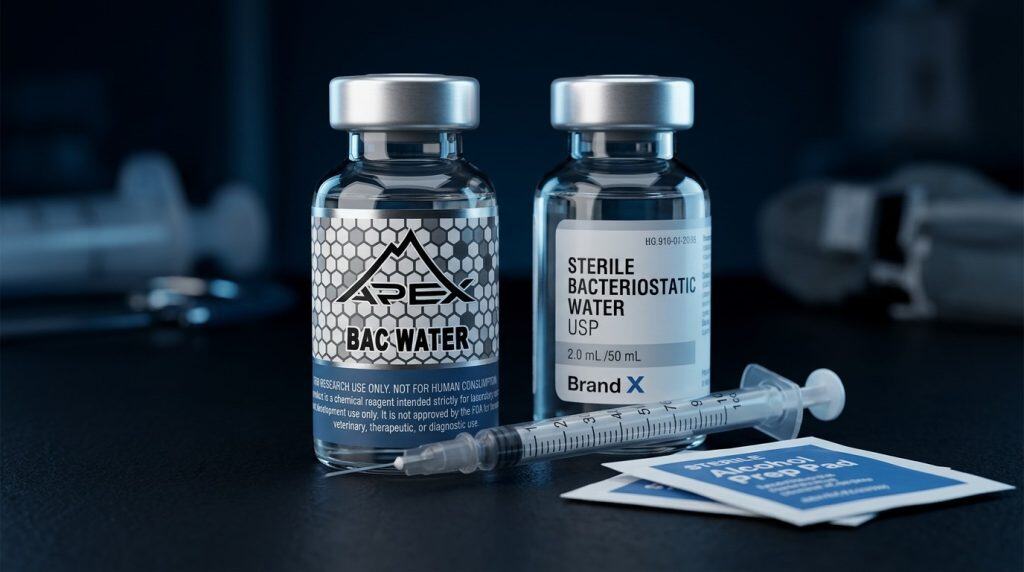
Bacteriostatic water is sterile water for injection containing 0.9% benzyl alcohol as a bacteriostatic preservative, manufactured under USP standards. The benzyl alcohol prevents microbial growth in multi-use vials, allowing the same vial to be punctured multiple times over weeks without contamination risk. It is the standard reconstitution solvent for lyophilized research peptides and distinguishes from plain sterile water by this preservative content.
This peptide is the standard reconstitution solvent used in peptide research worldwide. It is the liquid you add to a lyophilized (freeze-dried) peptide vial to dissolve the powder into a working solution for experimental use. While the concept is simple, understanding what the molecule actually is, how its preservative works, when to use it versus alternatives, and how to handle it properly is essential knowledge for any researcher working with peptides. A surprising number of experimental issues — contamination, premature degradation, inconsistent results — can be traced back to improper solvent selection or handling.
This guide covers everything researchers need to know about bacteriostatic water, from its chemical composition and preservative mechanism to practical usage protocols, storage guidelines, and the critical differences between it and other sterile solvents.
Bacteriostatic Water: Chemical Composition and USP Standards
The compound is sterile water for injection that contains 0.9% benzyl alcohol (9 mg/mL) as an antimicrobial preservative. The “bacteriostatic” designation means that the benzyl alcohol inhibits (stops) bacterial growth without necessarily killing all microorganisms — it is bacteriostatic, not bactericidal. This preservative is what distinguishes this compound from plain sterile water and makes it suitable for multi-use vial use.
The formulation meets United States Pharmacopeia (USP) standards for sterile water for injection with antimicrobial agent. The only two ingredients are purified water (USP grade) and benzyl alcohol (0.9% v/v). There are no buffers, salts, or additional additives. The pH is approximately 5.7, which is slightly acidic and compatible with the vast majority of research peptides.
How Benzyl Alcohol Preservative Works
Benzyl alcohol is a simple aromatic alcohol (C₆H₅CH₂OH) that exerts its antimicrobial effect by disrupting bacterial cell membrane integrity. At a concentration of 0.9%, it is effective against most common environmental bacterial contaminants — the types of organisms that might be introduced when a needle punctures the rubber stopper and breaks the sterile seal. This is critically important because every time you insert a needle into a vial, you create a potential entry point for environmental microorganisms.
Without a preservative (as in plain sterile water), bacterial contamination can begin immediately after the first puncture and multiply rapidly at refrigerator temperatures. Within 24-48 hours, bacterial byproducts can degrade the dissolved peptide and render the solution unusable. With the benzyl alcohol preservative in it, microbial growth is suppressed for approximately 28 days after the first puncture, allowing safe multiple withdrawals throughout that period — which is why the peptide is the standard choice for multi-use research peptide vials.
Bacteriostatic Water vs Sterile Water vs Normal Saline
Three different aqueous solvents are commonly discussed in peptide research contexts. They are not interchangeable, and understanding their differences prevents costly errors:
| Property | Bacteriostatic Water | Sterile Water (SWFI) | Normal Saline (0.9% NaCl) |
|---|---|---|---|
| Composition | Sterile water + 0.9% benzyl alcohol | Sterile water only | Sterile water + 0.9% sodium chloride |
| Antimicrobial preservative | Yes (benzyl alcohol) | None | None (unless bacteriostatic saline) |
| Multi-use (repeat punctures) | Yes — up to ~28 days | No — single puncture | No (standard saline) |
| Shelf life after opening | ~28 days | ~24 hours, single use | Single use |
| Tonicity | Hypotonic (no added salt) | Hypotonic | Isotonic (0.9% NaCl) |
| Typical research use | Default multi-draw reconstitution solvent | Single-use protocols only | Only when a protocol explicitly requires isotonic saline |
References: Bacteriostatic Water for Injection monograph, United States Pharmacopeia (USP); Benzyl alcohol compound record (preservative), NCBI PubChem CID 244; Bacteriostatic Water for Injection product labeling, DailyMed (U.S. National Library of Medicine).
Bacteriostatic Water (BAC Water)
- Composition: Sterile water + 0.9% benzyl alcohol preservative
- Multi-use: Yes — safe for multiple needle punctures over 28 days
- Best for: Any peptide reconstitution where multiple withdrawals will be made over days or weeks
- Shelf life after opening: 28 days
- Available from: Apex Laboratory (multiple sizes)
Sterile Water for Injection (SWFI)
- Composition: Sterile water only — no preservative
- Multi-use: No — single puncture only, discard remainder after first use
- Best for: Single-use protocols where the entire vial contents will be used immediately
- Shelf life after opening: 24 hours maximum, single puncture only
- Note: More wasteful and expensive than BAC water for multi-use protocols because each withdrawal requires a fresh vial
Normal Saline (0.9% Sodium Chloride)
- Composition: Sterile water + 0.9% NaCl — no antimicrobial preservative
- Multi-use: No (unless bacteriostatic saline, which contains both NaCl and benzyl alcohol)
- Best for: Specific protocols that require isotonic saline as the diluent (not standard for peptide reconstitution)
- Note: Not recommended as a default peptide reconstitution solvent. Use only if your specific protocol explicitly calls for normal saline.
The bottom line: For the vast majority of peptide research workflows, bacteriostatic water is the correct and most practical choice. It provides the antimicrobial protection needed for safe multi-use protocols while maintaining compatibility with nearly all research peptides.
Shop Reconstitution Solvents
Bacteriostatic Water (multiple sizes) · Acetic Acid Solution 1% · Reconstitution Calculator — Same-day shipping from Apex Laboratory.
How to Use Bacteriostatic Water for Peptide Reconstitution
The reconstitution process using the agent follows a specific protocol designed to protect both the sterility of the solvent and the integrity of the peptide. Here is the condensed procedure — for the complete, detailed step-by-step protocol with troubleshooting, see our full guide: How to Reconstitute Peptides.
- Step 1: Allow both the peptide vial and the bacteriostatic water vial to reach room temperature (10-15 minutes out of freezer/refrigerator).
- Step 2: Sterilize both vial stoppers with 70% isopropyl alcohol swabs. Allow to air dry completely.
- Step 3: Using a clean insulin syringe, draw up the desired volume of bacteriostatic water. Use our reconstitution calculator to determine the correct volume for your desired concentration.
- Step 4: Insert the needle into the peptide vial and slowly add the bacteriostatic water along the inside glass wall — do not squirt directly onto the lyophilized powder.
- Step 5: Allow the peptide to dissolve naturally. Gently roll the vial if needed. Never shake.
- Step 6: Label the vial with compound name, concentration, date, and initials. Refrigerate at 2-8°C.
Proper Storage of Bacteriostatic Water
Unopened Vials
Store unopened the molecule vials at room temperature (15-30°C / 59-86°F) in a clean, dry location away from direct sunlight and heat sources. Do not freeze it — freezing can crack glass vials and does not improve stability. Unopened vials remain sterile until the expiration date printed on the label, which is typically 2-3 years from the date of manufacture.
After First Use (Opened/Punctured)
Once the rubber stopper has been punctured by a needle for the first time, the 28-day clock starts. Store the opened vial at room temperature or in the refrigerator, upright, with the stopper intact. Always sterilize the stopper with an alcohol swab before each needle insertion. After 28 days from the first puncture, discard any remaining it and open a fresh vial — the preservative’s effectiveness diminishes beyond this window.
When to Use an Alternative Solvent
While this peptide is the default solvent for most peptides, there are specific situations where an alternative is needed:
Acetic Acid Solution (0.6-1%)
Use acetic acid solution when a peptide does not dissolve in the agent within 5 minutes of gentle rolling. This is most common with larger, more hydrophobic peptides or GLP-1 analogs at higher concentrations. Compounds that may benefit from acetic acid reconstitution include Semaglutide, Liraglutide, and some larger peptides above 4,000 g/mol.
DMSO (Dimethyl Sulfoxide)
A small volume of DMSO (10-20% of total volume) can be used as an initial co-solvent for extremely hydrophobic peptides that resist aqueous dissolution entirely. After dissolving the peptide in DMSO, dilute with the molecule or aqueous buffer to the final working volume. Note that DMSO at high concentrations can interfere with some biological assays — keep the final DMSO concentration as low as possible.
When Bacteriostatic Water Is Fine (Most Peptides)
The following popular compounds dissolve easily in standard bacteriostatic water with no alternative solvent needed: BPC-157, TB-500, Ipamorelin, CJC-1295, Sermorelin, GHRP-2, GHRP-6, Melanotan II, AOD9604, Selank, Semax, Epithalon, Oxytocin, DSIP, and most other peptides under 4,000 g/mol.
How Much Bacteriostatic Water Do I Need?
The amount of the compound you use determines the concentration of your reconstituted peptide. There is no single “correct” volume — it depends on your desired working concentration and experimental protocol. Our free Peptide Reconstitution Calculator computes the exact concentration, mcg/mL, and syringe units for any peptide and volume combination.
As a general guideline, most researchers use 1-3 mL of the compound per peptide vial. Using less water creates a more concentrated solution (a smaller measured volume per sample, but potentially reduced stability). Using more water creates a more dilute solution (easier to measure small volumes accurately, but a larger measured volume per sample). For standard reconstitution volumes by compound, see our reconstitution guide.
In terms of purchasing, a single 30 mL vial can reconstitute approximately 10-15 peptide vials (at 2-3 mL per vial). If you are working with multiple peptides simultaneously, a 30 mL vial is the most economical choice. For occasional use with single compounds, a 10 mL vial may be sufficient.
Where to Source Bacteriostatic Water for Research
For laboratory research, source bacteriostatic water from a supplier that provides batch documentation rather than generic retail stock. Apex Laboratory supplies USP-grade bacteriostatic water with a per-batch Certificate of Analysis (sterility, bacterial endotoxins, pH, and particulate matter), in 10 mL and 30 mL sizes, for in-vitro research use only. Pair it with the peptide reconstitution calculator to plan exact concentrations.
Safety Considerations
Benzyl Alcohol Sensitivity
Benzyl alcohol at the 0.9% concentration used in bacteriostatic water is well-characterized and widely used in pharmaceutical preparations. However, researchers should be aware that benzyl alcohol can interfere with certain sensitive in-vitro assays, particularly those involving neural cell cultures or neonatal tissue models. If your specific assay is known to be sensitive to benzyl alcohol, use plain sterile water (single-use) as your reconstitution solvent instead.
Sterile Technique
The benzyl alcohol preservative provides antimicrobial protection, but it is not a substitute for proper aseptic technique. Always sterilize vial stoppers before each needle insertion, use a fresh sterile syringe for each withdrawal, work in a clean environment, and never touch the needle tip with your fingers or any non-sterile surface.
Frequently Asked Questions
Can I use bacteriostatic water after the 28-day window?
It is not recommended. The 0.9% benzyl alcohol preservative is designed to maintain antimicrobial effectiveness for approximately 28 days after the first needle puncture. Beyond this window, the cumulative effect of repeated punctures, air exposure, and preservative depletion increases the risk of microbial contamination. Bacteriostatic water is inexpensive — discard the old vial and open a fresh one.
Does bacteriostatic water need to be refrigerated?
No. Unopened bacteriostatic water should be stored at room temperature (15-30°C). After opening, it can be stored at room temperature or refrigerated — either is acceptable. Do not freeze it. The benzyl alcohol preservative is effective at both room temperature and refrigerator temperature.
Can I use bacteriostatic water for peptides that require acetic acid?
You should first try bacteriostatic water. If the peptide does not dissolve within 5 minutes of gentle rolling, switch to acetic acid solution. Do not mix bacteriostatic water with acetic acid — use one or the other as your reconstitution solvent.
Is bacteriostatic water the same as distilled water?
No. Distilled water is simply water that has been purified by distillation. It is not sterile (bacteria can recontaminate it after distillation) and contains no preservative. Distilled water should never be used for peptide reconstitution. Bacteriostatic water is sterile, preservative-protected, and manufactured to USP pharmaceutical standards specifically for injection-grade applications.
How many peptide vials can I reconstitute with one bacteriostatic water vial?
That depends on the volume used per reconstitution. At a standard 2 mL per peptide vial: a 10 mL BAC water vial reconstitutes approximately 5 peptides; a 30 mL vial reconstitutes approximately 15. Use our reconstitution calculator to plan your exact volumes and determine how much bacteriostatic water you need for your research protocol.
Continue Your Research
- How to Reconstitute Peptides: A Complete Step-by-Step Lab Protocol
- Peptide Storage Guide: Temperature, Stability & Shelf Life
- How to Read a Certificate of Analysis (COA)
- Peptide Reconstitution Calculator — Free Tool
- Peptide Concentration & Reconstitution Math (mg/mL, mcg/mL)
- CJC-1295 Research Guide
- Ipamorelin Research Guide
- AOD9604 Research Guide
- Epithalon Research Guide
- Selank Research Guide
- Melanotan II Research Guide
- BPC-157 Research Guide
- TB-500 (Thymosin Beta-4) Research Guide
Research Use Disclaimer
This guide is provided for educational and laboratory reference purposes only. All products sold by Apex Laboratory are intended strictly for in-vitro research use and are not for human consumption. Researchers are responsible for following institutional safety protocols and applicable regulations when handling research materials and solvents.