
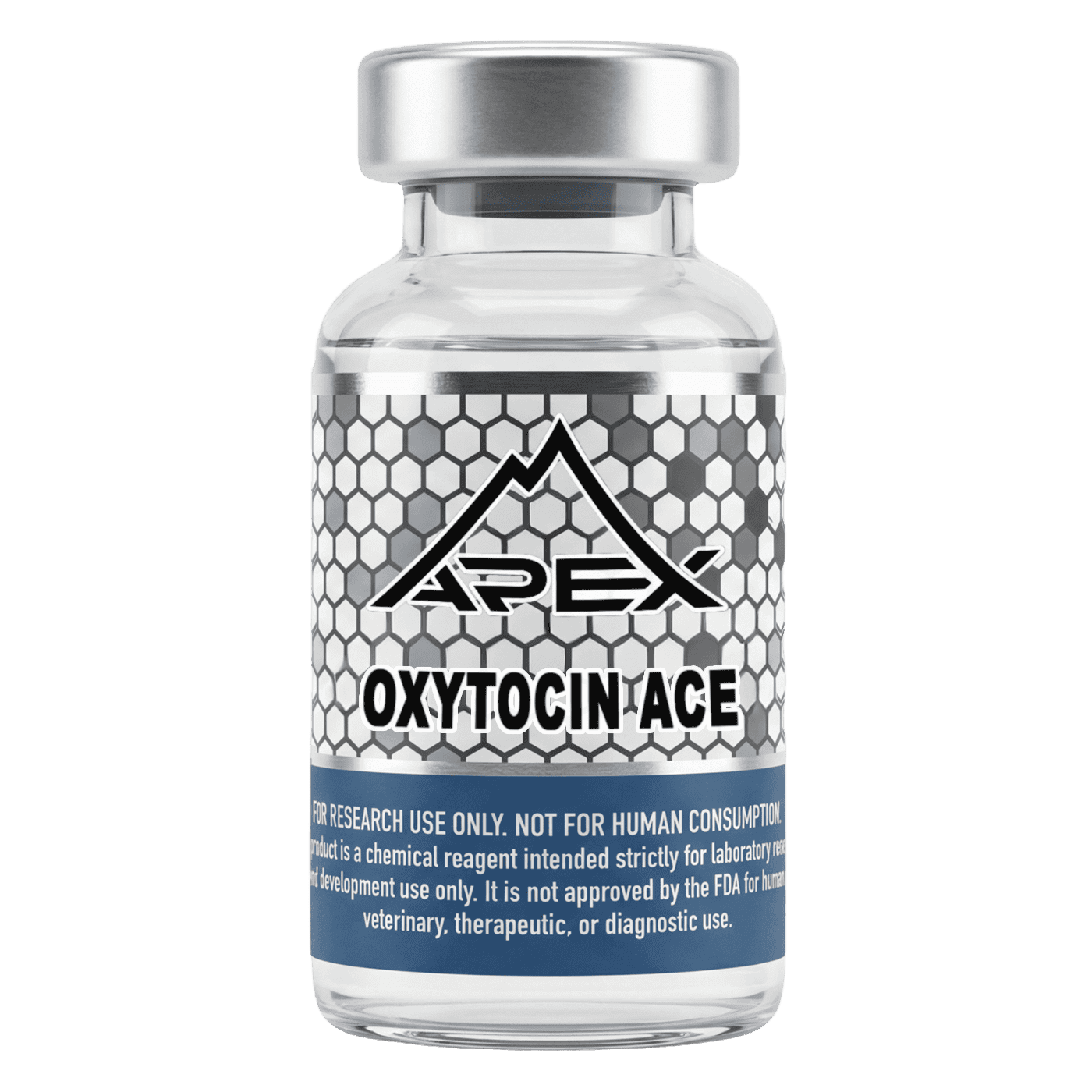
Certificate of Analysis — Oxytocin 10mg
Posterior pituitary nonapeptide – CAS 50-56-6
Verified by Apex Laboratory in-house HPLC (purity by 220 nm peak area) and ESI mass spectrometry (mass identity confirmation). Data on this page describes the current shipping lot.
- Purity (HPLC, area %): 99.37%
- Mass found (ESI-MS): 1007.22 Da
- Mass expected: 1007.19 Da
- HPLC retention time: 8.5 min
- Batch ID: APX-2026-0316-O
- Test date: March 16, 2026
- Analyst: K. Norwood
Oxytocin Acetate is the acetate salt of oxytocin, the classic posterior-pituitary nonapeptide and one of the founding molecules of neuroendocrine research. The HPLC trace and mass-spectrometry summary shown above are the release data for the lot currently on the shelf (batch APX-2026-0316-O) — not a stock graphic, not a request-only PDF. The chromatogram you see is the powder that ships. Supplied by Apex Laboratory as a high-purity reference reagent for in-vitro laboratory research and development only; it is not approved for human consumption, veterinary use, or any therapeutic application.
Compound Overview
Oxytocin is a 9-residue (nonapeptide) cyclic peptide hormone with the canonical sequence Cys-Tyr-Ile-Gln-Asn-Cys-Pro-Leu-Gly-NH2. Its defining structural feature is an intramolecular disulfide bridge linking Cys1 and Cys6, which closes a six-residue ring and leaves a three-residue C-terminal tail terminating in a glycinamide. That compact, conformationally constrained ring is what the oxytocin receptor reads, and it is also why oxytocin and its sister hormone vasopressin — which differ at only two of nine positions — are studied side by side as a model of how minute sequence changes redirect receptor selectivity.
Mechanistically, oxytocin signals through the oxytocin receptor (OXTR), a class A G-protein-coupled receptor that couples primarily to Gq/11, driving phospholipase C activation, inositol trisphosphate production, and intracellular calcium mobilization. Cross-reactivity with the vasopressin receptor subtypes (V1a, V1b, V2) is a recurring theme in receptor-pharmacology studies, making oxytocin a useful tool compound for dissecting selectivity within the broader neurohypophysial peptide family. In cell and tissue models researchers probe its role in smooth-muscle contractility, calcium-dependent secretory signaling, and central neuromodulatory circuits.
Research Background & Published Literature
Few peptides carry as deep a literature record. Oxytocin was the first peptide hormone to be fully sequenced and chemically synthesized, work by Vincent du Vigneaud that was recognized with the 1955 Nobel Prize in Chemistry and effectively launched the modern field of peptide synthesis. In the decades since, oxytocin has become a workhorse across reproductive physiology, smooth-muscle pharmacology, behavioral neuroscience, and OXTR structure–function studies, with thousands of indexed reports covering its receptor signaling, species variants, and in-vitro assay use. Because it is a small, well-characterized, disulfide-cyclized peptide, it is also a common positive control and calibration standard in peptide analytical method development.
Researchers exploring the published record on this compound can use the search portals below to locate current peer-reviewed work on its receptor signaling, structure–activity relationships, and experimental applications in controlled laboratory settings:
- PubMed — oxytocin receptor (OXTR) signaling literature
- PubMed — oxytocin nonapeptide structure–activity studies
- PubChem — oxytocin chemical record (CAS 50-56-6)
Technical Specifications
| Product Name | Oxytocin Acetate |
| Other Names / Synonyms | Oxytocin (free peptide); OXT; α-hypophamine; posterior-pituitary nonapeptide |
| Classification | Neuropeptide hormone / cyclic nonapeptide (acetate salt) |
| CAS Number | 50-56-6 |
| Molecular Formula | C₄₃H₆₆N₁₂O₁₂S₂ (free peptide) |
| Molecular Weight | 1007.19 g/mol (free peptide) |
| Sequence / Structure | 9 residues — Cys-Tyr-Ile-Gln-Asn-Cys-Pro-Leu-Gly-NH₂, cyclized by a Cys1–Cys6 disulfide bridge |
| Purity Specification | ≥99% (HPLC + MS verified — 99.37% this lot; see chromatogram above) |
| Physical Form | Lyophilized (freeze-dried) powder — sealed vial |
| Recommended Diluent | Sterile or bacteriostatic water for laboratory reconstitution |
| Available Sizes | 2 mg, 5 mg, 10 mg per vial |
| Intended Use | In-vitro research only — not for human consumption |
Storage, Handling & Stability
As a small disulfide-cyclized peptide, oxytocin acetate is comparatively robust in dry form but is sensitive to oxidation and disulfide scrambling once in solution. Store the lyophilized vial at -20°C for long-term stability, protected from light and moisture. After reconstitution with a sterile diluent, keep working solutions at 2–8°C, use them promptly, and aliquot to avoid repeated freeze-thaw cycles — each cycle risks oxidation of the Cys1–Cys6 bridge that defines the active ring.
- Limit time at ambient temperature during weighing and reconstitution; the disulfide ring is the most labile element of the molecule.
- Reseal the vial immediately after each withdrawal to limit moisture uptake and oxygen exposure.
- Avoid strongly alkaline buffers and reducing agents in stock solutions, which can cleave the disulfide and degrade the peptide.
- Label every aliquot with compound name, concentration, reconstitution date, and operator initials for full lot traceability.
Quality Assurance & Analytical Verification
Every batch passes a dual-verification release protocol before it enters inventory, and the data for the lot now shipping is published directly to the panel at the top of this page — not held behind an email gate. High-Performance Liquid Chromatography confirms chromatographic purity (this lot: 99.37%, with a single dominant peak eluting near 8.5 minutes on reversed phase), and Mass Spectrometry confirms molecular identity. For a 1007 Da peptide like oxytocin, the ESI+ spectrum is dominated by low charge states — the singly protonated [M+H]+ ion near m/z 1008 and the doubly protonated [M+2H]2+ ion near m/z 504 — and a mass found of 1007.22 against an expected 1007.19 places the result well inside acceptance, confirming an intact disulfide-cyclized backbone rather than a reduced or scrambled variant.
To understand how this peak purity figure is derived, see our guide on HPLC and mass spectrometry purity verification, learn how to interpret the values on the panel above in how to read a Certificate of Analysis, and review current and prior batch records in the Lab Verified archive.
Frequently Asked Questions
How does oxytocin differ structurally from vasopressin?
Both are 9-residue, disulfide-cyclized neurohypophysial peptides, and they differ at only two of nine positions: oxytocin carries isoleucine at position 3 and leucine at position 8, whereas vasopressin substitutes phenylalanine and arginine, respectively. Those two changes are enough to shift receptor selectivity from the oxytocin receptor toward the vasopressin V1/V2 receptors, which is precisely why the pair is studied together in selectivity and structure–activity research.
Why is the disulfide bridge so important for this peptide?
The Cys1–Cys6 disulfide closes the six-residue ring that the oxytocin receptor recognizes. If that bond is reduced or scrambled — for example by reducing agents, alkaline conditions, or repeated freeze-thaw — the constrained ring opens and the molecule no longer presents the conformation under study. Verifying intact molecular weight by mass spectrometry, as shown in the panel above, is one practical check that the ring survived synthesis, lyophilization, and shipping.
What diluent is recommended for reconstituting oxytocin acetate?
Sterile or bacteriostatic water for laboratory reconstitution is the standard diluent for preparing a known-concentration stock from the lyophilized powder. Avoid reducing or strongly alkaline media that can cleave the disulfide bridge. The reconstitution and handling steps in this section are for laboratory preparation of research solutions only.
What is the primary research application of this compound?
Oxytocin acetate is used in vitro and in cell- and tissue-model systems to study oxytocin receptor (OXTR) signaling, Gq/11-coupled calcium mobilization, smooth-muscle contractility, neurohypophysial peptide receptor selectivity, and as a well-characterized reference peptide in analytical method development. All applications are laboratory research uses.
Is this product approved for human use?
No. All compounds sold by Apex Laboratory are classified as chemical research reagents intended strictly for in-vitro laboratory research. They are not approved for human consumption, veterinary use, or any therapeutic application. Purchasers who imply intended bodily use will have their orders cancelled and their accounts permanently suspended.
Which vial sizes are available, and is bulk ordering offered?
Oxytocin acetate is stocked in 2 mg, 5 mg, and 10 mg vials. For bulk quantities, custom packaging, or recurring supply agreements, contact our team through the contact page with the compound name, desired quantity, preferred vial size, and your target delivery timeline. Volume pricing is available for qualifying orders.
Related Research Compounds
Researchers working on neuropeptide hormone and GPCR signaling pathways may also be interested in related reagents from Apex Laboratory: VIP (vasoactive intestinal peptide), Gonadorelin Acetate (GnRH), Kisspeptin-10, and DSIP (delta sleep-inducing peptide). Browse the full Apex Laboratory research catalog to view all available peptides, reagents, and laboratory supplies.
Shipping, Packaging & Delivery
Domestic orders confirmed before 2:00 PM Eastern Time on a business day leave the same day via tracked US carriers. Each oxytocin acetate vial is sealed and packed in insulated, temperature-appropriate packaging built to protect the lyophilized peptide in transit. On arrival, move the vial to -20°C storage without delay. If your protocol is time-sensitive or you need a specific delivery window, reach out ahead of time and we will coordinate shipping timing around your laboratory schedule.
Research Use Disclaimer
For in-vitro research use only. Not for human consumption. Oxytocin Acetate, like all products sold by Apex Laboratory, is intended exclusively for qualified researchers, accredited laboratories, and educational institutions. Purchasers assume full responsibility for ensuring safe handling, proper storage, and compliance with all applicable federal, state, and local laws, regulations, and institutional policies governing the purchase and use of chemical research reagents.

Reviews
There are no reviews yet.