
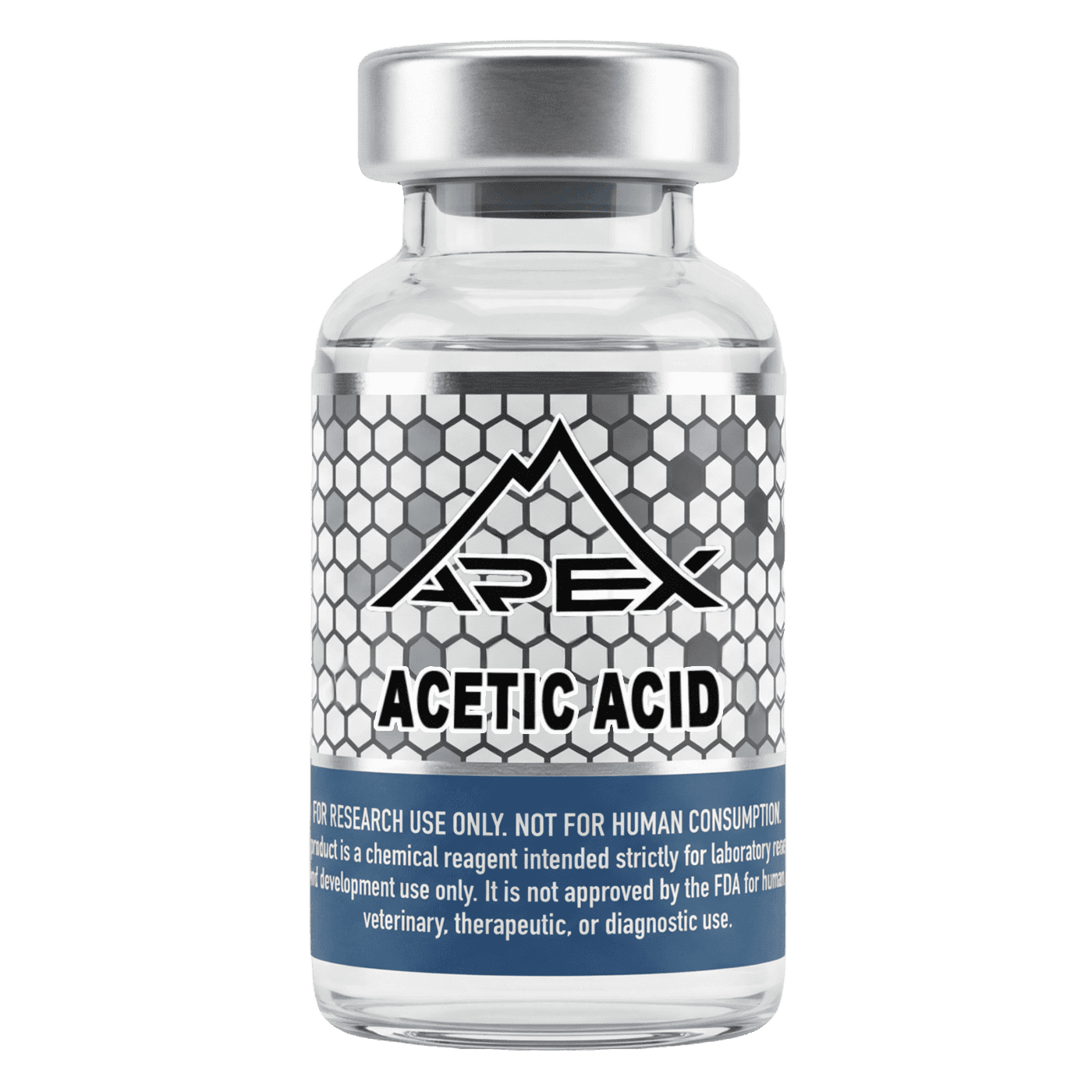
Certificate of Analysis — Acetic Acid Solution 10ml
Verified by Apex Laboratory against USP compendial methods: sterility (USP <71>), bacterial endotoxins (LAL), pH, and particulate matter (USP <788>), with 0.9% benzyl alcohol preservative. Data on this page describes the current shipping lot.
- Sterility (USP <71>): Pass
- Bacterial endotoxins: < 0.25 EU/mL · LAL
- pH: 2.4
- Particulate matter (USP <788>): Pass
- Preservative: None (acidified diluent)
- Batch ID: APX-2026-0331-A
- Test date: March 31, 2026
- Analyst: K. Norwood
View Acetic Acid Solution 10ml on the Lab Verified COA archive
Acetic Acid Solution 1% (10ml) is a sterile, acidified reconstitution diluent — 1% glacial acetic acid (CH₃COOH) in water — supplied by Apex Laboratory as a research-grade solvent for laboratories that need to bring poorly soluble lyophilized peptides into clean, fully dissolved solution. The release panel above (sterility, LAL endotoxin, pH, and particulate matter) is the actual quality record for the lot currently shipping — not a stock graphic, and no email request is required to view it. For in-vitro laboratory research and development use only; not for human consumption, veterinary use, or any therapeutic application.
Compound Overview
Acetic acid is the simplest stable carboxylic acid carrying a methyl group, with the structure CH₃COOH and a single ionizable carboxyl proton. In a 1% aqueous preparation it behaves as a weak acid that partially dissociates to acetate and a hydronium ion, holding the solution at a mildly acidic pH (the current batch measures 2.4). That controlled acidity is the entire point of the reagent. Many synthetic peptides — particularly hydrophobic sequences, those rich in aggregation-prone residues, and certain larger backbones such as some GLP-1-class analogs — resist clean dissolution in neutral diluents like sterile or bacteriostatic water, forming turbid suspensions or visible gel. Lowering the pH protonates side-chain and terminal groups, raises net charge and electrostatic repulsion between molecules, and disrupts the contacts that drive aggregation, allowing the peptide to enter true solution.
What distinguishes a dilute acetic acid diluent from a strong-acid alternative is its mildness and reversibility. Mineral acids such as hydrochloric acid drop the pH far more aggressively and introduce chloride that can interfere with downstream mass spectrometry and enzymatic assays. Acetic acid, by contrast, is volatile and largely removable by lyophilization, is buffered by its own conjugate base, and leaves an MS-friendly acetate counter-ion. In practice researchers dissolve a stubborn peptide in a small volume of acetic acid solution first, then dilute into the neutral working buffer the assay requires.
Research Background & Published Literature
Dilute acetic acid is one of the oldest and most widely documented solubilization aids in peptide chemistry, grounded in well-established acid-base and colloidal-stability behavior rather than any single discovery. Standard peptide-handling references recommend a mild acid such as 0.1% to 1% acetic acid as the first-line solvent for hydrophobic or aggregation-prone sequences, escalating to organic co-solvents only when acidification alone is insufficient. Because acetic acid is itself a compendial solvent, its identity, assay, and impurity limits are defined by recognized pharmacopeial standards — the framework Apex applies when sourcing and verifying the bulk acid used here.
Researchers looking for primary literature on acetic acid as a peptide solubilization and reconstitution medium, and on its physicochemical behavior, can begin with the following authority resources:
- United States Pharmacopeia — USP solvent and reagent standards
- PubMed — acetic acid in peptide solubility and reconstitution
- PubChem — acetic acid physicochemical record (CID, pKa, properties)
Technical Specifications
| Product Name | Acetic Acid Solution 1% (10ml) |
| Other Names / Synonyms | Ethanoic acid; glacial acetic acid (diluted); AcOH |
| Classification | Research solvent / acidified peptide reconstitution diluent |
| CAS Number | 64-19-7 |
| Molecular Formula | CH₃COOH (C₂H₄O₂) |
| Molecular Weight | 60.05 g/mol |
| Structure | 1% (w/v) acetic acid in water; single carboxyl proton, weak monoprotic acid |
| Measured pH (this lot) | 2.4 — see release panel above |
| Physical Form | Clear, colorless sterile liquid in sealed vial |
| Preservative | None (acidified diluent) |
| Analytical Verification | Sterility, bacterial endotoxin (LAL), pH, particulate matter — per batch COA |
| Available Size | 10 mL vial |
| Intended Use | In-vitro research use only — not for human consumption |
Storage, Handling & Stability
Unlike a lyophilized peptide, this product ships as a ready-prepared liquid, so storage is straightforward. Keep the sealed vial at controlled room temperature (15–30°C) away from direct light and heat, or refrigerate at 2–8°C if your protocol calls for cold storage. Do not freeze it — freeze-thaw offers no benefit for a low-concentration aqueous acid and risks vial stress. Because the solution carries no antimicrobial preservative, treat it as a limited-use diluent once the closure has been punctured, and apply aseptic withdrawal technique on every draw.
- Withdraw with a sterile needle through a swabbed septum; reseal and return the vial to storage promptly to limit evaporation of the volatile acid.
- Once opened, use within a short working window consistent with your laboratory’s SOP for unpreserved diluents, and inspect for cloudiness or particulates before each use.
- Handle in a manner appropriate to a corrosive weak acid — gloves, eye protection, and adequate ventilation per your chemical safety program.
- Label any decanted working volumes with reagent name, concentration, preparation date, and operator initials for full traceability.
Quality Assurance & Analytical Verification
Acetic acid solution is a sterile aqueous reagent, so the meaningful release tests are those of a finished solution rather than the HPLC-plus-MS identity panel used for peptide powders. Every lot is screened for sterility, bacterial endotoxin by the Limulus Amebocyte Lysate (LAL) assay, pH, and particulate matter, and the underlying glacial acetic acid is verified against compendial assay and impurity limits before dilution. The panel at the top of this page reports the actual results for batch APX-2026-0331-A, tested 2026-03-31: sterility Pass, endotoxin < 0.25 EU/mL, pH 2.4, particulate matter Pass, analyst K. Norwood. The measured pH is the most diagnostic value here, confirming the acid strength on which clean reconstitution depends.
For how Apex documents release data and how to interpret a batch record, see our guide on how to read a Certificate of Analysis, and browse current batch records in the Lab Verified archive. Historical lot reports are available on request through our contact page.
Frequently Asked Questions
When should I reach for acetic acid solution instead of bacteriostatic or sterile water?
Use it when a lyophilized research peptide will not dissolve cleanly in a neutral diluent — for example when the powder forms a cloudy suspension, a gel, or visible particles after adding bacteriostatic water. Lowering the pH increases the peptide’s net charge and breaks up aggregation, which often brings hydrophobic or sticky sequences fully into solution. Neutral diluents remain the default for routine reconstitution; reserve the acidified solvent for sequences that genuinely require it.
Why is the pH so low, and is 2.4 expected for a 1% solution?
Yes. Acetic acid is a weak monoprotic acid, and a 1% (w/v) preparation partially dissociates to give a pH in the low-to-mid 2 range. The value of 2.4 reported on this lot’s release panel confirms the solution is at the intended acid strength. That controlled acidity is what disrupts peptide aggregation; it is also why the reagent should be diluted into your neutral assay buffer once the peptide is dissolved.
Why acetic acid rather than hydrochloric acid for difficult peptides?
Acetic acid is milder, is buffered by its own acetate conjugate base, and is volatile — meaning it can be largely removed by subsequent lyophilization. It also leaves an acetate counter-ion that is broadly compatible with mass spectrometry and enzymatic assays, whereas chloride from HCl can interfere with downstream analysis. For most research solubilization tasks a dilute acetic acid solution achieves the needed pH drop without the harshness of a strong mineral acid.
Does the solution contain a preservative, and how long is it usable once opened?
No. This is an unpreserved acidified diluent, as noted on the release panel. The low pH is itself unfavorable to microbial growth, but without an added antimicrobial agent you should treat an opened vial as a limited-use reagent, withdraw aseptically, and follow your laboratory’s SOP for unpreserved solutions. Inspect for any cloudiness or particulates before each use.
Will acetic acid interfere with mass spectrometry verification of my peptide?
Dilute acetic acid is generally MS-friendly — it is volatile and a common additive in electrospray solvent systems — one reason it is preferred over chloride-introducing acids. For how peptide identity and purity are confirmed analytically, see our overview of HPLC and mass spectrometry purity testing and the dedicated mass spectrometry verification guide.
Is this product approved for human use?
No. All compounds and solutions sold by Apex Laboratory, including this Acetic Acid Solution, are classified as chemical research reagents intended strictly for in-vitro laboratory research. They are not approved for human consumption, veterinary use, or any therapeutic application. Purchasers who imply intended bodily use will have their orders cancelled and their accounts permanently suspended.
Related Research Compounds
Researchers stocking reconstitution and reagent supplies alongside this acidified diluent may also want Bacteriostatic Water (the standard neutral, benzyl-alcohol-preserved diluent), Glutathione, and Vitamin B12 1mg for broader research-solution workflows. To plan target concentrations once a peptide is dissolved, use the peptide reconstitution calculator, or browse the complete Apex Laboratory research catalog.
Shipping, Packaging & Delivery
Orders confirmed before 2:00 PM Eastern Time on a business day leave the same day via tracked domestic carriers within the United States. Each Acetic Acid Solution vial is cushioned to protect the sealed liquid in transit. On arrival, inspect the vial and move it to your preferred room-temperature or refrigerated storage. If your protocol is time-sensitive or you need a specific delivery window, message our support team ahead of ordering so we can coordinate dispatch around your schedule.
Research Use Disclaimer
For in-vitro research use only. Not for human consumption. All products sold by Apex Laboratory — including this Acetic Acid Solution 1% (10ml) — are supplied exclusively to qualified researchers, accredited laboratories, and educational institutions. Purchasers assume full responsibility for safe handling of this acidified reagent, proper storage, and compliance with all applicable federal, state, and local laws, regulations, and institutional policies governing the use of chemical research reagents.

Reviews
There are no reviews yet.