
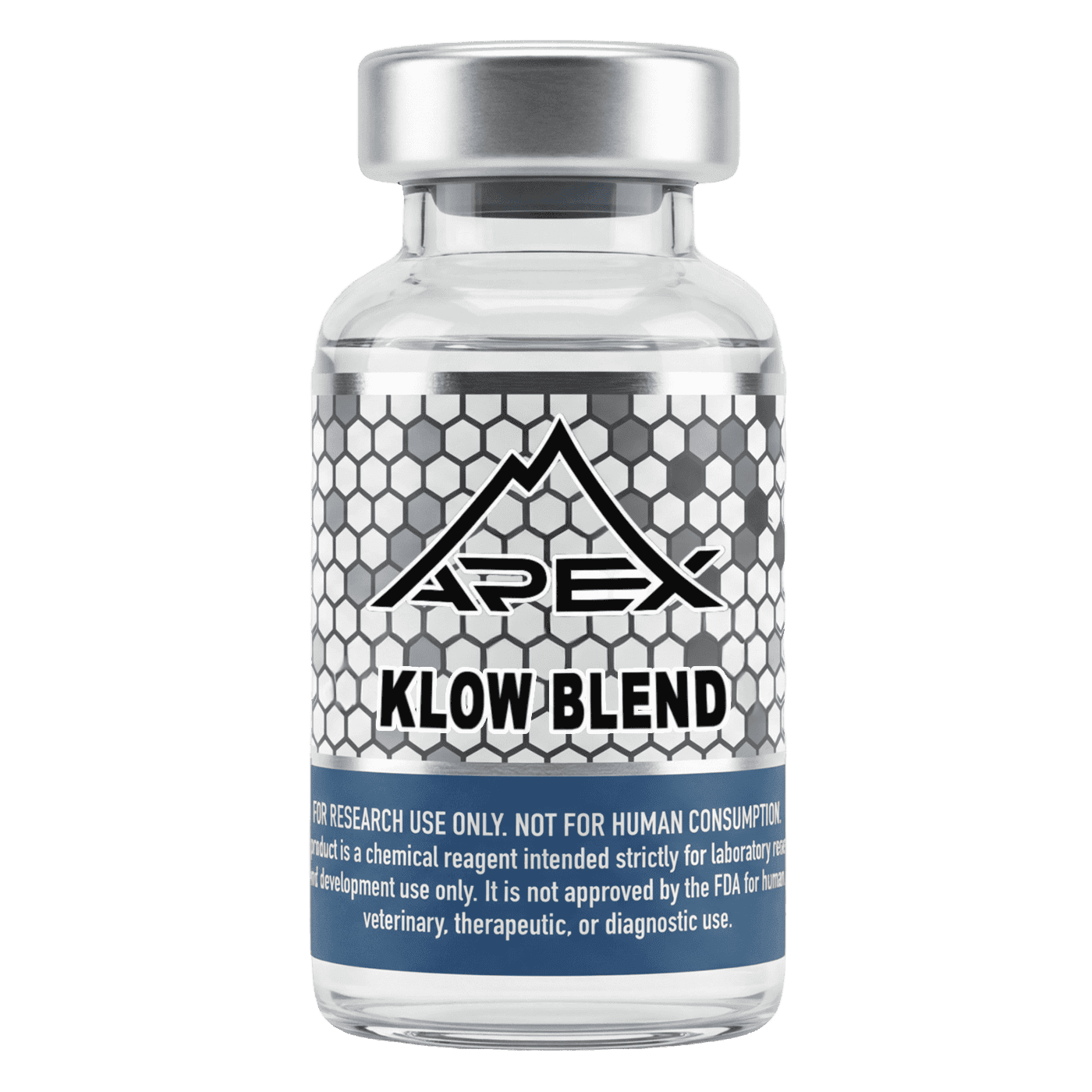
Certificate of Analysis — Klow Blend 80mg
Multi-component research blend · 4 peptides · GHK-Cu + BPC-157 + TB-500 + KPV
Verified by Apex Laboratory in-house HPLC (purity by 220 nm peak area) and ESI mass spectrometry (mass identity confirmation). Data on this page describes the current shipping lot.
- Purity (HPLC, area %): 99.75%
- Batch ID: APX-2026-0326-K
- Test date: March 26, 2026
- Analyst: K. Norwood
- Components: GHK-Cu (50mg), 99.74% pure; BPC-157 (10mg), 99.75% pure; TB-500 (10mg), 99.77% pure; KPV (10mg), 99.78% pure
View Klow Blend 80mg on the Lab Verified COA archive · Read the Klow Blend Research Guide
KLOW Blend 80mg — Four-Peptide Research Reagent Built Around KPV
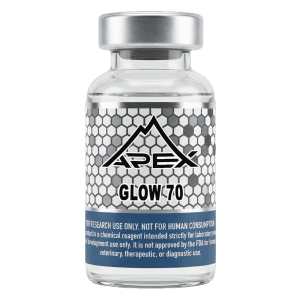
KLOW Blend 80mg is the four-component extension of the GLOW formulation. Its composition is GHK-Cu 50 mg, BPC-157 10 mg, TB-500 10 mg, and KPV 10 mg — 80 mg of total peptide material in one lyophilized vial. Everything that distinguishes KLOW from GLOW comes down to a single addition: the KPV tripeptide. KPV sits in a different research literature from the other three components, so its presence is the entire reason a laboratory chooses KLOW. Read this page for the KPV rationale and the four-pathway design; the three shared components are documented in full on the GLOW Blend product page. KLOW is supplied for in-vitro and preclinical research use only.
KPV — The Component That Defines KLOW
KPV is the C-terminal tripeptide fragment (lysine-proline-valine) of α-melanocyte-stimulating hormone (α-MSH). In the research literature it is studied in in-vitro models of NF-κB signaling and inflammatory-pathway regulation. That places it in a mechanistically separate research domain from the angiogenesis, copper-transport, and matrix-remodeling pathways associated with GHK-Cu, BPC-157, and TB-500. For a research group, adding KPV is not a concentration change — it is the addition of a fourth, independent research subject to the same co-formulated vial. KLOW exists specifically for protocols that need an α-MSH fragment studied alongside the three tissue-research peptides, from one reconstituted solution at a fixed ratio. KPV has its own molecular weight and HPLC retention time, so it is reported as a distinct peak on the Certificate of Analysis.
The Four-Pathway Design
The three GLOW components cluster around tissue-remodeling and angiogenesis research. KPV is the outlier by design: it brings an inflammatory-signaling research pathway that the three-peptide blend does not cover, converting the reagent from a three-pathway tool into a four-pathway one. The practical consequence is selection logic rather than potency: if an experiment needs the α-MSH-fragment pathway represented, KLOW supplies all four compounds together; if it does not, GLOW provides the same three tissue-research peptides for less. KLOW is therefore best understood as GLOW plus one deliberately chosen, mechanistically distinct research peptide — not as a stronger or higher-dose version of the same thing.
The Three Shared Components, In Brief
KLOW shares its tissue-research base with GLOW. GHK-Cu (50 mg, MW 401.91) is the copper-binding tripeptide studied in copper-transport and matrix-remodeling research and serves as the concentration anchor for the vial. BPC-157 (10 mg, MW 1419.53) is the pentadecapeptide referenced throughout angiogenesis and cytoprotection models. TB-500 (10 mg, MW 4963.50) is the thymosin β4-related peptide studied for actin regulation and cell migration. Full per-component research context for these three appears on the GLOW page; on KLOW they form the familiar 50:10:10 base that the 10 mg KPV fraction is added to.
Identity & Purity Verification
Each KLOW lot is analyzed by reverse-phase HPLC and mass spectrometry, with all four components resolved as separate peaks at their own retention times. The interactive Certificate of Analysis above lists the batch number, test date, per-component purity for all four peptides, and a combined purity figure for the exact lot shipped, and it can be cross-referenced against the third-party records on the Lab Verified hub. The KPV peak is what visually separates a KLOW certificate from a GLOW one. This is documentation only and makes no use, dose, or efficacy claim.
Cost & Convenience vs. Buying Components Separately
| Approach | What you get | Price |
|---|---|---|
| GHK-Cu 50 mg | 1 component | $36 |
| BPC-157 10 mg | 1 component | $58 |
| TB-500 10 mg | 1 component | $89 |
| KPV 10 mg | the KLOW differentiator | $49 |
| Four components separately | 4 vials, manual ratio matching | $232 |
| KLOW Blend 80 mg | 1 vial, ratio pre-matched | $155 |
Bought individually the four components total $232 across four vials. KLOW co-formulates them for $155 — about a 33% reduction — in one lot with one Certificate of Analysis. The KPV fraction alone accounts for $49 of the separate-purchase total, which is the measurable cost of the research pathway KLOW adds over GLOW.
Reconstitution, Storage & Handling
Store the lyophilized KLOW vial at -20 °C, protected from light and moisture. Reconstitute with bacteriostatic water and use the reconstitution calculator (KLOW is a built-in preset) to obtain all four per-component concentrations at once. The reconstitution guide covers technique; the storage guide covers reconstituted shelf-life. Hold reconstituted solution at 2-8 °C for short-term research use. Handling is the responsibility of the qualified purchaser.
Selecting KLOW for a Research Program
KLOW is the right reagent when an experiment needs the KPV / α-MSH-fragment pathway represented alongside GHK-Cu, BPC-157, and TB-500 from a single reconstituted solution. It is a four-pathway tissue-and-signaling research reagent, and the KPV component is the entire reason to prefer it over the three-peptide GLOW blend. Laboratories whose protocols do not involve an α-MSH fragment generally select GLOW instead and treat KLOW as the KPV-inclusive option to reach for only when that fourth pathway is part of the design.
Documentation & Batch Records
Each lot ships with a batch identifier printed on the vial that matches the batch shown on the Certificate of Analysis, so a research record can be traced to the exact tested material. The certificate records the test date and the analyst, the per-component retention times and purity, and the combined purity for the lot. Apex retains these records and publishes them on the Lab Verified hub so a reviewer, collaborator, or auditor can confirm a batch independently rather than taking a supplier figure on trust. For research groups operating under documented quality procedures, this per-lot traceability is often the deciding factor in selecting a co-formulated reagent: one certificate covers every component in the vial.
Frequently Asked Questions
What is the single difference between KLOW and GLOW?
KPV. KLOW is GLOW plus 10 mg of KPV, the α-MSH C-terminal tripeptide, taking the total from 70 mg to 80 mg. That fourth component adds an inflammatory-signaling research pathway absent from the three-peptide GLOW blend.
When would a researcher pick KLOW instead of GLOW?
When the experimental design needs the KPV / α-MSH-fragment pathway represented alongside the three tissue-research peptides. If KPV is not part of the protocol, GLOW provides the same other three components for less.
Is KLOW a stronger version of GLOW?
No. KLOW is not a more-concentrated GLOW — it is GLOW with one additional, mechanistically distinct research peptide. The three shared components are present at the same 50:10:10 masses; KPV is an addition, not a change to the others.
Does the KPV peptide resolve separately on the COA?
Yes. KPV has its own molecular weight and HPLC retention time, so it is reported as an individual peak with its own purity figure, alongside GHK-Cu, BPC-157, and TB-500 and a combined-purity value for the lot.
How is KLOW reconstituted and stored for research?
Reconstitute with bacteriostatic water and use the reconstitution calculator (KLOW preset) for the four per-component concentrations. Store lyophilized at -20 °C; keep reconstituted solution refrigerated at 2-8 °C for short-term research use.
Is KLOW Blend 80mg for human use?
No. It is a research reagent for in-vitro and laboratory use only and is not for human or veterinary consumption.
For in-vitro research use only. Not for human or veterinary consumption. Klow Blend 80mg is intended exclusively for qualified researchers, accredited laboratories, and educational institutions. Purchasers are responsible for safe handling, storage, and compliance with applicable federal, state, local, and institutional requirements governing chemical research reagents.

Reviews
There are no reviews yet.