
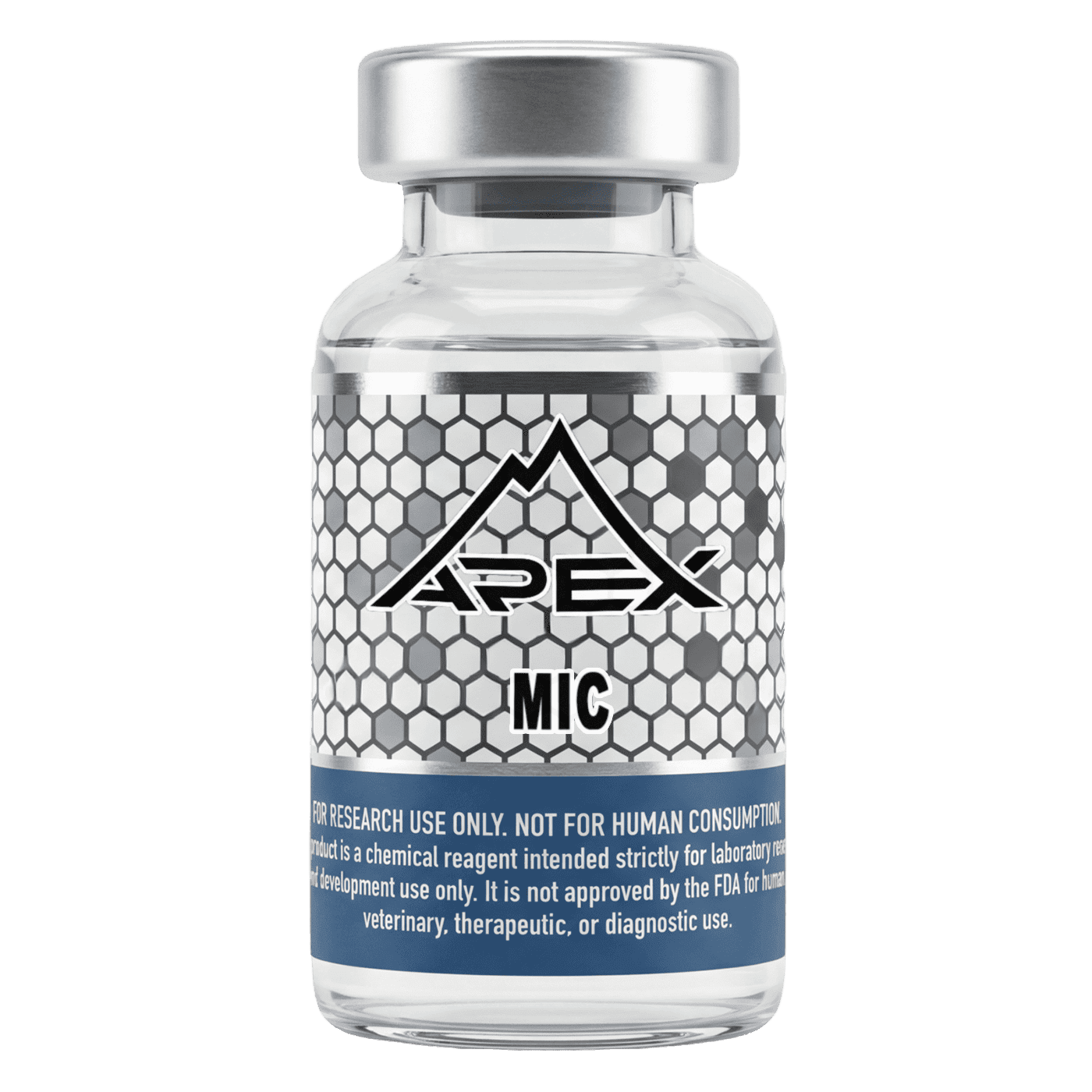
Certificate of Analysis — MIC Blend (Lipo C + B12) 10mg
Lipotropic blend · Methionine + Inositol + Choline + B12 cofactor
Verified by Apex Laboratory in-house HPLC (purity by 220 nm peak area) and ESI mass spectrometry (mass identity confirmation). Data on this page describes the current shipping lot.
- Purity (HPLC, area %): 99.30%
- Batch ID: APX-2026-0310-M
- Test date: March 10, 2026
- Analyst: K. Norwood
- Components: Methionine (25mg), 99.37% pure; Inositol (50mg), 99.41% pure; Choline Chloride (50mg), 99.45% pure
View MIC Blend (Lipo C + B12) 10mg on the Lab Verified COA archive
MIC Blend (Lipo C + B12) 10mg is a multi-component methyl-donor and inositol research reagent that combines three small molecules — methionine, inositol, and choline chloride — alongside a vitamin B12 (cyanocobalamin) cofactor. The chromatographic panel above, resolving each component as its own peak, is taken from the current shipping lot (batch APX-2026-0310-M, released 2026-03-10) rather than a stock illustration: what is plotted is what arrives at the bench. This material is supplied by Apex Laboratory strictly for in-vitro laboratory research and development. It is not approved for human consumption, veterinary use, or any therapeutic application.
Compound Overview
Unlike a single-molecule reagent, the MIC blend is a defined mixture in which each constituent occupies a distinct node of one-carbon and lipid metabolism in cell and tissue models. Methionine (C₅H₁₁NO₂S, MW 149.21) is the sulfur-containing essential amino acid that serves as the precursor to S-adenosylmethionine (SAM), the universal methyl donor that drives phosphatidylcholine biosynthesis through the PEMT pathway. Choline chloride (C₅H₁₄ClNO, MW 139.62) feeds the parallel CDP-choline (Kennedy) pathway for phosphatidylcholine assembly and is itself oxidised to betaine, regenerating methionine from homocysteine. Inositol (C₆H₁₂O₆, MW 180.16) is the cyclohexanehexol backbone of the phosphoinositide second-messenger system and of inositol-containing lipids. The cyanocobalamin (B12) cofactor sits upstream as the obligate coenzyme for methionine synthase, the enzyme that recycles homocysteine back to methionine. What distinguishes this blend from its individual catalog siblings — standalone Lipo-C or single-vitamin B12 — is that it presents all four nodes of the methionine-choline-folate-cobalamin axis in one preparation, allowing convergent rather than isolated study of methyl-group flux in laboratory model systems.
Research Background & Published Literature
The methyl-donor concept — that methionine, choline and inositol influence hepatic lipid handling — traces back to classical choline-deficiency models, in which diets lacking choline and methionine reliably induced hepatic triglyceride accumulation in animal systems. Modern work re-frames this mechanistically: choline and SAM availability gate phosphatidylcholine synthesis, which is in turn rate-limiting for VLDL assembly and lipid export in hepatocyte models, while inositol participates in phosphoinositide signalling. The methionine-choline-deficient (MCD) diet remains a widely cited preclinical model of steatohepatitis, making each component a recurring variable in metabolic and hepatology research. In every case the readouts are in-vitro and animal-model endpoints, not human outcomes.
Researchers interested in the published literature surrounding these components can explore the following peer-reviewed resources for additional context on mechanism, methyl-donor metabolism, and experimental applications in controlled laboratory settings:
- PubMed — methionine/choline and hepatic lipid metabolism (search)
- PubChem — inositol compound record (search)
Technical Specifications
| Product Name | MIC Blend (Lipo C + B12) 10mg |
| Other Names / Synonyms | Lipo-C + B12; MIC + B12; Methionine / Inositol / Choline blend |
| Classification | Methyl-donor + vitamin research blend (defined small-molecule mixture) |
| Components & Per-Vial Mass | Methionine 25 mg · Inositol 50 mg · Choline Chloride 50 mg · Cyanocobalamin (B12) cofactor |
| Component Molecular Weights | Methionine 149.21 · Inositol 180.16 · Choline Chloride 139.62 g/mol |
| Structure | Sulfur amino acid (Met) + cyclitol (inositol) + quaternary ammonium choline salt + corrinoid B12 cofactor |
| Purity Specification | ≥99% per component (HPLC); 99.30% combined — see panel above (Met 99.37% / Inositol 99.41% / Choline 99.45%) |
| Physical Form | See product label for current form (sealed vial) |
| Recommended Diluent | Sterile bacteriostatic water or laboratory-grade water for lab dilutions |
| Available Sizes | 10 mg blend vial |
| Intended Use | In-vitro research use only — not for human consumption |
Storage, Handling & Stability
Because this is a multi-component preparation, stability is governed by its least robust constituent. Methionine is oxidation-prone at its thioether sulfur, choline chloride is markedly hygroscopic, and the cyanocobalamin cofactor is photolabile. Store the sealed vial at -20°C for long-term integrity and protect it from light. Once diluted with sterile solvent, refrigerate working solutions at 2–8°C, prepare them fresh where the protocol allows, and aliquot to avoid repeated freeze-thaw of the whole stock. For component-specific shelf-life expectations, our storage and stability guide covers temperature handling that applies equally to small-molecule research reagents.
- Shield the vial from direct and ambient light to protect the photolabile B12 cofactor.
- Reseal promptly after each withdrawal — the choline chloride fraction readily absorbs atmospheric moisture.
- Limit time at room temperature to slow methionine sulfoxide formation.
- Label every aliquot with blend name, dilution concentration, reconstitution date, and operator initials for full lot traceability.
Quality Assurance & Analytical Verification
Apex Laboratory releases every lot only after batch-level analytical verification, and the data for the lot you receive is published directly on this page rather than locked behind a request. For a defined small-molecule mixture, reversed-phase HPLC is the workhorse method: each component resolves at its own retention time, so the chromatogram functions as both a purity check and an identity check in a single run. On batch APX-2026-0310-M (analyst K. Norwood, tested 2026-03-10), choline chloride elutes earliest at ~2.5 min, inositol at ~3.5 min, and methionine latest at ~4.0 min. Each peak meets the ≥99% per-component specification (99.45%, 99.41% and 99.37% respectively), giving the 99.30% combined value shown above. This per-component separation is the right approach for a blend — a single lumped figure cannot confirm each ingredient is present and correct, whereas baseline-resolved peaks can. For a deeper explanation of how chromatographic purity is determined, see our guide on HPLC purity verification, and to interpret the figures on this page review how to read a Certificate of Analysis. Current and historical batch documentation is archived in the Lab Verified archive.
Frequently Asked Questions
What does each letter in “MIC” stand for, and what is the B12 for?
MIC denotes the three constituents — Methionine, Inositol and Choline — that occupy different points of hepatic methyl-group and lipid metabolism in laboratory model systems. The added vitamin B12 (cyanocobalamin) is included as a cofactor because it is the obligate coenzyme for methionine synthase, the enzyme that regenerates methionine from homocysteine, tying the vitamin directly into the same one-carbon cycle the other three components feed.
Why does the chromatogram show three separate peaks?
This is a defined mixture rather than a single molecule, so reversed-phase HPLC resolves each component as its own peak: choline chloride near 2.5 min, inositol near 3.5 min and methionine near 4.0 min. Reporting baseline-separated peaks lets the analyst confirm both the identity and the individual purity of every ingredient, which a single combined number could not do on its own.
How should this blend be stored given its mixed composition?
Store the sealed vial at -20°C protected from light. The stability ceiling is set by the most sensitive constituent — the photolabile B12 cofactor, the oxidation-prone methionine, and the hygroscopic choline chloride — so light protection, prompt resealing and minimal freeze-thaw are more important here than for a single robust small molecule. Refrigerate diluted working solutions at 2–8°C.
What is the primary research application of this blend?
In laboratory settings the MIC + B12 blend is used to study the convergence of methyl-donor (SAM/methionine), choline-pathway and inositol-pathway metabolism on hepatic lipid handling, and to supply defined one-carbon-cycle inputs in cell and tissue models such as the methionine-choline-deficient steatohepatitis system. All such work is conducted in in-vitro and animal-model systems only.
How is this different from the standalone Lipo-C and B12 products?
Standalone Lipo-C supplies the methionine/inositol/choline core, and Vitamin B12 supplies the cobalamin cofactor alone. This blend co-formulates both in one vial at the per-component masses listed in the specifications table, which is useful when a protocol calls for the complete methyl-donor-plus-cofactor set rather than measuring out each reagent independently.
Is this product approved for human use?
No. All compounds sold by Apex Laboratory, including the MIC Blend (Lipo C + B12), are classified as chemical research reagents intended strictly for in-vitro laboratory research. They are not approved for human consumption, veterinary use, or any therapeutic application, and nothing on this page should be read as a metabolic, weight, or medical claim for people. Purchasers who imply intended bodily use will have their orders cancelled and their accounts permanently suspended.
Related Research Compounds
Researchers studying methyl-donor and metabolic-reagent pathways may also be interested in related catalog items from Apex Laboratory, including Lipo-C 10ml (the standalone MIC core), L-Carnitine 5000mg (a fatty-acyl transport research reagent), and Vitamin B12 1mg (the cobalamin cofactor alone). Browse the full Apex Laboratory research catalog to compare all available reagents, solutions and peptides.
Shipping, Packaging & Delivery
Orders confirmed before 2:00 PM Eastern Time on a business day leave the same day through tracked US domestic carriers. Each MIC Blend vial travels in insulated, temperature-appropriate packaging chosen to protect the light- and moisture-sensitive constituents in transit. On arrival, move the vial into -20°C storage right away and keep it shielded from light. If your protocol is time-critical or you need a specific delivery window, reach out to support beforehand so we can align the shipment with your bench schedule.
Research Use Disclaimer
For in-vitro research use only. Not for human consumption. All products sold by Apex Laboratory — including the MIC Blend (Lipo C + B12) 10mg — are intended exclusively for qualified researchers, accredited laboratories, and educational institutions. This blend is a chemical research reagent and is not a drug, supplement, or treatment; no statement here describes a benefit, effect, or use for people. Purchasers assume full responsibility for safe handling, proper storage, and compliance with all applicable federal, state, and local laws, regulations, and institutional policies governing the purchase and use of chemical research reagents.

Reviews
There are no reviews yet.