
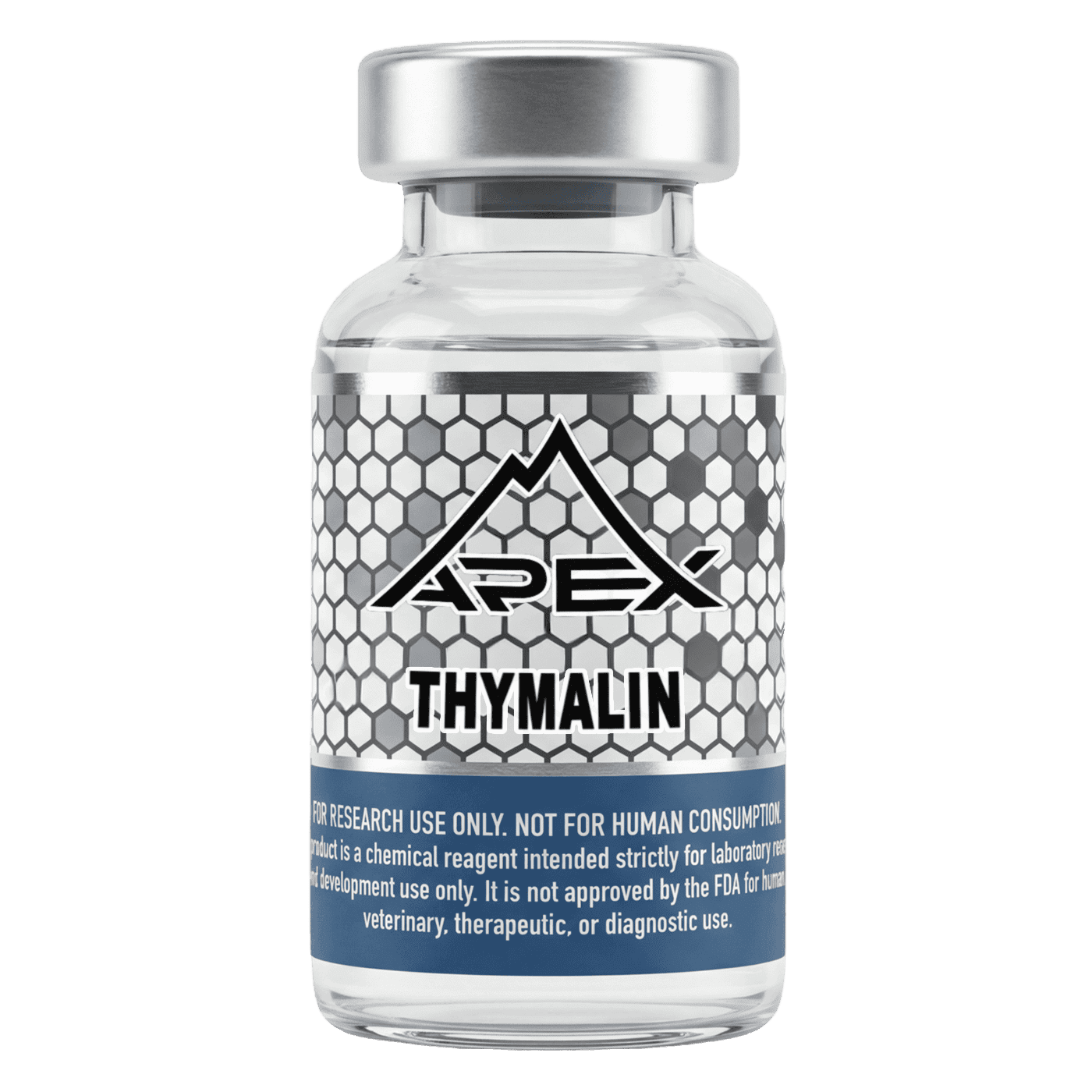
Certificate of Analysis — Thymalin 10mg
Calf thymus polypeptide complex · Immunomodulator (Khavinson)
Verified by Apex Laboratory in-house HPLC (purity by 220 nm peak area) and ESI mass spectrometry (mass identity confirmation). Data on this page describes the current shipping lot.
- Batch ID: APX-2026-0418-T
- Test date: April 18, 2026
- Analyst: K. Norwood
Thymalin is a bioregulatory thymic polypeptide complex isolated from calf thymus tissue and supplied by Apex Laboratory as a high-purity research reagent. Unlike a single defined peptide, it is a low-molecular-weight fraction of short peptides characterized by its reversed-phase chromatographic fingerprint rather than one molecular ion. The RP-HPLC fingerprint and analytical summary shown above are drawn from the current shipping lot (batch APX-2026-0418-T) — no email gate, no document request, no proxy summary. What you receive matches the trace that is plotted. This material is intended strictly for in-vitro laboratory research and development applications and is not approved for human consumption, veterinary use, or any therapeutic purpose.
Compound Overview
Thymalin is not a single molecule but a standardized polypeptide fraction extracted from bovine (calf) thymus, the primary lymphoid organ responsible for T-lymphocyte maturation. The preparation is dominated by short peptides in the 3-10 residue range, with molecular masses spanning roughly 1-10 kDa and a side-chain composition enriched in lysine, arginine, and glutamate. This acidic-and-basic residue balance is characteristic of thymic bioregulatory extracts and underlies the material’s behavior on ion-pairing reversed-phase columns. Because the active principle is distributed across many co-eluting species rather than concentrated in one peak, Thymalin is best understood as a defined mixture standardized by total polypeptide content (10 mg per vial) and by its chromatographic profile against a reference lot.
The most-studied identified component is the dipeptide Glu-Trp (glutamyl-tryptophan), the same minimal sequence later isolated under the research name Thymogen, present here as a trace identity marker rather than the bulk of the mass. Mechanistically, thymic peptide fractions of this class are investigated for their role in modeling T-cell differentiation signaling, thymic stromal interactions, and immune homeostasis. What distinguishes Thymalin from its conceptual siblings is its origin as a multi-component tissue extract: where Thymosin Alpha 1 is a single, fully defined 28-residue synthetic peptide, Thymalin retains the heterogeneity of the source fraction, a useful comparator in studies contrasting purified peptides against complex bioregulatory mixtures.
Research Background & Published Literature
Thymalin originated in the bioregulatory peptide research program directed by Professor Vladimir Khavinson at the Saint Petersburg Institute of Bioregulation and Gerontology. That program produced a family of tissue-derived peptide complexes — including the pineal extract Epithalamin and its synthetic analog Epithalon — built around the hypothesis that short peptides recovered from specific organs participate in tissue-specific regulatory signaling. Thymalin sits in this lineage as the thymus-derived member, and the bulk of its published characterization appears in the Russian-language and translated experimental literature, notably the Bulletin of Experimental Biology and Medicine and Advances in Gerontology, alongside Khavinson’s English-language reviews on peptide bioregulation. Researchers comparing the defined-peptide and complex-extract approaches frequently cross-reference this work against the better-known thymosin fractions.
Researchers exploring the published literature surrounding this compound can review the following sources for additional context on its composition, signaling context, and experimental applications in controlled laboratory settings:
- PubMed search — Thymalin thymic peptide immunomodulator
- PubChem — glutamyl-tryptophan (Glu-Trp, identified component)
Technical Specifications
| Product Name | Thymalin 10mg |
| Other Names | Calf thymus polypeptide complex · Khavinson thymic bioregulator |
| Classification | Bioregulatory thymic peptide complex (defined mixture) |
| Composition | Short thymic polypeptides, 3-10 residues · Lys/Arg/Glu enriched |
| Identified Marker Component | Glu-Trp dipeptide (Thymogen sequence), trace marker |
| Component Mass Range | ~1-10 kDa across the polypeptide fraction |
| Potency / Loading | 10 mg total polypeptide per vial (±5% by Lowry assay) |
| Excipient | Glycine, 20 mg (bulking agent) |
| Identity Method | RP-HPLC fingerprint vs reference batch |
| Sterility / Endotoxin | Sterility Pass · endotoxin < 5 EU/vial (LAL) |
| Physical Form | Lyophilized powder · sealed glass vial |
| Recommended Diluent | Bacteriostatic water or sterile laboratory-grade water |
| Available Size | 10 mg vial |
| Intended Use | In-vitro research only — not for human consumption |
Because Thymalin is a tissue-derived complex rather than a synthetic single peptide, it is not assigned a single CAS number, molecular formula, or exact molecular weight; the relevant identity descriptors are total polypeptide loading, the component mass range, and the chromatographic fingerprint. Those fields are reported above and verified against batch APX-2026-0418-T.
Storage, Handling & Stability
As a lyophilized polypeptide fraction with a glycine matrix, Thymalin is hygroscopic and should be protected from moisture and light. Store the sealed vial at -20°C for long-term stability. Once reconstituted with a sterile diluent, keep the working solution refrigerated at 2-8°C and aliquot to avoid repeated freeze-thaw cycles, which are particularly damaging to a heterogeneous mixture because different component peptides degrade at different rates and can shift the chromatographic profile away from the reference fingerprint. For workflow guidance, see the peptide storage guide.
- Reconstitute immediately before use and keep handling at ambient temperature to a minimum, as the multi-component matrix is sensitive to thermal cycling.
- Reseal the vial promptly after each withdrawal; the glycine bulking matrix readily absorbs atmospheric moisture once the stopper is breached.
- Aliquot the reconstituted fraction so a single working volume is thawed once rather than the whole vial repeatedly.
- Label every aliquot with the lot number (APX-2026-0418-T), concentration, reconstitution date, and operator initials for full traceability.
Quality Assurance & Analytical Verification
Apex Laboratory characterizes every batch before it enters inventory, and the release data for the current lot is published directly to this page rather than hidden behind a request form. The summary at the top of this page is this batch’s actual release record, not a marketing graphic. Because Thymalin is a defined mixture rather than a single molecule, its quality protocol differs from that used for synthetic peptides: instead of a single-mass confirmation, identity is established by an RP-HPLC fingerprint compared against a qualified reference batch, so that the relative positions and proportions of the co-eluting component peaks must match the expected profile. Total polypeptide content is quantified by Lowry assay and held to 10 mg per vial within ±5%, while sterility and bacterial endotoxin (LAL, < 5 EU/vial) are confirmed on each lot.
For background on how chromatographic purity and fingerprinting are performed and read, see our guide on HPLC and mass spectrometry purity verification and the published certificates in the Lab Verified archive. Historical reports for prior lots are available on request.
Frequently Asked Questions
Why does Thymalin not have a single molecular weight or CAS number?
Thymalin is a tissue-derived polypeptide complex, not a single synthetic molecule. It contains many short peptides spanning roughly 1-10 kDa, so there is no one molecular formula or exact mass to report. Identity is established instead by its RP-HPLC fingerprint against a reference batch, and the vial is standardized to 10 mg of total polypeptide by Lowry assay.
How is Thymalin different from Thymosin Alpha 1?
Both relate to thymic peptide research, but they are structurally distinct. Thymosin Alpha 1 is a single, fully defined 28-residue synthetic peptide with a known sequence and mass, whereas Thymalin is a multi-component extract fraction. Researchers often use the two side by side to contrast a purified single peptide against a heterogeneous bioregulatory mixture in the same experimental model.
What is the Glu-Trp component listed on the COA?
Glu-Trp (glutamyl-tryptophan) is the smallest identified bioactive sequence within the thymic fraction and corresponds to the research peptide known as Thymogen. In this preparation it is present as a trace identity marker rather than the bulk of the mass, which is made up of a range of longer short-peptide species.
What is the primary research application of this compound?
Thymalin is used in in-vitro and model-system studies of thymic peptide signaling — including T-lymphocyte differentiation pathways, thymic stromal interactions, and the bioregulatory-peptide framework developed in the Khavinson research program — and as a complex-mixture comparator against defined synthetic thymic peptides.
How should Thymalin be reconstituted for laboratory work?
It is supplied as a lyophilized powder and is typically reconstituted with bacteriostatic water or sterile laboratory-grade water to a known concentration, then stored refrigerated and aliquoted to limit freeze-thaw cycles. Because it is a mixture, minimizing thermal cycling helps preserve the chromatographic profile against the reference fingerprint.
Is this product approved for human use?
No. All compounds sold by Apex Laboratory are classified as chemical research reagents intended strictly for in-vitro laboratory research. They are not approved for human consumption, veterinary use, or any therapeutic application. Thymalin is not an approved drug in the United States. Purchasers who imply intended bodily use will have their orders cancelled and their accounts permanently suspended.
Related Research Compounds
Researchers studying thymic and bioregulatory peptide pathways may also be interested in related compounds from Apex Laboratory: Thymosin Alpha 1 (defined thymic peptide), Epithalon (Khavinson pineal tetrapeptide), and Pinealon 10mg (short bioregulatory peptide). For the wider research context, see the longevity and bioregulator research peptides pillar guide and the Epithalon research guide, or browse the full Apex Laboratory research catalog.
Shipping, Packaging & Delivery
Orders confirmed before 2:00 PM Eastern Time on a business day leave the same day via tracked domestic carriers within the United States. Each Thymalin vial is dispatched in insulated, temperature-appropriate packaging chosen to keep the lyophilized fraction stable through transit. On arrival, move the vial into -20°C storage without delay. If your protocol is time-sensitive or you need a specific delivery window, reach our support team ahead of ordering so we can coordinate timing around your laboratory schedule.
Research Use Disclaimer
For in-vitro research use only. Not for human consumption. All products sold by Apex Laboratory — including Thymalin 10mg — are intended exclusively for qualified researchers, accredited laboratories, and educational institutions. Thymalin is supplied as a chemical research reagent and is not an approved drug or therapeutic product in the United States. Purchasers assume full responsibility for safe handling, proper storage, and compliance with all applicable federal, state, and local laws, regulations, and institutional policies governing the purchase and use of chemical research reagents.

Reviews
There are no reviews yet.