
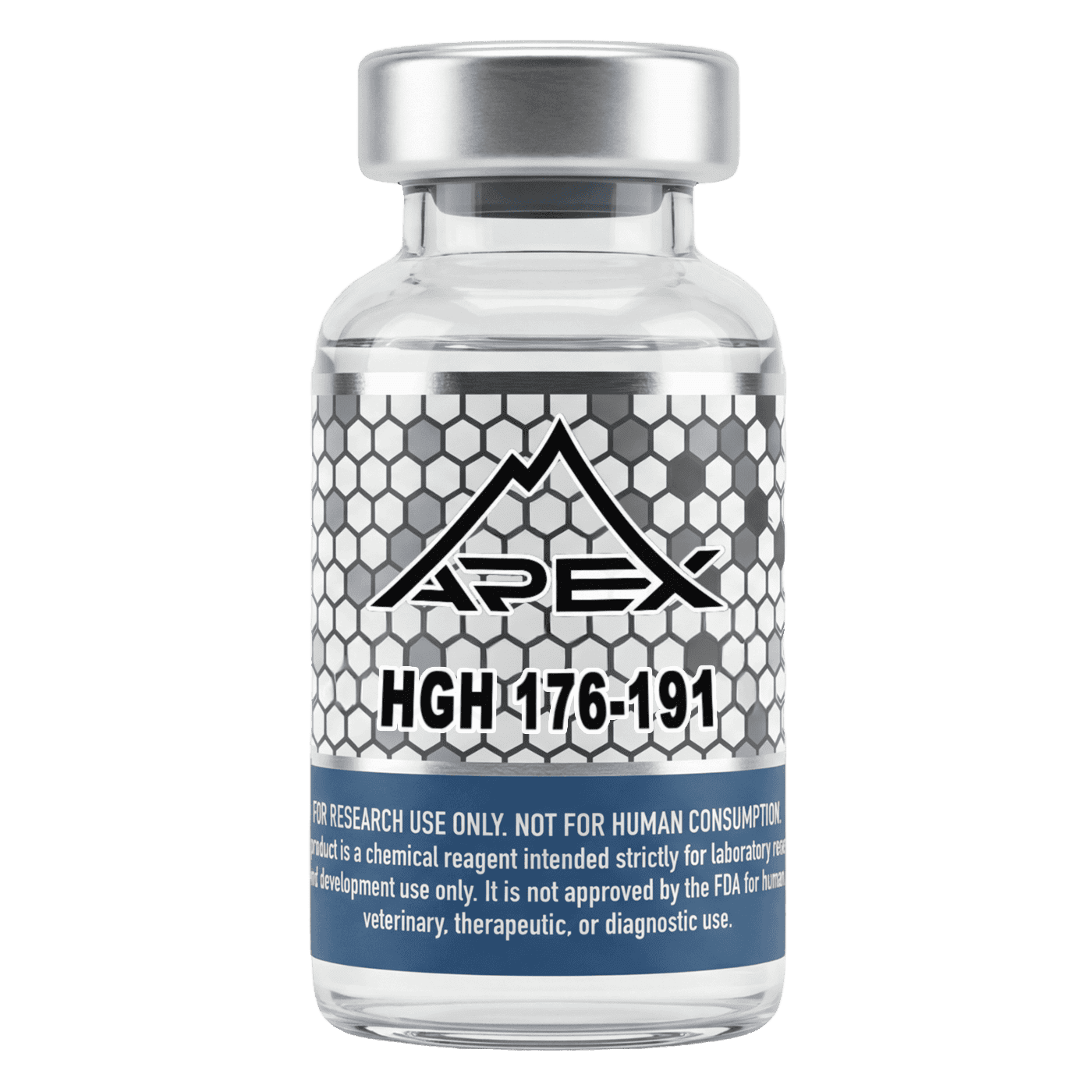
Certificate of Analysis — HGH Fragment 176-191 5mg
hGH fragment 176-191 – lipolytic peptide – CAS 66004-57-7
Verified by Apex Laboratory in-house HPLC (purity by 220 nm peak area) and ESI mass spectrometry (mass identity confirmation). Data on this page describes the current shipping lot.
- Purity (HPLC, area %): 99.78%
- Mass found (ESI-MS): 1817.12 Da
- Mass expected: 1817.07 Da
- HPLC retention time: 13.0 min
- Batch ID: APX-2026-0409-H
- Test date: April 9, 2026
- Analyst: K. Norwood
View HGH Fragment 176-191 5mg on the Lab Verified COA archive
HGH Fragment 176-191 is the synthetic 16-residue C-terminal fragment of human growth hormone, supplied by Apex Laboratory as a high-purity research peptide for metabolic and lipid-signaling investigation in laboratory models. The HPLC chromatogram and mass spectrometry summary displayed above are drawn directly from the current shipping lot (batch APX-2026-0409-H, tested 2026-04-09) — not a stock graphic and not gated behind a document request. The lot you receive is the lot that was plotted. This material is offered strictly for in-vitro laboratory research and development; it is not for human consumption, veterinary use, or any therapeutic application.
Compound Overview
HGH Fragment 176-191 reproduces the final sixteen amino acids of the 191-residue human growth hormone sequence (residues 176 through 191), the segment located at the extreme carboxyl terminus of the parent hormone. Investigators isolated this stretch because it appears to carry the lipid-metabolic signaling activity of hGH while shedding the somatotropic and insulin-antagonizing properties associated with the full-length molecule and with the growth hormone receptor itself. In adipocyte and other cell-model systems, the fragment is examined for its capacity to modulate lipolysis and lipogenesis without engaging the classical IGF-1 growth axis.
The peptide is best understood by contrast with its near sibling, AOD9604. AOD9604 is the same C-terminal sequence carrying one structural addition: an N-terminal tyrosine residue grafted on to stabilize the molecule for research handling. HGH Fragment 176-191, by comparison, is the unmodified native fragment with no added tyrosine, which is reflected in its lower molecular weight (1817.12 g/mol versus AOD9604’s heavier mass). Both differ fundamentally from secretagogue-class peptides such as Ipamorelin and GHRH analogs like CJC-1295 No DAC, which act upstream to stimulate endogenous growth hormone release rather than mimicking a downstream fragment of the hormone. That distinction — a terminal effector fragment versus an upstream releaser — is the central reason this compound is studied as a standalone metabolic reagent rather than a growth-axis modulator.
Research Background & Published Literature
The lipolytic activity of the hGH C-terminus was mapped in a body of work associated with researchers at Monash University, who systematically truncated the parent hormone to identify the minimal sequence responsible for fat-metabolism signaling in laboratory models. That programme characterized residues 176-191 as the shortest fragment retaining lipid-modulating behaviour while lacking the receptor-binding determinants that drive growth and glucose-handling effects. Subsequent in-vitro and animal-model literature has examined how the isolated fragment influences fatty-acid release and lipogenic enzyme activity in adipose tissue preparations, and how that behaviour differs from the intact hormone.
Researchers exploring the published record around this peptide can consult the following peer-reviewed and database resources for additional context on its mechanism, structural origin, and experimental use in controlled laboratory settings:
- Heffernan et al. (2001) — hGH C-terminal lipolytic fragment research
- PubMed — growth hormone fragment 176-191 lipolysis literature
- PubChem — C-terminal hGH fragment (AOD9604) chemical record
Technical Specifications
| Product Name | HGH Fragment 176-191 |
| Other Names / Synonyms | hGH Fragment (176-191); hGH 176-191; HGH Frag; C-terminal growth hormone fragment |
| Classification | hGH C-terminal lipolytic fragment (peptide) |
| CAS Number | 66004-57-7 |
| Molecular Formula | C₇₈H₁₂₅N₂₃O₂₃S₂ |
| Molecular Weight | 1817.12 g/mol (observed by MS; 1817.07 calculated) |
| Sequence / Structure | 16-residue native C-terminal fragment of human growth hormone (residues 176–191) |
| Purity Specification | ≥99% (HPLC + MS verified — 99.78% on the displayed lot) |
| Physical Form | Lyophilized (freeze-dried) powder · sealed glass vial |
| Recommended Diluent | Sterile phosphate-buffered saline (PBS) or assay buffer for benchtop reconstitution; small amounts of dilute acetic acid aid initial dissolution |
| Available Sizes | 1 mg, 2 mg, 5 mg, 10 mg vials |
| Intended Use | In-vitro research use only — not for human consumption |
Storage, Handling & Stability
As a small lyophilized peptide, HGH Fragment 176-191 is comparatively forgiving in the dry state but should still be protected from heat, light, and humidity. Hold the sealed vial at -20°C for long-term storage; brief shipping excursions to ambient temperature are tolerated, which is why the powder arrives stable, but it should be returned to the freezer on arrival. Once dissolved into a benchtop laboratory buffer, store the working solution at 2–8°C and treat it as a short-shelf-life reagent, dividing it into single-use aliquots so the stock is not repeatedly thawed and refrozen.
- Allow the vial to reach room temperature before opening to avoid drawing condensation onto the lyophilized cake.
- Dissolve the powder by directing buffer gently down the vial wall rather than onto the cake, and swirl — do not shake vigorously — to limit shear on the peptide.
- Aliquot the dissolved stock immediately so freeze-thaw cycling of the master solution is minimized.
- Label every aliquot with compound name, concentration, preparation date, and operator initials for full lot traceability.
Quality Assurance & Analytical Verification
Every lot of HGH Fragment 176-191 clears a two-step analytical gate before it is added to inventory: reversed-phase High-Performance Liquid Chromatography to establish chromatographic purity, and Mass Spectrometry to confirm molecular identity against the expected mass. The results for the lot currently shipping are published at the top of this page rather than held back for request — the chromatogram, the 99.78% purity figure, the observed mass of 1817.12 Da against a calculated 1817.07 Da, and the analyst signoff are all visible up front.
For a peptide of this size (roughly 1817 Da) electrospray mass spectrometry typically resolves a small set of low charge states, most often the singly and doubly protonated ions, [M+H]⁺ and [M+2H]²⁺. Because the tight 0.05 Da agreement between observed and calculated mass is well within instrument tolerance, identity is confirmed without ambiguity, and the single sharp HPLC peak near a 13.0-minute retention time reflects the absence of significant truncation or deletion sequences. For the methodology behind these checks, see our guides on mass spectrometry peptide verification and how to read a Certificate of Analysis, or browse confirmed batch records in the Lab Verified archive.
Frequently Asked Questions
How does HGH Fragment 176-191 differ from AOD9604?
Both are the C-terminal lipolytic region of human growth hormone, but AOD9604 carries an added N-terminal tyrosine residue that HGH Fragment 176-191 does not. The fragment offered here is the unmodified native 16-residue sequence, which is why its molecular weight (1817.12 g/mol) is lower than AOD9604’s. In model systems both are studied for the same lipid-metabolic signaling, but their differing structure makes them distinct reagents for comparative work.
Why does this fragment retain lipolytic signaling but not growth-promoting activity?
Published truncation studies attribute the fat-metabolism behaviour of human growth hormone to its carboxyl terminus, while the receptor-binding and somatotropic determinants reside elsewhere in the 191-residue molecule. Isolating residues 176-191 therefore preserves the lipid-signaling segment while removing the regions that drive the IGF-1 growth axis and glucose-handling effects — the property that makes the fragment useful as a research probe in adipocyte models.
What molecular weight and purity should I expect on the COA?
The displayed lot was verified by mass spectrometry at 1817.12 Da against a calculated 1817.07 Da, with HPLC purity of 99.78%. Every batch is released to a ≥99% specification confirmed by both HPLC and MS, and the data shown corresponds to the lot currently shipping rather than a historical reference.
What diluent is suitable for benchtop reconstitution?
For in-vitro work, dissolve the lyophilized powder in a standard laboratory buffer such as sterile phosphate-buffered saline (PBS) or your assay buffer; a small volume of dilute acetic acid can assist initial dissolution before bringing the solution up to the target concentration. Add the buffer gently against the vial wall, then store the prepared solution refrigerated at 2–8°C and aliquot it to avoid repeated freeze-thaw cycles. See the peptide storage guide for stability detail.
Is this product approved for human use?
No. All compounds sold by Apex Laboratory are classified as chemical research reagents intended strictly for in-vitro laboratory research. HGH Fragment 176-191 is not approved for human consumption, veterinary use, or any therapeutic application by the FDA or any other regulatory authority. Purchasers who imply intended bodily use will have their orders cancelled and their accounts permanently suspended.
Related Research Compounds
Researchers working with the C-terminal growth hormone fragment often run it alongside related growth-axis and metabolic reagents from Apex Laboratory: AOD9604 (the tyrosine-modified sibling fragment), Ipamorelin (a selective growth hormone secretagogue), CJC-1295 No DAC (a GHRH analog), and Tesamorelin (a stabilized GHRH(1-44) analog). For the broader receptor and signaling context, see the growth hormone axis research peptides pillar guide, or browse the complete Apex Laboratory research catalog.
Shipping, Packaging & Delivery
Orders confirmed before 2:00 PM Eastern Time on a business day are dispatched the same day through tracked domestic carriers within the United States. Each HGH Fragment 176-191 vial is sealed and cushioned in insulated, temperature-appropriate packaging chosen to keep the lyophilized powder stable in transit. Move the vial into -20°C storage as soon as it arrives. If your protocol is time-critical or you need a specific delivery window, reach out through our contact page in advance and we will coordinate the dispatch timing around your laboratory schedule.
Research Use Disclaimer
For in-vitro research use only. Not for human consumption. All products sold by Apex Laboratory — including HGH Fragment 176-191 — are intended exclusively for qualified researchers, accredited laboratories, and educational institutions. This peptide is supplied solely as a chemical research reagent and has not been evaluated or approved for any human or veterinary therapeutic use. Purchasers assume full responsibility for safe handling, proper storage, and compliance with all applicable federal, state, and local laws, regulations, and institutional policies governing the purchase and use of chemical research reagents.

Reviews
There are no reviews yet.