
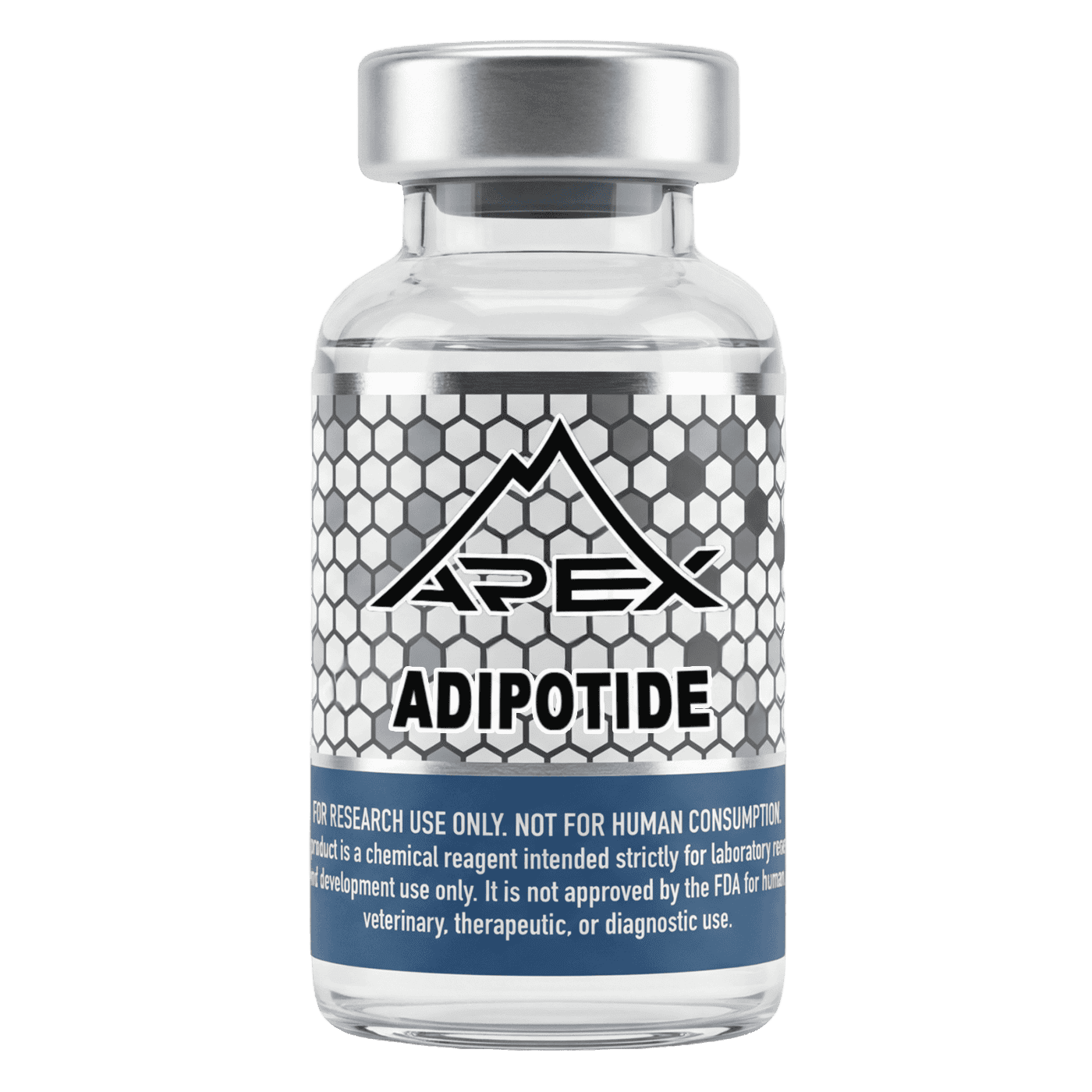
Certificate of Analysis — Adipotide (FTPP) 10mg
Pro-apoptotic targeted peptide (CKGGRAKDC linker) – CAS 859216-15-2
Verified by Apex Laboratory in-house HPLC (purity by 220 nm peak area) and ESI mass spectrometry (mass identity confirmation). Data on this page describes the current shipping lot.
- Purity (HPLC, area %): 99.57%
- Mass found (ESI-MS): 2555.18 Da
- Mass expected: 2555.20 Da
- HPLC retention time: 13.5 min
- Batch ID: APX-2026-0307-A
- Test date: March 7, 2026
- Analyst: K. Norwood
Adipotide (FTTP) is a chimeric, two-domain research peptide best known from ligand-directed vascular-targeting studies, supplied by Apex Laboratory as a high-purity research reagent. The HPLC trace and mass-spectrometry numbers shown above are pulled from the lot currently leaving our shelves — batch APX-2026-0307-A, released at 99.57% — not a stock graphic or a redacted PDF held behind an email gate. The data on this page is the data in the vial. This compound is offered strictly for in-vitro laboratory research and development; it is not a therapeutic and is not approved for human or veterinary use.
Compound Overview
Adipotide (FTTP) is a synthetic chimeric construct that fuses a homing peptide to a proapoptotic effector peptide through a short linker. The homing module is the cyclic nonapeptide CKGGRAKDC — the same linker recorded on the Certificate of Analysis above — which in published in-vitro and preclinical work recognizes the molecular markers prohibitin and annexin-A1. Tethered to it is the dimeric amphipathic sequence D(KLAKLAK)2, a membrane-interacting peptide that remains largely inert in the extracellular space but acts on mitochondrial membranes once internalized, where it can initiate apoptosis through mitochondrial membrane permeabilization in cultured cells.
What distinguishes Adipotide from a generic membrane-active peptide is this address-then-act architecture: the effector domain remains quiescent until the homing domain engages its molecular target, at which point the construct concentrates locally. That logic places Adipotide among ligand-directed and vascular-targeting research peptides rather than with metabolic signaling reagents such as AOD9604 or the GLP-1 incretins; it does not act as a receptor agonist and has no role in incretin or growth-hormone signaling. Its mechanism is structural and pro-apoptotic, which is why it is investigated in cell-culture and preclinical model systems of targeted delivery rather than in receptor-binding panels.
Research Background & Published Literature
Adipotide entered the literature through a widely cited 2011 study in Science Translational Medicine by Barnhart and colleagues, which characterized the peptide in a non-human-primate model and examined its interaction with vascular endothelium. That work built on earlier in-vivo phage-display screens that identified the prohibitin-binding homing motif, and it remains the anchor reference for laboratories examining ligand-directed delivery of a proapoptotic cargo to a defined cellular compartment. Research interest since then has centered on the construct as a model system for vascular targeting, mitochondrial apoptosis induction in cultured cells, and the pharmacology of peptide conjugates — all within preclinical and in-vitro contexts.
Researchers exploring the published record around this compound can consult the following peer-reviewed and database resources for additional context on its mechanism, homing chemistry, and experimental use in controlled laboratory settings:
- PubMed — Adipotide / prohibitin-targeting peptide literature
- PubChem — Adipotide (FTTP) compound record
Technical Specifications
| Product Name | Adipotide (FTTP) |
| Other Names / Synonyms | FTTP · Prohibitin-targeting peptide-1 (Prohibitin-TP01) |
| Classification | Targeted proapoptotic chimeric peptide (ligand-directed conjugate) |
| CAS Number | 859216-15-2 |
| Molecular Formula | C₁₁₁H₂₀₄N₃₆O₂₈S₂ |
| Molecular Weight | 2555.20 g/mol (MS-confirmed 2555.18, see panel above) |
| Structure | Cyclic CKGGRAKDC homing motif conjugated to dimeric D(KLAKLAK)2 proapoptotic domain |
| Purity Specification | ≥99% (HPLC + MS verified — this lot 99.57%) |
| Physical Form | Lyophilized powder · sealed glass vial |
| Recommended Reconstitution | Laboratory-grade aqueous buffer or assay-compatible solvent |
| Available Sizes | 2 mg · 5 mg · 10 mg |
| Intended Use | In-vitro research only — not for human consumption |
Storage, Handling & Stability
Adipotide is a relatively large, amphipathic 30-residue construct, and the membrane-interacting D(KLAKLAK)2 domain makes it prone to surface adsorption and aggregation in dilute aqueous solution. Store the lyophilized vial at -20°C for long-term stability; the dry powder is the most stable physical state. Reconstitute only the working volume you need into a laboratory-grade aqueous buffer, hold reconstituted aliquots at 2–8°C, and use them promptly — cationic amphipathic peptides of this type tend to lose titer to repeated freeze-thaw and to plastic surfaces. Low-binding tubes are advisable for stock solutions.
- Keep the lyophilized vial sealed at -20°C until use, and let it reach room temperature before opening to avoid condensation onto the powder.
- Aliquot reconstituted stock so no working tube is freeze-thawed more than necessary — the amphipathic domain is sensitive to repeated cycling.
- Use low-protein-binding tubes and tips to limit adsorptive loss of this amphipathic peptide from dilute solutions.
- Treat the compound as a proapoptotic research reagent: wear appropriate PPE and follow your institution’s chemical-safety SOPs for handling and disposal.
- Label every aliquot with compound name, concentration, reconstitution date, and operator initials for full traceability.
Quality Assurance & Analytical Verification
Every Adipotide lot is released only after a dual-verification workflow, and the resulting numbers are published to this page for the batch currently shipping rather than summarized in marketing copy. Reversed-phase HPLC establishes chromatographic purity — this lot resolved at 99.57% with a retention time of 13.5 minutes, consistent with the moderate hydrophobicity expected from the leucine-rich KLAKLAK domain — while electrospray mass spectrometry confirms molecular identity against the theoretical 2555.20 g/mol.
For a conjugate of this size, ESI+ verification is read across the multi-charge envelope rather than from a single ion: the observed deconvoluted mass of 2555.18 back-calculated from those charge states sits within 0.01 Da of the expected value, which is the standard of confirmation we require before a batch enters inventory. To see how that deconvolution is performed, see our guide on mass spectrometry for peptide verification, and for the chromatography side review HPLC purity testing. The full Certificate of Analysis for batch APX-2026-0307-A is archived in our Lab Verified collection; if you would like the analytical record for a prior lot, request it by batch number through our contact page.
Frequently Asked Questions
What do the two domains of Adipotide actually do?
Adipotide is a chimera. The CKGGRAKDC cyclic motif is the homing domain — in published work it recognizes the molecular markers prohibitin and annexin-A1. The D(KLAKLAK)2 sequence is the effector domain, a membrane-interacting peptide that is largely inert until internalized, at which point it permeabilizes mitochondrial membranes and can drive apoptosis in cultured cells. The design is what laboratories study: a delivery address fused to a payload.
What is the exact molecular formula and weight of this peptide?
This is the cyclic, disulfide-bonded form. Its molecular formula C₁₁₁H₂₀₄N₃₆O₂₈S₂ gives a theoretical average mass of 2555.20 g/mol, and mass spectrometry on batch APX-2026-0307-A returned 2555.18 — a 0.01 Da match to theory.
How is Adipotide different from a metabolic signaling peptide?
It is mechanistically unrelated. Receptor-agonist reagents such as AOD9604 or HGH Fragment 176-191 work by binding and signaling through cell-surface receptors. Adipotide instead works structurally: it homes to a molecular target and delivers a proapoptotic cargo. There is no receptor agonism involved, which is why it is studied in ligand-directed targeting and apoptosis models rather than in signaling assays.
What reconstitution and handling does this peptide need in the lab?
Use a laboratory-grade aqueous buffer or assay-compatible solvent appropriate to your protocol. Because the amphipathic effector domain is prone to aggregation and surface adsorption, prepare only the working volume required, store reconstituted stock at 2–8°C in low-binding tubes, and minimize freeze-thaw cycles. The lyophilized powder kept at -20°C is the most stable form for long-term storage.
Is this product approved for human use?
No. All compounds sold by Apex Laboratory are classified as chemical research reagents intended strictly for in-vitro laboratory research. Adipotide (FTTP) is an investigational research compound studied only in cell and animal models; it has never received marketing authorization from the FDA or any other regulatory authority and is not approved for human consumption, veterinary use, or any therapeutic application. Purchasers who imply intended bodily use will have their orders cancelled and their accounts permanently suspended.
Is bulk ordering available?
Yes. For bulk quantities, custom packaging, or recurring supply agreements, contact our team through the contact page with the compound name, desired quantity, preferred size (2 mg, 5 mg, or 10 mg), and your target delivery timeline. Volume pricing is available for qualifying institutional and recurring orders.
Related Research Compounds
Laboratories working with ligand-directed and metabolism-adjacent research peptides may also be interested in related reagents from Apex Laboratory: AOD9604, a synthetic hGH fragment used in lipid-metabolism research; HGH Fragment 176-191; and 5-Amino-1MQ, an NNMT-inhibitor small molecule studied in metabolic model systems. Browse the full Apex Laboratory research catalog to see all available peptides, reagents, and laboratory solutions, or visit the About page to read how our HPLC and mass-spectrometry verification process works.
Shipping, Packaging & Delivery
Place an order before 2:00 PM Eastern Time on a business day and it ships the same day through tracked US domestic carriers. Each Adipotide vial travels in insulated, temperature-appropriate packaging chosen to protect the lyophilized powder in transit. Move the vial into -20°C storage as soon as it arrives. If your protocol is time-sensitive or you need a specific delivery window, let our support team know in advance and we will coordinate a shipping schedule that fits your lab’s workflow.
Research Use Disclaimer
For in-vitro research use only. Not for human consumption. All products sold by Apex Laboratory — including Adipotide (FTTP) — are intended exclusively for qualified researchers, accredited laboratories, and educational institutions. Adipotide is an investigational research compound that has not received marketing authorization from the FDA or any other regulatory authority for any indication, and nothing on this page describes or endorses human or veterinary use. Purchasers assume full responsibility for safe handling, proper storage, and compliance with all applicable federal, state, and local laws, regulations, and institutional policies governing the purchase and use of chemical research reagents.

Reviews
There are no reviews yet.