
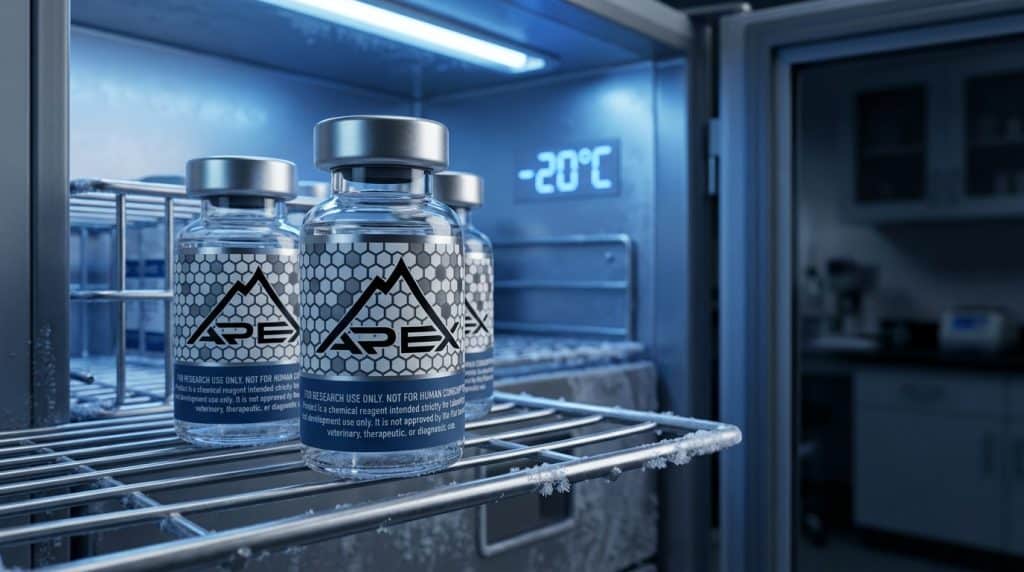
Proper storage is the single most important factor in maintaining the integrity of research peptides between synthesis and experimental use. A compound that was manufactured at ≥99% purity can degrade to unusable levels within days if stored incorrectly — while the same compound stored properly can remain stable for months or even years. Understanding the science behind peptide stability, and applying the correct storage protocols for each stage of your workflow, protects both your research investment and the reliability of your experimental data.
This guide covers every aspect of peptide storage that researchers need to know — from long-term freezer storage of lyophilized material to short-term refrigeration of reconstituted solutions, aliquoting strategies, degradation prevention, and compound-specific recommendations for popular products from our research catalog.
Why Peptide Storage Matters for Research Quality
Peptides are inherently less stable than small molecule compounds because their biological activity depends on maintaining a specific three-dimensional structure held together by relatively weak forces — hydrogen bonds, van der Waals interactions, and in some cases disulfide bridges. When a peptide degrades, these structural features are disrupted, and the compound loses its ability to bind its target receptor or activate its intended signaling pathway. The result is reduced or absent biological activity, which translates directly into unreliable experimental data and wasted research materials.
The four primary enemies of peptide stability are heat, moisture, light, and oxygen. Each of these accelerates different degradation pathways: heat promotes aggregation and deamidation; moisture enables hydrolysis of peptide bonds; light drives photodegradation of susceptible amino acid residues (particularly tryptophan and tyrosine); and oxygen causes oxidation of methionine and cysteine residues. Proper storage protocols are designed to minimize exposure to all four of these factors simultaneously.
Storing Lyophilized (Unreconstituted) Peptides
Lyophilized peptides — the freeze-dried powder form in which most research peptides are supplied, including all products from Apex Laboratory — are in their most stable state. The lyophilization process removes virtually all water from the peptide, eliminating the primary medium through which most degradation reactions occur. A properly lyophilized peptide stored correctly can remain stable for years.
Recommended Conditions for Lyophilized Storage
- Temperature: -20°C (standard laboratory freezer) — this is the gold standard for long-term peptide storage. At this temperature, molecular motion is minimal and degradation reactions proceed extremely slowly. Most lyophilized peptides maintain ≥95% integrity for 12-24+ months at -20°C.
- For maximum long-term stability: -80°C (ultra-low freezer) — if your laboratory has an ultra-low freezer, storing peptides at -80°C provides the absolute maximum stability. This is recommended for particularly valuable or irreplaceable compounds, or for storage periods exceeding 2 years.
- Short-term acceptable: 2-8°C (refrigerator) — lyophilized peptides can be stored in a refrigerator for periods up to several weeks without significant degradation. This is acceptable for compounds that will be used soon but not ideal for long-term storage.
- Room temperature transit: generally safe for days — lyophilized peptides are remarkably stable at ambient temperature for short periods. This is why shipping at room temperature (as done by Apex Laboratory) does not compromise the compound — the lyophilized state protects the peptide during the transit window. However, transfer to freezer storage promptly upon receipt.
Critical Storage Rules for Lyophilized Peptides
- Keep the vial sealed until you are ready to reconstitute. The rubber stopper and crimp cap create an airtight barrier against moisture and oxygen. Once opened, the protective atmosphere is broken.
- Minimize temperature cycling — every time you remove a vial from the freezer and return it, the temperature fluctuation stresses the peptide. If you need to access the same compound multiple times, consider reconstituting and aliquoting (see below) rather than repeatedly warming and re-freezing the lyophilized vial.
- Protect from light — store vials in their original packaging or in an opaque container within the freezer. While most freezers are dark when closed, laboratory freezers that are opened frequently expose contents to fluorescent lighting.
- Control moisture exposure — if you live or work in a humid environment, condensation can form on cold vials when removed from the freezer. Allow vials to equilibrate to room temperature (10-15 minutes) before opening the seal to prevent moisture droplets from contacting the lyophilized cake.
Storing Reconstituted Peptides
Once a lyophilized peptide is reconstituted with bacteriostatic water or another solvent, its stability profile changes dramatically. The peptide is now in solution, exposed to water (enabling hydrolysis), and subject to much faster degradation kinetics than in its dry form. Proper handling of reconstituted peptides is critical to maintaining usable potency throughout your experimental timeline.
Recommended Conditions for Reconstituted Peptides
- Temperature: 2-8°C (refrigerator) — all reconstituted peptides should be stored in a standard laboratory refrigerator immediately after reconstitution. Do not leave reconstituted vials at room temperature for extended periods.
- Orientation: upright — store vials standing upright to minimize the surface area of solution in contact with the rubber stopper, reducing potential leaching of stopper materials.
- Protection from light — wrap vials in aluminum foil or store in an opaque container within the refrigerator, especially for photosensitive compounds.
Stability Windows After Reconstitution
The usable life of a reconstituted peptide depends on the solvent used, the specific compound, and storage temperature. Published stability data and standard laboratory practice support the following general guidelines:
- Reconstituted with bacteriostatic water, stored at 2-8°C: 14-28 days for most peptides. The 0.9% benzyl alcohol preservative actively inhibits bacterial growth, allowing safe multiple withdrawals throughout this period.
- Reconstituted with sterile water (no preservative), stored at 2-8°C: use within 24-48 hours. Without a preservative, bacterial contamination begins immediately after the first needle puncture breaks the sterile seal. Single puncture only.
- Reconstituted with acetic acid solution, stored at 2-8°C: 14-21 days. The acidic pH provides some antimicrobial protection and may enhance stability for certain compounds.
- Frozen aliquots at -20°C: several months for most peptides, though each aliquot should be thawed only once.
Shop Storage & Reconstitution Supplies
Bacteriostatic Water · Acetic Acid Solution · Browse All Research Peptides — ≥99% purity, HPLC verified, same-day shipping.
The Aliquoting Strategy: Maximizing Reconstituted Peptide Lifespan
Aliquoting is the single most effective technique for extending the useful life of your reconstituted peptides. The concept is simple: immediately after reconstitution, divide the total solution into multiple smaller volumes (aliquots) in individual sterile microcentrifuge tubes, then freeze all aliquots at -20°C. When you need material for an experiment, thaw only one aliquot, use it entirely, and discard the tube. The remaining aliquots stay frozen and untouched until needed.
This approach eliminates the two biggest causes of reconstituted peptide degradation: repeated freeze-thaw cycles (each cycle stresses the peptide structure) and repeated needle punctures through the rubber stopper (each puncture risks introducing contaminants and exposes the solution to air). For a complete reconstitution protocol including aliquoting instructions, see our How to Reconstitute Peptides guide.
How to Aliquot Reconstituted Peptides
- Step 1: Reconstitute the peptide according to your protocol (see our reconstitution guide).
- Step 2: Using a sterile syringe, withdraw a single-use volume from the vial. For example, if your reconstituted vial contains 2 mL total and your typical experiment uses 0.25 mL, create 8 aliquots of 0.25 mL each.
- Step 3: Dispense each aliquot into a sterile, labeled microcentrifuge tube (0.5 mL or 1.5 mL tubes work well).
- Step 4: Label each tube with compound name, concentration, volume, date, and your initials.
- Step 5: Immediately place all aliquots in the freezer at -20°C.
- Step 6: When needed, remove one aliquot, thaw it slowly in the refrigerator (not at room temperature), use the entire contents, and discard the tube.
Compound-Specific Storage Recommendations
While the general storage principles above apply to all peptides, certain compounds have specific characteristics that affect their optimal storage conditions. Here are storage recommendations for popular compounds from the Apex Laboratory catalog based on their molecular properties:
Small Peptides (Under 1,500 g/mol) — Excellent Stability
Smaller peptides generally have the best stability profiles due to their simpler structures and fewer susceptible residues. Compounds in this category include BPC-157 (MW: 1,419 g/mol — also uniquely gastric acid-stable), Ipamorelin (MW: 711 g/mol — very small pentapeptide with excellent stability), GHK-Cu (MW: 403 g/mol — copper complex provides additional structural stability), GHRP-2 and GHRP-6 (hexapeptides ~800-870 g/mol), and Epithalon (MW: 390 g/mol — tetrapeptide, extremely stable). These compounds typically maintain excellent stability for 24+ months lyophilized at -20°C and 21-28 days reconstituted at 2-8°C.
Medium Peptides (1,500 – 5,000 g/mol) — Good Stability
Most research peptides fall in this range, including Semaglutide (MW: 4,113 g/mol — albumin-binding fatty acid chain enhances solution stability), Tirzepatide (MW: 4,813 g/mol), Retatrutide (MW: 4,471 g/mol), TB-500 (MW: 4,963 g/mol), LL-37 (MW: 4,493 g/mol), and Sermorelin (MW: 3,357 g/mol). These maintain good stability for 12-24 months lyophilized at -20°C and 14-21 days reconstituted at 2-8°C. Aliquoting is particularly recommended for this size range to avoid repeated freeze-thaw stress.
Cyclic Peptides — Enhanced Stability
Peptides with cyclic structures — such as Melanotan II (cyclic heptapeptide), PT-141 (cyclic heptapeptide), and Oxytocin (cyclic with disulfide bridge) — generally exhibit enhanced stability compared to their linear counterparts of similar size. The cyclic constraint reduces conformational flexibility, making these compounds more resistant to unfolding and aggregation. Reconstituted cyclic peptides may remain stable for up to 28-30 days at 2-8°C.
Large Peptides and Proteins (Over 5,000 g/mol) — Handle with Extra Care
Larger compounds like IGF-1 LR3 (MW: 9,117 g/mol), Tesamorelin (MW: 5,135 g/mol), Follistatin 344 (~36,000 g/mol), ACE-031 (~90,000 g/mol), and HCG (~36,700 g/mol) require the most careful handling. Their complex tertiary structures are more susceptible to denaturation from temperature changes, mechanical agitation, and freeze-thaw stress. Always aliquot immediately after reconstitution, minimize time at room temperature, and use reconstituted material within 7-14 days. Never shake these compounds — gentle rolling only.
Signs of Peptide Degradation: When to Discard
Knowing when a peptide has degraded is just as important as knowing how to prevent degradation. Using a degraded compound will produce unreliable data and waste experimental resources. Watch for these warning signs, and if you observe any of them, discard the material and reconstitute a fresh vial:
- Cloudiness or turbidity — a solution that was previously clear has become hazy or opaque, indicating peptide aggregation.
- Visible particles or flakes — precipitated peptide material floating in the solution or settled at the bottom of the vial.
- Color change — most peptide solutions should be colorless to very faint yellow. Any darkening, browning, or unexpected coloration suggests oxidative or chemical degradation.
- Unusual odor — fresh peptide solutions are typically odorless (aside from the mild benzyl alcohol scent if using bacteriostatic water). Any foul, sulfurous, or unusual smell indicates degradation or contamination.
- Gel formation — the solution has become viscous, gelatinous, or semi-solid, indicating severe aggregation.
- Reduced or absent experimental activity — if a compound that previously worked in your assay stops producing expected results at the same concentration, degradation is the most likely explanation.
Common Storage Mistakes to Avoid
Even experienced researchers sometimes make storage errors that silently compromise their peptide inventory. The most common mistakes are:
- Storing lyophilized vials in the refrigerator instead of the freezer. While refrigeration (2-8°C) is adequate for short-term holding (days to weeks), it is not cold enough for long-term storage. Always default to -20°C freezer storage for any lyophilized compound that won’t be reconstituted within a few days.
- Repeatedly removing a frozen vial and returning it. Each freeze-thaw cycle can cause physical stress to the lyophilized cake. If you need multiple portions from one vial, reconstitute the entire vial once and aliquot into individual-use volumes.
- Leaving reconstituted vials on the bench during experiments. It is easy to leave a reconstituted vial sitting at room temperature while working. Set a timer or develop a habit of immediately returning the vial to the refrigerator after each withdrawal.
- Failing to label reconstituted vials with the date. Without a reconstitution date, you have no way to track whether the compound is within its stability window. Always label with compound name, concentration, date, and your initials.
- Using the same syringe for multiple withdrawals. Each syringe reuse risks introducing contaminants that accelerate degradation and introduce biological contamination. Always use a fresh, sterile syringe for each withdrawal. They are inexpensive — your peptides are not.
Frequently Asked Questions
How long do lyophilized peptides last in the freezer?
Most lyophilized peptides maintain ≥95% integrity for 12-24 months when stored at -20°C in their original sealed vials. Smaller peptides (under 1,500 g/mol) like BPC-157, Ipamorelin, and Epithalon tend to be the most stable and can last 2+ years. Larger peptides and proteins should ideally be used within 12-18 months. Storage at -80°C further extends these timelines.
Can I store peptides in a regular kitchen freezer?
A standard home freezer (typically -18 to -20°C) is adequate for peptide storage. The key concern is temperature consistency — frost-free freezers cycle their temperature periodically to prevent ice buildup, which creates minor temperature fluctuations. If possible, store peptides toward the back of the freezer where temperature is most stable. A dedicated laboratory freezer without auto-defrost is ideal but not strictly required.
What happens if my peptide thaws during a power outage?
A single, brief thaw event (a few hours) is unlikely to cause significant degradation of lyophilized peptides. The dry state protects the compound even at elevated temperatures for short periods. If the vial remained sealed and the thaw lasted less than 24 hours, return it to the freezer and it should be fine. Reconstituted peptides are more vulnerable — if a reconstituted vial thawed and warmed to room temperature for several hours, consider discarding it and reconstituting a fresh vial.
Should I store peptides in the freezer or refrigerator after receiving my order?
Lyophilized (unreconstituted) peptides should go directly into the freezer at -20°C upon receipt. Reconstituted peptides should go in the refrigerator at 2-8°C. When your Apex Laboratory order arrives, transfer all vials to your freezer as soon as possible. The lyophilized state provides excellent transit stability, but beginning proper cold storage immediately upon receipt ensures maximum long-term integrity.
Do all peptides need to be stored at the same temperature?
For simplicity and safety, storing all lyophilized peptides at -20°C is the universal best practice. There is no peptide that is harmed by colder storage — you can never go wrong with -20°C. Some small, highly stable peptides can tolerate refrigerator storage for weeks without issue, but there is no advantage to storing them warmer, so -20°C should be your default for everything.
Continue Your Research
- How to Reconstitute Peptides: A Complete Step-by-Step Lab Protocol
- Peptide Reconstitution Calculator — Free Research Tool
- BPC-157 Peptide: Mechanism, Research Applications & Published Studies
- Semaglutide vs Tirzepatide: Mechanism, Research Data & Key Differences
Research Use Disclaimer
This guide is provided for educational and laboratory reference purposes only. All peptides and research supplies sold by Apex Laboratory are intended strictly for in-vitro research use and are not for human consumption. Researchers are responsible for following their institution’s safety protocols and all applicable regulations when handling and storing research compounds.