
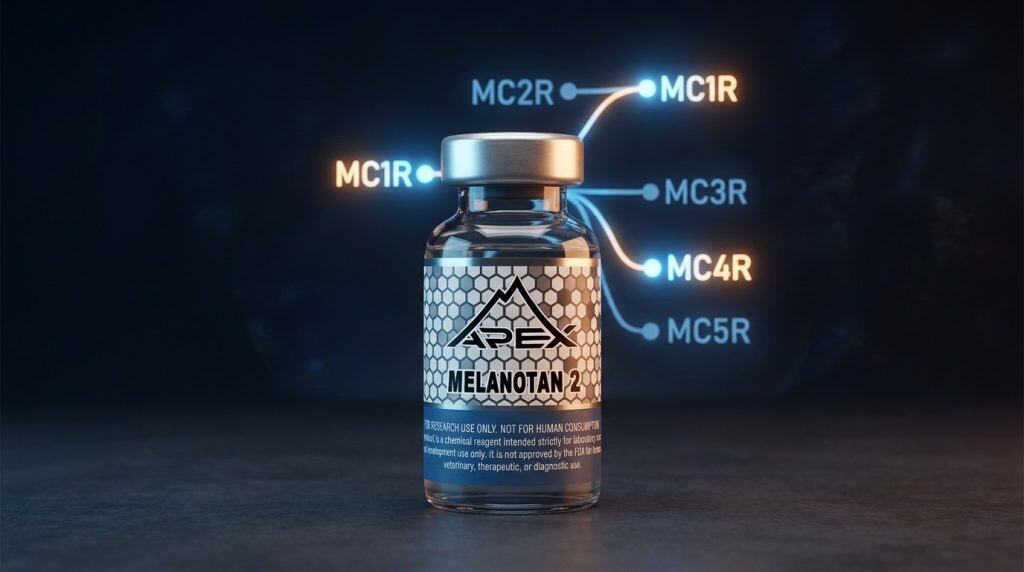
Melanotan II is one of the most pharmacologically interesting peptides in research use today — not because it does one thing well, but because it activates an entire family of receptors that control remarkably diverse biological processes. As a non-selective melanocortin receptor agonist, Melanotan II binds MC1R, MC3R, MC4R, and MC5R, influencing pathways governing pigmentation, energy homeostasis, sexual function, inflammation, and exocrine gland activity. This broad receptor profile has made it one of the most studied synthetic peptides in melanocortin biology and has directly led to the development of more selective clinical compounds including PT-141 (Bremelanotide), which was derived from Melanotan II research.
This guide provides a comprehensive overview of Melanotan II for researchers — covering its molecular identity, the melanocortin receptor family it targets, the mechanism of melanogenesis induction, published research across multiple biological domains, and detailed comparisons to Melanotan I and PT-141.
What Is Melanotan II? Molecular Identity
Melanotan II (MT-II) is a synthetic cyclic heptapeptide — a seven-amino acid peptide with a lactam bridge that creates a constrained ring structure. It was originally developed at the University of Arizona by Victor Hruby and Mac Hadley’s research group as a synthetic analog of alpha-melanocyte-stimulating hormone (α-MSH), a naturally occurring 13-amino acid peptide that regulates skin pigmentation through the melanocortin system.
Melanotan II Technical Specifications
- Full Name: Melanotan II / MT-II / [Ac-Nle-c(Asp-His-D-Phe-Arg-Trp-Lys)-NH2]
- CAS Registry Number: 121062-08-6
- Molecular Weight: 1,024.18 g/mol
- Amino Acid Count: 7 residues (cyclic heptapeptide)
- Structure: Cyclic — constrained by a lactam bridge between Asp and Lys side chains
- Parent Hormone: Synthetic analog of alpha-melanocyte-stimulating hormone (α-MSH)
- Receptor Profile: Non-selective melanocortin agonist — activates MC1R, MC3R, MC4R, MC5R
- Physical Appearance: White to off-white lyophilized powder
- Solubility: Freely soluble in bacteriostatic water
The cyclic structure is pharmacologically critical — it constrains the peptide backbone into a conformation that enhances receptor binding affinity and provides dramatically improved metabolic stability compared to the linear α-MSH parent hormone. While native α-MSH is rapidly degraded by circulating peptidases (half-life of minutes), Melanotan II’s cyclic structure resists enzymatic degradation and maintains its bioactive conformation in solution, making it a practical tool for research applications.
The Melanocortin Receptor Family
To understand Melanotan II’s pharmacology, you need to understand the receptor family it targets. The melanocortin receptors are a group of five G-protein coupled receptors (MC1R through MC5R) that are activated by melanocortin peptides derived from the proopiomelanocortin (POMC) precursor protein. Each receptor has distinct tissue distribution and biological functions:
MC1R — Skin and Pigmentation
MC1R is expressed primarily on melanocytes (pigment-producing cells in the skin and hair follicles). Activation of MC1R stimulates melanogenesis — the synthesis and distribution of melanin pigment. This is the receptor responsible for Melanotan II’s most widely recognized research application: stimulation of cutaneous pigmentation. MC1R activation triggers a cAMP-CREB-MITF signaling cascade that upregulates tyrosinase, the rate-limiting enzyme in melanin biosynthesis.
MC3R — Energy Homeostasis and Inflammation
MC3R is expressed in the hypothalamus, gut, and immune cells. It plays a modulatory role in energy homeostasis and has documented anti-inflammatory properties. MC3R activation is associated with reduced pro-inflammatory cytokine production and modulation of feeding behavior, though its role is less dominant than MC4R in appetite regulation.
MC4R — Appetite, Energy Expenditure, and Sexual Function
MC4R is expressed predominantly in the hypothalamus and brainstem. It is the central melanocortin receptor controlling appetite suppression and energy expenditure regulation. MC4R activation is also the primary pathway through which melanocortin peptides modulate sexual arousal and erectile function — the discovery that led directly to the development of PT-141 (Bremelanotide) from Melanotan II research. Published characterization of MC4R’s role in sexual function was detailed in studies including Wessells et al. (2000) in the International Journal of Impotence Research.
MC5R — Exocrine Gland Function
MC5R is expressed in exocrine glands including sebaceous glands, lacrimal glands, and preputial glands. It regulates sebum production and other exocrine secretions. MC5R is the least studied of the melanocortin receptors but is relevant to dermatological research applications.
Shop Melanocortin Research Peptides
Melanotan II · Melanotan I (Afamelanotide) · PT-141 (Bremelanotide) — All ≥99% purity, HPLC & Mass Spec verified, same-day shipping.
Mechanism of Action: Melanogenesis
The melanogenesis pathway activated by Melanotan II through MC1R follows a well-characterized intracellular signaling cascade. When Melanotan II binds MC1R on the melanocyte surface, it activates adenylate cyclase through Gαs coupling, increasing intracellular cAMP. Elevated cAMP activates protein kinase A (PKA), which phosphorylates CREB (cAMP response element-binding protein). Activated CREB translocates to the nucleus and upregulates MITF (microphthalmia-associated transcription factor), the master regulator of melanocyte gene expression.
MITF then drives transcription of the key enzymes in melanin biosynthesis: tyrosinase (the rate-limiting enzyme that converts L-tyrosine to L-DOPA and subsequently to dopaquinone), TRP-1 (tyrosinase-related protein 1), and TRP-2 (dopachrome tautomerase). The net result is increased melanin production within melanosomes, which are then transferred to surrounding keratinocytes, producing visible darkening of the skin.
What makes this mechanism significant for research is that Melanotan II activates the same physiological pigmentation pathway that UV radiation activates — but through direct receptor stimulation rather than DNA damage-mediated signaling. This distinction has made it an important research tool for studying melanogenesis independently of UV-induced DNA damage pathways.
Published Research: Key Studies and Applications
Pigmentation Research
The foundational pigmentation research was conducted at the University of Arizona, where the original Melanotan peptides were developed. Published studies in human volunteers demonstrated significant increases in skin melanin content following subcutaneous administration, documented through spectrophotometric skin reflectance measurements. The pigmentation response was dose-dependent, developed gradually over days to weeks, and persisted after discontinuation — consistent with actual melanin deposition in the epidermis rather than a transient surface effect.
Sexual Function Research
During early clinical studies of Melanotan II for pigmentation, researchers observed an unexpected effect: pro-erectile and sexual arousal responses in male subjects. This serendipitous discovery led to extensive investigation of the melanocortin system’s role in sexual physiology and ultimately to the development of PT-141 (Bremelanotide) — a Melanotan II metabolite that was engineered to retain MC4R-mediated sexual function activity while reducing MC1R-mediated pigmentation effects. PT-141 subsequently received FDA approval in 2019 as Vyleesi for hypoactive sexual desire disorder.
Appetite and Energy Homeostasis Research
Melanotan II’s activation of MC4R in the hypothalamus has been extensively studied in the context of appetite regulation and energy homeostasis. Published preclinical research demonstrated reduced food intake and increased energy expenditure following central and peripheral administration. These findings contributed to the broader understanding of the melanocortin system as a key regulator of energy balance and body weight, a research area that continues to generate significant published literature.
Photoprotection Research
An emerging research application examines Melanotan II’s potential photoprotective properties. The rationale is that increased eumelanin (brown/black melanin) in the skin provides natural UV absorption, potentially reducing UV-induced DNA damage. Published studies have investigated whether melanocortin-stimulated melanogenesis produces photoprotective melanin comparable to UV-induced tanning. This research line is related to the development of Melanotan I (Afamelanotide), which has been approved in Europe for the photosensitivity condition erythropoietic protoporphyria.
Melanotan II vs Melanotan I vs PT-141: Three Melanocortin Compounds Compared
Apex Laboratory carries all three major melanocortin research peptides. Understanding their differences is essential for selecting the appropriate compound for your specific research question:
Melanotan II — Non-Selective, Cyclic, Broad Activity
Melanotan II (CAS: 121062-08-6, MW: 1,024 g/mol): Cyclic heptapeptide. Non-selective agonist at MC1R, MC3R, MC4R, and MC5R. Produces pigmentation (MC1R), appetite modulation (MC4R), sexual function effects (MC4R), and exocrine gland modulation (MC5R). The broadest activity profile of the three compounds. Best for research requiring multi-receptor melanocortin system activation or for studying the interplay between different melanocortin pathways.
Melanotan I (Afamelanotide) — MC1R Selective, Linear, Pigmentation-Focused
Melanotan I (CAS: 75921-69-6, MW: 1,646 g/mol): Linear 13-amino acid analog of α-MSH. More MC1R-selective than Melanotan II, producing primarily pigmentation effects with substantially less MC4R-mediated appetite and sexual function activity. Approved in Europe as Scenesse for erythropoietic protoporphyria. Best for research focused specifically on melanogenesis and MC1R signaling without significant MC4R confounders.
PT-141 (Bremelanotide) — MC4R Focused, Sexual Function
PT-141 (CAS: 189691-06-3, MW: 1,025 g/mol): Cyclic heptapeptide metabolite of Melanotan II. Retains potent MC4R activity for sexual function research while producing less MC1R-mediated pigmentation than the parent compound. FDA-approved as Vyleesi. Best for research focused on melanocortin-mediated sexual physiology and MC4R signaling.
Storage, Handling, and Reconstitution
Lyophilized Storage
Store at -20°C in the original sealed vial. Melanotan II’s cyclic structure provides enhanced stability compared to linear peptides of similar size — the constrained ring resists unfolding and aggregation. Excellent lyophilized stability for 18-24+ months at -20°C. For complete protocols, see our Peptide Storage Guide.
Reconstitution
Dissolves instantly in bacteriostatic water. For a 10 mg vial, adding 2 mL produces 5 mg/mL (5,000 mcg/mL). Use our reconstitution calculator for custom volumes, or follow our reconstitution protocol.
After Reconstitution
Store at 2-8°C and use within 28 days. Cyclic peptides like Melanotan II generally exhibit excellent reconstituted stability — the constrained structure resists hydrolysis and aggregation in solution. Aliquot for frozen storage at -20°C if longer-term storage is needed.
Frequently Asked Questions
What is the difference between Melanotan I and Melanotan II?
Melanotan I is a linear 13-amino acid α-MSH analog with preferential MC1R selectivity (primarily pigmentation). Melanotan II is a cyclic 7-amino acid analog with non-selective MC1R/MC3R/MC4R/MC5R activity (pigmentation plus appetite, sexual function, and exocrine effects). They share the same receptor family but have different selectivity profiles and biological activities.
What is the CAS number and molecular weight of Melanotan II?
CAS: 121062-08-6. Molecular weight: 1,024.18 g/mol. It is a cyclic heptapeptide with the sequence Ac-Nle-c[Asp-His-D-Phe-Arg-Trp-Lys]-NH2.
How did PT-141 originate from Melanotan II research?
During clinical studies of Melanotan II for pigmentation, researchers observed unexpected pro-erectile effects mediated through MC4R activation. This led to the development of PT-141 (Bremelanotide), a Melanotan II metabolite optimized to retain MC4R sexual function activity while reducing pigmentation effects. PT-141 was subsequently FDA-approved in 2019 as Vyleesi.
Why is the cyclic structure important?
The lactam bridge in Melanotan II constrains the peptide into a rigid ring conformation that dramatically improves two properties: receptor binding affinity (the constrained shape pre-organizes the pharmacophore for optimal receptor interaction) and metabolic stability (the cyclic structure is far more resistant to enzymatic degradation than the linear α-MSH parent hormone). This makes Melanotan II a practical research tool with a usable half-life, whereas native α-MSH is degraded within minutes.
Is Melanotan II approved for human use?
No. Melanotan II has not been approved by the FDA or any regulatory agency for human therapeutic use. Its derivative Melanotan I (Afamelanotide/Scenesse) is approved in Europe for erythropoietic protoporphyria, and its derivative PT-141 (Bremelanotide/Vyleesi) is FDA-approved for HSDD. All Melanotan II sold by Apex Laboratory is intended strictly for in-vitro laboratory research.
Continue Your Research
- BPC-157 Peptide: Mechanism, Research Applications & Published Studies
- TB-500 (Thymosin Beta-4): Mechanism & Research Guide
- Retatrutide: The Triple Agonist Peptide
- Peptide Storage Guide: Temperature, Stability & Shelf Life
Research Use Disclaimer
This article is provided for educational and research reference purposes only. Melanotan II and all products sold by Apex Laboratory are intended exclusively for in-vitro laboratory research use and are not for human consumption. Researchers should consult the published melanocortin literature cited in this article for complete pharmacological data.