
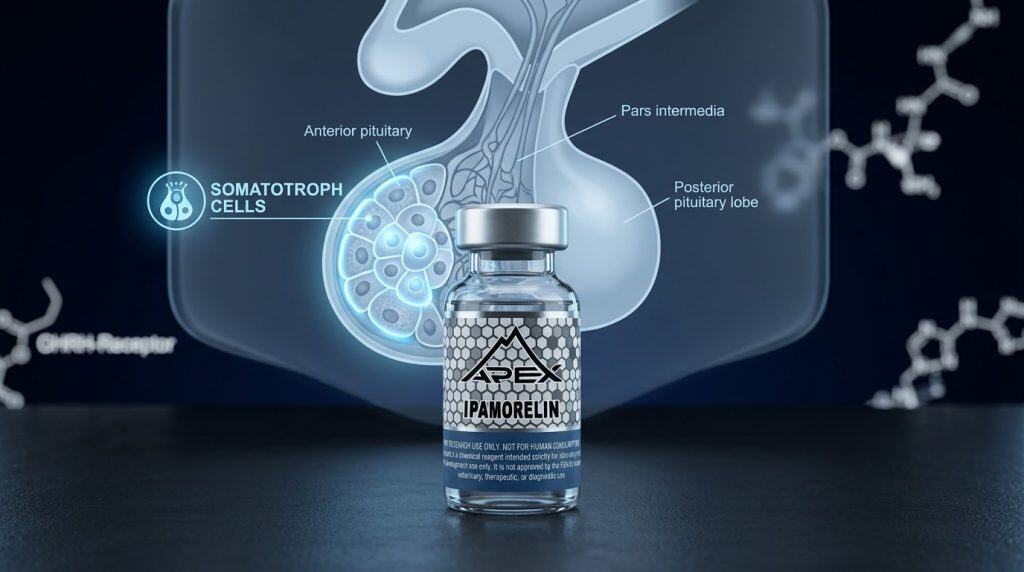
Ipamorelin stands out among growth hormone secretagogues for one critical property: selectivity. While older GH-releasing peptides like GHRP-2 and GHRP-6 stimulate GH release but also significantly affect cortisol, prolactin, ACTH, and appetite signaling, Ipamorelin achieves potent GH release through the ghrelin receptor (GHSR-1a) with minimal impact on these off-target pathways. This selectivity has made it one of the most widely used peptides in GH-axis research and the preferred GH secretagogue for protocols where clean, isolated GH signaling is the objective.
This guide provides a detailed overview of Ipamorelin for researchers — covering its molecular characteristics, the pharmacological basis of its selectivity, published data, its use in combination protocols with CJC-1295, and detailed comparisons to other growth hormone secretagogues in the Apex Laboratory catalog.
What Is Ipamorelin? Molecular Identity
Ipamorelin is a synthetic pentapeptide — a peptide composed of just five amino acids — that functions as a growth hormone secretagogue (GHS) by activating the ghrelin receptor (growth hormone secretagogue receptor type 1a, GHSR-1a) on anterior pituitary somatotroph cells. Its remarkably small size (only five residues) makes it one of the most compact bioactive peptides in research use, contributing to its excellent stability and straightforward handling characteristics.
Ipamorelin Technical Specifications
- Full Name: Ipamorelin (Aib-His-D-2Nal-D-Phe-Lys-NH2)
- CAS Registry Number: 170851-70-4
- Molecular Weight: 711.85 g/mol
- Amino Acid Count: 5 residues (pentapeptide)
- Classification: Growth Hormone Secretagogue / Ghrelin Receptor Agonist
- Target Receptor: GHSR-1a (Growth Hormone Secretagogue Receptor type 1a)
- Physical Appearance: White to off-white lyophilized powder
- Solubility: Freely soluble in bacteriostatic water
- Stability: Excellent — small pentapeptide structure provides robust stability in both lyophilized and reconstituted forms
Ipamorelin was first characterized by Raun et al. (1998) in the European Journal of Endocrinology, which established its selectivity profile and distinguished it from earlier, less selective GH secretagogues. This foundational publication remains one of the most cited references in GHS research.
Mechanism of Action: Why Ipamorelin Is Called “Selective”
All growth hormone secretagogues work by activating the ghrelin receptor (GHSR-1a) on somatotroph cells in the anterior pituitary, stimulating GH synthesis and pulsatile release. What differentiates Ipamorelin from other GHS compounds is the specificity of its signaling — what it does NOT activate is as important as what it does.
What Ipamorelin Activates
Ipamorelin binds GHSR-1a and stimulates GH release from pituitary somatotrophs in a dose-dependent manner. Published pharmacological characterization by Hansen et al. (1999) demonstrated potent, reproducible GH elevation with a clean pulsatile release pattern that mimics the natural physiological rhythm of endogenous GH secretion. The GH response is dose-dependent up to a plateau, beyond which additional compound does not produce further GH elevation — indicating receptor saturation kinetics consistent with specific receptor-mediated signaling.
What Ipamorelin Does NOT Significantly Affect
- Cortisol: Unlike GHRP-2 and GHRP-6, Ipamorelin does not produce meaningful cortisol elevation at standard research doses. This is critical because cortisol is a catabolic hormone that can confound GH-related research outcomes.
- Prolactin: Ipamorelin produces minimal prolactin elevation, whereas GHRP-2 can cause moderate prolactin increases. Prolactin elevation is an unwanted side effect in most GH research protocols.
- ACTH: Adrenocorticotropic hormone remains largely unaffected by Ipamorelin, unlike some other ghrelin mimetics that stimulate the hypothalamic-pituitary-adrenal (HPA) axis.
- Appetite/Ghrelin Signaling: While GHRP-6 is known for strongly stimulating appetite (consistent with ghrelin’s physiological role as a hunger hormone), Ipamorelin’s appetite-stimulating effects are substantially weaker, likely due to differences in receptor binding kinetics and downstream signaling bias.
This selectivity profile is what makes Ipamorelin the preferred GHS for research protocols where isolated GH axis stimulation is needed without confounding effects on the HPA axis, prolactin, or appetite pathways.
Shop GH-Axis Research Peptides at Apex Laboratory
Ipamorelin · CJC-1295 + Ipamorelin Blend · CJC-1295 No DAC · CJC-1295 with DAC · Sermorelin — ≥99% purity, same-day shipping.
Ipamorelin + CJC-1295: The Dual-Pathway GH Research Protocol
One of the most common research protocols involving Ipamorelin is its combination with CJC-1295 No DAC (Mod GRF 1-29), a synthetic GHRH (growth hormone-releasing hormone) analog. This combination is popular because the two peptides target different receptors on the same pituitary somatotroph cell, creating a dual-pathway stimulation of GH release.
How the Combination Works
- CJC-1295 No DAC activates the GHRH receptor on somatotrophs, directly stimulating GH gene transcription and GH synthesis. Think of it as telling the cell to make more GH.
- Ipamorelin activates the ghrelin receptor (GHSR-1a) on the same somatotrophs, amplifying GH release from the existing pool. Think of it as telling the cell to release the GH it has.
By stimulating both the production and release pathways simultaneously, the combination is hypothesized to produce synergistic GH output greater than either peptide alone. This is supported by published pharmacological data on the complementary nature of GHRH receptor and GHSR-1a signaling on somatotroph cAMP and calcium signaling cascades.
Apex Laboratory offers a pre-blended CJC-1295 + Ipamorelin Blend for research groups studying this combination, as well as the individual compounds separately for protocols requiring independent dosing control.
Ipamorelin vs GHRP-2 vs GHRP-6 vs Hexarelin: GHS Comparison
The growth hormone secretagogue family includes several compounds that all activate the ghrelin receptor but differ significantly in their selectivity, potency, and off-target effects. Understanding these differences is essential for selecting the appropriate GHS for a specific research question.
Ipamorelin — Maximum Selectivity
Ipamorelin (MW: 711.85 g/mol, CAS: 170851-70-4): The most selective GHS available. Potent GH release with minimal cortisol, prolactin, and appetite effects. Best for research requiring clean, isolated GH signaling without hormonal confounders.
GHRP-2 (Pralmorelin) — High Potency, Moderate Selectivity
GHRP-2 (MW: 817.97 g/mol, CAS: 158861-67-7): Stronger GH release per dose than Ipamorelin but with moderate cortisol and prolactin elevation. Most potent of the GHRPs in terms of raw GH output. Useful when maximum GH stimulation is the priority and off-target hormonal effects are acceptable confounders.
GHRP-6 — Strong Appetite Stimulation
GHRP-6 (MW: 873.01 g/mol, CAS: 87616-84-0): Notable for strong appetite-stimulating effects mediated through ghrelin pathway activation, in addition to GH release. Useful specifically for research studying ghrelin-mediated appetite signaling. More off-target hormonal effects than Ipamorelin.
Hexarelin — Most Potent, Least Selective
Hexarelin (MW: 887.04 g/mol, CAS: 140703-51-1): The most potent GHS in terms of absolute GH release but the least selective. Significantly elevates cortisol and prolactin. Uniquely activates cardiac CD36 receptors in addition to GHSR-1a, making it valuable for cardiovascular-endocrine crossover research but less suitable for clean GH-only studies.
Storage, Handling, and Reconstitution
Lyophilized Storage
Store lyophilized Ipamorelin at -20°C. As a very small pentapeptide (just 5 amino acids, MW: 711.85 g/mol), Ipamorelin demonstrates excellent lyophilized stability — among the best of any research peptide. It can remain stable for 24+ months at -20°C. For detailed storage protocols, see our Peptide Storage Guide.
Reconstitution
Ipamorelin dissolves instantly in bacteriostatic water — no alternative solvent needed. For a 5 mg vial, adding 2.5 mL produces a convenient concentration of 2 mg/mL (2,000 mcg/mL). Use our reconstitution calculator for custom volumes, or follow our reconstitution protocol.
After Reconstitution
Store at 2-8°C and use within 21 days. Ipamorelin’s small molecular size contributes to excellent solution stability. Aliquot for longer-term frozen storage at -20°C.
Purchasing Research-Grade Ipamorelin
At Apex Laboratory, Ipamorelin is verified to ≥99% purity through dual HPLC and Mass Spectrometry analysis (CAS: 170851-70-4, confirmed MW: 711.85 g/mol). Multiple vial sizes are available, along with the CJC-1295 + Ipamorelin Blend for combination research. We also carry the complete GH secretagogue lineup: GHRP-2, GHRP-6, Hexarelin, Sermorelin, and Tesamorelin. All ship same-day. Visit our About page for quality verification details, or read our COA guide to understand our analytical documentation.
Frequently Asked Questions
Why is Ipamorelin considered the most selective GH secretagogue?
Published pharmacological data demonstrates that Ipamorelin produces robust, dose-dependent GH release from pituitary somatotrophs while causing minimal elevation of cortisol, prolactin, and ACTH — hormones that are significantly affected by other GHS compounds like GHRP-2, GHRP-6, and Hexarelin. This clean signaling profile allows researchers to study GH-axis effects in isolation without hormonal confounders.
What is the CAS number and molecular weight of Ipamorelin?
Ipamorelin has CAS registry number 170851-70-4 and a molecular weight of 711.85 g/mol. It is a pentapeptide (5 amino acids) with the sequence Aib-His-D-2Nal-D-Phe-Lys-NH2.
Why is Ipamorelin commonly paired with CJC-1295?
Ipamorelin (ghrelin receptor agonist) and CJC-1295 (GHRH receptor agonist) target two different receptor pathways on the same pituitary somatotroph cells. CJC-1295 stimulates GH production while Ipamorelin amplifies GH release, creating a dual-pathway approach hypothesized to produce synergistic GH output beyond either compound alone.
Does Ipamorelin stimulate appetite like GHRP-6?
Ipamorelin’s appetite-stimulating effects are substantially weaker than those of GHRP-6, despite both acting on the ghrelin receptor. This difference likely reflects variation in receptor binding kinetics and downstream signaling bias between the two compounds. For research specifically studying ghrelin-mediated appetite signaling, GHRP-6 is the more appropriate tool compound.
Is Ipamorelin approved for human use?
No. Ipamorelin is classified as a research chemical and has not been approved by the FDA or any regulatory agency for human therapeutic use. All Ipamorelin sold by Apex Laboratory is intended strictly for in-vitro laboratory research and is not for human consumption.
Continue Your Research
- BPC-157 Peptide: Mechanism, Research Applications & Published Studies
- TB-500 (Thymosin Beta-4): Mechanism, Research & Published Studies
- Semaglutide vs Tirzepatide: Mechanism, Research Data & Key Differences
- Peptide Reconstitution Calculator — Free Research Tool
Research Use Disclaimer
This article is provided for educational and research reference purposes only. Ipamorelin and all products sold by Apex Laboratory are intended exclusively for in-vitro laboratory research use and are not for human consumption. Researchers should consult the peer-reviewed publications cited in this article for complete pharmacological data.