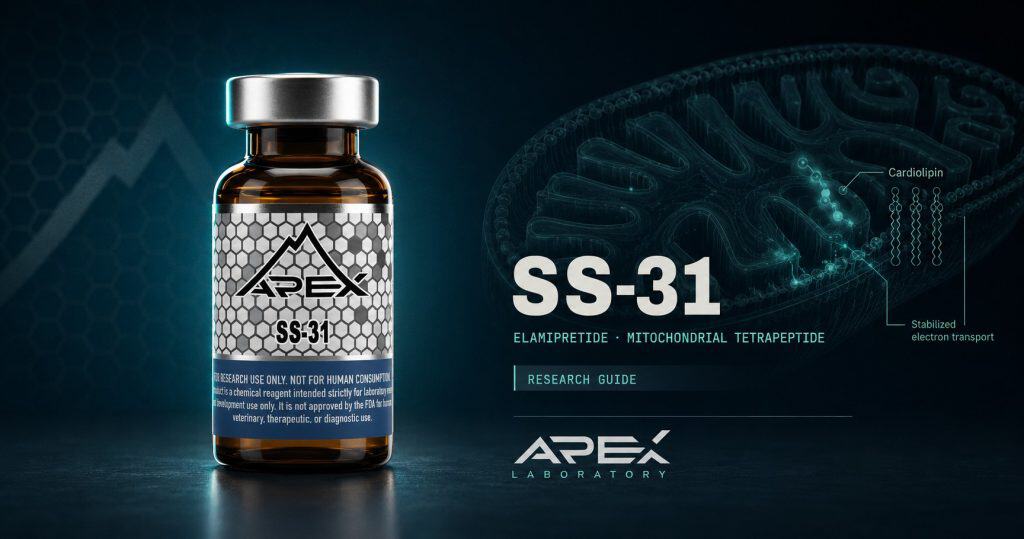
SS-31, also known as elamipretide, is a mitochondria-targeted aromatic-cationic tetrapeptide (H-D-Arg-Dmt-Lys-Phe-NH2) developed within the Szeto-Schiller peptide program at Weill Cornell. It binds cardiolipin on the inner mitochondrial membrane, where published research associates it with cristae stabilization, electron-transport efficiency, and reduced reactive-oxygen-species production. Apex Laboratory supplies SS-31 as a research-grade chemical reagent for in-vitro and preclinical research, distinct from the FDA-approved FORZINITY (elamipretide) pharmaceutical formulation.
In the early 2000s, a pharmacology program led by Hazel H. Szeto and Peter W. Schiller at Weill Cornell Medical College set out to build small, cell-permeable peptides that could cross biological membranes and concentrate where they were needed. One of the molecules to emerge from that effort behaved in an unexpected way: rather than acting at the cell surface, it crossed the plasma membrane and homed to the inner mitochondrial membrane, the most electrically and metabolically active membrane in the cell. The compound was designated SS-31 — the thirty-first in the Szeto-Schiller peptide series — and later assigned the research names MTP-131 and Bendavia and the generic name elamipretide.[1]
What made SS-31 distinctive was not just where it went but what it bound once it arrived: cardiolipin, the signature phospholipid of the inner mitochondrial membrane.[2] In the two decades since, SS-31 has accumulated a substantial preclinical literature spanning ischemia-reperfusion, heart failure, and aging models, alongside a clinical-development arc that culminated in a same-molecule pharmaceutical formulation. This guide summarizes that research for laboratory context. SS-31 sits within the Apex longevity and bioregulator research cluster, and it is supplied strictly as a research-grade chemical reagent for in-vitro and preclinical investigation — not as a drug, dietary product, or therapy for human or veterinary use.
SS-31 at a Glance
- SS-31 (elamipretide; also MTP-131, Bendavia) is a mitochondria-targeted aromatic-cationic tetrapeptide, sequence H-D-Arg-Dmt-Lys-Phe-NH2, not a nuclear-encoded or naturally occurring peptide.
- It was developed within the Szeto-Schiller (SS) peptide program of Hazel Szeto and Peter Schiller at Weill Cornell, and clinically developed by Stealth BioTherapeutics.
- Its molecular target is cardiolipin, an anionic phospholipid of the inner mitochondrial membrane, rather than a classical cell-surface receptor or enzyme.
- Preclinical work documents cristae stabilization, electron-transport-chain efficiency, ATP-synthesis support, and reduced reactive-oxygen-species emission in cell and animal models.
- The FDA granted FORZINITY (elamipretide) accelerated approval on 2025-09-19 (NDA 215244) for Barth syndrome — a same-molecule pharmaceutical formulation categorically distinct from research-grade SS-31.
- Apex supplies SS-31 strictly as a research-grade chemical reagent at ≥99% purity (HPLC + MS) for in-vitro and preclinical use only — not for human or veterinary consumption.
SS-31 (Elamipretide)
What Is SS-31 (Elamipretide)?
SS-31 is a synthetic mitochondria-targeted tetrapeptide — a chain of just four amino acids — that belongs to a class often described as aromatic-cationic or cell-permeable Szeto-Schiller peptides. It carries several research and development designations that recur across the literature: SS-31 is the original discovery code, MTP-131 and Bendavia are development-stage names, and elamipretide is the assigned generic (international nonproprietary) name.[3] When the published literature refers to any of these names, it is referring to the same molecule.
A mitochondria-targeted aromatic-cationic tetrapeptide
The “aromatic-cationic” description captures the chemistry that lets SS-31 do what it does. The peptide alternates aromatic residues with positively charged (cationic) residues, a pattern that allows it to cross cell membranes without a transporter and then concentrate at the inner mitochondrial membrane.[4] Unlike many peptide research reagents that act on surface receptors, SS-31 is studied for a target that lives deep inside the organelle. For the broader family context, see the Apex MOTS-c research guide, which covers a mechanistically distinct mitochondrial peptide.
From the Szeto-Schiller series to elamipretide
SS-31 was not isolated from a biological source; it was rationally designed and synthesized as part of a numbered peptide series.[1] That synthetic origin matters for researchers, because the molecule contains non-standard chemistry — a D-amino acid, a methylated tyrosine, and a C-terminal amide — that has to be confirmed analytically rather than assumed. Those structural features are detailed in the next section.
Molecular Structure and Sequence (H-D-Arg-Dmt-Lys-Phe-NH2)
The SS-31 sequence is H-D-Arg-Dmt-Lys-Phe-NH2, which spells out as D-arginine, 2′,6′-dimethyltyrosine, lysine, and phenylalanine, ending in a C-terminal amide rather than a free carboxyl. PubChem (CID 11764719) lists a molecular formula of C32H49N9O5 and a free-base molecular weight of approximately 639.8 g/mol; the Apex catalog value of 640.77 g/mol is consistent within rounding and salt-form context. The CAS number is 736992-21-5.[4]
The dimethyltyrosine residue and C-terminal amide
Two structural features distinguish SS-31 from a conventional tetrapeptide. The second residue is 2′,6′-dimethyltyrosine (Dmt), a tyrosine analog bearing two methyl groups on the aromatic ring, and the chain terminates in an amide (-NH2) rather than the usual carboxylate. The first residue is also a D-arginine rather than the standard L-form. Each of these modifications contributes to the peptide’s membrane permeability and metabolic stability and means that confirming identity requires mass-spectrometric verification, not a simple amino-acid count.
Alternating aromatic and cationic residues drive cell permeability
The structural logic behind SS-31 is that its alternating aromatic and basic residues give it the physicochemical profile needed to traverse membranes and accumulate in the inner mitochondrial membrane independent of the mitochondrial membrane potential.[4] For practical identity-confirmation workflows, see the Apex primers on how to read a peptide certificate of analysis and HPLC testing for peptide purity.
Cardiolipin Binding and Inner-Mitochondrial-Membrane / Cristae Stabilization
The central mechanistic finding in the SS-31 literature is its interaction with cardiolipin. In a foundational 2013 study, Birk and colleagues reported that SS-31 binds cardiolipin with high affinity on the inner mitochondrial membrane, an association that protected cristae structure and re-energized ischemic mitochondria.[2] Cardiolipin is a uniquely shaped, four-tailed anionic phospholipid found almost exclusively in the inner mitochondrial membrane, where it is required for normal cristae folding and for the proper assembly of the electron-transport machinery.
Cardiolipin binding → cristae & supercomplex stabilization → electron-transport efficiency
SS-31 does not act through a classical cell-surface receptor. It crosses the plasma membrane and concentrates in the inner mitochondrial membrane independent of membrane potential, where it binds the anionic phospholipid cardiolipin with high affinity. This association protects the cytochrome c/cardiolipin complex by shielding the heme iron of cytochrome c, preventing cardiolipin peroxidation; stabilizes cristae architecture and respiratory supercomplexes; and is linked in preclinical models to more efficient electron transport, supported ATP synthesis, and reduced reactive-oxygen-species emission. All steps are characterized in cell and animal systems. Birk et al. (2013), J Am Soc Nephrol.
High-affinity cardiolipin binding and protection of the cytochrome c/cardiolipin complex
Birk and colleagues reported that the SS-31/cardiolipin association inhibits the peroxidase activity of the cytochrome c/cardiolipin complex by protecting the heme iron of cytochrome c, which in turn prevents cardiolipin from being peroxidized.[2] Because peroxidized cardiolipin is an early trigger in mitochondrial dysfunction, protecting it is a recurring theme across the mechanistic work. A 2025 mechanism review by Sabbah and colleagues consolidated this picture across independent teams, describing cardiolipin binding, modulation of inner-membrane electrostatics, and stabilization of cardiolipin-dependent protein assemblies.[3]
Cristae architecture and respiratory supercomplexes
By binding cardiolipin, SS-31 is reported to help maintain the tightly folded cristae that house the respiratory chain and to support the assembly of respiratory supercomplexes.[3] A 2020 cross-linking mass-spectrometry study by Chavez and colleagues mapped the mitochondrial protein-interaction landscape of SS-31 and found that its interactors are themselves cardiolipin-binding proteins, falling into two functional groups: oxidative-phosphorylation (ATP-producing) proteins and 2-oxoglutarate (Krebs-cycle) metabolic proteins.[5] This reinforces a cardiolipin-centric, protein-assembly model rather than a single-target receptor mechanism.
Electron-Transport-Chain Efficiency and Reactive Oxygen Species Reduction
The mechanistic consequence of cardiolipin protection is most often framed in terms of electron-transport efficiency. In a 2014 paper, Birk and colleagues described how targeting mitochondrial cardiolipin and the cytochrome c/cardiolipin complex promotes electron transport and optimizes mitochondrial ATP synthesis.[6] Cytochrome c that is loosely bound to cardiolipin functions as an electron carrier in the respiratory chain; when cardiolipin is peroxidized, that electron-carrier function is disrupted, so protecting the complex is mechanistically linked to keeping electron flow efficient.
From cardiolipin protection to ATP synthesis
The link between cardiolipin protection and improved bioenergetics is supported by the protein-interaction data: because SS-31 associates with oxidative-phosphorylation proteins, its reported effects on ATP synthesis are mechanistically downstream of its membrane interactions rather than a separate activity.[5] The 2025 Sabbah review frames this electron-transport and ATP-synthesis support as the core of the bioenergetic rationale.[3]
Reduced reactive-oxygen-species and redox-stress emission
A more efficient, intact electron-transport chain leaks fewer electrons, and a recurring report across the literature is that SS-31 reduces reactive-oxygen-species (ROS) emission. In aged-mouse work, Campbell and colleagues reported that improving mitochondrial function with SS-31 reversed age-related redox stress.[7] Researchers studying redox biology alongside NAD-dependent metabolism may find the Apex NAD+ research guide a useful companion reference. All of these findings derive from cell and animal systems and are reported here as research context, not established human pharmacology.
The Szeto-Schiller Program: Discovery and Research Lineage
SS-31’s provenance is captured in its name. The “SS” stands for Szeto-Schiller, after Hazel H. Szeto and Peter W. Schiller, whose pharmacology program at Weill Cornell Medical College (Cornell University) produced a numbered series of small cell-permeable peptides, of which SS-31 was the most extensively characterized.[1] Preserving that attribution matters, because a large share of the foundational mechanistic work traces back to this originating group and its collaborators.
Hazel Szeto, Peter Schiller, and Weill Cornell pharmacology
In a first-person account, Szeto described the discovery of the SS peptides as partly serendipitous — the recognition that a class of small peptides designed for one purpose unexpectedly concentrated in mitochondria and restored mitochondrial plasticity.[1] Szeto subsequently framed SS-31 as a first-in-class cardiolipin-protective compound aimed at restoring mitochondrial bioenergetics, a framing that set the agenda for much of the work that followed.[4]
From academic peptide series to Stealth BioTherapeutics development
SS-31 transitioned from an academic research tool into a clinically developed candidate under Stealth BioTherapeutics, which advanced the molecule (as MTP-131 and then elamipretide) through preclinical and clinical programs.[3] That development arc is the reason the same molecule now exists in two categorically different contexts — a topic addressed in the regulatory section below.
Preclinical Models: Ischemia-Reperfusion and Cardiac Protection
Much of the early SS-31 literature centered on ischemia-reperfusion injury and cardiac models, where mitochondrial energy failure is a defining feature. In the foundational 2013 renal study, Birk and colleagues reported that SS-31 accelerated the recovery of ATP after ischemia and reduced acute kidney injury, with cristae protection as the structural correlate.[2]
Renal ischemia-reperfusion and ATP recovery
The renal ischemia-reperfusion model was where the cardiolipin mechanism was first tied to a functional outcome: protecting cristae and the cytochrome c/cardiolipin complex during reperfusion was associated with faster restoration of mitochondrial ATP production.[2] This established the template — preserve cardiolipin, preserve bioenergetics — that recurs across later tissue models.
Advanced heart failure in a canine model
In a 2016 study, Sabbah and colleagues reported that chronic subcutaneous elamipretide (MTP-131) in dogs with advanced heart failure improved left-ventricular ejection fraction and restored mitochondrial respiration, membrane potential, ATP synthesis, and the ATP/ADP ratio, while the circulating markers NT-proBNP, TNF-α, and CRP were measured as part of the assessment.[8] These are findings in a large-animal disease model and are reported as preclinical research context, not as evidence of clinical benefit in humans.
Preclinical Models: Aging Skeletal Muscle and Redox Stress (Longevity Angle)
The longevity-research interest in SS-31 comes largely from a pair of aged-mouse studies in which the peptide produced rapid, measurable changes in mitochondrial function. In a 2013 study, Siegel and colleagues reported that a single dose of SS-31 restored in-vivo mitochondrial ATP production, P/O coupling, and the PCr/ATP ratio toward young levels in aged-mouse skeletal muscle within about one hour, while lowering mitochondrial hydrogen-peroxide emission — with no effect in young muscle.[9]
SS-31 vs MOTS-c: Two Mitochondrial Research Peptides
| Attribute | SS-31 (Elamipretide) | MOTS-c |
|---|---|---|
| Length | 4 residues (tetrapeptide) | 16 amino acids |
| Origin | Synthetic, designed (Szeto-Schiller series) | Naturally occurring; mitochondrial 12S rRNA-encoded |
| Molecular target | Cardiolipin (inner mitochondrial membrane) | Folate / one-carbon cycle → AMPK |
| Reported role | Membrane & cristae stabilizer; bioenergetics | Metabolic signaling peptide; exercise-mimetic |
| Originating group | Szeto & Schiller, Weill Cornell | Lee & Cohen, USC |
| Regulatory status | Same-molecule FDA-approved formulation exists (FORZINITY); reagent is research-only | No approved formulation; research-only |
Rapid restoration of mitochondrial energetics in aged muscle
The speed of that effect — energetic recovery within an hour of a single dose — is one reason SS-31 is studied as a mitochondrial-function tool in aging biology rather than only in acute injury.[9] The selectivity for aged over young tissue in that study is consistent with a mechanism that protects already-compromised mitochondria rather than enhancing healthy ones.
Reversal of age-related redox stress and exercise tolerance
Building on that work, Campbell and colleagues reported in 2019 that improving mitochondrial function with SS-31 reversed age-related redox stress and improved exercise tolerance in aged mice.[7] The longevity framing here should be read precisely: these are healthspan-style observations of mitochondrial function and physical capacity in aged animals, not lifespan-extension claims. Researchers comparing longevity-cluster bioregulators may also consider the Apex Epithalon versus MOTS-c comparison, which contrasts two aging-research peptides that act through entirely different mechanisms.
The Investigational and Approved Clinical Landscape
The clinical history of elamipretide is mixed, and presenting it accurately requires distinguishing trials that met their endpoints from those that did not. The most important point is that not every indication studied has succeeded: the molecule’s development includes both negative randomized trials and an open-label dataset that ultimately supported a narrow approval.
Primary mitochondrial myopathy: the MMPOWER-3 trial did not meet endpoints
In primary mitochondrial myopathy, the Phase 3 MMPOWER-3 randomized controlled trial (N=218; NCT03323749), reported by Karaa and colleagues in 2023, did not meet its primary endpoints of six-minute walk test distance or total fatigue at 24 weeks, although the peptide was well tolerated.[10] This is a negative result and must be read as such: it did not demonstrate efficacy for that indication.
Barth syndrome: TAZPOWER and its open-label extension
In Barth syndrome, the picture is more nuanced. A natural-history comparison study by Hornby and colleagues assessed elamipretide against an external control,[11] and Thompson and colleagues reported the 168-week open-label extension of the TAZPOWER program, describing sustained six-minute-walk improvement, fatigue and echocardiographic improvements, and improvement in the monolysocardiolipin-to-cardiolipin (MLCL/CL) biomarker.[12] Importantly, the blinded randomized phase of TAZPOWER did not meet its primary endpoints; it was the long-term open-label extension that drove the intermediate-endpoint case.
Heart failure and dry age-related macular degeneration
Beyond these, elamipretide has been studied investigationally in heart failure and in dry age-related macular degeneration (geographic atrophy). A 2025 review by Sabbah and colleagues synthesizes the Barth, primary-mitochondrial-myopathy, and AMD trial results alongside the mechanism.[3] These remain investigational research settings and are named here as trials, not as approved uses.
Regulatory Status: FORZINITY Accelerated Approval and the Research-Grade Distinction
A note on the regulatory record is essential here, and it represents a correction to the premise this guide was originally scoped under. Earlier internal planning treated elamipretide as fully investigational with no approved formulation; verified records supersede that assumption. According to a 2026 peer-reviewed report by Zhao and colleagues, the U.S. Food and Drug Administration granted accelerated approval to elamipretide on September 19, 2025.[13] The approved product is marketed as FORZINITY (elamipretide hydrochloride injection, NDA 215244, Stealth BioTherapeutics), indicated to improve muscle strength in adult and pediatric patients with Barth syndrome weighing at least 30 kg.
Accelerated approval, the intermediate endpoint, and the confirmatory-trial requirement
The approval was accelerated and rests on an intermediate clinical endpoint (knee-extensor muscle strength) drawn from the TAZPOWER open-label extension rather than a positive blinded randomized primary endpoint.[12] As is standard for accelerated approval, continued approval may be contingent on verification of clinical benefit in a confirmatory trial.[13] No EU marketing authorization is confirmed in the records reviewed here.
Same molecule, categorically distinct regulatory frameworks
Because a same-molecule FDA-approved pharmaceutical formulation now exists, SS-31 falls under the same framing Apex applies to compounds like Semaglutide and PT-141: same molecule (elamipretide); categorically distinct regulatory frameworks. FORZINITY is a finished pharmaceutical drug product manufactured, tested, and labeled for a specific approved human indication. Apex’s research-grade SS-31 is a chemical reagent — lyophilized powder, ≥99% by HPLC and mass spectrometry, for in-vitro and preclinical research only — and is not pharmaceutical, not for human consumption, and not therapeutically equivalent to FORZINITY. For a full treatment of this distinction, see research-grade versus pharmaceutical-grade peptides.
SS-31 and MOTS-c: Complementary but Mechanistically Distinct
Within the longevity and mitochondrial-research cluster, SS-31 is frequently considered alongside MOTS-c, but the two are mechanistically distinct and should not be conflated. SS-31 is a synthetic, designed tetrapeptide that binds cardiolipin and acts as a membrane- and cristae-stabilizing agent. MOTS-c, by contrast, is a naturally occurring 16-amino-acid mitochondrial-derived peptide encoded within mitochondrial DNA that functions in the literature as a metabolic signaling peptide.
Cardiolipin-binding membrane stabilizer vs mitochondrial-derived signaling peptide
The foundational MOTS-c paper by Lee and colleagues describes a peptide that intercepts the folate and one-carbon cycle to activate AMP-activated protein kinase (AMPK) and regulate metabolic homeostasis — a signaling and metabolic-regulatory role quite different from SS-31’s structural, membrane-targeted mechanism.[14] One molecule stabilizes the inner membrane; the other transmits a metabolic signal. The MOTS-c citation here is included strictly as a comparison reference, not as an SS-31 study.
Complementary tools, not interchangeable agents
Researchers sometimes describe SS-31 and MOTS-c as complementary tools that address different layers of mitochondrial biology — one the physical integrity of the energy-producing membrane, the other a retrograde metabolic signal — rather than as interchangeable agents.[3] For the full treatment of MOTS-c and its mitochondrial-derived-peptide family, see the Apex MOTS-c research guide and the Humanin and MOTS-c research guide.
Research Dosing Context and Handling Considerations
Apex provides handling context for laboratory work only; nothing in this section constitutes a dosing recommendation for humans, and the published administration data summarized here are from animal studies and clinical trials, reported as literature reference rather than as a use protocol.
Reported preclinical administration in animal studies
In the foundational aging-muscle study, SS-31 was administered to mice by single intraperitoneal injection on a weight-normalized (mg/kg) basis,[9] and the canine heart-failure study used chronic daily subcutaneous administration over several months.[8] Human clinical trials used subcutaneous dosing.[10] These species- and model-specific schedules cannot be translated into any human research protocol; allometric scaling, route differences, and pharmacokinetic variability make such extrapolation scientifically unsupportable.
Reconstitution, storage, and freeze-thaw handling
As a lyophilized peptide, SS-31 is generally stored at −20°C in its dry form, with reconstituted aliquots held at −80°C and freeze-thaw cycles minimized to preserve integrity. These are general peptide-handling conventions rather than compound-specific stability data. For protocol detail, consult the Apex guides on how to reconstitute peptides and peptide storage.
Safety, Tolerability & Adverse-Event Observations (Research Context)
Because elamipretide has progressed through preclinical models and named clinical trials, its tolerability profile is now documentable from the published record. The observations below are reported as research findings from animal studies, clinical-trial datasets, and the FORZINITY label record — not as patient advice, expected effects, or guidance for the research-grade reagent, which is supplied for in-vitro and preclinical use only.
Tolerability reported in clinical trials
In published clinical research, elamipretide was generally well tolerated across its trial program. The Phase 3 MMPOWER-3 randomized controlled trial in primary mitochondrial myopathy (N=218) reported that the peptide was well tolerated over 24 weeks, even though it did not meet its primary efficacy endpoints.[10] In the 168-week open-label extension of the TAZPOWER program in Barth syndrome, Thompson and colleagues likewise reported a generally favorable tolerability profile, with injection-site reactions documented as the most frequently observed treatment-emergent finding associated with subcutaneous administration.[12] These are trial observations for an investigational and now narrowly approved pharmaceutical context, not safety conclusions for any research use.
Adverse-event observations in preclinical models
In published animal research, the large-animal heart-failure study by Sabbah and colleagues administered chronic daily subcutaneous elamipretide to dogs over several months and reported improvements in left-ventricular and mitochondrial measures without describing the compound as poorly tolerated in that model.[8] Across the preclinical literature, the recurring observation is that effects were most pronounced in compromised or aged tissue rather than healthy tissue, a selectivity pattern documented in aged-mouse skeletal-muscle work.[9] These are model-specific research findings and do not establish a safety profile for any human or non-laboratory use.
Documented in the approved-label context
With FORZINITY (elamipretide) having received FDA accelerated approval, an adverse-event profile is now formally documented in a regulatory context for the narrow approved Barth-syndrome indication, with continued approval contingent on confirmatory-trial verification.[13] That label-stage characterization applies to the finished pharmaceutical product. Apex’s research-grade SS-31 is a chemical reagent supplied strictly for in-vitro and preclinical research and is categorically distinct from the FORZINITY formulation; the tolerability and adverse-event observations summarized here are research and regulatory context only. For the full distinction, see research-grade versus pharmaceutical-grade peptides.
Sourcing Research-Grade SS-31 (Elamipretide)
For any SS-31 experiment, reproducibility depends on knowing exactly what is in the vial. Because SS-31 contains non-standard chemistry — a D-arginine, a 2′,6′-dimethyltyrosine residue, and a C-terminal amide — small synthesis errors can change identity in ways a routine purity number alone would not reveal, so research-grade material should be accompanied by analytical documentation rather than label claims.
HPLC purity and ESI-MS identity verification
Apex supplies SS-31 (elamipretide) at ≥99% purity, verified by reversed-phase high-performance liquid chromatography (HPLC) for purity and by electrospray-ionization mass spectrometry (ESI-MS) for identity, confirming the expected mass near 640.77 g/mol against the C32H49N9O5 formula. Each lot is documented with a per-batch certificate of analysis available through the lab-verified COA archive; researchers should review the lot-specific COA rather than relying on a generic specification. Background on interpreting these documents is available in the guides on reading a peptide COA and HPLC purity testing.
Research-use-only designation and adjacent reagents
SS-31 is sold strictly for in-vitro and preclinical laboratory research and is not for human or veterinary use; it is categorically distinct from the FDA-approved FORZINITY pharmaceutical formulation. The Apex editorial standards and research library document how each guide is sourced and reviewed. Researchers assembling a mitochondrial- and longevity-focused reagent panel often pair SS-31 with related compounds; the items below situate it within the broader research context.
SS-31 and Adjacent Research Reagents
SS-31
Mitochondria-targeted tetrapeptide (binds cardiolipin) research reagent; supplied at ≥99% purity verified by HPLC and mass spectrometry.
View ProductMOTS-c (Human)
16-aa mitochondrial-derived peptide; complementary mitochondrial-signaling research reagent.
View ProductHumanin
24-aa mitochondrial-derived peptide; cytoprotective mitochondrial-research comparator.
View ProductFrequently Asked Questions
What is SS-31 (elamipretide)?
SS-31, also designated elamipretide, MTP-131, and Bendavia, is a mitochondria-targeted aromatic-cationic tetrapeptide developed within the Szeto-Schiller (SS) peptide program. Its sequence is H-D-Arg-2′,6′-dimethyltyrosine-Lys-Phe-NH2, and the published literature describes it as a cell-permeable compound that concentrates in the inner mitochondrial membrane. The molecule is studied primarily for its interaction with cardiolipin and its reported effects on mitochondrial bioenergetics in preclinical models. Apex supplies it strictly as a research-grade chemical reagent for laboratory use only.
What is the role of cardiolipin in the SS-31 mechanism?
Cardiolipin is required for normal cristae architecture and for the proper assembly of electron-transport-chain components on the inner mitochondrial membrane. Published mechanistic work reports that SS-31 binds cardiolipin, is associated with stabilization of cristae and respiratory supercomplexes, and protects the cytochrome c/cardiolipin complex in experimental models. These reported interactions are linked in the literature to electron-transport efficiency and reduced reactive-oxygen-species emission, though the findings derive from preclinical and in-vitro systems.
What is the clinical and regulatory status of elamipretide?
The U.S. FDA granted accelerated approval to elamipretide hydrochloride (brand name FORZINITY, NDA 215244, Stealth BioTherapeutics) on September 19, 2025, to improve muscle strength in patients with Barth syndrome weighing at least 30 kg, with a confirmatory trial required as a condition of that accelerated approval. Other indications studied investigationally include primary mitochondrial myopathy, where the Phase 3 MMPOWER-3 trial did not meet its primary endpoints, plus heart failure and dry age-related macular degeneration. Apex supplies SS-31 only as a research-grade chemical reagent, distinct from the approved pharmaceutical formulation.
What does the research say about SS-31 tolerability and side effects?
In published clinical research, elamipretide was generally well tolerated. The Phase 3 MMPOWER-3 trial reported good tolerability over 24 weeks despite not meeting efficacy endpoints, and the 168-week TAZPOWER open-label extension in Barth syndrome documented injection-site reactions as the most common finding associated with subcutaneous dosing. In preclinical models, effects were most evident in compromised or aged tissue. These are trial and animal-study observations reported as research context, not side-effect guidance for the research-grade reagent.
What is the half-life of SS-31 (elamipretide)?
The published literature does not establish a single definitive human half-life value to cite here, but the pharmacokinetic context can be summarized from how it was administered. Clinical trials such as MMPOWER-3 used once-daily subcutaneous dosing, and the canine heart-failure study used chronic daily subcutaneous administration, dosing schedules consistent with a relatively short plasma residence rather than a long-acting depot. These are administration facts drawn from animal studies and clinical trials, reported as research reference and not as a dosing recommendation for any human use.
How is research-grade SS-31 reconstituted and stored?
As a lyophilized peptide, SS-31 is typically reconstituted with a suitable sterile diluent for in-vitro work, with reconstituted aliquots stored at −80°C, the dry powder kept at −20°C, and freeze-thaw cycles minimized to preserve integrity. These are general peptide-handling conventions for laboratory research rather than compound-specific stability data or any use protocol. For step-by-step handling, see the Apex guides on how to reconstitute peptides and the peptide storage guide; researchers should follow institutional protocols for all reagent preparation.
How does SS-31 differ from MOTS-c?
SS-31 and MOTS-c are mechanistically distinct. SS-31 is a synthetic mitochondria-targeted tetrapeptide that binds cardiolipin on the inner mitochondrial membrane and is studied as a membrane- and cristae-stabilizing compound. MOTS-c is a naturally occurring mitochondrial-derived peptide encoded within mitochondrial DNA that functions in the published literature as a metabolic signaling peptide, with reported effects on AMPK signaling and metabolic homeostasis. Researchers sometimes describe them as complementary tools addressing different aspects of mitochondrial biology rather than interchangeable agents.
Why is purity and analytical verification important for research-grade SS-31?
Because SS-31 contains a non-standard residue (2′,6′-dimethyltyrosine), a C-terminal amide, and a D-arginine, accurate synthesis and rigorous analytical confirmation are important for reproducible experimental results. Research-grade material is typically characterized to a high-purity specification verified by HPLC and electrospray-ionization mass spectrometry, with a certificate of analysis provided per lot. This verification supports identity and purity for in-vitro and preclinical research applications only and does not imply any therapeutic standard.
Continue Your Research
Researchers building broader context across the Apex Research Library may find the following references useful:
- Longevity & Bioregulator Research Peptides — the cluster hub situating SS-31 among mitochondrial and aging-research reagents
- MOTS-c Research Guide — a mechanistically distinct mitochondrial-derived peptide studied as a metabolic signal
- Humanin & MOTS-c Research Guide — the founding mitochondrial-derived peptides and how they relate to one another
- NAD+ Research Guide — the redox cofactor that contextualizes SS-31’s reactive-oxygen-species findings
- Epithalon vs MOTS-c — two longevity-research peptides compared across mechanism and study design
- How to Reconstitute Peptides — general protocol for preparing lyophilized peptides like SS-31 for in-vitro work
- How to Read a Peptide Certificate of Analysis — interpreting HPLC purity and ESI-MS identity data on a lot-specific COA
- Peptide Storage Guide — lyophilized and reconstituted storage practices to preserve peptide integrity
Research Use Disclaimer
All SS-31 (elamipretide) products and the information in this guide are intended strictly for in-vitro and preclinical laboratory research. Apex’s SS-31 is a research-grade chemical reagent and is not a drug, dietary supplement, or therapeutic product. Although a same-molecule pharmaceutical formulation (FORZINITY, elamipretide) received FDA accelerated approval for a specific Barth-syndrome indication, that finished drug product and Apex’s research-grade reagent occupy categorically distinct regulatory frameworks; the research-grade reagent is not pharmaceutical-grade, is not therapeutically equivalent, and is not for human or veterinary consumption, diagnosis, treatment, or any clinical use. The mechanistic, bioenergetic, cardiac, and aging findings summarized here derive from cell-culture and animal-model studies and clinical-trial reports and are presented for research context only; they do not constitute therapeutic, efficacy, safety, or lifespan claims for the research reagent. Researchers are responsible for compliance with all applicable institutional, local, and national regulations governing the acquisition, handling, and use of research chemicals. See research-grade versus pharmaceutical-grade peptides for the full distinction.