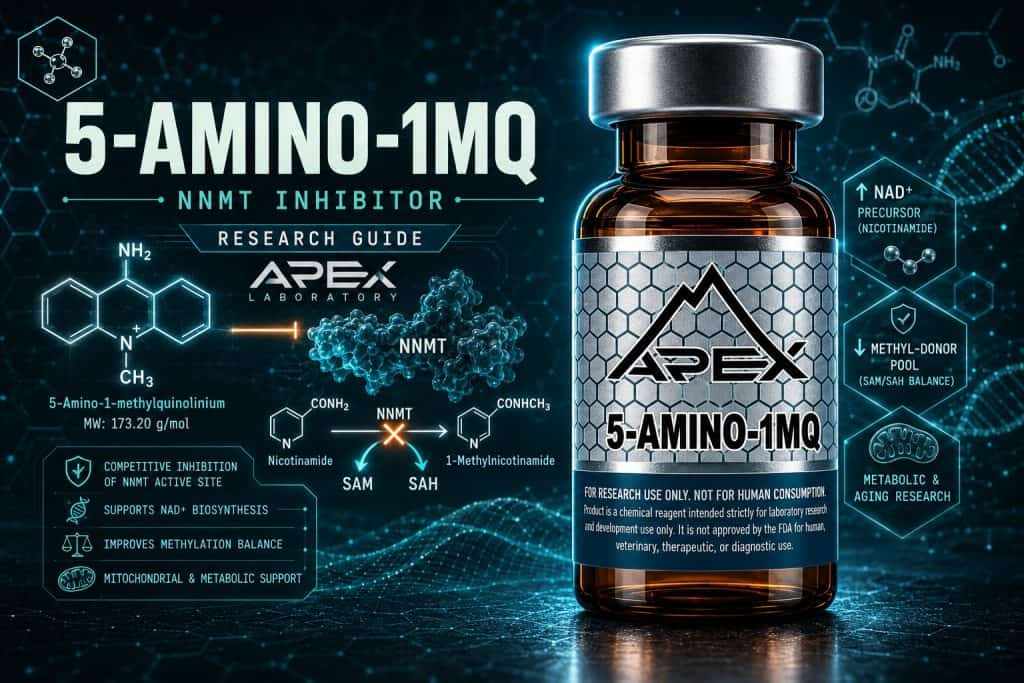
5-Amino-1MQ (5-amino-1-methylquinolinium, abbreviated 5A1MQ) is a small-molecule inhibitor of nicotinamide N-methyltransferase (NNMT), the enzyme that uses S-adenosylmethionine to methylate nicotinamide into 1-methylnicotinamide. By blocking that single methyltransferase reaction in adipocyte and diet-induced-obesity research, NNMT inhibition is studied for its potential to spare both the cellular NAD+ precursor pool and the SAM methyl-donor economy, with reported preclinical effects on lipogenesis, fat mass, and insulin sensitivity.
Most metabolic-research tools push on a single output and accept a cascade of trade-offs. 5-Amino-1MQ is interesting precisely because it does the opposite: by inhibiting one enzyme — nicotinamide N-methyltransferase (NNMT) — a single intervention spares two scarce cellular currencies at once. NNMT spends nicotinamide, a precursor in the NAD+ salvage pathway, and it spends S-adenosylmethionine (SAM), the universal biological methyl donor, in the same reaction. Slowing that reaction is therefore studied as a way to preserve both the NAD+ precursor pool and the methyl-donor economy simultaneously, an elegance that has made the compound a useful chemical probe in adipocyte and diet-induced-obesity research.[1]
This guide explains the enzymology behind that idea, the methylquinolinium inhibitor lineage from which 5-Amino-1MQ emerged, and the preclinical metabolic findings reported in cell and rodent models. It also frames the compound honestly: the literature is young, the data are entirely in-vitro and animal, and Apex Laboratory supplies the material only as a research-grade chemical reagent for laboratory use. For broader context on this catalog area, see the GLP-1 and metabolic research hub.
Key Research Takeaways
- 5-Amino-1MQ is a small-molecule inhibitor of nicotinamide N-methyltransferase (NNMT) built on a methylquinolinium scaffold — it is NOT a peptide.
- NNMT consumes nicotinamide (a NAD+ precursor) and S-adenosylmethionine (the universal methyl donor); inhibiting it is studied as a way to spare both pools at once.
- The methylquinolinium inhibitor class was developed in the Watowich and McHardy program (UTMB Galveston and UT San Antonio), with later development through Ridgeline Therapeutics.
- In diet-induced-obese mouse models, NNMT inhibition has been reported to suppress adipocyte lipogenesis, limit fat-mass gain, and improve insulin sensitivity — all preclinical observations.
- The evidence base is young and overwhelmingly in-vitro and rodent; reviews note no documented NNMT-targeting clinical trials, so no human or therapeutic claims apply.
- Apex supplies 5-Amino-1MQ strictly as a research-grade chemical reagent (≥99% by HPLC + ESI-MS) for in-vitro and preclinical research, not for human consumption.
Molecular Specifications
What Is 5-Amino-1MQ?
5-Amino-1MQ — full chemical name 5-amino-1-methylquinolinium, frequently abbreviated 5A1MQ in the primary literature — is a small-molecule inhibitor of the enzyme nicotinamide N-methyltransferase (NNMT). It is built on a methylquinolinium scaffold carrying a primary-amine substitution and binds within the NNMT active site to slow the enzyme’s methylation reaction. Critically, it is not a peptide and contains no amino-acid sequence; it belongs to a different chemical class than the peptide reagents that dominate much of this catalog.[1]
In terms of molecular identity, the 5-amino-1-methylquinolinium cation corresponds to PubChem CID 950107, with molecular formula C₁₀H₁₁N₂⁺ and a molecular weight in the region of 158–159 Da depending on whether the neutral or cationic convention is used. Because the compound is a quaternary cation, it is supplied as a salt; the counterion and exact salt form should be confirmed against the per-lot Certificate of Analysis (COA) rather than assumed. A CAS number is best treated as under verification for this compound class, and identity should be confirmed against the COA and an authoritative chemical database before use — a point we return to in the analytical-characterization section.[2]
The compound’s research interest rests almost entirely on what its single enzyme target does, so the natural starting point is the enzymology of NNMT itself.[3]
NNMT Enzymology: Methylating Nicotinamide With SAM
Nicotinamide N-methyltransferase is a cytosolic enzyme that catalyzes a single, well-characterized reaction: it transfers a methyl group from S-adenosylmethionine (SAM) onto nicotinamide (the amide form of vitamin B3), producing 1-methylnicotinamide (1-MNA, also written MNAM) and S-adenosylhomocysteine (SAH). In shorthand, the reaction is nicotinamide + SAM → 1-methylnicotinamide + SAH. Pissios’s widely cited review reframed NNMT as “more than a vitamin B3 clearance enzyme,” arguing that this methylation step sits at a metabolic crossroads connecting NAD+ metabolism, one-carbon/methyl-donor flux, and adipose energy homeostasis.[3]
Synthesis reviews of NNMT as a metabolic target describe the same reaction stoichiometry and emphasize two downstream consequences that motivate inhibitor research: depletion of nicotinamide (which feeds the NAD+ salvage pathway) and generation of SAH and, indirectly, homocysteine through SAM consumption.[4]
Structural basis of the active site
Crystallographic work has captured NNMT bound to its end-product, 1-methylnicotinamide, in both monkey and mouse enzymes. These structures illuminate how the substrate and product occupy the active site and, by extension, how small molecules that mimic substrate or product geometry — including methylquinolinium-class compounds — can engage the enzyme.[5] Understanding the active-site architecture is what allowed medicinal chemists to rationally design inhibitors that fit it.
Why Inhibit NNMT? Preserving the NAD+ Precursor and Methyl-Donor Pool
NNMT inhibition → preserved NAD+ precursor + SAM methyl-donor pools
5-Amino-1MQ binds the active site of nicotinamide N-methyltransferase (NNMT) and slows the SAM-dependent methylation of nicotinamide to 1-methylnicotinamide. Because that one reaction simultaneously spends nicotinamide — a NAD+ salvage-pathway precursor — and S-adenosylmethionine, the universal methyl donor, inhibiting it is studied for its potential to spare both pools at once. In cell models, this has been associated with reduced intracellular 1-methylnicotinamide and elevated intracellular NAD+ and SAM, the molecular signature behind the compound’s reported adipocyte and diet-induced-obesity research effects.[1]
The mechanistic rationale for inhibiting NNMT is the dual-sparing logic that opened this guide. Every turn of the NNMT reaction consumes one molecule of nicotinamide and one molecule of SAM. Nicotinamide is a key precursor that the NAD+ salvage pathway recycles back into NAD+, the central cofactor of cellular energy metabolism and a substrate for sirtuins and other NAD+-dependent enzymes. SAM is the cell’s universal methyl donor, supplying methyl groups for DNA, protein, and small-molecule methylation across one-carbon metabolism. A single enzyme therefore draws down two distinct and metabolically expensive pools at once, which is what makes a selective inhibitor conceptually attractive as a research tool: one intervention, two spared currencies.[3]
The founding pharmacology paper for this inhibitor class reported that, in cell models, NNMT inhibition reduced intracellular 1-methylnicotinamide (the reaction product) while raising intracellular NAD+ and SAM — direct evidence that slowing the enzyme spares both upstream substrates rather than merely altering one.[1] That coupled rise in NAD+ and SAM is the molecular fingerprint researchers look for to confirm on-target NNMT inhibition, and it is the mechanistic reason the compound is studied in metabolic rather than, say, purely epigenetic contexts.
Because elevated NNMT activity is documented in the liver and white adipose tissue of obese and diabetic animal models, reviews have framed pharmacological NNMT inhibition as a strategy to restore these pools precisely in tissues where the enzyme is overactive — a context-dependence that distinguishes it from a blunt, system-wide metabolic stimulant.[4] The NAD+ angle in particular links this compound to a broader research conversation; readers studying that cofactor directly may find the NAD+ research guide a useful companion. These remain mechanistic research hypotheses explored in cell and animal systems, not established physiological outcomes, and the magnitude of any NAD+ or SAM change is model- and concentration-dependent rather than a fixed property of the compound.
5-Amino-1MQ and the Methylquinolinium Inhibitor Lineage
The methylquinolinium NNMT-inhibitor class — the lineage to which 5-Amino-1MQ belongs — was developed primarily in the research program associated with Stanley J. Watowich and Stanton F. McHardy, spanning the University of Texas Medical Branch (UTMB) at Galveston and the University of Texas at San Antonio. Their foundational 2018 work described methylquinolinium scaffolds bearing primary-amine substitutions as selective, membrane-permeable NNMT inhibitors. Selectivity was an explicit design goal: the lead compounds did not inhibit related SAM-dependent methyltransferases or NAD+-salvage enzymes, an important property for interpreting any downstream metabolic effect as NNMT-specific rather than off-target.[1]
The same program subsequently extended the inhibitor class into other research indications, including aged skeletal-muscle biology, demonstrating that the methylquinolinium chemotype could be deployed as a research tool across multiple tissue contexts.[8] More recent compound-specific work, conducted in collaboration with Ridgeline Therapeutics, explicitly named and characterized 5A1MQ, providing the clearest direct link between the named compound and the inhibitor lineage described in the earlier class-level papers.[2] Preserving this named-group provenance matters for research integrity: it situates 5-Amino-1MQ within a coherent, traceable medicinal-chemistry program rather than as an orphan reagent.
Adipocyte and Diet-Induced-Obesity Metabolic Research
The most developed body of preclinical research on this inhibitor class concerns adipose tissue and diet-induced obesity (DIO). In the founding pharmacology study, the membrane-permeable NNMT inhibitor suppressed adipocyte lipogenesis and reversed high-fat-diet-induced obesity in mice — reducing body weight and white-adipose mass — without altering food intake, suggesting the effect was metabolic rather than appetite-mediated.[1]
Compound-specific work on 5A1MQ extended these observations. Over a 28-day daily-dosing study in DIO mice, the compound dose-dependently limited body-weight and fat-mass gain, improved oral glucose tolerance and insulin sensitivity, and attenuated hepatic steatosis.[2] These compound-level findings align directionally with the original genetic target-validation evidence: antisense-oligonucleotide knockdown of NNMT in white adipose tissue and liver protected mice from diet-induced obesity by increasing cellular energy expenditure, a study that first established NNMT as a metabolic target.[6] It is worth being precise here: the knockdown work is genetic, not pharmacological, and is cited as parent target-validation rather than as 5-Amino-1MQ data.
Why adipose NNMT is elevated in obesity
Cell-based work helps explain why NNMT becomes a relevant target in adipose tissue specifically. In 3T3-L1 adipocytes, glucose availability regulates NNMT expression — glucose deprivation induces higher NNMT levels — and the enzyme’s expression has been linked to GLUT4 and insulin-resistance signaling.[7] This positions adipocyte NNMT as a node that both responds to and may reinforce a dysregulated metabolic state, which is the conceptual reason researchers test inhibition in obese models rather than in lean baseline animals.
The interpretive thread connecting these studies is consistent: NNMT appears to be upregulated in metabolically stressed adipose tissue, where its activity drains the very NAD+ precursor and methyl-donor pools that energy-demanding tissue can least afford to lose. Inhibiting the enzyme is therefore studied as a way to relieve that drain at its source. The original target-validation knockdown, the compound-specific 5A1MQ dosing study, and the adipocyte-regulation work each approach this hypothesis from a different experimental direction — genetic, pharmacological, and expression-level respectively — and they point in a broadly concordant direction in rodent and cell systems.[6] All of these are animal-model and cell-culture observations and carry no human or therapeutic implication; concordance across model types strengthens the research rationale but does not establish a human effect.
Relationship to NAD+ Replenishment and AMPK/Sirtuin Strategies
NNMT inhibition is most usefully understood as one of several research strategies that converge on cellular NAD+ and energy metabolism, rather than as a stand-alone approach. Because slowing NNMT reduces consumption of nicotinamide — a NAD+ salvage-pathway precursor — cell-model work has associated NNMT inhibition with higher intracellular NAD+.[1] This is conceptually adjacent to, but mechanistically distinct from, directly supplying NAD+ precursors. Researchers comparing approaches may find the NAD+ research guide a helpful reference point for the supplementation side of that question.
The redox dimension reinforces the connection. In the same inhibitor program, NNMT inhibition in aged mice raised the cellular NAD+/NADH ratio and was associated with activation of senescent muscle stem cells — an effect consistent with NAD+-dependent (including sirtuin-linked) signaling.[8] Energy-sensing pathways such as AMPK are studied with separate chemical tools; researchers exploring that axis often work with the AICAR research reagent, and mitochondrial-derived peptides such as those covered in the MOTS-c research guide approach the same energy-metabolism problem from yet another angle. We emphasize that direct head-to-head comparisons between NNMT inhibition, NAD+ precursor supplementation, and AMPK activation remain open research questions, not settled equivalences.
Beyond Adipose: Skeletal Muscle, Liver, and Other Preclinical Research
Although adipose and DIO models dominate the 5-Amino-1MQ literature, NNMT-inhibition research has expanded into other tissues — with the important caveat that not every study uses the methylquinolinium scaffold, and compound identity must be tracked carefully. In aged skeletal muscle, the Watowich/McHardy methylquinolinium-class inhibitor activated senescent muscle stem cells, raised the cellular NAD+/NADH redox ratio, and improved regenerative capacity after injury — the same inhibitor class as 5-Amino-1MQ, applied to a muscle and aging indication rather than obesity.[8]
On the liver side, the 5A1MQ-specific DIO study reported attenuated hepatic steatosis alongside its adipose and glycemic findings, indicating that the compound’s reported metabolic effects are not confined to fat tissue alone.[2] More recently, NNMT inhibition has been explored in a heart-failure-with-preserved-ejection-fraction (HFpEF) mouse model, where inhibition improved cardiac structure and function. That cardiac study, however, used a structurally distinct nicotinamide-based NNMT inhibitor (not the methylquinolinium 5-amino-1MQ scaffold), so it should be read strictly as evidence that NNMT inhibition as a target strategy is being investigated beyond adipose — not as a cardiac claim for 5-Amino-1MQ specifically.[10] This kind of scaffold-level discipline is exactly why per-compound identity verification matters.
Pharmacokinetics and Research Dosing Context
Compound-specific pharmacokinetic characterization of 5A1MQ comes principally from the 28-day DIO study, which profiled the compound’s plasma exposure and tissue distribution after intravenous, oral, and subcutaneous administration in mice. The compound showed good distribution to the metabolically relevant tissues — adipose, muscle, and liver — consistent with the membrane permeability reported for the parent inhibitor class.[2] The founding class paper had likewise emphasized membrane permeability as a deliberate design property, since an intracellular enzyme target requires the inhibitor to reach the cytosol.[1]
Two framing points are essential here. First, all of this is preclinical rodent pharmacology; there is no established human dosing, and none should be inferred from animal exposure data. Second, the catalog notes that 5-Amino-1MQ is also supplied in a capsule research form in addition to lyophilized powder — this is a description of how the reagent is physically presented for laboratory handling, not a dosing recommendation or an endorsement of any route of administration. For laboratory handling of powdered reagents generally, see how to reconstitute research compounds and the storage guide; note that as a small-molecule salt rather than a peptide, 5-Amino-1MQ’s exact solubility and stability should be confirmed against its COA.
Comparative Pharmacology: Other NNMT Inhibitor Chemotypes
5-Amino-1MQ vs Adjacent Metabolic-Research Strategies
| Attribute | 5-Amino-1MQ (NNMT inhibitor) | NAD+ precursor supplementation | AICAR (AMPK activator) |
|---|---|---|---|
| Molecular class | Small-molecule NNMT inhibitor (methylquinolinium) | NAD+ precursor / cofactor reagent | Small-molecule AMPK activator (nucleotide analog) |
| Primary target | Nicotinamide N-methyltransferase (NNMT) enzyme | NAD+ salvage / biosynthesis substrate supply | AMP-activated protein kinase (AMPK) |
| NAD+ rationale | Spares nicotinamide precursor by blocking its methylation | Directly supplies precursor to raise NAD+ | Energy-sensing; downstream of cellular AMP/ATP status |
| Methyl-donor (SAM) effect | Spares SAM in the same reaction (dual-sparing) | No direct SAM-sparing mechanism | No direct SAM-sparing mechanism |
| Evidence stage | In-vitro + rodent preclinical; no NNMT clinical trials documented | Varies by precursor; broader research literature | Long-standing exercise-mimetic research reagent |
5-Amino-1MQ is not the only chemical strategy aimed at NNMT, and seeing it alongside other chemotypes clarifies what is scaffold-specific versus target-general. Beyond the methylquinolinium class, independent medicinal-chemistry groups have developed structurally distinct NNMT inhibitors — including a tricyclic small-molecule chemotype advanced for metabolic disorders.[11] The existence of multiple, chemically unrelated scaffolds converging on the same enzyme is itself informative: it indicates an active, competitive medicinal-chemistry field and provides a degree of cross-scaffold support for NNMT as a genuine metabolic-research target.
The comparison also draws a useful boundary. Effects that appear across distinct scaffolds are more plausibly attributable to NNMT inhibition itself, whereas any property unique to one scaffold — permeability, selectivity profile, pharmacokinetics — belongs to that specific compound. For 5-Amino-1MQ, the methylquinolinium scaffold’s reported selectivity against related SAM-dependent methyltransferases and NAD+-salvage enzymes is one such scaffold-level property that should not be assumed for chemically different inhibitors.[1] The table below summarizes how these research strategies relate; it is a comparison of research pharmacology, not of approved therapies.
Methyl-Donor and Homocysteine Considerations
Because NNMT consumes SAM and generates SAH, its activity is woven into one-carbon metabolism — the network that governs methyl-group supply and homocysteine handling. Early work established human adipose tissue as a genuine source of NNMT and connected NNMT activity to homocysteine production via SAH, grounding the methyl-donor angle in tissue biology rather than abstract stoichiometry.[12] This is the same SAH/homocysteine relationship that synthesis reviews flag when discussing the downstream consequences of NNMT activity.[4]
For researchers interpreting metabolic studies, the practical implication is that NNMT sits at an intersection where NAD+ metabolism and methyl-donor metabolism overlap. Genetic models add a note of caution against assuming uniform benefit: whole-body Nnmt-knockout male mice on a high-fat diet showed improved insulin sensitivity but unchanged glucose tolerance, demonstrating that removing NNMT does not improve every metabolic endpoint identically.[9] That kind of endpoint-specific nuance is exactly the sort of detail that a careful research interpretation should preserve rather than smooth over.
COA, HPLC, and ESI-MS: Research-Grade Trust and Identity Verification
For a small-molecule reagent whose entire research value depends on selectively engaging one enzyme, identity and purity documentation are not optional formalities — they are the foundation of interpretable data. Apex supplies 5-Amino-1MQ with a per-lot Certificate of Analysis (COA) reporting purity by high-performance liquid chromatography (HPLC) and identity confirmation by electrospray-ionization mass spectrometry (ESI-MS). Material is supplied at ≥99% purity by these methods. Readers new to interpreting these documents may find the guides on how to read a COA and HPLC purity testing useful.
Identity verification carries particular weight for this compound. Catalog CAS numbers in the methylquinolinium space can be inconsistent, and the safest research practice is to treat the CAS as under verification and confirm the molecular identity — the 5-amino-1-methylquinolinium cation, C₁₀H₁₁N₂⁺, PubChem CID 950107 — against the COA and an authoritative chemical database before any experiment. The original inhibitor-class work made selectivity testing a centerpiece precisely because confidence in which molecule you are studying, and that it acts only on NNMT, is what makes a result mechanistically meaningful.[1] Apex’s analytical documentation and standards are described under lab-verified testing and our editorial standards.
Research Limitations and the State of the Evidence
An honest assessment of 5-Amino-1MQ has to foreground how young and narrow the evidence base is. The directly relevant compound-specific literature is recent and thin, and much of the foundational support comes from a small number of originating groups; only a subset of the cited work names 5A1MQ explicitly, with the remainder describing the parent methylquinolinium class, genetic NNMT models, or distinct inhibitor chemotypes.[1] Recent target reviews characterize NNMT inhibition as a still-emerging, actively evolving area rather than a mature one.[13]
Most importantly, all evidence is in-vitro or preclinical rodent research. Synthesis reviews of NNMT as a metabolic-syndrome target explicitly note that, as of their writing, no clinical trials targeting NNMT had been documented.[4] Genetic-model nuance — such as improved insulin sensitivity but unchanged glucose tolerance in Nnmt-knockout mice — further argues against generalizing any single reported benefit.[9] Every metabolic observation described in this guide is a research finding in cells or animals; none of it constitutes a human, therapeutic, or weight-loss claim, and the compound is not approved for any use.
Safety, Tolerability & Adverse-Event Observations (Research Context)
Because 5-Amino-1MQ is a research-use-only chemical reagent with no human data, there is no clinical safety profile and nothing below should be read as a description of patient side-effects or as guidance for use. What follows is a summary of tolerability and adverse-event observations reported in published preclinical studies, framed strictly as research findings in animal and cell systems.
In the published compound-specific animal research, the principal tolerability signal comes from the 28-day diet-induced-obesity (DIO) dosing study in mice: 5A1MQ was administered once daily for 28 days across intravenous, oral, and subcutaneous routes, and the investigators reported dose-dependent metabolic effects without describing overt toxicity that halted dosing over that interval.[2] In the founding pharmacology study, the methylquinolinium-class inhibitor reduced body weight and white-adipose mass in mice without altering food intake, an observation often read as evidence that the metabolic effect was not driven by aversion or sickness behavior; the same paper made selectivity against related SAM-dependent methyltransferases and NAD+-salvage enzymes an explicit design goal, which is relevant to off-target risk in research interpretation.[1] Separately, in the same inhibitor program’s aged-mouse skeletal-muscle work, dosing was tolerated well enough to permit functional regeneration endpoints to be measured.[8]
One mechanistic consideration deserves explicit flagging for researchers designing studies. Because NNMT consumes S-adenosylmethionine and generates S-adenosylhomocysteine, NNMT activity is tied to one-carbon and homocysteine metabolism, as detailed in the methyl-donor and homocysteine considerations discussed above and grounded in early adipose-tissue work linking NNMT to homocysteine via SAH.[12] Genetic models add a note of caution against assuming uniform benefit: whole-body Nnmt-knockout mice improved on some metabolic endpoints but not others, underscoring that perturbing this enzyme does not produce a single, predictable systemic outcome.[9]
The overriding limitation is that every observation here is from rodent or cell-culture research. Synthesis reviews note that no clinical trials targeting NNMT had been documented, so there is no human tolerability, dose-limiting-toxicity, or adverse-event dataset of any kind.[4] Apex supplies 5-Amino-1MQ exclusively as a chemical reagent for in-vitro and preclinical research; it is not for human consumption, and no safety conclusion for human exposure can be drawn from the preclinical record.
Sourcing Research-Grade 5-Amino-1MQ
5-Amino-1MQ and Adjacent Research Reagents
5-Amino-1MQ
Small-molecule NNMT (nicotinamide N-methyltransferase) inhibitor research reagent; supplied at ≥99% purity verified by HPLC and mass spectrometry.
View ProductNAD+
β-Nicotinamide adenine dinucleotide; the cofactor whose precursor pool NNMT inhibition preserves.
View ProductFor laboratories working with 5-Amino-1MQ, the quality of the reagent directly determines the quality of the data. Apex Laboratory supplies 5-Amino-1MQ as a research-grade chemical reagent at ≥99% purity, verified by HPLC and electrospray-ionization mass spectrometry (ESI-MS), with a Certificate of Analysis accompanying each lot. Given the identity-verification considerations specific to the methylquinolinium class, we encourage researchers to confirm the molecular identity against the COA before use; details of our analytical process are documented under lab-verified testing and our editorial standards.
5-Amino-1MQ is sold strictly as a chemical reagent for in-vitro and preclinical research only. It is not a pharmaceutical, not a dietary supplement, and not for human consumption, diagnosis, or treatment. To place this compound in the wider context of metabolic-research reagents, explore the GLP-1 and metabolic research hub and the full research library.
Frequently Asked Questions
What is 5-Amino-1MQ?
5-Amino-1MQ (5-amino-1-methylquinolinium, abbreviated 5A1MQ in the literature) is a small-molecule inhibitor of the enzyme nicotinamide N-methyltransferase (NNMT). It is built on a methylquinolinium scaffold and is not a peptide. It is supplied strictly as a research-grade chemical reagent for in-vitro and preclinical research, and it is not an approved drug or supplement.
What does NNMT do, and why is it studied as an inhibition target?
Nicotinamide N-methyltransferase (NNMT) uses S-adenosylmethionine (SAM) as a methyl donor to methylate nicotinamide, producing 1-methylnicotinamide and S-adenosylhomocysteine. Because nicotinamide is a precursor for NAD+ and SAM is the cell’s universal methyl donor, researchers study NNMT inhibition as a way to preserve the NAD+ precursor pool and methyl-donor pool. This is a research hypothesis explored in cell and animal models, not an established therapeutic effect.
What metabolic research has involved 5-Amino-1MQ?
In published preclinical work, small-molecule NNMT inhibitors of the methylquinolinium class, including 5A1MQ, have been studied in diet-induced obese mice, where investigators reported reduced body-weight and fat-mass gain, suppressed adipocyte lipogenesis, and improved insulin sensitivity. A 2024 study also characterized 5A1MQ pharmacokinetics and tissue distribution in mice. These are animal-model research findings only and do not support any human or therapeutic claims.
What tolerability or adverse-event findings have been reported for 5-Amino-1MQ in research?
In published animal research, a 28-day daily-dosing study in diet-induced-obese mice reported dose-dependent metabolic effects without describing dose-halting toxicity over that period, and the founding study found reduced fat mass without altered food intake. No clinical trials targeting NNMT have been documented, so there is no human safety or adverse-event dataset. Researchers should also note NNMT’s link to one-carbon and homocysteine metabolism when designing studies. All findings are preclinical, not patient side-effects.
What is the half-life and pharmacokinetic profile of 5-Amino-1MQ in research studies?
The main pharmacokinetic data come from a 2024 mouse study that profiled 5A1MQ plasma exposure and tissue distribution after intravenous, oral, and subcutaneous dosing, reporting good distribution to metabolically relevant tissues including adipose, muscle, and liver. Specific half-life values are study-, route-, and species-dependent and should be read from the primary paper. These are preclinical rodent pharmacokinetic findings only; no human half-life or pharmacokinetic data exist for this compound.
How is research-grade 5-Amino-1MQ reconstituted and stored?
As a small-molecule quaternary-cation salt rather than a peptide, 5-Amino-1MQ’s exact solubility, suitable solvent, and stability should be confirmed against the per-lot Certificate of Analysis rather than assumed from peptide handling norms. General laboratory handling of powdered research compounds is covered in the reconstitution and storage guides; store the lyophilized powder desiccated and protected from light, and confirm per-lot handling against the supplied COA. This is laboratory handling information, not a dosing or administration instruction.
Is 5-Amino-1MQ a peptide, and how does it differ from NAD+ precursor supplementation?
No, it is a small organic molecule (a substituted methylquinolinium, formula C10H11N2+, approximately 158-159 Da), not a peptide, and contains no amino-acid sequence. Mechanistically it differs from NAD+ precursor supplementation: rather than directly supplying a precursor, it inhibits NNMT to reduce consumption of nicotinamide, a NAD+ salvage-pathway precursor. In cell models this has been associated with higher intracellular NAD+ and SAM. Direct comparisons between the two approaches remain an open research question.
Is 5-Amino-1MQ approved by the FDA or available as a medicine?
No. There is no FDA-approved drug or any approved medicine containing 5-Amino-1MQ, and published reviews note that clinical trials targeting NNMT had not been documented as of 2024. All available evidence is in-vitro or preclinical animal research. It is offered only as a research-use-only chemical reagent and is not intended for human consumption, diagnosis, or treatment.
Continue Your Research
Researchers building broader context across the Apex Research Library may find the following references useful:
- NAD+ Research Guide — The central cofactor whose precursor pool NNMT inhibition is studied to preserve; the direct-supplementation counterpart strategy.
- AICAR Research Guide — AMPK-activator reagent representing an adjacent energy-metabolism research strategy contrasted with NNMT inhibition.
- MOTS-c Research Guide — Mitochondrial-derived peptide that approaches energy and metabolic homeostasis from a different molecular angle.
- GLP-1 and Metabolic Research Hub — The cluster overview situating 5-Amino-1MQ among metabolic-research reagents.
- How to Read a Certificate of Analysis — Why HPLC purity and ESI-MS identity data matter when verifying a research-grade reagent like 5-Amino-1MQ.
- HPLC Purity Testing Explained — Background on the chromatographic method behind the ≥99% purity specification.
- Lab-Verified Testing Standards — Apex’s per-lot analytical verification process for research-grade reagents.
- Apex Research Library — The full catalog of research-grade compound guides across all clusters.
Research Use Disclaimer
This content is provided for educational and informational purposes only and describes in-vitro and preclinical (animal) research. 5-Amino-1MQ is supplied by Apex Laboratory strictly as a research-grade chemical reagent for laboratory research use only. It is not a pharmaceutical, not a dietary supplement, and is not approved by the FDA, EMA, or any regulatory authority for any use. It is NOT for human or veterinary consumption, diagnosis, treatment, or any in-vivo human application. Nothing in this guide constitutes medical advice or a therapeutic, efficacy, or weight-management claim; all metabolic findings described are research observations in cells and animals and have not been established in humans. Researchers are responsible for handling, storage, and use in compliance with all applicable institutional and legal requirements.