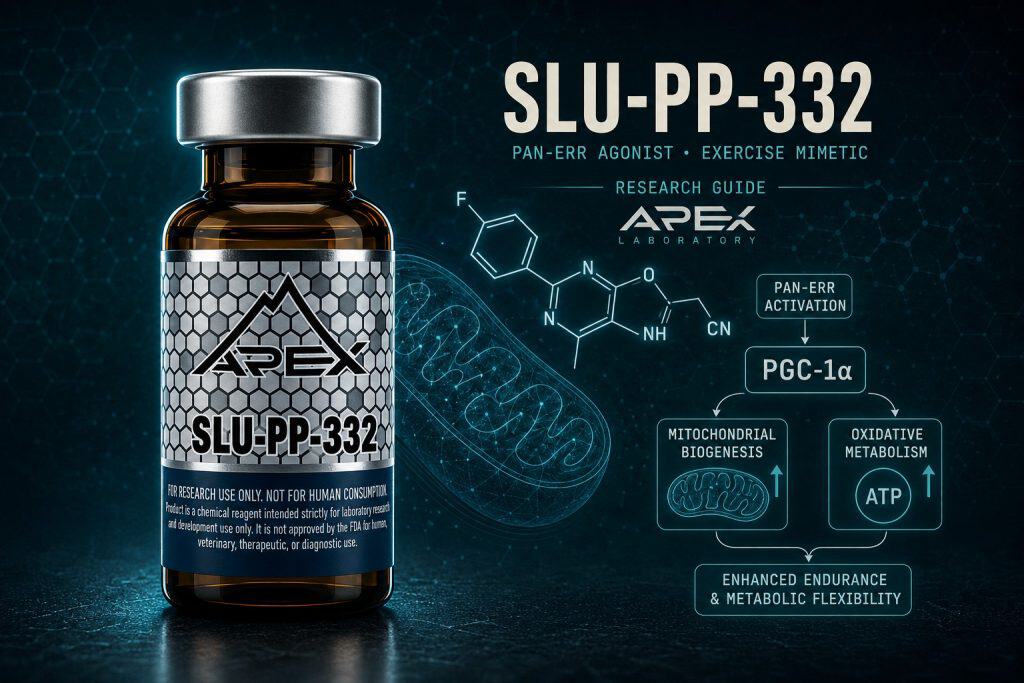
SLU-PP-332 is a small-molecule synthetic pan-agonist of the estrogen-related receptors ERRα, ERRβ, and ERRγ, with its highest reported potency at ERRα. Developed in the Thomas Burris laboratory at Saint Louis University and the University of Florida, it activates a PGC-1α-linked transcriptional program governing mitochondrial biogenesis and fatty-acid oxidation, and is studied in preclinical rodent and cell models as an exercise mimetic.
A single small molecule, given to sedentary mice with no change to their cages and no treadmill in sight, was reported to switch on the same acute genetic program their muscles run during aerobic exercise — and to measurably enhance their running endurance. That molecule was SLU-PP-332, and the 2023 study describing it in ACS Chemical Biology introduced it as a synthetic pan-agonist of the estrogen-related receptors that behaves, at the level of muscle gene expression, like a chemical stand-in for a workout.[1]
The years since have produced a small but fast-moving body of preclinical literature spanning skeletal-muscle cell culture, mouse exercise and obesity models, heart-failure and aging-kidney studies, and analytical-chemistry characterization.[11] This guide summarizes that research for laboratory context. SLU-PP-332 sits within the broader Apex GLP-1 and metabolic research cluster, and — importantly — it is a small-molecule reagent, not a peptide. It is supplied strictly as a research-grade chemical reagent for in-vitro and preclinical investigation, not as a drug, dietary product, or therapy for human or veterinary use.
SLU-PP-332 at a Glance
- SLU-PP-332 is a small-molecule synthetic pan-agonist of the estrogen-related receptors (ERRα, ERRβ, ERRγ), with its highest reported potency at ERRα — it is NOT a peptide.
- It was developed as an in-vivo chemical probe in the laboratory of Thomas P. Burris (Saint Louis University and the University of Florida), with medicinal chemistry by Walker and Elgendy.
- Because ERRs are coactivated by PGC-1α, the compound drives a transcriptional program governing mitochondrial biogenesis, oxidative phosphorylation, and fatty-acid oxidation in research models.
- In mice it has been characterized as an exercise mimetic, reported to induce an ERRα-dependent acute aerobic exercise gene program and to increase type IIa oxidative muscle fibers and running endurance.
- Separate rodent studies report increased energy expenditure with decreased fat mass in obesity models, improved cardiac function in heart failure, and reversal of age-related kidney mitochondrial dysfunction.
- SLU-PP-332 has no FDA, EMA, or other approval anywhere and zero registered human trials; Apex supplies it strictly as a research-grade chemical reagent at ≥99% purity for in-vitro and preclinical use only.
SLU-PP-332
What Is SLU-PP-332?
SLU-PP-332 is a small-molecule synthetic agonist of the estrogen-related receptors (ERRs), a family of orphan nuclear-receptor transcription factors. It is a pan-agonist, meaning it activates all three ERR subtypes — ERRα, ERRβ, and ERRγ — with its highest reported potency at ERRα.[1] Chemically it belongs to the acylhydrazone class, and a recent structure-activity-relationship study describes it as a well-established exercise mimetic and a widely used chemical probe for ERR activation.[7]
A small molecule, not a peptide
This distinction matters for researchers cross-referencing the Apex catalog. Most compounds in the metabolic cluster are peptides or peptide hormones; SLU-PP-332 is neither. It is a low-molecular-weight organic compound that works by binding and activating nuclear-receptor transcription factors directly, rather than acting as a peptide ligand at a cell-surface receptor. PubChem catalogues it as CID 5338394, with the molecular formula C18H14N2O2 and a molecular weight of approximately 290.3 g/mol.
An in-vivo chemical probe for ERR pharmacology
SLU-PP-332 was designed in the Thomas P. Burris laboratory as an in-vivo chemical tool to interrogate what happens when the ERRs are pharmacologically activated in a living animal — a question that had been difficult to address because the ERRs are orphan receptors without a well-defined endogenous ligand.[1] It is supplied as a research-grade chemical reagent for laboratory use only, and all of the findings summarized below derive from cell-culture and rodent experiments.
Pan-ERR Agonism: ERRα, ERRβ, and ERRγ
The estrogen-related receptors are a subfamily of three nuclear receptors — ERRα (NR3B1), ERRβ (NR3B2), and ERRγ (NR3B3). Despite their name, they do not bind estrogen; they were named for their sequence similarity to the classical estrogen receptors. They are constitutively active orphan receptors whose transcriptional output is governed largely by their coactivators rather than by a circulating hormone.[12]
SLU-PP-332 vs AICAR: Two Exercise-Mimetic Research Compounds
| Attribute | SLU-PP-332 | AICAR |
|---|---|---|
| Compound class | Small-molecule acylhydrazone | Small-molecule nucleoside analog |
| Primary molecular target | Estrogen-related receptors (ERRα/β/γ) | AMP-activated protein kinase (AMPK) |
| Mechanistic entry point | Direct nuclear-receptor agonism | Energy-sensor kinase activation |
| Convergent downstream node | PGC-1α-coactivated oxidative program | PGC-1α program via AMPK |
| Oral bioavailability (rodent) | Lacking (dosed intraperitoneally) | Orally active in cited study |
| Regulatory status | Research-only; no approved formulation | Research-only; no approved formulation |
Three orphan nuclear-receptor subtypes
A 2015 review describes ERRα and ERRγ in particular as central regulators of metabolic control across high-energy-demand tissues such as skeletal muscle and heart.[13] SLU-PP-332 engages all three subtypes as a pan-agonist, which distinguishes it from isoform-selective tool compounds and is one reason the discovery group described it as a means of probing aggregate ERR activation in vivo.[1]
Highest potency at ERRα; ERRγ as the cardiac mediator
Although SLU-PP-332 activates all three receptors, its highest reported potency is at ERRα, and the foundational study attributed its acute aerobic exercise gene program to an ERRα-dependent mechanism.[1] In a separate heart-failure study, however, genetic-dependency experiments identified ERRγ as the principal mediator of the compound’s cardioprotective transcriptional effects.[3] The functional weight of each isoform therefore appears to differ by tissue — a nuance that researchers should preserve rather than collapsing into a single “ERRα-only” account.
The PGC-1α / Mitochondrial-Biogenesis Connection
To understand why agonizing the ERRs produces an oxidative, mitochondria-rich phenotype, it helps to start with the coactivator that partners with them. The ERRs are the canonical transcription-factor partners of PGC-1α (peroxisome proliferator-activated receptor gamma coactivator 1-alpha), the master regulator of mitochondrial biogenesis. Through this partnership the ERRs drive expression of genes governing mitochondrial biogenesis, oxidative phosphorylation, fatty-acid oxidation, and the tricarboxylic-acid cycle.[12]
Pan-ERR agonism → PGC-1α coactivation → mitochondrial-biogenesis and fatty-acid-oxidation program
SLU-PP-332 binds and activates the estrogen-related receptors ERRα, ERRβ, and ERRγ (highest potency at ERRα), constitutively active orphan nuclear receptors that partner with the coactivator PGC-1α. Through this ERR/PGC-1α axis the compound drives transcription of genes governing mitochondrial biogenesis, oxidative phosphorylation, and fatty-acid oxidation, and induces an ERRα-dependent acute aerobic exercise gene program (including Ddit4) in muscle. Downstream, ERR agonism also upregulates the autophagy regulator TFEB. In cardiac tissue, ERRγ rather than ERRα appears to mediate the transcriptional effect. All steps are characterized in cell and animal models. Billon et al. (2023), ACS Chem Biol.
ERRs as PGC-1α-coactivated master regulators
In the foundational study, SLU-PP-332 increased mitochondrial function and cellular respiration in a skeletal-muscle cell line, consistent with engaging this ERR/PGC-1α oxidative-metabolism axis.[1] A Burris-group mechanism paper added a downstream node, reporting that ERR agonists directly upregulate TFEB — a master regulator of the autophagy-lysosome system — in cardiac myocytes and C2C12 myoblasts, broadening the transcriptional program beyond mitochondrial biogenesis alone.[5]
Independent replication in human myoblasts
An important check on any mechanism is whether it reproduces outside the originating laboratory and outside rodent cells. A 2025 pilot study from independent Italian groups (Tor Vergata and L’Aquila) treated primary myoblasts isolated from physically inactive women with SLU-PP-332 and reported upregulation of SIRT1, PGC-1α, ERRα, and FNDC5, alongside reduced oxidative stress and senescence markers and promotion of myotube formation.[8] The authors explicitly framed this as a hedged pilot study requiring further work, but it provides early independent corroboration of the PGC-1α/ERRα axis in human cells.
Exercise-Mimetic Effects in Rodent Models
The headline characterization of SLU-PP-332 in the literature is as an “exercise mimetic” — a term used to describe agents that reproduce some of the molecular signatures of physical activity without the activity itself. The foundational 2023 study reported that, in mice, the compound induced an ERRα-dependent acute aerobic exercise gene program, increased the proportion of type IIa oxidative muscle fibers, and enhanced exercise endurance and capacity.[1]
The ERRα-dependent acute aerobic exercise gene program (Ddit4)
A central observation across the exercise studies is that SLU-PP-332 robustly induces Ddit4, a gene whose expression is acutely triggered by aerobic exercise. A 2026 study introducing the orally bioavailable analog SLU-PP-915 confirmed that both compounds induce Ddit4, using it as a shared molecular marker of the acute-aerobic-exercise response.[6] A 2026 systematic review consolidating this work added Slc25a25 to the ERRα-dependent acute-exercise gene set and summarized the type IIa fiber increase and endurance findings.[11]
Endurance and capacity findings (and what they do not say)
It is worth being precise about what the acute-exercise studies report and what they do not. The endurance-and-capacity findings describe enhanced running performance and oxidative-fiber shifts; they do not, in those acute designs, hinge on weight loss. Body-weight and fat-mass outcomes differ by study design, as the next section details. These are rodent results characterizing a research compound — they have not been confirmed in humans and constitute no performance or health claim.
Energy Expenditure and Metabolic Findings (Obesity / Metabolic Syndrome)
Beyond the acute exercise response, SLU-PP-332 has been studied in chronic metabolic-disease models, where the outcome profile differs in an important way from the endurance studies. A 2024 study in the Journal of Pharmacology and Experimental Therapeutics reported that, in diet-induced-obese and genetically obese (ob/ob) mice, SLU-PP-332 increased energy expenditure and fatty-acid oxidation, decreased fat-mass accumulation, reduced obesity, and improved insulin sensitivity.[2]
Increased energy expenditure and fatty-acid oxidation
The metabolic mechanism reported in these obesity models is consistent with the ERR/PGC-1α oxidative program: by raising the cell’s capacity for fatty-acid oxidation and overall energy expenditure, the compound shifted the energy balance of the obese animals. The 2026 systematic review situates this within a broader profile that also includes improved glycemic control and increased basal energy expenditure across the cited rodent studies.[11]
The conceptual logic here is worth spelling out, because it explains why a single transcriptional switch can move so many metabolic endpoints at once. Fatty-acid oxidation, oxidative phosphorylation, and mitochondrial biogenesis are not independent processes; they are coordinated arms of a single oxidative-metabolism program that the ERRs and PGC-1α regulate together. When SLU-PP-332 raises the transcriptional output of that program, the result reported in the obesity models is an animal whose tissues burn more fat and expend more energy at rest — which is mechanistically why fat mass and insulin sensitivity both move in the same study.[2] This coordinated-program framing is the through-line that connects the muscle, obesity, cardiac, and renal findings, and it is the reason the compound is repeatedly described in the literature as an exercise mimetic rather than a single-pathway agent.
Why the fat-mass result must be attributed by study design
A careful reading of the literature reveals a distinction that is easy to blur. The chronic obesity/metabolic-syndrome study explicitly reports decreased fat mass.[2] By contrast, the acute aerobic-exercise and endurance work is characterized by enhanced performance without the same emphasis on weight change. These are different experimental designs answering different questions, and the responsible reading is to attribute the fat-mass decrease specifically to the chronic obesity model rather than generalizing a single body-composition outcome across every study.
Cardiac, Renal, and Aging Research
The same oxidative-metabolism program that makes SLU-PP-332 interesting in muscle has been investigated in other high-energy-demand tissues, broadening the preclinical footprint of the compound and the wider ERR-agonist class.
Heart failure: ejection fraction and survival
A 2024 Circulation study used structure-based design to develop two distinct pan-ERR agonists, SLU-PP-332 and the analog SLU-PP-915. In a pressure-overload heart-failure model, both compounds improved ejection fraction, ameliorated fibrosis, and increased survival, while transcriptionally activating fatty-acid-metabolism and mitochondrial genes. Genetic-dependency experiments identified ERRγ as the main mediator of this cardioprotection.[3]
The aging kidney: reversing mitochondrial dysfunction
A multi-institution study from Georgetown, the NIH, and the Burris group reported that eight weeks of SLU-PP-332 treatment in 21-month-old mice reversed age-related mitochondrial dysfunction and inflammation in the kidney, with the ERRs framed as caloric-restriction mimetics acting through the PGC-1α/ERRα axis.[4]
Autophagy via TFEB as a shared downstream node
Linking these tissues mechanistically, the TFEB autophagy finding suggests the ERR-agonist class engages cellular-quality-control pathways in both cardiac and muscle cells, offering one explanation for why the same compound produces benefits across such different organ systems in research models.[5] All of these are preclinical observations and do not establish efficacy or safety for any indication in humans.
How SLU-PP-332 Differs From AMPK Activators (AICAR) and PPARδ Agonists
SLU-PP-332 is not the first molecule to be studied as an exercise mimetic, and placing it against the earlier paradigm clarifies what is distinctive about it. The canonical exercise-mimetic work, published by Narkar and colleagues in 2008, demonstrated that the orally active AMP-activated protein kinase (AMPK) activator AICAR enhanced running endurance by roughly 44% in sedentary mice, and that a PPARβ/δ agonist synergized with training.[10]
Different molecular entry points, overlapping downstream programs
AICAR works by activating AMPK, the cellular energy sensor, which in turn engages the PGC-1α program. SLU-PP-332 instead bypasses AMPK and directly agonizes the ERRs — the transcription factors that PGC-1α coactivates. Because both routes ultimately converge on PGC-1α-driven oxidative-metabolism and mitochondrial gene expression, they can produce overlapping phenotypes despite engaging entirely distinct upstream targets.[1] Researchers comparing these mechanistic approaches may find the Apex AICAR research guide a useful reference point; the comparison is one of research pharmacology and should not be read as functional equivalence between compounds.
Adjacent metabolic-research reagents
Within the metabolic cluster, several compounds are studied for distinct but complementary energy-metabolism pathways. The mitochondrial-derived peptide MOTS-c is also characterized as an AMPK-linked exercise mimetic, while the NNMT inhibitor 5-Amino-1MQ targets a different node of NAD+ and methyl-donor metabolism. Each engages a separate molecular target, and none should be treated as interchangeable with SLU-PP-332.
Pharmacokinetics and Metabolism (Research Context)
An honest account of SLU-PP-332 has to address a significant pharmacokinetic limitation, because it shapes how the compound is used in research and why a successor analog was developed.
Limited oral bioavailability and the SLU-PP-915 successor
SLU-PP-332 has sufficient pharmacokinetic exposure to function as an in-vivo tool, but it lacks oral bioavailability and is administered to rodents by intraperitoneal injection. A 2026 study states this explicitly: SLU-PP-332 improves aerobic performance in mice but lacks oral bioavailability, which motivated the design of the chemically distinct, orally bioavailable analog SLU-PP-915. Both compounds robustly induce the acute-aerobic-exercise gene Ddit4.[6] This is a useful illustration of iterative medicinal chemistry: the original probe established proof of concept, and scaffold optimization addressed its delivery limitation.
In-vitro metabolite mapping by high-resolution mass spectrometry
The metabolic fate of SLU-PP-332 has been characterized in vitro using human liver preparations. A 2026 study from the German Sport University Cologne used LC-HRMS/MS and human liver S9 fraction and microsomes to identify six Phase-I and three Phase-II metabolites of the compound.[9] A second, independent analytical study from the UCLA Olympic Analytical Laboratory mapped a larger panel of in-vitro human-liver-S9 metabolites — including mono- and dihydroxylated, glucuronidated, and sulfated species — by the same high-resolution mass-spectrometry approach.[14] Both arise in a doping-control context and are presented here strictly as analytical-chemistry characterization, not as any use recommendation. No human pharmacokinetic or dosing data for SLU-PP-332 exist.
Discovery and Research Lineage (Burris Laboratory)
Preserving the provenance of SLU-PP-332 matters both for scientific accuracy and for weighing how much of the literature comes from a single originating group. The compound emerged from the laboratory of Thomas P. Burris, with medicinal-chemistry work attributed to J.K. Walker and B. Elgendy, across Saint Louis University and the University of Florida.[1]
Structure-based design and SAR optimization
The development followed a structure-based, rational-design approach to producing ERR agonists with in-vivo activity. A 2026 study reported the first comprehensive structure-activity-relationship (SAR) analysis of the SLU-PP-332 scaffold, defining the structural determinants of ERRα/ERRγ agonism, potency, selectivity, and drug-like properties — and describing SLU-PP-332 itself as a well-established exercise mimetic and widely used chemical probe for ERR activation.[7] The same structure-based program produced the cardioprotective analog characterized in the heart-failure work.[3]
Commercial development and disclosures
Commercial development of the ERR-agonist series has proceeded through Pelagos Pharmaceuticals and Myonid Therapeutics, with Burris named as an inventor and disclosed stockholder in the relevant publications. These author-disclosure statements are part of the literature record and are noted here for transparency; they do not alter the preclinical, research-only status of the compound.
Molecular Specifications and Analytical Characterization (COA / HPLC + ESI-MS)
For any experiment using SLU-PP-332, reproducibility depends on knowing precisely what is in the vial. As a defined small molecule rather than a peptide, its identity is established through its molecular formula, mass, and chromatographic behavior.
PubChem-verified identity
The compound corresponds to PubChem CID 5338394, with the molecular formula C18H14N2O2 and a molecular weight of approximately 290.3 g/mol. PubChem records the IUPAC name (E)-4-hydroxy-N’-(naphthalen-2-ylmethylene)benzohydrazide and the synonyms “ERR pan-Agonist 332,” SR9861, and ChEMBL4208749, which together confirm the identity of the record. A CAS number of 303760-60-3 appears as a PubChem synonym and is reported here as PubChem-sourced rather than catalog-confirmed. Researchers verifying identity should rely on the molecular formula, accurate mass, and mass-spectrometric confirmation; for general workflow, see the Apex primers on how to read a certificate of analysis and HPLC purity testing.
Analytical characterization as the trust standard
The analytical literature on SLU-PP-332 is itself instructive: the doping-control metabolite studies relied on high-resolution liquid chromatography-mass spectrometry to characterize the parent compound and its metabolites with confidence.[9] That same analytical rigor — reversed-phase HPLC for purity and electrospray-ionization mass spectrometry for identity — underpins how a research-grade reagent should be documented, and it is the standard Apex applies through per-batch certificates of analysis.
Regulatory Status and Research-Use-Only Framing
The regulatory status of SLU-PP-332 is unambiguous and central to how it must be described. It is a research-only compound with no regulatory approval anywhere.
No approval; zero registered human trials
SLU-PP-332 has not been approved by the FDA, the EMA, or any other regulatory authority, and there is no human pharmaceutical formulation of it. As of this guide’s review date, there are zero registered human clinical trials for the compound, and all published evidence comes from rodent in-vivo studies and cell-based in-vitro experiments. The authors of a 2026 systematic review state plainly that clinical trials are still needed to confirm efficacy and safety in humans.[11]
Doping-control and analytical context
Because ERR agonists and exercise mimetics fall within the framing of metabolic modulators monitored in sport, multiple 2026 doping-control method papers developed mass-spectrometry detection of SLU-PP-332 and its metabolites.[14] This context is noted strictly as research and analytical background; it is not a use recommendation, and nothing in this guide endorses human administration. SLU-PP-332 is supplied as a research-grade chemical reagent for in-vitro and preclinical research only and is not for human or veterinary consumption.
Limitations of the Current Evidence Base
Responsible interpretation of SLU-PP-332 requires acknowledging how young and concentrated its literature is. This is an early-stage research compound, and the evidence base should be read accordingly.
A young literature concentrated in one originating lab
The SLU-PP-332-specific primary studies cluster in the years 2023 through 2026 and are heavily concentrated in the originating Burris/Saint Louis University/University of Florida group, with recurring authorship from Billon, Burris, Walker, and Elgendy. Only a few genuinely independent groups have published on the compound — notably the Italian myoblast pilot study and the UCLA and Cologne analytical laboratories — and the two doping-control metabolite papers, while from different labs, address overlapping analytical questions rather than independent biological mechanisms.[8]
No human data; open mechanistic questions
There are no human efficacy or safety data, and the relative contributions of the three ERR isoforms, long-term safety, and off-target effects remain open questions in the literature.[6] Every finding summarized in this guide — mechanistic, metabolic, cardiac, renal, and exercise-related — is a rodent in-vivo or cell in-vitro observation and must be read as preclinical research context, never as an established therapeutic, performance, or safety outcome.
Safety, Tolerability & Adverse-Event Observations (Research Context)
Because SLU-PP-332 is a preclinical research compound, the only tolerability information available comes from published animal studies, and it should be read as research findings in those models rather than as a human side-effect profile. No human safety data exist, and no adverse-event monitoring in people has ever been conducted.
Tolerability documented in published rodent studies
In published animal research, the chronic metabolic-syndrome study dosed diet-induced-obese and genetically obese (ob/ob) mice over a multi-week course and reported the intended metabolic effects without describing the compound as overtly toxic in those models.[2] In the pressure-overload heart-failure model, both SLU-PP-332 and its analog SLU-PP-915 were administered chronically and were associated with improved survival rather than excess mortality — a survival signal that researchers interpret, in that disease model, as consistent with adequate tolerability over the study period.[3] These are outcomes recorded in animal experiments; they are not assurances of safety and do not transfer to humans.
Open safety questions and the WADA analytical context
A 2026 systematic review of the ERR-agonist exercise-mimetic literature states plainly that clinical trials are still needed to confirm both efficacy and safety in humans, and it identifies long-term safety and the relative contributions of the three ERR isoforms as unresolved questions.[11] Separately, because ERR agonists fall within the framing of metabolic modulators monitored in sport, anti-doping laboratories have published in-vitro human-liver metabolite work to enable detection of SLU-PP-332.[9] This anti-doping analytical work is noted strictly as research and detection-science background; it is not a use recommendation, and nothing here endorses human administration.
Research-Dosing Context and Half-Life (Study Facts, Not a Protocol)
Researchers frequently search for the doses used in the SLU-PP-332 literature. The figures below are reported strictly as facts of how published studies were designed in animal models — they are not a recommended dose, a human dose, or a usage protocol, and no validated human dosing exists for this compound.
Administration route reported in the published studies
A defining practical feature of SLU-PP-332 is its route of administration. A 2026 study states explicitly that the compound improves aerobic performance in mice but lacks oral bioavailability, which is why rodent studies administer it by intraperitoneal (IP) injection rather than orally — and why the originating group developed the chemically distinct, orally bioavailable analog SLU-PP-915.[6] For laboratories cross-referencing study designs, this means the dosing figures in the SLU-PP-332 literature reflect parenteral (IP) administration in rodents, not an oral exposure. For catalog separation, the oral-format listing is SLU-PP-332 Caps (100pcs), distinct from the injectable-study designs summarized here.
Half-life and pharmacokinetic exposure in research models
SLU-PP-332 is reported to have sufficient pharmacokinetic exposure to function as an in-vivo chemical tool, which is what allowed the originating studies to use it to interrogate ERR pharmacology in living animals.[6] No formal human half-life has been published, because no human pharmacokinetic study of the compound exists; the only metabolic-fate data are in-vitro, derived from human liver S9 fraction and microsomes that mapped its Phase-I and Phase-II metabolites by high-resolution mass spectrometry.[9] Any half-life value for SLU-PP-332 should therefore be treated as a model-specific research parameter rather than an established human pharmacokinetic figure. For general background on how lyophilized research compounds are prepared and stored, see the Apex guides on how to reconstitute peptides and reagent storage.
Sourcing Research-Grade SLU-PP-332
For any SLU-PP-332 experiment, the reliability of the result begins with the identity and purity of the reagent. Because the compound is a defined small molecule whose activity depends on chemical integrity, research-grade material should arrive with analytical documentation rather than label claims alone.
HPLC purity and ESI-MS identity verification
Apex supplies SLU-PP-332 at ≥99% purity, verified by reversed-phase high-performance liquid chromatography (HPLC) for purity and by electrospray-ionization mass spectrometry (ESI-MS) for identity, confirming the expected mass against the C18H14N2O2 formula. Each lot is documented with a per-batch certificate of analysis available through the lab-verified COA archive; researchers should review the lot-specific COA rather than relying on a generic specification. Background on interpreting these documents is available in the guides on reading a certificate of analysis and HPLC purity testing.
Research-use-only designation and adjacent reagents
SLU-PP-332 is sold strictly for in-vitro and preclinical laboratory research and is not for human or veterinary use. The Apex editorial standards and research library document how each guide is sourced and reviewed. Researchers assembling an energy-metabolism reagent panel often pair SLU-PP-332 with adjacent compounds such as the AMPK activator AICAR and the NNMT inhibitor 5-Amino-1MQ; the items below situate it within the broader metabolic-research context.
SLU-PP-332 and Adjacent Research Reagents
SLU-PP-332
Small-molecule pan-ERR (estrogen-related receptor) agonist research reagent; supplied at ≥99% purity verified by HPLC and mass spectrometry.
View ProductAICAR
AMPK-activator exercise-mimetic research compound; complementary energy-metabolism pathway.
View ProductFrequently Asked Questions
What is SLU-PP-332?
SLU-PP-332 is a small-molecule synthetic pan-agonist of the estrogen-related receptors (ERRα, ERRβ, and ERRγ), with its highest reported potency at ERRα. It was developed in the laboratory of Thomas P. Burris (Saint Louis University and the University of Florida) as an in-vivo chemical probe to study ERR pharmacology. In published rodent and cell-based research it has been characterized as an exercise mimetic because it activates transcriptional programs that overlap with those induced by aerobic exercise. It is supplied strictly as a research-grade chemical reagent for in-vitro and preclinical laboratory use and is not approved for any human or veterinary application.
How does SLU-PP-332 work as an exercise mimetic?
In the published preclinical literature, SLU-PP-332 activates the estrogen-related receptors, which are PGC-1α-coactivated regulators of mitochondrial biogenesis, oxidative phosphorylation, and fatty-acid oxidation. Researchers have reported that it induces an ERRα-dependent acute aerobic exercise gene program (including the exercise-responsive gene Ddit4), increases mitochondrial function and cellular respiration in muscle cells, and increases type IIa oxidative muscle fibers in mice. These effects are described as resembling some molecular adaptations seen with aerobic exercise. This mechanistic description reflects animal-model and cell-culture findings only; no human efficacy has been established.
What does SLU-PP-332 research show in animal models?
Reported rodent findings include enhanced running endurance and exercise capacity, increased energy expenditure and fatty-acid oxidation, and reduced fat mass with improved insulin sensitivity in diet-induced-obese and ob/ob mouse models. Separate studies report improved cardiac function and survival in a pressure-overload heart-failure model and reversal of age-related mitochondrial dysfunction in the kidneys of aged mice. These are preclinical results in animals and isolated cells; they have not been confirmed in humans, and outcomes such as changes in body weight differ across the acute-exercise versus chronic-obesity study designs.
What does research show about SLU-PP-332 side effects and tolerability?
No human safety data exist for SLU-PP-332, so all tolerability information comes from animal studies and must be read as research findings, not a human side-effect profile. In published rodent research, chronic dosing in obesity and pressure-overload heart-failure models produced the intended metabolic and cardiac effects, with the heart-failure work reporting improved survival rather than excess mortality over the study period. A 2026 systematic review states that long-term safety remains unresolved and that clinical trials are still needed to evaluate safety in humans. These are model observations, not assurances of safety.
What doses of SLU-PP-332 were used in published studies?
Published doses are reported here only as study design facts, not as a recommended or human dose, and no validated human dosing exists. The compound lacks oral bioavailability, so rodent studies administer it by intraperitoneal (IP) injection rather than orally, which is why the originating group later developed the orally bioavailable analog SLU-PP-915. Any dosing figure in the literature reflects parenteral administration in mice within a specific experimental design and should not be interpreted as a usage protocol or extrapolated to any other species.
What is the half-life of SLU-PP-332?
No human half-life has been published for SLU-PP-332, because no human pharmacokinetic study of the compound exists. In animal research it is reported to have sufficient pharmacokinetic exposure to function as an in-vivo chemical tool, but it lacks oral bioavailability and is dosed by intraperitoneal injection in rodents. The only metabolic-fate data are in-vitro, mapping Phase-I and Phase-II metabolites using human liver S9 fraction and microsomes by high-resolution mass spectrometry. Any half-life value should be treated as a model-specific research parameter, not an established human figure.
How is SLU-PP-332 reconstituted and stored for research use?
As a lyophilized small-molecule reagent, SLU-PP-332 is reconstituted in a compatible solvent for in-vitro or preclinical work; because it is an acylhydrazone rather than a water-soluble peptide, solubility should be confirmed against the lot-specific certificate of analysis. General handling conventions for lyophilized research compounds, including aqueous versus organic-solvent considerations and aliquoting to minimize freeze-thaw, are covered in the Apex reconstitution and storage guides. Apex supplies the compound lyophilized; store the powder cold, keep reconstituted aliquots frozen, and protect from light. This is laboratory handling guidance, not a directive for any human use.
How is SLU-PP-332 different from AMPK activators like AICAR?
SLU-PP-332 and AICAR are both studied as exercise mimetics but act through different molecular entry points. AICAR is an AMP-activated protein kinase (AMPK) activator, and the classical exercise-mimetic paradigm described by Narkar and colleagues works through the AMPK-PGC-1α pathway and PPARδ agonists. SLU-PP-332 instead directly agonizes the estrogen-related receptors (ERRα/β/γ). Because ERRs are coactivated by PGC-1α, the two approaches can converge on overlapping oxidative-metabolism and mitochondrial gene programs despite engaging distinct upstream targets. This is a comparison of research pharmacology, not a comparison of approved therapies.
Continue Your Research
Researchers building broader context across the Apex Research Library may find the following references useful:
- GLP-1 & Metabolic Research Peptides — the cluster hub situating SLU-PP-332 among metabolic and energy-homeostasis reagents
- AICAR Research Guide — the classical AMPK-activator exercise mimetic that contextualizes the ERR-vs-AMPK comparison
- 5-Amino-1MQ Research Guide — an NNMT inhibitor targeting a separate node of NAD+ and methyl-donor metabolism
- MOTS-c Research Guide — a mitochondrial-derived peptide also studied as an AMPK-linked exercise mimetic
- How to Reconstitute Peptides — general protocol for preparing lyophilized research compounds for in-vitro work
- Peptide & Reagent Storage Guide — storage and freeze-thaw handling conventions for lyophilized research-grade material
- How to Read a Certificate of Analysis — interpreting HPLC purity and ESI-MS identity data on a lot-specific COA
- HPLC Testing for Purity — how reversed-phase HPLC quantifies purity for research-grade reagents
Research Use Disclaimer
All SLU-PP-332 products and the information in this guide are intended strictly for in-vitro and preclinical laboratory research. SLU-PP-332 is a research-grade chemical reagent and is not a drug, dietary supplement, or therapeutic product. It is not approved by the FDA, EMA, or any other regulatory authority, it has no approved indication anywhere, and there are no registered human clinical trials for it. It is not for human or veterinary consumption, diagnosis, treatment, or any clinical use. The mechanistic, metabolic, cardiac, renal, and exercise-related findings summarized here derive entirely from cell-culture and animal-model studies and are presented for research context only; they do not constitute therapeutic, efficacy, safety, or performance claims. Any references to doping-control or anti-doping analytical work are provided as research and analytical background only and are not a recommendation for human use. Researchers are responsible for compliance with all applicable institutional, local, and national regulations governing the acquisition, handling, and use of research chemicals.